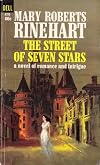
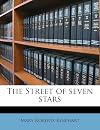
The Street of Seven Stars
by Mary Roberts Rinehart
On This Page
Description
Often referred to as the "American Agatha Christie," Mary Roberts Rinehart did much to popularize and refine the mystery genre in the United States. The Street of Seven Stars follows an American musician, Harmony Wells, to Austria, where she has gone to hone her violin skills. Though the dashing doctor she meets there appears to want to protect her, there may be more to his motives than meets the eye..
Tags
Recommendations










Member Reviews
I finished [The Street of Seven Stars] by Mary Roberts Rinehart. It is a romance from 1914 by an author who is known for mysteries. The publisher put it on a list of gothic mysteries but it is not a mystery and I don't think there is anything sinister enough to be gothic. The beginning is very good and the ending is fine but it bogged down in the middle.
The setting is an American student colony in Vienna.
The description of the city at the time and the wide variety of characters from various walks of life and different nationalities was the best part. The main character is Harmony a violin student. She is on her own in Vienna. I thought that was unusual for a genteel heroine in that era. Seems like there is usually relatives or an show more employer who is charged with looking after her. They may be nasty or negligent but they are theoretically there. Harmony's love of playing music is conveyed well but I wanted to know how she felt about performing for strangers. Her past life was also missing. The middle needed more going on. The novel may have suffered from censorship. There is a weird section where the author criticizes the advice given to Harmony but we are never told what the advice was. I think it was about Free Love but I had to go back and reread that section and think about the context. It was like reading someone's angry blog response on the Internet and discovering the offending article has been pulled. I thought it was interesting that a woman who was passed from one medical student to the next along with an apartment was a developed character. She was a foreign trollop though. Maybe foreigners were allowed different standards. It was nice having sexual proprieties and how to pay bills addressed. show less
The setting is an American student colony in Vienna.
The description of the city at the time and the wide variety of characters from various walks of life and different nationalities was the best part. The main character is Harmony a violin student. She is on her own in Vienna. I thought that was unusual for a genteel heroine in that era. Seems like there is usually relatives or an show more employer who is charged with looking after her. They may be nasty or negligent but they are theoretically there. Harmony's love of playing music is conveyed well but I wanted to know how she felt about performing for strangers. Her past life was also missing. The middle needed more going on. The novel may have suffered from censorship. There is a weird section where the author criticizes the advice given to Harmony but we are never told what the advice was. I think it was about Free Love but I had to go back and reread that section and think about the context. It was like reading someone's angry blog response on the Internet and discovering the offending article has been pulled. I thought it was interesting that a woman who was passed from one medical student to the next along with an apartment was a developed character. She was a foreign trollop though. Maybe foreigners were allowed different standards. It was nice having sexual proprieties and how to pay bills addressed. show less
I have liked Mary Roberts Rinehart since I was a kid, but it's her mysteries that I enjoy. This is a typical romance of the 1910-1930's. It's a great period piece.
A period piece sprinkled with saccharine - mildly awful, but engaging enough that I finished it. The characters act stupidly enough to be in an opera libretto.
There is certainly a lot of character development here.The book seems to be about an American girl named Harmony who seeks to make her fortune as a musician, in Germany. She meets a guy (Peter) who takes it upon himself to protect her. He seeks to protect her and such. However, she wishes to be independent and to continue in her career efforts rather than marry.Harmony seems to be well established (brought up) in the blooming culture of women being strong, self-sufficient, equal, etc. (as well as liberally minded) and seems to take it for granted that anyone else might think anything else. I hadn’t realized that such a culture existed to bring her up in during that time period—so much so that she could take it for granted, anyhow, show more without even realizing the opposition.The characters are confronted with some moral issues, but if they offend you, the end part of the book probably won’t. I mean, Harmony and Peter end up both living in the same place, along with a doctor lady and an orphan child that Peter is taking care of. This is not an abnormal living arrangement in Harmony's culture, but it is offensive in the culture of those who would be her references (and Peter understands it), and so she has a lot of trouble because of this, even though she and Peter don’t seem to think they love each other much of the time (and even though the doctor is there with them). Ultimately, Harmony leaves and goes out on her own (without telling Peter where she went). She comes back just before the sick orphan child dies.It gets to where Harmony feels that Peter proposes to her every time things go wrong, as if it will make everything better.Anyway, Harmony doesn’t want to marry Peter since she wants to pursue her career *and* because she doesn’t think she loves him (she thinks he just wants to protect her out of pity or something)—and she wants him to pursue his career instead. However, through their character development they finally learn some things and decide to marry (at the very end is when they come to this conclusion).Anyway, if they were that set on their careers, I don’t see why they shouldn’t have just gotten married and both continued as they were, without being miserable about each other (except with more romance after), unless they were expecting to have children immediately—but they never even mentioned children (so I’m guessing they just were brought up in a culture where you had to do certain things when you got married, no questions asked). It seemed like they thought they had to be comfortably settled to get married—like all married people were well off and had leisure to sit around idly on expensive furniture all day or something. Did one exist?One thing I didn't quite understand was why they thought of themselves as lonely even when they were with each other all the time. I don’t equate desire for sex (or even desire for romance) with loneliness, personally, although it can certainly coincide in a powerful way. It’s not at all the same thing, although both are quite severe, even apart. Sure there might be immensely strong desire for it, but that’s hardly the same thing as loneliness. I’m guessing the characters hardly knew what true loneliness was, separate from sexual longings—either that, or it just wasn’t something they considered or experienced much.Anyway, it’s a wild book. The writing style is nice—not the easiest to follow, but fairly relaxing. The narration was great. show less
Ratings
Members
- Recently Added By
Author Information

142+ Works 8,213 Members
Mary Roberts Rinehart was born in the City of Allegheny, Pennsylvania on August 12, 1876. While attending Allegheny High School, she received $1 each for three short stories from a Pittsburgh newspaper. After receiving inspiration from a town doctor who happened to be a woman, she developed a curiosity for medicine. She went on to study nursing at show more the Pittsburgh Training School for Nurses at Homeopathic Hospital. After graduating in 1896, she began her writing career. The first of her many mystery stories, The Circular Staircase (1908), established her as a leading writer of the genre; Rinehart and Avery Hopwood successfully dramatized the novel as The Bat (1920). Her other mystery novels include The Man in Lower Ten (1909), The Case of Jennie Brice (1914), The Red Lamp (1925), The Door (1930), The Yellow Room (1945), and The Swimming Pool (1952). Stories about Tish, a self-reliant spinster, first appeared in the Saturday Evening Post and were collected into The Best of Tish (1955). She wrote more than 50 books, eight plays, hundreds of short stories, poems, travelogues and special articles. Three of her plays were running on Broadway at one time. During World War I, she was the first woman war correspondent at the Belgian front. She died September 22, 1958 at the age of 82. (Bowker Author Biography) show less
Work Relationships
Is contained in
error
MARY ROBERTS RINEHART Ultimate Collection: Murder Mysteries, Thriller Novels, Travel Books, Essays & Autobiography: The Circular Staircase, The Bat, The ... the King, Sight Unseen, The Confession, K… by Mary Roberts Rinehart
Common Knowledge
- Canonical title
- The Street of Seven Stars
- Original title
- The Street of Seven Stars
- Original publication date
- 1914-09-01
- People/Characters
- Harmony Wells; Peter Byrne
- Important places
- Austria
- First words
- The old stucco house sat back in a garden, or what must once have been a garden, when that part of the Austrian city had been a royal game preserve.
- Last words
- (Click to show. Warning: May contain spoilers.)The sentry, who was only a soldier from Salzburg with one lung, was also a gentleman and a patriot. He uncovered his head.
- Original language
- English
Classifications
Statistics
- Members
- 120
- Popularity
- 272,680
- Reviews
- 4
- Rating
- (3.19)
- Languages
- English
- Media
- Paper, Ebook
- ISBNs
- 42
- ASINs
- 21