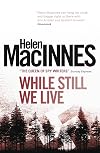
While Still We Live
by Helen MacInnes
On This Page
Description
English girl Sheila Matthews' innocent holiday to Poland becomes a nightmare when the German Army invade in the summer of 1939. Working for the Polish underground as a double-agent, she plays a dangerous game, and is soon suspected by the Germans. Forced to flee to the forest and hunted by a ruthless German officer, she must rely on the dashing Captain Adam Wisniewski to help her home.Tags
Recommendations






















Member Recommendations

Member Reviews
One of my favorite thrillers of all time, written by espionage queen Helen MacInnes in 1944, while WWII was still raging, set during and after the fall of Warsaw, and chronicling the early days of the Polish resistance. The first time I read it, I was impressed with how tightly it was crafted and the total lack of sugar coating, despite the main character being a young woman. And saddened to think it would take more than 40 years after the defeat of the Nazis for the Poles to regain true independence out from the shadow of the Iron Curtain.
On this subsequent reading, I am still impressed at Ms. MacInnes prowess as a suspense writer, and was also drawn to reflect on the parallels between the fight of the Poles against the Nazis and the show more current fight of the Ukrainians against Russia. The more things change, the more they stay the same. show less
On this subsequent reading, I am still impressed at Ms. MacInnes prowess as a suspense writer, and was also drawn to reflect on the parallels between the fight of the Poles against the Nazis and the show more current fight of the Ukrainians against Russia. The more things change, the more they stay the same. show less
This title originally was titled The Unconquerable (I think in the British market). A vintage tale which was one of those narratives that had me going on and on in my head, "Fer crying out loud, you dumb woman, get out of Poland right now".
Sheila is British and winds upbeing co-opted into being a double agent . That led to a very implausible situation because at no moment was there any indication that she's trained in spy craft, that she thinks quickly and assertively, ot that she has the foggiest notion of the political situation. A rather dimly-conceived story, which I wouldn't expect from this author.
My memory of this tale (caveat: having read it some 40 years ago) was that the story was exciting and featured such a courageous show more heroine. Well, not. How time and distance lends a different interpretation to stories like this! Other thriller-espionage books by MacInnes are better crafted. I awarded 3-stars because other than the major implausibility niggle, it was a good espionage-chase-and-escape story for those who like that untrammelled adventure. show less
Sheila is British and winds up
My memory of this tale (caveat: having read it some 40 years ago) was that the story was exciting and featured such a courageous show more heroine. Well, not. How time and distance lends a different interpretation to stories like this! Other thriller-espionage books by MacInnes are better crafted. I awarded 3-stars because other than the major implausibility niggle, it was a good espionage-chase-and-escape story for those who like that untrammelled adventure. show less
I really felt sorry for Sheila. She was caught up in a situation not of her own making. I can't imagine what you would do if you were "drafted" out the blue to be a spy. She was a most unlikely spy...the Nazi's must have been desperate. Along the way she experiences betrayal from Nazi collaborators and selfless sacrifice by ordinary people trying to help her escape. The best thing she got out the entire deal is she met the love of her life...so a little romance thrown in. It's a fairly long book...676 pages... but the pace is slow as the story unwinds. A story well told and diffidently worth the time and effort.
Sheila Matthews, English but fluent in German, is in Poland when the Nazis invade at the beginning of the Second World War. She ends up having to flee from a German army officer who’s convinced she’s a spy. I found this story initially compelling, particularly because of the female protagonist, but I eventually became bogged down and bored when Sheila was not present in the story. Also, the edition I read (an ebook from the library) was riddled with typos, which were distracting. I may try again someday in print, or I may not. I’ll keep trying other books by MacInnes, though.
The novel is set in Poland in August 1939 just before the Germans invaded. People are enjoying the last days of summer as the tension builds. Many don't think the threat is real but others with inside knowledge know there is danger. All this is narrated through the eyes of Sheila Mathews, a young English woman who has come to Poland to visit her elderly aunt. She is so taken with Poland and her aunt that she extends her stay until it is tool late. Then she falls in love with a Polish army officer, becomes involved with the Gestapo, masquerades as a German woman and eventually flees across Poland just steps ahead of the pursuing Gestapo while participating in guerrilla warfare.
The narrative does give a great description of life in show more occupied Poland. The book was published in 1944 so does not have the advantage of hindsight so some assumptions expressed by the characters did not come about as hoped. Interestingly, there is no mention of Jews and the Holocaust or the Warsaw Ghetto.
. show less
The narrative does give a great description of life in show more occupied Poland. The book was published in 1944 so does not have the advantage of hindsight so some assumptions expressed by the characters did not come about as hoped. Interestingly, there is no mention of Jews and the Holocaust or the Warsaw Ghetto.
. show less
Lifelong favorite set in pre-war and wartime Poland. Romance sublime in the fabric of courageous resistance to the brutal occupation. A story that has stayed with me for decades. A re-reader.
A moving tribute to the tragedy and heroism of the Poles during the1939 German invasion of Poland, the siege of Warsaw, and the resistance/underground movement.
Members
- Recently Added By
Lists

Best Spy Fiction
153 works; 102 members
Author Information

39+ Works 7,998 Members
Helen MacInnes was born in Glasgow, Scotland on October 7, 1907. In 1928, she received a degree in French and German from the University of Glasgow in Scotland. She later studied at University College in London and worked as a librarian. She got married in 1932, moved to New York in 1937, and became an American citizen in 1952. In 1939, she began show more writing suspense novels and won the Columbia Prize for Literature in 1966. Many of her novels were adapted into movies including Above Suspicion, Assignment in Brittany, The Venetian Affair, and The Salzburg Connection. She died from the effects of a stroke on September 30, 1985 at the age of 77. (Bowker Author Biography) show less
Awards and Honors
Distinctions
Notable Lists
Series
Belongs to Publisher Series
Fontana (2173)
Common Knowledge
- Original title
- While Still We Live
- Alternate titles
- The Unconquerable
- Original publication date
- 1944
- People/Characters
- Sheila Matthews / "Anna Braun"; Barbara Aleksander; Madame Teresa Korytowska Aleksander (mother of Barbara); Stanisław Aleksander (eldest brother of Barbara); Andrew Aleksander (older brother of Barbara); Stefan Aleksander (14, younger brother of Barbara) (show all 54); Teresa Aleksander (younger sister of Barbara); Marta Korytowska Madalińska (aunt of Barbara); Edward Korytowski (uncle of Barbara); John Matthews (uncle of Sheila); Maria (kitchen servant); Zofia (kitchen servant); Wanda (friend of little Teresa); Felix (stable hand); Jan Reska (schoolmaster); Kawka (neighbour); Father Mazur (village priest); Russell "Steve" Stevens (American journalist, friend of Andrew); Adam Wiśniewski (army captain, friend of Andrew); Johann Hofmeyer; Michał Olszak; Charles Matthews (father of Sheila); Colonel Bolt (Security Police); Henryk Ryng / Heinrich Dittmar (porter); Elżbieta / Lisa Köhler (porter's wife); Gustav Schlott (Swedish friend of Stevens); Casimir (12, refugee boy); Hefner (assistent of Dittmar); Wolfgang Streit (Gestapo captain); Hans Greiser (Gestapo captain); Josef Engelmann (Gestapo); Treltsch (Gestapo driver); Thaddeus (resistance fighter); Dutka (villager); Galiński (German spy); Jan Piętka (resistance fighter); Captain Reymont (resistance fighter); Colonel Sierakowski; Antoni Roszak (field doctor); Marian Roszak (field nurse, wife of Antoni); Franziska (field nurse); Zygmunt; Kati Hulka (villager, girlfriend of Zygmunt); Katarzyna "Jadwiga" Hulka (villager, mother of Kati); Peter (villager); Żak (village elder); Zofia (villager); Tomasz (village doctor); Captain Winkler (Gestapo); Father Brys (village priest); Madame Olszak (mother of Michał Olszak); Veronika (servant of Madame Olszak); Wenceslas; Dr. Lilienkron
- Important places
- Poland; Warsaw, Poland; Korytów, Poland; Dwór, Poland
- Important events
- World War II (1939 | 1945)
- Epigraph
- Poland has not yet perished
While still we live
These are the opening words of the Song of the Polish Legions. It was first sung in the black year of 1797, when Poland had been divided between the three empir... (show all)es of Russia, Prussia, and Austria, and her exiled sons were fighting in the Legions under the gallant General Dombrowski. Thereafter, during the nineteenth century, with its incessant bloody revolts against foreign tyranny, the Song of the Legions spread secretly all over Poland, giving encouragement and hope to all those who were willing to sacrifice themselves for the future freedom of their country. Such was its power and so glorious was its history that it became the national anthem of liberated Poland; and even under new oppressors it is still sung by the Polish people, who refuse to become slaves. The noble truth of its words has been proven by history, past and present: no nation, no cause will ever die if it breeds the kind of man who is willing to sacrifice everything for it, even his life. - First words
- The blinding directness of the sun had gone, but its heat remained.
- Last words
- (Click to show. Warning: May contain spoilers.)He had the strange feeling that, for the moment, he didn't exist.
- Original language
- English
- Canonical DDC/MDS
- 813.54
- Canonical LCC
- PZ3.H5392
- Disambiguation notice
- The title of the book refers to the second line of the Polish national anthem: "Kiedy my żyjemy". See https://en.m.wikipedi... (show all)a.org/wiki/Poland...
Classifications
- Genres
- Fiction and Literature, Suspense & Thriller
- DDC/MDS
- 813.54 — Literature & rhetoric American literature in English American fiction in English 1900-1999 1945-1999
- LCC
- PZ3 .H5392 — Language and Literature Fiction and juvenile belles lettres Fiction and juvenile belles lettres Fiction in English
- BISAC
Statistics
- Members
- 344
- Popularity
- 91,932
- Reviews
- 10
- Rating
- (3.67)
- Languages
- Dutch, English
- Media
- Paper, Audiobook, Ebook
- ISBNs
- 18
- ASINs
- 17