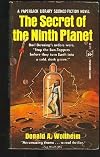
The Secret of the Ninth Planet
by Donald A. Wollheim
On This Page
Description
The Secret of the Ninth Planet is a science-fiction novel written by Donald A. Wollheim and first published in 1959. Wollheim takes his heroes on a grand tour of the solar system as that team struggles to prevent an alien force from blowing up the sun.Tags
Recommendations








Member Reviews
Nostalgia has its limits.
This was very possibly the first science fiction book I ever read, probably around 1970. I found it in my elementary school library, and presumably thought that something about the ninth planet would be interesting. So I read it -- and remembered it enough to identify it half a century later and find a copy. Having read it again, I find myself wondering what made it so interesting.
The book is, of course, highly inaccurate about the solar system; it was written before any interplanetary probes had been launched. I can accept that; I have no problems, e.g., with Robert A. Heinlein's "Future History" books, which feature a human-habitable Mars, or James Blish's "Cities in Flight," which give us a tenth planet that show more isn't there. An author can't be expected to know what no one knows.
But an author can be expected to know what everyone knows. Proper science fiction obeys the laws of physics except where it justifies an exception. The justification may be hand-waving ("hyperspace"), but there is one, and the number of exceptions is kept as small as possible. Here, we have anti-gravity, "sun-tapping" (capturing solar energy at a distance and redirecting it), an energy weapon that produces a visible beam in a vacuum, mind control of aliens at a distance, and an orbital entanglement of Neptune and Pluto that was known to be impossible even in 1959. And life on Neptune. How? Life needs energy. Where does it come from? And how can a pressure suit that works in Venus conditions also work on Pluto? It's too many new laws and gadgets.
And there are logical flaws. Assume that "sun-tapping" is possible -- maybe, since anti-gravity is possible, you can generate special gravity to pull in the energy. Sure, the laws of thermodynamics would make this more costly, energy-wise, than it's worth, but assume it for the sake of the argument. What sort of idiot builds the "sun-tap" stations on planets, two of which have inhabitants and three of which have atmospheres and all of which have geology (earthquakes) which might interfere. Don't build them on planets; build them in a random orbit and keep them safe! The sun-tappers are simply too stupid to have developed their technology.
And what sane person shoots at aliens on sight? Sure, the sun-tappers had been tapping the sun, but for all we know, that's an attempt to communicate: "Here's our base; come visit us." Eventually it appears this is not so (though the sun-tappers still seem too socially primitive for their technology), but the earth people don't even try. Exactly who are the uncivilized brutes here?
The whole thing reads like the worst of 1930s "science fiction" -- gadget fantasy with no science and no sociology. It's pre-John Campbell (who revolutionized science fiction in 1938), and there was a reason why Campbell's coming was such a revolution: he swept away stuff like this.
Admittedly all that might be accepted if the story were good. But 80% of the book is spent traveling between worlds and blowing up alien artifacts, and the worlds are not only inaccurate but poorly realized. It's only in the last few chapters that we get some idea of what is going on, and watch Our Heroes win an improbable victory against enemies who are, yet again, too stupid to make any sense. It's not exciting, merely improbable.
Frankly, I feel ashamed that I liked this book enough to remember it. Yes, I was a pre-teen. Even so. I can only be glad that I didn't remember the bad science!
[Update May 17, 2025 to correct a mis-typed word in first paragraph.] show less
This was very possibly the first science fiction book I ever read, probably around 1970. I found it in my elementary school library, and presumably thought that something about the ninth planet would be interesting. So I read it -- and remembered it enough to identify it half a century later and find a copy. Having read it again, I find myself wondering what made it so interesting.
The book is, of course, highly inaccurate about the solar system; it was written before any interplanetary probes had been launched. I can accept that; I have no problems, e.g., with Robert A. Heinlein's "Future History" books, which feature a human-habitable Mars, or James Blish's "Cities in Flight," which give us a tenth planet that show more isn't there. An author can't be expected to know what no one knows.
But an author can be expected to know what everyone knows. Proper science fiction obeys the laws of physics except where it justifies an exception. The justification may be hand-waving ("hyperspace"), but there is one, and the number of exceptions is kept as small as possible. Here, we have anti-gravity, "sun-tapping" (capturing solar energy at a distance and redirecting it), an energy weapon that produces a visible beam in a vacuum, mind control of aliens at a distance, and an orbital entanglement of Neptune and Pluto that was known to be impossible even in 1959. And life on Neptune. How? Life needs energy. Where does it come from? And how can a pressure suit that works in Venus conditions also work on Pluto? It's too many new laws and gadgets.
And there are logical flaws. Assume that "sun-tapping" is possible -- maybe, since anti-gravity is possible, you can generate special gravity to pull in the energy. Sure, the laws of thermodynamics would make this more costly, energy-wise, than it's worth, but assume it for the sake of the argument. What sort of idiot builds the "sun-tap" stations on planets, two of which have inhabitants and three of which have atmospheres and all of which have geology (earthquakes) which might interfere. Don't build them on planets; build them in a random orbit and keep them safe! The sun-tappers are simply too stupid to have developed their technology.
And what sane person shoots at aliens on sight? Sure, the sun-tappers had been tapping the sun, but for all we know, that's an attempt to communicate: "Here's our base; come visit us." Eventually it appears this is not so (though the sun-tappers still seem too socially primitive for their technology), but the earth people don't even try. Exactly who are the uncivilized brutes here?
The whole thing reads like the worst of 1930s "science fiction" -- gadget fantasy with no science and no sociology. It's pre-John Campbell (who revolutionized science fiction in 1938), and there was a reason why Campbell's coming was such a revolution: he swept away stuff like this.
Admittedly all that might be accepted if the story were good. But 80% of the book is spent traveling between worlds and blowing up alien artifacts, and the worlds are not only inaccurate but poorly realized. It's only in the last few chapters that we get some idea of what is going on, and watch Our Heroes win an improbable victory against enemies who are, yet again, too stupid to make any sense. It's not exciting, merely improbable.
Frankly, I feel ashamed that I liked this book enough to remember it. Yes, I was a pre-teen. Even so. I can only be glad that I didn't remember the bad science!
[Update May 17, 2025 to correct a mis-typed word in first paragraph.] show less
Yes, the science is hopelessly naive (even for 1959) but the fiction is grand---a rip-roaring hybrid of The Hardy Boys, Tom Swift, and Buck Rogers. This is pure pulp heaven featuring a balmy ocean on Venus, angry Martian bugs, and a secret on Pluto so monumental it will change human destiny...FOREVER! So put your brain in neutral, place your cynicism on hold, and just enjoy! LOL!
A blast from the past! Sci-fi all the way back to the beginning of the Space Age!
In The Secret of the Ninth Planet, I felt like I was reading a Buck Rogers or Flash Gordon story from the 1930s. Set in the far future (sometime around now, I expect) but written when there was very little information available on the outer planets (Martian canals anyone?). Donald A Wollheim's young adult story of high schooler Burl Denning and how he gets roped into saving the planet is a fun, but scientifically inaccurate page turner.
Part of Wollheim's "Secret" series for younger readers, the novel brilliantly captures the era's optimism and curiosity about space exploration (albeit with a somewhat military and xenophobic bent). It's a decent blend of show more science fiction and youthful adventure, capturing the spirit of exploration and the boundless possibilities of the universe. While the scientific inaccuracies are blatant by today's standards, they add a retro feel to the narrative, reminiscent of classic pulp science fiction.
The "Secret" series, a staple in young adult science fiction when I was growing up, also includes titles like The Secret of Saturn's Rings and The Secret of the Martian Moons, each one taking the young protagonists on fantastic journeys across the solar system. This series, much like his renowned "Mike Mars" series, showcases Wollheim's talent for engaging young readers with a mix of adventure and science, albeit with a fanciful twist.
Beyond his work as an author, Wollheim was instrumental in shaping the science fiction community as we know it today. Often referred to as the father of the modern science fiction convention, he played a pivotal role in organizing the first of these gatherings, setting the stage for what would eventually evolve into massive events like Worldcon. His influence extended beyond literature into the very fabric of sci-fi culture, fostering a community where enthusiasts and creators could come together to innovate in the genre.
If you come across a copy of The Secret of the Ninth Planet, it's a nostalgic gem worth picking up. The book is a delightful snapshot of a bygone era of science fiction, brimming with adventure and wonder. It's a good read for those who appreciate simple sci-fi and enjoy fantastical stories as imagined through the lens of the Sputnik era. show less
In The Secret of the Ninth Planet, I felt like I was reading a Buck Rogers or Flash Gordon story from the 1930s. Set in the far future (sometime around now, I expect) but written when there was very little information available on the outer planets (Martian canals anyone?). Donald A Wollheim's young adult story of high schooler Burl Denning and how he gets roped into saving the planet is a fun, but scientifically inaccurate page turner.
Part of Wollheim's "Secret" series for younger readers, the novel brilliantly captures the era's optimism and curiosity about space exploration (albeit with a somewhat military and xenophobic bent). It's a decent blend of show more science fiction and youthful adventure, capturing the spirit of exploration and the boundless possibilities of the universe. While the scientific inaccuracies are blatant by today's standards, they add a retro feel to the narrative, reminiscent of classic pulp science fiction.
The "Secret" series, a staple in young adult science fiction when I was growing up, also includes titles like The Secret of Saturn's Rings and The Secret of the Martian Moons, each one taking the young protagonists on fantastic journeys across the solar system. This series, much like his renowned "Mike Mars" series, showcases Wollheim's talent for engaging young readers with a mix of adventure and science, albeit with a fanciful twist.
Beyond his work as an author, Wollheim was instrumental in shaping the science fiction community as we know it today. Often referred to as the father of the modern science fiction convention, he played a pivotal role in organizing the first of these gatherings, setting the stage for what would eventually evolve into massive events like Worldcon. His influence extended beyond literature into the very fabric of sci-fi culture, fostering a community where enthusiasts and creators could come together to innovate in the genre.
If you come across a copy of The Secret of the Ninth Planet, it's a nostalgic gem worth picking up. The book is a delightful snapshot of a bygone era of science fiction, brimming with adventure and wonder. It's a good read for those who appreciate simple sci-fi and enjoy fantastical stories as imagined through the lens of the Sputnik era. show less
The plot line is hokey: aliens are sucking the energy from the sun and beaming it back to heat up their far away planet, and the teen-age hero has to fly all over the solar system to prevent Sol going nova. But suspending disbelief, as if I were a young teenager again, allows me to enjoy the thrills of the adventure and learn a few things about the Solar System (a la 1959).
A silly story really, but it kept me entertained. Many thanks to the narrator for his great reading.
Ratings
Members
- Recently Added By
Lists

Books Read in 2020
4,379 works; 124 members
Author Information

205+ Works 8,136 Members
Series
Belongs to Publisher Series
Work Relationships
Is contained in
Common Knowledge
- Original publication date
- 1959
- Dedication
- For - three denizens of this minor planet: Eleanor, Bill and of course Janet.
- First words
- While the circumnavigation of the solar system seems farfetched, it may not be once the problem of effective anti-gravitational control is solved.
- Last words
- (Click to show. Warning: May contain spoilers.)"We've got a lot to talk about."
Classifications
Statistics
- Members
- 115
- Popularity
- 282,078
- Reviews
- 5
- Rating
- (3.00)
- Languages
- Arabic, English, German, Irish
- Media
- Paper, Ebook
- ISBNs
- 10
- UPCs
- 1
- ASINs
- 12