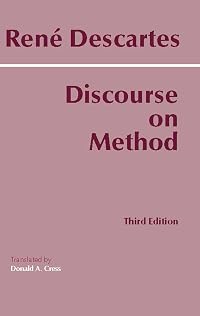
Discourse on Method
by René Descartes
On This Page
Description
One of the most influential books ever written, Descartes' Discourse on the Method delves into some of the most basic and profound philosophical problems facing humanity. Follow this great mind through the logical processes that ultimately led him to conclude, "I think, therefore I am"—and to change Western philosophy forever in the process..
Tags
Recommendations























Member Recommendations

caflores Descartes es más claro y breve, pero Spinoza lleva la racionalidad más lejos.
Member Reviews
Even though he purports to sweep the slate clean and start from scratch it doesn't feel like it. He starts with "I think therefore i am" and i am quite content with that but then out of nowhere he produces perfection, imperfection, dependency, composition and other concepts which without first analysing and defining he uses to construct God and other things. That really baffled me for it didn't feel at all like a rigorous approach. Though when i think about it it doesn't seem possible to define things without having some things already defined so the whole clean slate approach is not possible in the absolute. He had to start somewhere, with some precepts but i just don't like the precepts he chose for start. Too much was presupposed for show more my liking.
Still the book was delightful especially for the glimpses into Rene's life and his struggles around philosophising and publication. show less
Still the book was delightful especially for the glimpses into Rene's life and his struggles around philosophising and publication. show less
Clássica prosa conselheira do início do moderno, possui uma fluidez muito prazenteira e introduz de modo leve inúmeras preocupações cartesianas: a moderação no viver, a importância do individualismo e da descoberta individual, a separação corpo e mente, como uma boa ordem investigativa e procedimental leva a resultados mais consistentes. Além disso, já incita o leitor mais curioso a ler suas meditações.
Together with Bacon's New Organon, this small, lucid book is the methodological foundation of the entire scientific revolution - the "birth" of modern science during the 17th century - & perhaps even of technology as such. The celebrated & hypnotic mantra "nous rendre comme maîtres & possesseurs de la nature" - to acquire command of all nature by the radically cautious & methodical acquisition of knowledge that Descartes outlines - became a programme, a prize, an obsession, & decided, for better or worse, the size & shape of our universe.
Like a warm bath for the mind, and takes about as long - parts 1-4 at least. Reading it in English, I wonder if he is so straightforward and readable in French. Parts 1-4 are eloquent and minimal, and certainly worth re-reading - meditations of reason. Part 5, home to the famous 'cogito ergo sum' line, is pretty tedious after the first page and that very quote. Just skip part 6. The introduction - despite being longer than the actual text - is worth reading. It sets the scene and gives the historical context. Interesting to note that it was originally published in French, so perhaps the line we know him by should rather be 'je pense donc je suis'. If it had ended on that line, I would rate it 5.
This book marks the shift in philosophical speculation, from the Nature-Grace ethos of the Medieval age to that of Nature-Freedom of the Enlightenment. Descartes essentially put an X through the then standing assumptions regarding knowledge. Agree or disagree, this book defines much of Western thought to this day.
This is an important book. Funny, most of the really powerful and long-lasting ideas have been in brief books like this one.
This is an important book. Funny, most of the really powerful and long-lasting ideas have been in brief books like this one.
Um livro surpreendentemente claro e acessível. Todas as ideias são explicadas logica e pacientemente, de acordo com o próprio método indicado pelo autor. Descartes parece relutante, ou no mínimo, cauteloso em apresentar as suas ideias, principalmente depois de saber o que aconteceu com Galileu. Todos os raciocínios aparecem quase pé ante pé ao longo do texto, desde a prova da existência de deus, até à imortalidade da alma e sobre a inteligência artificial de "máquinas que imitam o comportamento humano".
This work contains his famous "cogito, ergo sum" after which he seems to leap to other conclusions, including God, that do not necessarily follow. He lived for 8 productive years in wartime Holland, where he was able to isolate himself by moving frequently. He did not publish some of his works, having seen the effect for Galileo of publishing great discoveries. This may also have influenced some of his proofs of God: causality implies that something created all of this and I have imperfections; hence there must be something greater than me. He also advocated the power of one master workman in science as in other crafts, and perhaps saw himself as destined to make all of the discoveries along the paths he was pursuing. He observed that show more what led to knowledge was not so much good sense as pursuit of it through mental effort. He observed that, while giving his mind somewhat of a grounding, formal schooling served mostly to disclose his ignorance and that of those around him. His philosophical method includes regarding as false anything only probable and yet he notes that learned philosophers have debated for years without finding truth in the same matters. Amidst all of this, he is also able to make such practical observations as one regarding fashion: that what pleased people 10 years ago will again please them 10 years hence, and yet be ridiculous today. show less
1
Members
- Recently Added By
Lists

100 Books to Read in a Lifetime (That Are Older Than 200 Years)
415 works; 176 members

Filosofía - Clásicos
217 works; 1 member

CCE 100 Great Books List
145 works; 8 members

Literary Works Read in College
316 works; 15 members

Trinity College Booklist (1951): Class Three, Philosophy and Religion
80 works; 3 members

10 Books that Screwed Up the World (And 5 Others that Didn't Help)
15 works; 1 member

The Great Courses: The Great Ideas of Psychology
61 works; 1 member

How to Read a Book's Recommended Reading List
309 works; 10 members

Greatest Books, allegedly
484 works; 9 members

Philosophy, Politics and Economics
61 works; 1 member
My List
302 works; 1 member
New Lifetime Reading Plan by Fadiman and Major
225 works; 5 members

readingList
38 works; 1 member

In Our Time books
4,934 works; 2 members
Author Information

Best known for the quote from his Meditations de prima philosophia, or Meditations on First Philosophy (1641), "I think therefore I am," philosopher and mathematician Rene Descartes also devoted much of his time to the studies of medicine, anatomy and meteorology. Part of his Discourse on the Method for Rightly Conducting One's Reason and show more Searching for the Truth in the Sciences (1637) became the foundation for analytic geometry. Descartes is also credited with designing a machine to grind hyperbolic lenses, as part of his interest in optics. Rene Descartes was born in 1596 in La Haye, France. He began his schooling at a Jesuit college before going to Paris to study mathematics and to Poitiers in 1616 to study law. He served in both the Dutch and Bavarian military and settled in Holland in 1629. In 1649, he moved to Stockholm to be a philosophy tutor to Queen Christina of Sweden. He died there in 1650. Because of his general fame and philosophic study of the existence of God, some devout Catholics, thinking he would be canonized a saint, collected relics from his body as it was being transported to France for burial. (Bowker Author Biography) show less
Some Editions
Awards and Honors
Notable Lists
Series
Belongs to Publisher Series
Colecção História da Literatura (Livro 74)
Stichting De Roos (10)
L&PM Pocket (458)
GF Flammarion (1091)
Textos filosòfics (74)
Penguin Classics (L097)
Reclams Universal-Bibliothek (3767)
Work Relationships
Is contained in
Schlüsselwerke der Philosophie : die philosophische Basisbibliothek ; mehr als 20.000 Seiten! ; Logik, Ethik, Erkenntni by Mathias Bertram (indirect)
The Rationalists: Descartes: Discourse on Method & Meditations; Spinoza: Ethics; Leibniz: Monadology & Discourse on Metaphysics by René Descartes
Reglas para la dirección del espíritu ; Investigación de la verdad por la luz natural ; Discurso del método ; Las pasiones del alma ; Tratado del hombre by René Descartes
Teokset. I : Yksityisiä ajatelmia ; Järjen käyttöohjeet ; Metodin esitys ja optiikka ; Kirjeitä 1619-1640 / suomentanut Sami Jansson ; selitykset laatineet Tuomo Aho ... et al. ; johdannon kirjoittanut Lilli Alanen by René Descartes
Is abridged in
Common Knowledge
- Canonical title
- Discourse on Method
- Original title
- Discours de la méthode pour bien conduire sa raison, et chercher la vérité dans les sciences; Discours de la méthode pour bien conduire sa raison, et chercher la vérité dans les sciences
- Alternate titles
- Discourse on the Method of Rightly Conducting One's Reason and of Seeking Truth in the Sciences
- Original publication date
- 1637
- People/Characters
- René Descartes
- Important places*
- Descartes, Centre-Val de Loire, Frankrijk
- Important events
- Enlightenment; 17th century
- First words*
- Der gesunde Verstand (bon sens) ist die bestverteilte Sache der Welt, denn jedermann meint, damit so gut versehen zu sein, dass selbst diejenigen, die in allen übrigen Dingen sehr schwer zu befriedigen sind, doch gewöhnlich... (show all) nicht mehr Verstand haben wollen, als sie wirklich haben.
- Last words*
- (Click to show. Warning: May contain spoilers.)Darüber gebe ich hier eine öffentliche Erklärung, von der ich wohl weiss, dass sie nicht angetan ist, um mich in der Welt angesehen zu machen, aber ich habe auch gar keine Lust, es zu sein, und ich werde mich denen, durch deren Gunst ich ungestört meine Musse geniesse, stets für verpflichteter halten, als ich es denen wäre, die mir die ehrenvollsten Ämter der Erde anböten.
- Original language
- Französisch; French
- Canonical DDC/MDS
- 194.1
- Disambiguation notice
- Single edition. Careful not to combine with anthologies.
Contains the Discourse only. Do not combine with editions that contain other material (Meditations etc).
*Some information comes from Common Knowledge in other languages. Click "Edit" for more information.
Classifications
Statistics
- Members
- 3,382
- Popularity
- 5,010
- Reviews
- 45
- Rating
- (3.60)
- Languages
- 26 — Catalan, Chinese, Czech, Danish, Dutch, English, Estonian, Finnish, French, German, Galician, Hebrew, Hungarian, Icelandic, Italian, Japanese, Latvian, Multiple languages, Norwegian (Bokmål), Polish, Romanian, Russian, Spanish, Swedish, Turkish, Portuguese (Portugal)
- Media
- Paper, Audiobook, Ebook
- ISBNs
- 364
- ASINs
- 110