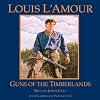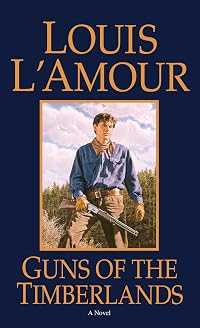
Guns of the Timberlands
by Louis L'Amour
On This Page
Description
Fiction. Western. Thriller. Historical Fiction. Clay Bell spent the last six years fighting Indians, rustlers, and the wilderness itself to make the B-Bar ranch the prize of the Deep Creek Range. But Jud Devitt, a ruthless speculator from the East, now threatens everything Clay has worked for. Devitt, holding a contract with the Mexican Central to deliver railroad ties, wants to harvest timber off the land where Clay grazes his cattle. Backing Devitt are shady politicians, a dishonest show more banker, and fifty of the toughest lumberjacks in the county. But as Colleen Riley, Devitt’s fiancée, realizes the brutal game he’s playing, her disapproval of his actions, and Clay Bell’s obvious integrity and charm, pull her toward a destiny that will tip the scales in their bloody battle over timber and cattle. show lessTags
Recommendations
















Member Reviews
Few could claim to have read all of Louis L’Amour’s more than 120 books but I’ve read a fair number, including the entire Sackett series, a couple of the Hopalong Cassidy novels, and other of his individual novels. It is with this background that I say “Guns of the Timberland” ranks with “Last of the Breed” as the most enjoyable.
The writing and plot are pretty much what you would expect. If you’re looking for an innovative plot or a focus on exquisite language – keep looking. This book offers you the predictable western plot. The valiant hero makes a desperate stand against almost insurmountable odds while the breathtakingly beautiful damsel gradually changes from bitter (or at least indifferent) enemy to soon to be show more wife. The story gets off to a slow start as L’Amour focuses on setting up the situation. His reliance on “telling” instead of “showing” contributes to the rather flat first third of the book.
However, there is one feature I found to be a refreshing departure from L’Amour’s formulaic approach. In the Sackett novels in particular, a member of the Sackett clan becomes entangled in a desperate situation. Once the situation is established, L’Amour introduces additional Sacketts in distant locations who learns of the difficulty. They immediately depart to offer assistance, and are depicted periodically as riding to the rescue. By the time they arrive, however, the original Sackett has singlehandedly emerged victorious. The introduction of strong supporting characters that eventually turn out to be irrelevant was always a great disappointment.
In “Guns of the Timberland” L’Amour reverses the formula. He introduces several strong characters, but his depictions are sketchy because me “tells” us they are strong instead of demonstrating their strengths through any action. In the end, however, many of them have a minor part in the final confrontation. I enjoyed the opportunity to see these characters pay at least a minor part. show less
The writing and plot are pretty much what you would expect. If you’re looking for an innovative plot or a focus on exquisite language – keep looking. This book offers you the predictable western plot. The valiant hero makes a desperate stand against almost insurmountable odds while the breathtakingly beautiful damsel gradually changes from bitter (or at least indifferent) enemy to soon to be show more wife. The story gets off to a slow start as L’Amour focuses on setting up the situation. His reliance on “telling” instead of “showing” contributes to the rather flat first third of the book.
However, there is one feature I found to be a refreshing departure from L’Amour’s formulaic approach. In the Sackett novels in particular, a member of the Sackett clan becomes entangled in a desperate situation. Once the situation is established, L’Amour introduces additional Sacketts in distant locations who learns of the difficulty. They immediately depart to offer assistance, and are depicted periodically as riding to the rescue. By the time they arrive, however, the original Sackett has singlehandedly emerged victorious. The introduction of strong supporting characters that eventually turn out to be irrelevant was always a great disappointment.
In “Guns of the Timberland” L’Amour reverses the formula. He introduces several strong characters, but his depictions are sketchy because me “tells” us they are strong instead of demonstrating their strengths through any action. In the end, however, many of them have a minor part in the final confrontation. I enjoyed the opportunity to see these characters pay at least a minor part. show less
A Western with all the tropes. I like this one because the plot is a little different. A rancher is trying to protect his land from a rogue businessman who wants to log off all the timber. There's some environmental sensibility which one doesn't expect in a Western, as the rancher is aware that cutting all the trees would ruin the land for the future. The businessman doesn't care about the future, but is only interested in short-term profit. As always, L'Amour is good at description and he treats the women in his stories with respect.
A stranger arrives in a small western town with a score of lumberjacks on payroll and the intent to cut down a growth of virgin timber before the government can stop him.
While a little slow to start, I felt this is one of the author's better stories.
While a little slow to start, I felt this is one of the author's better stories.
I’m only just getting into westerns and when a family member that reads a lot of them was moving, he gave me a couple of bags full. I’ve been slowly working my way through them by reading one a month and so far this is one of the better ones I’ve read.
With it being such a short book, I don’t know what I can really say about it. Unlike my last L’Amour novel, the length didn’t bother me because this one didn’t take place over years. The characters were interesting, I enjoyed the plot and the writing was great.
I’m still not loving westerns but every month they seem to get a bit better and now I’m starting to look forward to the next one.
With it being such a short book, I don’t know what I can really say about it. Unlike my last L’Amour novel, the length didn’t bother me because this one didn’t take place over years. The characters were interesting, I enjoyed the plot and the writing was great.
I’m still not loving westerns but every month they seem to get a bit better and now I’m starting to look forward to the next one.
A very enjoyable western, good guy vs. bad guy, underdog wins out but not without a lot of blood, sweat and tears. A great "escape" tale!
Clay Bell had spent the last six years fighting Indians, rustlers, and the wilderness itself to make the B-Bar ranch the prize of the Deep Creek Range. But Jud Devitt, a ruthless speculator from the east, now threatens everything Clay has worked so hard to accomplish. Devitt has a contract with the Mexican Central to deliver railroad ties and wants to harvest timber off the government land where Clay grazes his cattle. Backing Devitt are corrupt judges, shady politicians, a crooked banker, and fifty of the toughest lumberjacks in the county. But this time, Devitt is doing his dirty dealing against the show more wrong man.
The recording I listened to, read by Jason Culp, was well done--He did a good job of dramatizing the story and it was a pleasant listen. show less
Clay Bell had spent the last six years fighting Indians, rustlers, and the wilderness itself to make the B-Bar ranch the prize of the Deep Creek Range. But Jud Devitt, a ruthless speculator from the east, now threatens everything Clay has worked so hard to accomplish. Devitt has a contract with the Mexican Central to deliver railroad ties and wants to harvest timber off the government land where Clay grazes his cattle. Backing Devitt are corrupt judges, shady politicians, a crooked banker, and fifty of the toughest lumberjacks in the county. But this time, Devitt is doing his dirty dealing against the show more wrong man.
The recording I listened to, read by Jason Culp, was well done--He did a good job of dramatizing the story and it was a pleasant listen. show less
Became interested in Westerns, decided to try L'Amour. Wasn't bad. Wasn't exactly riveting but I did enjoy it to a degree. Follows the formula. Would not be opposed to reading more L'Amour if the mood strikes.
Members
- Recently Added By
Author Information

871+ Works 100,145 Members
Born in Jamestown, North Dakota on March 22, 1908, Louis L'Amour's adventurous life could have been the subject of one of his novels. Striking out on his own in 1923, at age 15, L'Amour began a peripatetic existence, taking whatever jobs were available, from skinning dead cattle to being a sailor. L'Amour knew early in life that he wanted to be a show more writer, and the experiences of those years serve as background for some of his later fiction. During the 1930s he published short stories and poetry; his career was interrupted by army service in World War II. After the war, L'Amour began writing for western pulp magazines and wrote several books in the Hopalong Cassidy series using the pseudonym Tex Burns. His first novel, Westward the Tide (1950), serves as an example of L'Amour's frontier fiction, for it is an action-packed adventure story containing the themes and motifs that he uses throughout his career. His fascination with history and his belief in the inevitability of manifest destiny are clear. Also present and typical of L'Amour's work are the strong, capable, beautiful heroine who is immediately attracted to the equally capable hero; a clear moral split between good and evil; reflections on the Native Americans, whose land and ways of life are being disrupted; and a happy ending. Although his work is somewhat less violent than that of other western writers, L'Amour's novels all contain their fair share of action, usually in the form of gunfights or fistfights. L'Amour's major contribution to the western genre is his attempt to create, in 40 or more books, the stories of three families whose histories intertwine as the generations advance across the American frontier. The novels of the Irish Chantry, English Sackett, and French Talon families are L'Amour's most ambitious project, and sadly were left unfinished at his death. Although L'Amour did not complete all of the novels, enough of the series exists to demonstrate his vision. L'Amour's strongest attribute is his ability to tell a compelling story; readers do not mind if the story is similar to one they have read before, for in the telling, L'Amour adds enough small twists of plot and detail to make it worth the reader's while. L'Amour fans also enjoy the bits of information he includes about everything from wilderness survival skills to finding the right person to marry. These lessons give readers the sense that they are getting their money's worth, that there is more to a L'Amour novel than sheer escapism. With over 200 million copies of his books in print worldwide, L'Amour must be counted as one of the most influential writers of westerns in this century. He died from lung cancer on June 10, 1988. (Bowker Author Biography) Louis L'Amour, truly America's favorite storyteller, was the first fiction writer ever to receive the Congressional Gold Medal from the United States Congress in honor of his life's work, & was also awarded the Medal of Freedom. There are over 260 million copies of his books in print worldwide. (Publisher Provided) show less
Common Knowledge
- Canonical title
- Guns of the Timberlands
- Original publication date
- 1955
- People/Characters
- Clay Bell; Jud Devitt; Bill Coffin; Colleen Riley; Noble Wheeler; Bert Garry (show all 7); Pete Simmons
- Epigraph
- [None]
- Dedication
- To Edna Lamoore Waldo
- First words
- The two riders on the Deep Creek trail had the morning to themselves.
- Last words
- (Click to show. Warning: May contain spoilers.)It was a good town, a good town. He would get the piano player himself.
Classifications
Statistics
- Members
- 758
- Popularity
- 37,263
- Reviews
- 11
- Rating
- (3.60)
- Languages
- Czech, English, Russian
- Media
- Paper, Audiobook, Ebook
- ISBNs
- 24
- ASINs
- 17