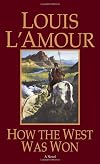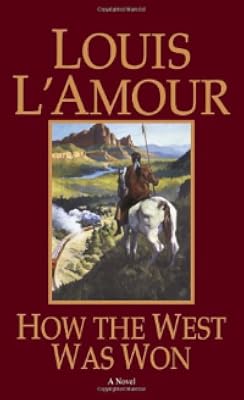
How the West was Won
by Louis L'Amour
On This Page
Description
Fiction. Western. Thriller. Historical Fiction. They came by river and by wagon train, braving the endless distances of the Great Plains and the icy passes of the Sierra Nevada. They were men like Linus Rawlings, a restless survivor of Indian country who'd headed east to see the ocean but left his heart—and his home—in the West. They were women like Lilith Prescott, a smart, spirited beauty who fled her family and fell for a gambling man in the midst of a frontier gold boom. These show more pioneering men and women sowed the seeds of a nation with their courage—and with their blood. Here is the story of how their paths would meet amid the epic struggle against fierce enemies and nature's cruelty, to win for all time the rich and untamed West. show lessTags
Recommendations








Member Reviews
The western expansion of the United States took place over many years but in How The West Was Won, author Louis L’Amour simplifies the story by choosing to describe the growth of one family. Through the Prescott family he is able to cover the era of the mountain man, the early settlers that pushed down the Ohio River, the California Gold Rush and, after the Civil War, the building of the railroad that made the west accessible to everyone and the army’s final solution to the Plains Indian.
In typical Louis L’Amour style, his men are bigger than life and his women are strong and true. The Prescott family bred restless people and each generation seemed to turn West to seek new land. They travelled by raft down the raging Ohio, or by show more wagon train across the plains. They were smart enough to see that California had more to offer than gold, they put down roots and helped develop the land.
Louis L’Amour excels at action and this book has lots of that. He is not one to develop his characters much beyond identifying who is a hero and who is a villain, but this was a simple, fun page-turner delivered in his straight forward style. Although his books stray from the actual historical facts, he certainly helps to develop and nurture the myth of the American West. show less
In typical Louis L’Amour style, his men are bigger than life and his women are strong and true. The Prescott family bred restless people and each generation seemed to turn West to seek new land. They travelled by raft down the raging Ohio, or by show more wagon train across the plains. They were smart enough to see that California had more to offer than gold, they put down roots and helped develop the land.
Louis L’Amour excels at action and this book has lots of that. He is not one to develop his characters much beyond identifying who is a hero and who is a villain, but this was a simple, fun page-turner delivered in his straight forward style. Although his books stray from the actual historical facts, he certainly helps to develop and nurture the myth of the American West. show less
It looks like L'Amour's intent was to sketch a portrait of different types of Western settlers: mountain men, families, farmers, railroad workers, lawmen, and outlaws. He did this by following a single family and the various members and descendants. L'Amour's stories have aged better than other. perhaps more literary stories, written at the same time. He is always respectful of his characters, including the women and the Indians, without being overly romantic about them. His protagonists are always practical, doing what needs to be done without fuss, with an integrity all their own.
Because of the format of this novel, we don't get very deeply into the characters, but I think L'Amour succeeded in what he was trying to do.
Because of the format of this novel, we don't get very deeply into the characters, but I think L'Amour succeeded in what he was trying to do.
My first Lamour book and I thought it was well written. Certainly did his research, and understands the times and the people. His characters impart a lot of timeless wisdom about life.
LL has a knack for deliberate and methodical insight being shown by the main characters Linus and Zeb Rawlins, which I think mirrors his own thought processes and personality. Each part of the novel is very thoroughly thought through, which I find admirable
LL has a knack for deliberate and methodical insight being shown by the main characters Linus and Zeb Rawlins, which I think mirrors his own thought processes and personality. Each part of the novel is very thoroughly thought through, which I find admirable
Not one of the better one, they did make a movie in the 50's with Henry Fonda.
The book is better. It is really three stories brought together as one. I liked the first story the best.
The book is better. It is really three stories brought together as one. I liked the first story the best.
Nowhere near as good as any of his other writings.
Classic, had never read this one. Going to watch the movie now.
Product Description
They came by river and by wagon train, braving the endless distances of the Great Plains and the icy passes of the Sierra Nevada. They were men like Linus Rawlings, a restless survivor of Indian country who’d headed east to see the ocean but left his heartÂand his homeÂin the West. They were women like Lilith Prescott, a smart, spirited beauty who fled her family and fell for a gambling man in the midst of a frontier gold boom. These pioneering men and women sowed the seeds of a nation with their courageÂand with their blood. Here is the story of how their paths would meet amid the epic struggle against fierce enemies and natureÂs cruelty, to win for all time the rich and untamed West.
From the show more Publisher
Louis L'Amour's great epic of human courage and endurance, his brave saga of the men and women who pushed relentlessly forward--despite the uncertainties of nature, the wrath of savage enemies, countless dangers and cruel death--to win the wide, shining lands of the rich and untamed West! show less
Members
- Recently Added By
Lists

Read the book and saw the movie
1,170 works; 195 members
Author Information

871+ Works 100,145 Members
Born in Jamestown, North Dakota on March 22, 1908, Louis L'Amour's adventurous life could have been the subject of one of his novels. Striking out on his own in 1923, at age 15, L'Amour began a peripatetic existence, taking whatever jobs were available, from skinning dead cattle to being a sailor. L'Amour knew early in life that he wanted to be a show more writer, and the experiences of those years serve as background for some of his later fiction. During the 1930s he published short stories and poetry; his career was interrupted by army service in World War II. After the war, L'Amour began writing for western pulp magazines and wrote several books in the Hopalong Cassidy series using the pseudonym Tex Burns. His first novel, Westward the Tide (1950), serves as an example of L'Amour's frontier fiction, for it is an action-packed adventure story containing the themes and motifs that he uses throughout his career. His fascination with history and his belief in the inevitability of manifest destiny are clear. Also present and typical of L'Amour's work are the strong, capable, beautiful heroine who is immediately attracted to the equally capable hero; a clear moral split between good and evil; reflections on the Native Americans, whose land and ways of life are being disrupted; and a happy ending. Although his work is somewhat less violent than that of other western writers, L'Amour's novels all contain their fair share of action, usually in the form of gunfights or fistfights. L'Amour's major contribution to the western genre is his attempt to create, in 40 or more books, the stories of three families whose histories intertwine as the generations advance across the American frontier. The novels of the Irish Chantry, English Sackett, and French Talon families are L'Amour's most ambitious project, and sadly were left unfinished at his death. Although L'Amour did not complete all of the novels, enough of the series exists to demonstrate his vision. L'Amour's strongest attribute is his ability to tell a compelling story; readers do not mind if the story is similar to one they have read before, for in the telling, L'Amour adds enough small twists of plot and detail to make it worth the reader's while. L'Amour fans also enjoy the bits of information he includes about everything from wilderness survival skills to finding the right person to marry. These lessons give readers the sense that they are getting their money's worth, that there is more to a L'Amour novel than sheer escapism. With over 200 million copies of his books in print worldwide, L'Amour must be counted as one of the most influential writers of westerns in this century. He died from lung cancer on June 10, 1988. (Bowker Author Biography) Louis L'Amour, truly America's favorite storyteller, was the first fiction writer ever to receive the Congressional Gold Medal from the United States Congress in honor of his life's work, & was also awarded the Medal of Freedom. There are over 260 million copies of his books in print worldwide. (Publisher Provided) show less
Some Editions
Common Knowledge
- Canonical title
- How the West was Won
- Original title
- How the West Was Won
- Original publication date
- 1962
- People/Characters
- Lilith Prescott; Linus Rawlings; Eve Rawlings; William Tecumseh Sherman; Charlie Gant
- Epigraph
- [None]
- Dedication
- [None]
- First words
- The sun was not an hour high when Linus Rawlings came upon the trail of the Ute war party.
- Last words
- (Click to show. Warning: May contain spoilers.)"We're going home."
Classifications
Statistics
- Members
- 804
- Popularity
- 34,560
- Reviews
- 8
- Rating
- (3.62)
- Languages
- Czech, English, Swedish
- Media
- Paper, Audiobook, Ebook
- ISBNs
- 24
- ASINs
- 11