On This Page
Description
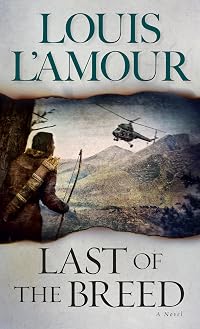
“For sheer adventure L’Amour is in top form.”—Kirkus ReviewsHere is the kind of authentically detailed epic novel that has become Louis L’Amour’s hallmark. It is the compelling story of U.S. Air Force Major Joe Mack, a man born out of time. When his experimental aircraft is forced down in Russia and he escapes a Soviet prison camp, he must call upon the ancient skills of his Indian forebears to survive the vast Siberian wilderness. Only one route lies open to Mack: the path show more of his ancestors, overland to the Bering Strait and across the sea to America. But in pursuit is a legendary tracker, the Yakut native Alekhin, who knows every square foot of the icy frontier—and who knows that to trap his quarry he must think like a Sioux. show less
Tags
Recommendations









Member Reviews
I liked the survival bits of this, though L'Amour is often frustratingly vague about how much time has passed between one scene and the next. Instead of knowing how a task is accomplished, we know only that it has been done.
I even enjoyed the cat and mouse chase, at least at the beginning. As the book went on, everything got more and more repetitive: the survival techniques, the chase, and especially the writing. Over and over again, we're told, "No one could survive out there!" and "Alekhin would catch the American and kill him!" and "Natalya stared into the distance, wondering if he was still alive," and "The past few months had made Joe lean and strong," and worst of all, "Joe was reverting to a savage Indian."
I understand L'Amour show more was writing after centuries of negative, and inaccurate, propaganda from the US government about native peoples, but even when I tried to make allowances for that, the constant harping on Joe's true self being "savage" and "uncivilized" was extremely tiresome. Joe, you see, is a special snowflake of a Red Indian. He, and he alone, is the only remaining Indian with a crude and primitive code of honor. He, and he alone, is the only one capable of waging so personal a war against his oppressors.
I know this type of book is intended to feed a fantasy of self-reliance and moral superiority, but I just don't have a lot of patience for anyone who truly believes that they are the last of a breed. Especially when being the last of a breed allows someone carte blanche to behave however they wish, all ties to humanity irrelevant because they are somehow apart from everyone around them.
Every single person is special. Every single person is unique. And every single person has to figure out how to accept that they are not any more special or unique than any other person. Joe is highly competent—most of the time—but his war is not holy. His "savage" inner self is not righteous. (Or Indian, for that matter.) And if he had any idea how much his pragmatic ruthlessness had in common with his antagonists', he might rethink his conviction that he is the last of his breed. show less
I even enjoyed the cat and mouse chase, at least at the beginning. As the book went on, everything got more and more repetitive: the survival techniques, the chase, and especially the writing. Over and over again, we're told, "No one could survive out there!" and "Alekhin would catch the American and kill him!" and "Natalya stared into the distance, wondering if he was still alive," and "The past few months had made Joe lean and strong," and worst of all, "Joe was reverting to a savage Indian."
I understand L'Amour show more was writing after centuries of negative, and inaccurate, propaganda from the US government about native peoples, but even when I tried to make allowances for that, the constant harping on Joe's true self being "savage" and "uncivilized" was extremely tiresome. Joe, you see, is a special snowflake of a Red Indian. He, and he alone, is the only remaining Indian with a crude and primitive code of honor. He, and he alone, is the only one capable of waging so personal a war against his oppressors.
I know this type of book is intended to feed a fantasy of self-reliance and moral superiority, but I just don't have a lot of patience for anyone who truly believes that they are the last of a breed. Especially when being the last of a breed allows someone carte blanche to behave however they wish, all ties to humanity irrelevant because they are somehow apart from everyone around them.
Every single person is special. Every single person is unique. And every single person has to figure out how to accept that they are not any more special or unique than any other person. Joe is highly competent—most of the time—but his war is not holy. His "savage" inner self is not righteous. (Or Indian, for that matter.) And if he had any idea how much his pragmatic ruthlessness had in common with his antagonists', he might rethink his conviction that he is the last of his breed. show less
“Even in the days when we were poor, there were always books. There were libraries, and we read everything. The mind was free to navigate any course; the world of ideas is a vast universe of unexplained worlds, and we were free to go anywhere!”
Thus says one of the characters in this fantastic adventure story. Here, we are taken to the cold wilderness of Siberia of the 1980s. Our hero is Joe Makatuzi, an American Indian in service to America as a pilot of experimental aircraft. When he is forced down by the Soviets, and taken prisoner into the heart of Siberia, you get the feeling that the Russian authorities have bitten off more than they can chew. This is no ordinary Joe, and right from the get-go, escape is the only thing on Joe show more Mack’s mind.
One man who helps him, Stephan Baronas, describes Joe to his daughter:
“Your young man has learned how to survive in one world, at least. Colonel Zamatev was unwise in not realizing he had captured something wild that could not stand being imprisoned. He is elemental, your friend. He is basic. His thoughts are simple, direct thoughts. I believe, although I don’t know him well enough. I am a little afraid that when Zamatev had him captured he bought more than he bargained for. To Zamatev his action was totally impersonal. He captured a man to squeeze information from him, then to cast him aside. To Makatozi his capture was a deadly, personal insult, I believe. Something to be wiped out in blood.”
But isn’t escape from Siberia and Colonel Arkady Zamatev impossible? Many have tried. None have succeeded… yet.
Louis L’Amour was a first-rate story-teller, and he shows the skills of his art here, just as he has in over 80 Western novels.
Not only is this the story of Joe Mack on his wilderness trek pursued by soldiers, trappers, and one excellent tracker with similar abilities, but it is layered with side stories of the Russian people he encounters along the way. It is a pure pleasure to read these stories and varying perspectives that L’Amour weaves into Joe Mack’s pursuit of freedom.
We are reminded of the importance of such qualities as courage, sacrifice, perseverance, and kindness--traits that seem in short supply today. show less
Thus says one of the characters in this fantastic adventure story. Here, we are taken to the cold wilderness of Siberia of the 1980s. Our hero is Joe Makatuzi, an American Indian in service to America as a pilot of experimental aircraft. When he is forced down by the Soviets, and taken prisoner into the heart of Siberia, you get the feeling that the Russian authorities have bitten off more than they can chew. This is no ordinary Joe, and right from the get-go, escape is the only thing on Joe show more Mack’s mind.
One man who helps him, Stephan Baronas, describes Joe to his daughter:
“Your young man has learned how to survive in one world, at least. Colonel Zamatev was unwise in not realizing he had captured something wild that could not stand being imprisoned. He is elemental, your friend. He is basic. His thoughts are simple, direct thoughts. I believe, although I don’t know him well enough. I am a little afraid that when Zamatev had him captured he bought more than he bargained for. To Zamatev his action was totally impersonal. He captured a man to squeeze information from him, then to cast him aside. To Makatozi his capture was a deadly, personal insult, I believe. Something to be wiped out in blood.”
But isn’t escape from Siberia and Colonel Arkady Zamatev impossible? Many have tried. None have succeeded… yet.
Louis L’Amour was a first-rate story-teller, and he shows the skills of his art here, just as he has in over 80 Western novels.
Not only is this the story of Joe Mack on his wilderness trek pursued by soldiers, trappers, and one excellent tracker with similar abilities, but it is layered with side stories of the Russian people he encounters along the way. It is a pure pleasure to read these stories and varying perspectives that L’Amour weaves into Joe Mack’s pursuit of freedom.
We are reminded of the importance of such qualities as courage, sacrifice, perseverance, and kindness--traits that seem in short supply today. show less
This is not a western novel. Imagine the modern American indian, the best of the best. He knows the old ways of living from the land. He is highly educated, wise, and good. L'Amour took this idea, and then dropped him in cold war Siberia, captured for his knowledge of experimental aircraft. Last of the breed is the story of his escape. It is an exciting survival story, but it is also an exploration of the qualities that make L'Amour's ideal man. As far as objectionable content, there is no swearing. The Russian general has a girlfriend that sleeps over, but there is no romantic action in the story. The hero does meet a lady that he learns to love, but it is a small part of the story. I'd feel comfortable with a teenager reading this show more book, particularly if he enjoys other survival stories. show less
Set during the Cold War era, Last of the Breed is the story of a US Air Force pilot who is captured by Soviet agents and imprisoned in Siberia. The authorities intend to extract information from Lt. Joseph Makatozi regarding technical secrets using any method available, including torture. However, “Mack” does not cooperate, but escapes into the wilds of Siberia as winter approaches. He uses his survival skills to not only stay alive, but keep a jump ahead of the best Russian trackers available. As the weeks and months pass, Mack finds himself reverting to become a warrior, with a mindset much like one of his Sioux and Cheyenne ancestors.
Hard to put down, this one will remain on my shelves for a future reread.
Hard to put down, this one will remain on my shelves for a future reread.
This book is based during the Cold War. Once you start it you won't put it down. A Native American Fighter pilot is shot down in Russia captured, sent to a Gulag and escapes. The rest of the book is a chase as the main character lives off the land, evades the Russian and in the end, well you are just going to have to read it for your self. I have read this book more than once one of my favorite L'Amour stories.
For me this is one that lost luster as I aged. I originally read this when I was in high school and loved every minute of it. Just got done listening to it and I have to say the main character was a bit pretentious. Still a pretty good story but not nearly as good as I remembered it. had to drop off a star from my original rating.
Major Joe Mac, of the US Air Force is a pilot and a Sioux Indian. While test flying an experimental aircraft over the Baring Straight, he is forced to crash in the drink and is captured by the Soviets. He escapes only to be trapped in Siberia. The rest of the book is the Soviets trying to recapture him and constantly failing.
Major Joe Mac, of the US Air Force is a pilot and a Sioux Indian. While test flying an experimental aircraft over the Baring Straight, he is forced to crash in the drink and is captured by the Soviets. He escapes only to be trapped in Siberia. The rest of the book is the Soviets trying to recapture him and constantly failing.
One of my favorites. Read it when it came out in the late '80s. I'd read all of the Sackett series, and loved them, so I figured I'd like this one. Turned out to be my favorite L'amour. I really like man vs man, and man vs nature stories. This one has it all. I identify with Joe Mack as "a man born out of time". I read it again years later, and enjoyed it just as much. I hope to get around to it again. If you're a fan of L'amour, be sure to read his autobiography, [b:Education of a Wandering Man|828165|Education of a Wandering Man|Louis L'Amour|https://i.gr-assets.com/images/S/compressed.photo.goodreads.com/books/1584724203l/828165._SY75_.jpg|509736]. It's the best autobiography I've ever read.
Members
- Recently Added By
Lists

Books I Want to Read
36 works; 1 member
Author Information

871+ Works 99,760 Members
Born in Jamestown, North Dakota on March 22, 1908, Louis L'Amour's adventurous life could have been the subject of one of his novels. Striking out on his own in 1923, at age 15, L'Amour began a peripatetic existence, taking whatever jobs were available, from skinning dead cattle to being a sailor. L'Amour knew early in life that he wanted to be a show more writer, and the experiences of those years serve as background for some of his later fiction. During the 1930s he published short stories and poetry; his career was interrupted by army service in World War II. After the war, L'Amour began writing for western pulp magazines and wrote several books in the Hopalong Cassidy series using the pseudonym Tex Burns. His first novel, Westward the Tide (1950), serves as an example of L'Amour's frontier fiction, for it is an action-packed adventure story containing the themes and motifs that he uses throughout his career. His fascination with history and his belief in the inevitability of manifest destiny are clear. Also present and typical of L'Amour's work are the strong, capable, beautiful heroine who is immediately attracted to the equally capable hero; a clear moral split between good and evil; reflections on the Native Americans, whose land and ways of life are being disrupted; and a happy ending. Although his work is somewhat less violent than that of other western writers, L'Amour's novels all contain their fair share of action, usually in the form of gunfights or fistfights. L'Amour's major contribution to the western genre is his attempt to create, in 40 or more books, the stories of three families whose histories intertwine as the generations advance across the American frontier. The novels of the Irish Chantry, English Sackett, and French Talon families are L'Amour's most ambitious project, and sadly were left unfinished at his death. Although L'Amour did not complete all of the novels, enough of the series exists to demonstrate his vision. L'Amour's strongest attribute is his ability to tell a compelling story; readers do not mind if the story is similar to one they have read before, for in the telling, L'Amour adds enough small twists of plot and detail to make it worth the reader's while. L'Amour fans also enjoy the bits of information he includes about everything from wilderness survival skills to finding the right person to marry. These lessons give readers the sense that they are getting their money's worth, that there is more to a L'Amour novel than sheer escapism. With over 200 million copies of his books in print worldwide, L'Amour must be counted as one of the most influential writers of westerns in this century. He died from lung cancer on June 10, 1988. (Bowker Author Biography) Louis L'Amour, truly America's favorite storyteller, was the first fiction writer ever to receive the Congressional Gold Medal from the United States Congress in honor of his life's work, & was also awarded the Medal of Freedom. There are over 260 million copies of his books in print worldwide. (Publisher Provided) show less
Some Editions
Awards and Honors
Distinctions
Series

Common Knowledge
- Canonical title
- Last of the Breed
- Original title
- Last of the Breed
- Original publication date
- 1986-07; 1986
- People/Characters
- Joe Makatozi; Zamatev; Alekhin; Arkady Arkadovich Zamatev; Major Joe Manatozi; Lt. Suvarov (show all 25); Talya Baronas; Pennington; Comrade Shepilov; Yakov; Kyra Lebedev; Emma Yavorsky; Stegman; Natalya Baronas aka Talya; Peshkov; Stephan Baronas; Comrade Wulff; Evegny Zhikarev; Nicholai Bocharev; Peter Petrovich; Ostap; Vanya; Nicolai Rukovsky; Lt. Potanin; Katerina
- Important places
- Bagderin, Yakutia, Siberia
- Important events
- Korean War
- Dedication
- To John and Carol Lee Veitch. Old Friends, Good Friends, The Best Friends.
To John and Carol Lee Veitch. Old Friends, Good Friends - First words
- The soldier placed the flat, skin-wrapped package on the table before Colonel Zamatev and stepped back, standing rigidly at attention.
- Last words
- (Click to show. Warning: May contain spoilers.)This was once a custom of my people. In my lifetime I shall take two. This is the first.
Classifications
- Genres
- Fiction and Literature, General Fiction, Suspense & Thriller
- DDC/MDS
- 813.52 — Literature & rhetoric American literature in English American fiction in English 1900-1999 1900-1945
- LCC
- PS3523 .A446 .L365 — Language and Literature American literature American literature Individual authors 1900-1960
- BISAC
Statistics
- Members
- 1,983
- Popularity
- 10,629
- Reviews
- 32
- Rating
- (4.01)
- Languages
- 5 — Danish, English, Italian, Swedish, Thai
- Media
- Paper, Audiobook, Ebook
- ISBNs
- 26
- ASINs
- 22