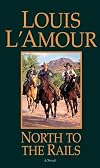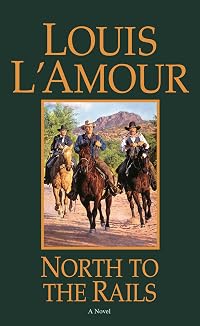
On This Page
Description
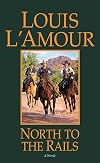
Fiction. Western. Thriller. Historical Fiction. HTML:When Tom Chantry comes west to buy cattle, he quickly runs into trouble. During a drunken scuffle in a bar, Dutch Akin challenges Chantry to a gunfight. Leaving town rather than face Akin, Chantry is quickly branded a coward.Later, when hiring men to take his herd to the railroad, Chantry faces a dilemma: No one wants to make the long, dangerous ride with a leader of questionable courage. So when French Williams, a shrewd and ruthless show more cattleman, makes Chantry an offer, Tom reluctantly accepts his unusual terms: Tom must remain with the drive from start to finish. If he fails to do so, the entire herd will belong to French.
Tom quickly learns that life is not going to be made easy for him. The first man French hires is Dutch Akin. show less
Tags
Recommendations












Member Reviews
After reading North to the Rails, I now understand perfectly why Louis L’Amour is so beloved. His portrait of life in the West has such richness, filled with casual, familiar detail about the land---its rivers, stands of timber and scrub, how the cycles of seasons and weather change it. The people populating that land are just as vivid: hard and rough, loyal or treacherous, quick to kindness or cruelty, standing on principles of courage and determination. And the story that takes place in this West has a kind of grandeur. L’Amour doesn’t ignore the dangers, but his hero, Tom Chantry, meets them with spirit, and the obstacles Chantry encounters allow the reader to share his growing understanding of what a frontier, with all its show more attendant lawlessness, requires of a settler. show less
A young man returns west to buy cattle and gets drawn into the Wild West lifestyle he dimly remembered from his childhood, when he was living on a ranch in what is now eastern Colorado. The men who killed his father seem to have some interest in him, maybe, but so do several strangers, and he must quickly abandon his original peaceful, gun-less stance and be the gunfighter his father once was. He is remarkably good at gunfighting and hand combat for a man who supposedly has had little use for violence out East for most of his life, but maybe fighting is in his blood? Still, this was a pretty decent story.
In this final book of the Chantry series Tom, the son of Borden Chantry, is heading west in search of cattle to ship back east. Still green and unused to the ways of the frontier, he's an easy target for cattle rustlers or thieves...or is he?
I really liked this story and the characters contained within. It's a better than average L'Amour.
I really liked this story and the characters contained within. It's a better than average L'Amour.
North to the Rails is a good story. It keeps its feeling from the beginning to the end. It is easy to imagine the characters and the scenery. The ending was unexpected but good. There is some gore but not enough to be turned away from wanting to complete the book. Four and one half star recommendation.
Tom Chantry comes west to buy cattle for his future father-in-law's meat packing plant. When he doesn't except a gun fight challenge, men think he is a coward. He just didn't think getting someone killed over a minor misunderstanding was worth it. Quickly though, men realize that Tom is a tough hombre when he buys a heard of cattle with French Williams, a man he knows he can't trust, and heads it to the rail head for shipment. Along the way, he discovers a brother & sister he does not know are out to kill him and that the town at the rail head holds the men who killed his father, Borden Chantry, many years ago.
This is typical of L'Amour's writing- fast moving with lots of action.
This is typical of L'Amour's writing- fast moving with lots of action.
Cowboys and outlaws who think he is a coward challenge Tom Chantry, who has returned to the West on a cattle buying mission
Product Description
When Tom Chantry comes west to buy cattle, he quickly runs into trouble. During a drunken scuffle in a bar, Dutch Akin challenges Chantry to a gunfight. Leaving town rather than face Akin, Chantry is quickly branded a coward.
Later, when hiring men to take his herd to the railroad, Chantry faces a dilemma: No one wants to make the long, dangerous ride with a leader of questionable courage. So when French Williams, a shrewd and ruthless cattleman, makes Chantry an offer, Tom reluctantly accepts his unusual terms: Tom must remain with the drive from start to finish. If he fails to do so, the entire herd will belong to French.
Tom quickly learns that life is not going to be made easy for him. The first man French show more hires is Dutch Akin.
From the Inside Flap
Tom Chantry wore no gun and wished no man harm. French Williams was a ruthless cattleman more than willing to use his weapon. But Tom needed Williams to help him drive a herd north to Dodge. Setting off together on a trail alive with danger, soft-spoken Chantry and hard-bitten Williams faced storms, treachery, and Indian attacks. Now the man some call a coward and the man many call a killer have no choice but to trust each other with their lives--for both have enemies and both are pursued by a violence from the past. show less
Members
- Recently Added By
Author Information

871+ Works 100,145 Members
Born in Jamestown, North Dakota on March 22, 1908, Louis L'Amour's adventurous life could have been the subject of one of his novels. Striking out on his own in 1923, at age 15, L'Amour began a peripatetic existence, taking whatever jobs were available, from skinning dead cattle to being a sailor. L'Amour knew early in life that he wanted to be a show more writer, and the experiences of those years serve as background for some of his later fiction. During the 1930s he published short stories and poetry; his career was interrupted by army service in World War II. After the war, L'Amour began writing for western pulp magazines and wrote several books in the Hopalong Cassidy series using the pseudonym Tex Burns. His first novel, Westward the Tide (1950), serves as an example of L'Amour's frontier fiction, for it is an action-packed adventure story containing the themes and motifs that he uses throughout his career. His fascination with history and his belief in the inevitability of manifest destiny are clear. Also present and typical of L'Amour's work are the strong, capable, beautiful heroine who is immediately attracted to the equally capable hero; a clear moral split between good and evil; reflections on the Native Americans, whose land and ways of life are being disrupted; and a happy ending. Although his work is somewhat less violent than that of other western writers, L'Amour's novels all contain their fair share of action, usually in the form of gunfights or fistfights. L'Amour's major contribution to the western genre is his attempt to create, in 40 or more books, the stories of three families whose histories intertwine as the generations advance across the American frontier. The novels of the Irish Chantry, English Sackett, and French Talon families are L'Amour's most ambitious project, and sadly were left unfinished at his death. Although L'Amour did not complete all of the novels, enough of the series exists to demonstrate his vision. L'Amour's strongest attribute is his ability to tell a compelling story; readers do not mind if the story is similar to one they have read before, for in the telling, L'Amour adds enough small twists of plot and detail to make it worth the reader's while. L'Amour fans also enjoy the bits of information he includes about everything from wilderness survival skills to finding the right person to marry. These lessons give readers the sense that they are getting their money's worth, that there is more to a L'Amour novel than sheer escapism. With over 200 million copies of his books in print worldwide, L'Amour must be counted as one of the most influential writers of westerns in this century. He died from lung cancer on June 10, 1988. (Bowker Author Biography) Louis L'Amour, truly America's favorite storyteller, was the first fiction writer ever to receive the Congressional Gold Medal from the United States Congress in honor of his life's work, & was also awarded the Medal of Freedom. There are over 260 million copies of his books in print worldwide. (Publisher Provided) show less
Series

Work Relationships
Is contained in
Common Knowledge
- Canonical title
- North to the Rails
- Original publication date
- 1971
- First words
- They could call it running away if they wanted to, but it made no sense to kill a man, or risk being killed over something so trivial.
- Last words
- (Click to show. Warning: May contain spoilers.)The wind stirred, and a little dust drifted over the whitened bones, and then lay still.
Classifications
Statistics
- Members
- 643
- Popularity
- 45,359
- Reviews
- 8
- Rating
- (3.62)
- Languages
- English, Norwegian (Bokmål), Swedish
- Media
- Paper, Audiobook, Ebook
- ISBNs
- 20
- ASINs
- 15