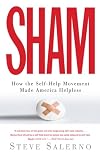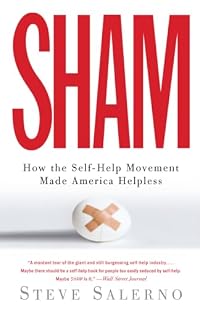
Sham: How the Self-Help Movement Made America Helpless
by Steve Salerno
On This Page
Description
Self-help: To millions of Americans it seems like a godsend. To many others it seems like a joke. But as investigative reporter Steve Salerno reveals in this groundbreaking book, it's neither--in fact it's much worse than a joke. Going deep inside the Self-Help and Actualization Movement (fittingly, the words form the acronym SHAM), Salerno offers the first serious exposé of this multibillion-dollar industry and the real damage it is doing--not just to its paying customers, but to all of show more American society. Based on the author's extensive reporting--and the inside look at the industry he got while working at a leading "lifestyle" publisher--SHAM shows how thinly credentialed "experts" now dispense advice on everything from mental health to relationships to diet to personal finance to business strategy. Americans spend upward of $8 billion every year on self-help programs and products. And those staggering financial costs are actually the least of our worries. SHAM demonstrates how the self-help movement's core philosophies have infected virtually every aspect of American life--the home, the workplace, the schools, and more. And Salerno exposes the downside of being uplifted, showing how the "empowering" message that dominates self-help today proves just as damaging as the blame-shifting rhetoric of self-help's "Recovery" movement. SHAM also reveals: * How self-help gurus conduct extensive market research to reach the same customers over and over--without ever helping them * The inside story on the most notorious gurus--from Dr. Phil to Dr. Laura, from Tony Robbins to John Gray * How your company might be wasting money on motivational speakers, "executive coaches," and other quick fixes that often hurt quality, productivity, and morale * How the Recovery movement has eradicated notions of personal responsibility by labeling just about anything--from drug abuse to "sex addiction" to shoplifting--a dysfunction or disease * How Americans blindly accept that twelve-step programs offer the only hope of treating addiction, when in fact these programs can do more harm than good * How the self-help movement inspired the disastrous emphasis on self-esteem in our schools * How self-help rhetoric has pushed people away from proven medical treatments by persuading them that they can cure themselves through sheer application of will As Salerno shows, to describe self-help as a waste of time and money vastly understates its collateral damage. And with SHAM, the self-help industry has finally been called to account for the damage it has done. Also available as an eBook show lessTags
Recommendations





























Member Reviews
This books fits my confirmation bias. Yes, I have one…evolved, matured, earned, and obviously acknowledged. I laugh at the old bookstore joke “Q: Can you direct me to the self-help section? A: If I told you, that would defeat the purpose.” Sharks hawking books, silly seminars (oops…that bias again), videos… yeah, no thanks. Really, … no thanks. Published in 2005, the message is still relevant. Probably even more so, given the explosion of “social” media in the intervening years since. Salerno has a dire warning: “To describe SHAM as a waste of time and money vastly understates its collateral damage.” He has the pedigree, and the experience, and the inside track - he shares that when working at Rodale “Another show more important lesson in self-help theology: SHAM’s answer when its methods fail? You need more of it. You always need more of it.”
The history is longer than we think:
Then there’s this astute anecdote
On Robbins, a minor dig, but it punctuates the point that he’s really a serious SHAM
It’s still a huge industry 16 years later, with dragon moms, and minimalists, and feng shui, jeez, look at even the artisanal waters out there… I know I’m not their target audience because I am so rarely as to be considered not influenced by advertisements. But they have a lot of targets who shell out a lot of money. One problem is
One incredibly lucrative SHAM that Salerno doesn’t talk about is the televangelists (but he does talk about faith healing). That's probably a whole other book. show less
The history is longer than we think:
In fact, by 1983, so substantial were sales figures for books of this genre that the lofty New York Times Book Review, which for decades fought the good fight on behalf of books written by actual writers, threw in the towel and added another category, “Advice Books,” to its distinguished best-seller list.
Then there’s this astute anecdote
Archie Brodsky, a senior research associate for the Program in Psychiatry and the Law at Harvard Medical School. “Psychotherapy has a chancy success rate even in a one-on-one setting over a period of years,” observes Brodsky, who coauthored (with Stanton Peele) Love and Addiction. “How can you expect to break a lifetime of bad behavioral habits through a couple of banquet-hall seminars or by sitting down with some book?Chancy. Yep, fits my bias. And we’re not even out of the Introduction. Anyway…Salerno rightly observes SHAM “is a religion whose clerics get very, very rich by stating the obvious in a laughably pontifical fashion.” Sound like I’m grousing because I didn’t think of any of these scams, um, SHAMs, um… No, my ethics don’t allow me to prey on the gullible. Not so with all of the SHAMs Salerno exposes here…Dr. Phil, Dr. Laura, Dr. John Gray (who apparently got his paper from a degree mill), Suze Orman, to name a few… whose hypocrisies have no shame. The Tony Robbinses, sports figures and the plethora of saccharine nonsense that they and the media spout (I may have paraphrased that a bit…), life coaches, motivational speakers, and then there’s the Recovery business (“As you can see, they’re big on toxicity in Recovery circles. And they’re huge on shame; thousands of self-help books have focused directly on the concept.”)… preying even more.
In sum, Victimization and Recovery have relentlessly encouraged ordinary people with ordinary lives to conceive of themselves as victims of some lifelong ailment that, even during the best of times, lurks just beneath the surface, waiting to undo them.Don’t think Salerno is minimizing actual victims…that’s a mistake. He’s calling out the snake oil peddlers who are manufacturing their target audiences.
On Robbins, a minor dig, but it punctuates the point that he’s really a serious SHAM
For someone whose stock in trade is the precise, life-changing use of language, Robbins can be surprisingly careless with it. Promotional materials describing his new line of nutritional products twice refer to one of the key ingredients as collodials instead of colloidals.And then there are the psychics and pseudoscience health quack. Some are semi-savvy … on Silvia Browne’s Larry King show appearance: “Undeterred by her lack of any formal credentials except a master’s degree in English literature, Browne used medical terminology freely, and sometimes even correctly.” Most are dangerous.
It’s still a huge industry 16 years later, with dragon moms, and minimalists, and feng shui, jeez, look at even the artisanal waters out there… I know I’m not their target audience because I am so rarely as to be considered not influenced by advertisements. But they have a lot of targets who shell out a lot of money. One problem is
…what mostly distinguish[ed] self-help gurus from laypeople is the former group’s ability to “write well enough to get a book deal.” The Internet eliminates even that “credential,” modest as it is, thus further lowering the bar. It allows people who couldn’t get a book deal to direct-market their self-published (or, increasingly, e-published) wares and become viable niche players in the burgeoning relationships market.(Not just SHAM books… pretty much anything)
One incredibly lucrative SHAM that Salerno doesn’t talk about is the televangelists (but he does talk about faith healing). That's probably a whole other book. show less
Interesting 2005 expose of the self-help industry. Featured are such well-known gurus as: Dr. Phil McGraw, Dr. Laura Schlessinger, Tony Robbins, Joel Osten and Oprah Winfrey. The SHAM of the title stands for: Self-Help and Actualization Movement. If buying and reading the books of the movement, listening to the radio and television programs, attending the seminars is so beneficial why does the Armerican public need to buy into the movement year after year. Won't at least some of us eventually turnout to be OK?
Interesting view of self-help gurus with a lot of poking at the flaws in their plans.
Didn't finish the book as I found it to be tedious and flimsy. The author seemed to pride himself in using big words to tell the story, which would have been better told in narrative form ala Gladwell. I was hoping for more substance, but simply found the kind of boring investigative journalism common to the daily news. Nothing was enlightening or enriching.
A well-written and enjoyable read on the self help industry. SHAM says it all.
Ratings
Members
- Recently Added By
Lists

Therapeutic Society
61 works; 1 member
Author Information
4+ Works 210 Members
Common Knowledge
- Original publication date
- 2005
- Dedication
- To Mom and Dad -- and the other members of their generation who, thank God, were codependent enough to put their kids first.
- First words
- (Introduction): In twenty-four years as a business writer and an investigative journalist, I have covered all kinds of "money stories."
As a concept, self-help is no Tony-come-lately. - Last words
- (Click to show. Warning: May contain spoilers.)And that's what makes them rich.
- Blurbers
- Gillespie, Nick; Carlson, Tucker
Classifications
- Genres
- Nonfiction, General Nonfiction
- DDC/MDS
- 155.2 — Philosophy and Psychology Psychology Differential and developmental psychology Individual Psychology
- LCC
- HV547 .S23 — Social sciences Social pathology. Social and public welfare. Criminology Social pathology. Social and public welfare. Self-help groups
- BISAC
Statistics
- Members
- 175
- Popularity
- 186,433
- Reviews
- 6
- Rating
- (3.46)
- Languages
- English
- Media
- Paper, Ebook
- ISBNs
- 5
- ASINs
- 1