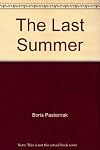
The Last Summer
by Boris Pasternak
On This Page
Description
The Last Summer is set in Russia during the winter of 1916, when the book’s central character, Serezha, pays a visit to his married sister. Tired after the long journey, he falls into a restless sleep and half-remembers, half-dreams the incidents of the last summer of peace before the First World War, "when life appeared to pay heed to individuals." As tutor in a wealthy, unsettled Moscow household, he focuses his intense romanticism on Mrs Arild, the employer’s paid companion, while show more spending his nights with the prostitute Sashka and others. In this evocation of Russia immediately prior to the Revolution, the characters are subtly etched against their social backgrounds, and Pasternak imbues the commonplace with his own intense and poetic vision. show lessTags
Recommendations





















Member Reviews
The Last Summer is only 90-odd pages long in my Penguin Modern Classics edition of 1960, but it’s more than a short story. Titled Povest (A Tale) when first published in 1934, it’s not listed among Boris Pasternak’s works in the Russian edition of Wikipedia, suggesting that perhaps the original was never published in the USSR as a separate title. (As far as I can tell, that is, using Google Translate’s word сказка meaning fairy tale, fable or story). Maybe Povest was published in a journal or a collection, and only published separately as a book when it was translated in 1959 by George Reavey and published by Peter Owen in the afterglow of Pasternak’s Nobel Prize in 1959.
The first thing to say about the introduction by show more Pasternak’s sister Lydia Slater is that it’s more about legacy-building than about clarifying the story. There are a great many superlatives, and she quotes V.S. Pritchett as saying it is a concerto in prose. She says its central theme is poetry, the essence of which is the suffering woman.
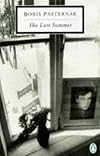
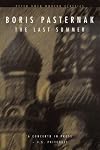
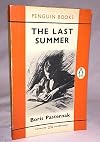
Well, maybe it is. She was at Oxford in 1960, which was the year of Pasternak’s death, though I do not know whether when the book went to print he had already died (of lung cancer, see the cigar in his hand in his father’s sketch on the book’s cover?) People who read Russian may well agree with her comparison of his work with Tolstoy’s. But those of us reading the book now, knowing all the weight of Soviet history and the constraints under which he wrote, and making do with the English translation, may beg to differ. Because to me, The Last Summer seems to be—thematically—more than about poetry.
Slater’s florid assertions to protect Pasternak’s status as a great poet may be because she would have been well aware of Soviet outrage about Doctor Zhivago and the CIA’s machinations to ensure that Pasternak got the Nobel Prize. She would have known that Pasternak’s wife and daughter were vulnerable to retaliation for Dr Zhivago reaching the west (see Wikipedia re their prompt despatch to the Gulags after his death). Even from the safety of Oxford, it would have been imprudent for Slater to point out any veiled anti-Soviet allusions in The Last Summer.
And they are there, though it takes close reading to find them, in a book difficult to comprehend because it is so clouded by reminiscences loosely interwoven, cutting into each other, brilliant descriptions of people, situations, thunderstorms, and thoughts. I started it three times before I took out my journal and began making copious notes and slowly got the drift of it. By the look of the two- and three-star reviews at Goodreads, most readers struggle with it too.
The Last Summer is bookended by Serezha’s return from Moscow to his sister Natasha’s house in Ousolie in 1916, a heavily polluted salt-mining place not even granted town status until 1925. This date is significant, because it’s (prudently) before the October Revolution in 1917, but after the failed one of 1905. Natasha is depicted as having believed in the aims of the 1905 revolution and as far as she is concerned the revolution has only been postponed. Here she is:
Natasha, in other words, has no idea what she is in for. (Pasternak, writing in 1934, had by this time, seen Lenin come and go, and had time to see the Soviet state in action. Russia was becoming industrialised, the consequent crisis of agricultural distribution had failed to be ameliorated by collectivisation, and he had witnessed the acquisition of private homes and subsequent overcrowding that he writes about so well in Doctor Zhivago).
To see the rest of my review please visit https://anzlitlovers.com/2018/11/07/the-last-summer-by-boris-pasternak-translate... show less
The first thing to say about the introduction by show more Pasternak’s sister Lydia Slater is that it’s more about legacy-building than about clarifying the story. There are a great many superlatives, and she quotes V.S. Pritchett as saying it is a concerto in prose. She says its central theme is poetry, the essence of which is the suffering woman.
Well, maybe it is. She was at Oxford in 1960, which was the year of Pasternak’s death, though I do not know whether when the book went to print he had already died (of lung cancer, see the cigar in his hand in his father’s sketch on the book’s cover?) People who read Russian may well agree with her comparison of his work with Tolstoy’s. But those of us reading the book now, knowing all the weight of Soviet history and the constraints under which he wrote, and making do with the English translation, may beg to differ. Because to me, The Last Summer seems to be—thematically—more than about poetry.
Slater’s florid assertions to protect Pasternak’s status as a great poet may be because she would have been well aware of Soviet outrage about Doctor Zhivago and the CIA’s machinations to ensure that Pasternak got the Nobel Prize. She would have known that Pasternak’s wife and daughter were vulnerable to retaliation for Dr Zhivago reaching the west (see Wikipedia re their prompt despatch to the Gulags after his death). Even from the safety of Oxford, it would have been imprudent for Slater to point out any veiled anti-Soviet allusions in The Last Summer.
And they are there, though it takes close reading to find them, in a book difficult to comprehend because it is so clouded by reminiscences loosely interwoven, cutting into each other, brilliant descriptions of people, situations, thunderstorms, and thoughts. I started it three times before I took out my journal and began making copious notes and slowly got the drift of it. By the look of the two- and three-star reviews at Goodreads, most readers struggle with it too.
The Last Summer is bookended by Serezha’s return from Moscow to his sister Natasha’s house in Ousolie in 1916, a heavily polluted salt-mining place not even granted town status until 1925. This date is significant, because it’s (prudently) before the October Revolution in 1917, but after the failed one of 1905. Natasha is depicted as having believed in the aims of the 1905 revolution and as far as she is concerned the revolution has only been postponed. Here she is:
Like all of them, Natasha believed that the most demanding cause of her youth had merely been postponed and that, when the hour struck, it would not pass her by. This belief explained all the faults of Natasha’s character. It explained her self-assurance, which was softened only by her complete ignorance of her defect. It also explained those traits of Natasha’s aimless righteousness and all-forgiving understanding, which inwardly illuminated her with an inexhaustible light and which yet did not correspond with anything in particular. (p.32)
Natasha, in other words, has no idea what she is in for. (Pasternak, writing in 1934, had by this time, seen Lenin come and go, and had time to see the Soviet state in action. Russia was becoming industrialised, the consequent crisis of agricultural distribution had failed to be ameliorated by collectivisation, and he had witnessed the acquisition of private homes and subsequent overcrowding that he writes about so well in Doctor Zhivago).
To see the rest of my review please visit https://anzlitlovers.com/2018/11/07/the-last-summer-by-boris-pasternak-translate... show less
A strange novella: beautiful in places, with dream-like qualities and hence the reader is often a little lost too.
Serezha visits his sister and family in 1916 Russia. He is very tired and dreams/reminisces about his recent past, particularly his time as tutor to a rich boy and the lady's companion who was also employed there.
The meandering nature of the book is echoed by significant references to water, swimming and floating, including "washed in public notoriety" (and oxymoron?), "women... had swum to the street surface, raised by chance and attraction from non-existence". and the fact that the story Serezha tries to write opens "Then it began to rain" because "such drafts inevitably abound in water as an element".
There are also some show more striking metaphors, such as "the streets on an empty stomach were impetuously straight and surly", "her self-assurance, which was softened only by her complete ignorance of her defect" and a prostitute's rug which "with a rare show ofobeisance invited him not to stand on ceremony"!
Overall, I liked parts of it, but wasn't won over by the whole. On the other hand, it's very short, so that was fine. show less
Serezha visits his sister and family in 1916 Russia. He is very tired and dreams/reminisces about his recent past, particularly his time as tutor to a rich boy and the lady's companion who was also employed there.
The meandering nature of the book is echoed by significant references to water, swimming and floating, including "washed in public notoriety" (and oxymoron?), "women... had swum to the street surface, raised by chance and attraction from non-existence". and the fact that the story Serezha tries to write opens "Then it began to rain" because "such drafts inevitably abound in water as an element".
There are also some show more striking metaphors, such as "the streets on an empty stomach were impetuously straight and surly", "her self-assurance, which was softened only by her complete ignorance of her defect" and a prostitute's rug which "with a rare show ofobeisance invited him not to stand on ceremony"!
Overall, I liked parts of it, but wasn't won over by the whole. On the other hand, it's very short, so that was fine. show less
Ratings
Members
- Recently Added By
Author Information

259+ Works 15,426 Members
Pasternak was acclaimed as a major poet some 30 years before Doctor Zhivago (1955) made him world famous. After first pursuing promising careers in music and philosophy, he started to write around 1909 and published his first collection of verse in 1914. His first genuine triumph came with the collection My Sister, Life (1917), in which a love show more affair stimulates a rapturous celebration of nature. The splendid imagery and difficult syntax of this volume are a hallmark of the early Pasternak. During the 1920s, Pasternak tried to accept the reality of the new society and moved from the lyric to the epic, taking up historical and contemporary subjects. The long poem The Year 1905 (1926) is an example. While tolerated by the literary establishment, Pasternak turned increasingly in the 1930s to translation rather than original verse. He was a prolific translator; his versions of major Shakespeare plays are the standard texts used in Soviet theaters. From the start, however, prose was an important focus for Pasternak. The most notable early work is the story "Zhenia's Childhood," written in 1918, which explored a girl's developing consciousness of her surroundings. There is also his artistic and intellectual autobiography Safe Conduct (1931). But Pasternak's greatest prose achievement came later with the novel Doctor Zhivago, written over a number of years and completed in 1955. Its hero, a physician and poet, confronts the great changes of the early twentieth century including world war, revolution, and civil war, and travels a path through life that creates a parallel between his fate and that of Christ. (The theme of preordained sacrifice is strengthened by the cycle of poems included as the last section of the book.) Doctor Zhivago was rejected for publication but appeared in 1957 in the West and won its author worldwide acclaim. A Nobel Prize followed in 1958. This led the Soviet authorities to launch a major public campaign against Pasternak and to make his personal life even more difficult. So successful were they that the poet officially turned down the award. After that, he was left in relative peace and died two years later. He was but the first of many writers in the post-Stalin period to challenge the Soviet state. During the 1970s and 1980s, Pasternak's heritage was cautiously brought into public purview in the Soviet Union. The Gorbachev period saw the removal of all restrictions on his work, and publication of Doctor Zhivago followed at long last. Several major editions of Pasternak's writings have appeared. (Bowker Author Biography) show less
Some Editions
Series
Belongs to Publisher Series
Common Knowledge
- Canonical title
- The Last Summer
- Original title
- Povest
- Alternate titles*
- Een verhaal
- Original publication date
- 1934 (Original Russian) (Original Russian)
- People/Characters*
- Serjozja
- Important places*
- Solikamsk, Rusland
- First words*
- Begin 1916 arriveerde Serjozja bij zijn zuster in Solikamsk.
- Last words*
- (Click to show. Warning: May contain spoilers.)Maar wat Serjozja niet bekende, was dat hij zich bij die nachtelijke ontmoeting had gegeneerd om naar de naam van die vrijwilliger te vragen.
*Some information comes from Common Knowledge in other languages. Click "Edit" for more information.
Classifications
- Genres
- General Fiction, Fiction and Literature
- DDC/MDS
- 891.7 — Literature & rhetoric Asian Literature East Indo-European and Celtic literatures Russian and East Slavic languages
- LCC
- PG3476 .P27 .P613 — Language and Literature Slavic languages and literatures. Baltic languages. Albanian language Slavic. Baltic. Albanian Russian literature Individual authors and works 1917-1960
- BISAC
Statistics
- Members
- 251
- Popularity
- 128,753
- Reviews
- 2
- Rating
- (3.32)
- Languages
- Dutch, English, Italian, Portuguese
- Media
- Paper
- ISBNs
- 8
- ASINs
- 13