The Raft
by Robert Trumbull
On This Page
Description
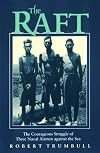
"The sinking of the plane was like a magician's trick. It was there and then it was gone, and there was nothing left in our big, wet, darkening world but the three of us and a piece of rubber that was not yet a raft." In 1942, three men on an antisubmarine patrol flight became lost and pitched into the Pacific. The plane sank beneath them, carrying most of the survival gear down with it. For thirty-four scorching days and shivering nights, they faced the ocean terrors on a four-by-eight-foot show more rubber raft. They had no water, food, compass, or paddles-only their will to survive. But by feats of super endurance, they made their way to the South Sea isle of Puka Puka, having meandered 1,200 miles. show lessTags
Recommendations






















Member Recommendations
Member Reviews
I just finished reading a French translation of Robert Trumbull’s book The Raft.
It recounts the miraculous survival of an American aviator crew, who, during the Pacific war, lose their bearings in the sky and fail to return to their aircraft. Running out of petrol, the pilot Harold Dixon successfully ditches their plane in the Pacific just before nightfall. As he and his crew, radioman Gene Aldrich and gunner Tony Pastula, are preparing their life raft and scramble to collect the emergency necessities they can lay their hands on, the plane suddenly sinks away under them, leaving the three men in the water in the middle of the ocean with nothing but a ridiculous small, half inflated raft.
The book I read is a cheap 1953 edition with a show more foreword by the famous Alain Bombard, the adventurer who crossed the Atlantic on an inflatable raft in 1952.
Bombard had willingly put himself in an emergency situation in order to proof several of his survival theories. He did cross the Ocean and survived without water or food rations for at least 53 days. While the general public embraced his sympathetic odyssey and his book “The voyage of the Hérétique” became an overnight bestseller, his crude theories, notably on drinking sea-water and his media exposure had turned the professional sea-people, the very people he wanted to reach, away from him.
It does not come as a surprise then, that he accepted to scribble a foreword for a book that was attempting to cash in on his own success. Bombard needed more real stories to confirm that what he had done was possible and that his conclusions could save people.
The story of the survival of the airplane crew was written ten year earlier, in 1942, during the War in the Pacific and is understandably heavily censored. There are practically no geographic or navigational details as to where the plane ditched and how the raft drifted during the 34 days at sea. The post-war French edition however mentions in a footnote that “it is now save to say that the wrecked crew landed on the Pukapuka atoll on the South seas, approximately 10 degrees south of the equator and 166 degrees west".
The writer Robert Trumbull was a young war correspondent covering the war in the Pacific. I suppose he interviewed the three men but he wrote the story solely from Harry Dixon’s (the officer) point of view. Without doubt commissioned by the Us Army, the 200 page story offered the troops an inspiring survival story with true heroics, a respect for military hierarchy and fear of God.
Struggling in the dark in the ocean, the three men succeed after half an hour of intense efforts to inflate, righten ( it opened upside-down ) and crawl into the tiny rubber boat of 1.2 by 2.4 m. With the plane sinking so fast, no food, water, navigational tools or anything that could have helped them, could be saved and embarked on board. The three men are virtually strangers of each other. The rotation of crews have put the forty year professional military sailor in the boat with two twenty year old boys.
Together, during 34 days they survive strong winds and heavy seas, they fight of sharks with their bare hands, they starve and are dehydrated, they are burned alive by the tropical sun, scorched by the salt and blinded by the piercing light.
Still they survive and are finally washed upon the shore of a tropical island. The story ends with a warship collecting the three men a few weeks later.
There is no reason to doubt the details described in the story and it is concern of how much these heroic men can take that keeps you reading about their ordeal.
Still, it is a pity that the story is censored. One can’t help wondering about the debriefing of the crew once they were back at their base. How did they lose their way ? Whose fault was it ? Did they discuss it in the raft ? Did they agree on a common story. Fact is that despite the loss of the plane, the three men were decorated and mentioned for their bravery.
The survival lessons from the ordeal were quick to be implemented.
The navigational issues, that is to say how to estimate your position with nothing but your senses was addressed already the next year with Harold Gatty’s groundbreaking work The Raft Book ( 1943 ), a collection of Polynesian techniques of non-instrument navigation. Gatty was an experienced Tasmanian mariner who had written down and used all kind’s of techniques still used by wayfarers in Polynesia. The Raft Book would turn out to be the kernel out of which the Polynesian cultural revival as masters of navigation would sprout.
I don’t know how fast improvements to the raft were made but inflatable rafts nowadays are fully equipped to avoid most of the issues described in The Raft : An inflatable canopy for protection against the weather elements, with an outside light for easy detection at night. There is a boarding ramp and grab handle for easy embarking, There are water and food canisters on board, flares, a knife, fishing kit, rain catching systems, first aid kit, signaling mirrors and even a torch.
Despite the book’s spare information, it remains an interesting read and a poignant story. It was recently retold in a motion picture under the apt title “Against The Sun”.
The truth however is that the three men survive by sheer luck. This is not to belittle their exploit, but without the regular shower of rain and the clemency of the weather they would not have made it. The fact that they are not ripped apart on the coral reef when finally reaching land and that they do so a few days before a cyclone batters the area where they drifted for so long time, are miracles on their own right.
The men's true heroism lies in their perseverance.
Maybe the sea is not that cruel after all… show less
It recounts the miraculous survival of an American aviator crew, who, during the Pacific war, lose their bearings in the sky and fail to return to their aircraft. Running out of petrol, the pilot Harold Dixon successfully ditches their plane in the Pacific just before nightfall. As he and his crew, radioman Gene Aldrich and gunner Tony Pastula, are preparing their life raft and scramble to collect the emergency necessities they can lay their hands on, the plane suddenly sinks away under them, leaving the three men in the water in the middle of the ocean with nothing but a ridiculous small, half inflated raft.
The book I read is a cheap 1953 edition with a show more foreword by the famous Alain Bombard, the adventurer who crossed the Atlantic on an inflatable raft in 1952.
Bombard had willingly put himself in an emergency situation in order to proof several of his survival theories. He did cross the Ocean and survived without water or food rations for at least 53 days. While the general public embraced his sympathetic odyssey and his book “The voyage of the Hérétique” became an overnight bestseller, his crude theories, notably on drinking sea-water and his media exposure had turned the professional sea-people, the very people he wanted to reach, away from him.
It does not come as a surprise then, that he accepted to scribble a foreword for a book that was attempting to cash in on his own success. Bombard needed more real stories to confirm that what he had done was possible and that his conclusions could save people.
The story of the survival of the airplane crew was written ten year earlier, in 1942, during the War in the Pacific and is understandably heavily censored. There are practically no geographic or navigational details as to where the plane ditched and how the raft drifted during the 34 days at sea. The post-war French edition however mentions in a footnote that “it is now save to say that the wrecked crew landed on the Pukapuka atoll on the South seas, approximately 10 degrees south of the equator and 166 degrees west".
The writer Robert Trumbull was a young war correspondent covering the war in the Pacific. I suppose he interviewed the three men but he wrote the story solely from Harry Dixon’s (the officer) point of view. Without doubt commissioned by the Us Army, the 200 page story offered the troops an inspiring survival story with true heroics, a respect for military hierarchy and fear of God.
Struggling in the dark in the ocean, the three men succeed after half an hour of intense efforts to inflate, righten ( it opened upside-down ) and crawl into the tiny rubber boat of 1.2 by 2.4 m. With the plane sinking so fast, no food, water, navigational tools or anything that could have helped them, could be saved and embarked on board. The three men are virtually strangers of each other. The rotation of crews have put the forty year professional military sailor in the boat with two twenty year old boys.
Together, during 34 days they survive strong winds and heavy seas, they fight of sharks with their bare hands, they starve and are dehydrated, they are burned alive by the tropical sun, scorched by the salt and blinded by the piercing light.
Still they survive and are finally washed upon the shore of a tropical island. The story ends with a warship collecting the three men a few weeks later.
There is no reason to doubt the details described in the story and it is concern of how much these heroic men can take that keeps you reading about their ordeal.
Still, it is a pity that the story is censored. One can’t help wondering about the debriefing of the crew once they were back at their base. How did they lose their way ? Whose fault was it ? Did they discuss it in the raft ? Did they agree on a common story. Fact is that despite the loss of the plane, the three men were decorated and mentioned for their bravery.
The survival lessons from the ordeal were quick to be implemented.
The navigational issues, that is to say how to estimate your position with nothing but your senses was addressed already the next year with Harold Gatty’s groundbreaking work The Raft Book ( 1943 ), a collection of Polynesian techniques of non-instrument navigation. Gatty was an experienced Tasmanian mariner who had written down and used all kind’s of techniques still used by wayfarers in Polynesia. The Raft Book would turn out to be the kernel out of which the Polynesian cultural revival as masters of navigation would sprout.
I don’t know how fast improvements to the raft were made but inflatable rafts nowadays are fully equipped to avoid most of the issues described in The Raft : An inflatable canopy for protection against the weather elements, with an outside light for easy detection at night. There is a boarding ramp and grab handle for easy embarking, There are water and food canisters on board, flares, a knife, fishing kit, rain catching systems, first aid kit, signaling mirrors and even a torch.
Despite the book’s spare information, it remains an interesting read and a poignant story. It was recently retold in a motion picture under the apt title “Against The Sun”.
The truth however is that the three men survive by sheer luck. This is not to belittle their exploit, but without the regular shower of rain and the clemency of the weather they would not have made it. The fact that they are not ripped apart on the coral reef when finally reaching land and that they do so a few days before a cyclone batters the area where they drifted for so long time, are miracles on their own right.
The men's true heroism lies in their perseverance.
Maybe the sea is not that cruel after all… show less
Reporter Robert Trumbull's book "The Raft" tells the story of Harold Dixon, Tony Pastula and George Aldrich. The trio's plane crashed in the ocean during World War II and they floated in a rubber raft for 35 days with a knife, rusting pistol and a couple of life jackets along side them. Their survival is nothing short of a miracle.
Told with sparse, short sentences, the book is not a literary masterpiece. However, the story is very readable and engrossing. There are loads of better written survival stories out there, but not as many that are quite as miraculous.
It is unfortunate that Trumbull's account relies only on an interview with Dixon for information. The book would be much more fascinating if it included interviews with Aldrich show more and Pastula as well. It's interesting that only Dixon was awarded the Navy Cross, while Aldrich and Pastula were simply commended by the Navy... it seems all three were in the same ordeal, not sure why one was treated differently than the others after the fact. show less
Told with sparse, short sentences, the book is not a literary masterpiece. However, the story is very readable and engrossing. There are loads of better written survival stories out there, but not as many that are quite as miraculous.
It is unfortunate that Trumbull's account relies only on an interview with Dixon for information. The book would be much more fascinating if it included interviews with Aldrich show more and Pastula as well. It's interesting that only Dixon was awarded the Navy Cross, while Aldrich and Pastula were simply commended by the Navy... it seems all three were in the same ordeal, not sure why one was treated differently than the others after the fact. show less
The perfect book to read while solidifying in subzero weather is The Raft by Robert Trumbull. And one look at the cover will suggest that another bite of that fat laden steak is well-worthwhile.
Trumbull retells the story of 3 aviators whose plane went down in the Pacific. They had a rubber raft and little else because the plane sank so quickly. They were adrift for 34 days and traveled over 1,000 miles. The raft was about four by eight feet. It was so small that no one could stretch out. "Imagine doubling up on a tiny mattress, with the strongest man you know striking the underside as hard as he could with a baseball bat, twice every three seconds, while someone else hurls buckets of cold salt water in your face." The raft also had a show more nasty tendency to overturn when waves got a little high, or the occupants moved incorrectly. Their clothes were often wet from spray. They were very hot during the day and cold at night. They had no food, and, after the several flips of the raft, only a penknife and themselves for company.
It's always amazing how resourceful people can be under trying circumstances. Harold Dixon, who had the most navigational experience, managed to calculate about where they were and where they needed to go, more or less, and then figured small ways to steer the craft to go in that particular direction.
Squalls were viewed as a mixed blessing. Rain was their only source of drinking water (which they gathered by wringing out their clothes. But squalls brought wind and waves which might turn them over.
Finally, after being tossed by the winds of a passing hurricane they sighted an island toward which they frantically paddled, The natives were astonished to see them for they managed to float through the surf of a coral reef that the natives considered impenetrable in their canoes. They were slowly nursed back to health and then eventually rescued. show less
Trumbull retells the story of 3 aviators whose plane went down in the Pacific. They had a rubber raft and little else because the plane sank so quickly. They were adrift for 34 days and traveled over 1,000 miles. The raft was about four by eight feet. It was so small that no one could stretch out. "Imagine doubling up on a tiny mattress, with the strongest man you know striking the underside as hard as he could with a baseball bat, twice every three seconds, while someone else hurls buckets of cold salt water in your face." The raft also had a show more nasty tendency to overturn when waves got a little high, or the occupants moved incorrectly. Their clothes were often wet from spray. They were very hot during the day and cold at night. They had no food, and, after the several flips of the raft, only a penknife and themselves for company.
It's always amazing how resourceful people can be under trying circumstances. Harold Dixon, who had the most navigational experience, managed to calculate about where they were and where they needed to go, more or less, and then figured small ways to steer the craft to go in that particular direction.
Squalls were viewed as a mixed blessing. Rain was their only source of drinking water (which they gathered by wringing out their clothes. But squalls brought wind and waves which might turn them over.
Finally, after being tossed by the winds of a passing hurricane they sighted an island toward which they frantically paddled, The natives were astonished to see them for they managed to float through the surf of a coral reef that the natives considered impenetrable in their canoes. They were slowly nursed back to health and then eventually rescued. show less
The Raft, by Robert Trumbull (pp 128), first Printed in 1942. This is the story of three naval aviators that crash landed in the Pacific during a reconnaissance patrol. They spent 34 days with little food and even less water drifting until they landed on an isolated small island and were nursed back to health by native families living there. Exact locations were withheld because of wartime considerations. Not great writing, but might be of interest to those who enjoy survival stories. This story was made into the movie Against The Sun, in 2014.
A gripping account of three naval airmen adrift in the Pacific for 34 days. During World war 2 January 16, 1942, US Navy airmen pilot Harold Dixon , bombardier Tony Pastula and radioman Gene Aldrich, flying a Douglas TBD Devastator torpedo bomber from the aircraft carrier USS Enterprise, encounter problems on a patrol mission over the South Pacific. Separated from other aircraft on the mission and unable to get their bearings, Dixon makes a decision to head back to the carrier.
Radioman Aldrich announces they are out of range of reception. Running low in fuel and unsure of their exact location, Dixon orders his crew to prepare for the ditching and to assemble their survival gear. After making a successful ditching, the survivors find show more themselves on a tiny life raft, surrounded by open ocean. Even seeing a dive bomber from their carrier searching for them, they realize that the search is too far away from their position, and the rescue effort will soon move away from them. Dixon describes their predicament as "lost at sea", the naval term for giving up the search.
Encounter with bad weather which was good at some point for them, sharks and storms , and waves. They been through alot but finally reached ashore but life of them changes Dixon never fly another mission, pastula due to medical issues he can't continue as Navy and Gene become radiomen. show less
Radioman Aldrich announces they are out of range of reception. Running low in fuel and unsure of their exact location, Dixon orders his crew to prepare for the ditching and to assemble their survival gear. After making a successful ditching, the survivors find show more themselves on a tiny life raft, surrounded by open ocean. Even seeing a dive bomber from their carrier searching for them, they realize that the search is too far away from their position, and the rescue effort will soon move away from them. Dixon describes their predicament as "lost at sea", the naval term for giving up the search.
Encounter with bad weather which was good at some point for them, sharks and storms , and waves. They been through alot but finally reached ashore but life of them changes Dixon never fly another mission, pastula due to medical issues he can't continue as Navy and Gene become radiomen. show less
Interesting read about one of the great survival stories of all time. This book gives a great insight into the culture of the 1940s as well as the details of how these men survived. Interestingly, only the officer was interviewed for the book. The thoughts and ideas of the enlisted men are not needed to tell the tale.
A very interesting book of survival and hardship. Not set in battle but their suggestions led to many changes in lifeboat regulations.
Members
- Recently Added By
Author Information
16+ Works 313 Members
Some Editions
Awards and Honors
Distinctions
Series
Belongs to Publisher Series
Dell War Book (26)
Common Knowledge
- Alternate titles
- The Raft: The Courageous Struggle of Three Naval Airmen Against the Sea; 34 Days on a Life Raft; The Raft: A True Adventure
- Original publication date
- 1942
- People/Characters
- Tony Pastula; Gene Aldrich; Harold Dixon
- Important places
- Pacific Ocean; Pukapuka Atoll
- Important events
- World War II
- First words
- The plane struck the surface of the seawith a sound like the slap of a giant hand on the water.
The plane struck the surface of the sea with sound like the slap of a giant hand on the water.
The plane struck the surface of the sea with a sound like the slap of a giant hand on the water. A great splash of water instantly covered the glass in front of me, momentarily shutting out my vision. Two sharp bumps, and the... (show all) plane settled quietly back on the long, slow swells. I had made a good landing. - Last words
- (Click to show. Warning: May contain spoilers.)We drove her off.
(Click to show. Warning: May contain spoilers.)Oh, yes - on the way home we were attacked by a Jap submarine. We drove her off. - Disambiguation notice
- 34 dagen op een reddingsvlot is the Dutch translation of 34 Days on a Life Raft, or simply The Raft
Classifications
Statistics
- Members
- 257
- Popularity
- 126,801
- Reviews
- 8
- Rating
- (3.67)
- Languages
- English, French
- Media
- Paper, Audiobook, Ebook
- ISBNs
- 19
- ASINs
- 22