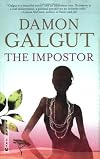
The Impostor
by Damon Galgut
On This Page
Description
Damon Galgut is one of South Africa's most exciting new literary voices. In The Impostor, his first novel since The Good Doctor, Galgut leads his readers into the developing heart of postapartheid South Africa, a landscape being reshaped by new waves of money and power. Adam Napier leaves Johannesburg looking for a fresh start. Jobless and directionless, but with a head full of literary ambitions, he moves into his brother's dilapidated house on the edge of a backwater town. One day he show more encounters Canning, a man who claims Adam saved his life in their school days, but whom Adam does not remember at all. But he plays along and, for a time, enjoys all that Canning has: a vast fortune and game preserve inherited from his father, and a beautiful, mysterious younger wife to whom Adam is compulsively, dangerously drawn. A spellbinding achievement from one of the defining members of a new generation of African writers, The Impostor evokes a glittering world in which the moneyed old guard, newly empowered black Africans, and shady foreign businessmen jockey for a piece of the new South African dream. show lessTags
Recommendations
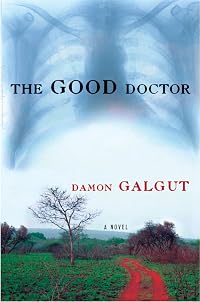
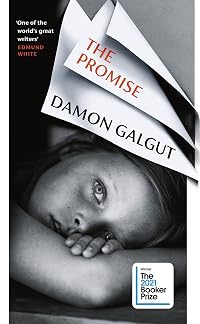











Member Recommendations
Member Reviews
I’ve read four or five of his novels and although I haven’t been impressed by all of them, he is undeniably talented. Galgut is a master of dread and of creating an unsettling atmosphere; this novel is no exception but I found the book more like a slow-paced thriller than anything else. The story, ultimately, is a story about losing one’s moral center and attempting to regain it—the theme applies not only to the protagonist but to his relationships and even, on a far broader scale, to the recent history of South Africa itself. His writing, as always, is top-notch but the plot struck me as overly complex and unnecessary. Galgut has shown in previous works that he can do extraordinary things with the simplest of events; that he show more has so overloaded the framework here is both disappointing and, ultimately, unconvincing. show less
Damon Galgut is my new discovery. I've been reading two of his books in a row and liked them a lot. I like his style of writing, which is clean, and pure; no unnecessary adjectives or metaphors, no wannabe poetry, just a straightforward story that has plenty of deepness just by itself.
The impostor has a thrillerlike tension which kept me quite hooked. (I won't disclose too much of the story though, for this reason) Yet, despite some elements that remind of a thriller, this definitely isn't one. It is very much a story of the new South Africa, of the way people survive in a fast changing environment. The book poses questions about morality in such an environment. How to keep up with politically correct liberalminded standards if the show more easy way is to just let go and choose the most profitable way for yourself?
The main character of this book, Adam Napier seems a rather sympathetic guy, who has just lost his job and his home and now wants to write poetry. But after a while I realized that this was not a very sympathetic person at all. And worse, that I could have been him, had I been born elsewhere. It is easy to have high moral standards when you are not challenged by life. It really made me think. show less
The impostor has a thrillerlike tension which kept me quite hooked. (I won't disclose too much of the story though, for this reason) Yet, despite some elements that remind of a thriller, this definitely isn't one. It is very much a story of the new South Africa, of the way people survive in a fast changing environment. The book poses questions about morality in such an environment. How to keep up with politically correct liberalminded standards if the show more easy way is to just let go and choose the most profitable way for yourself?
The main character of this book, Adam Napier seems a rather sympathetic guy, who has just lost his job and his home and now wants to write poetry. But after a while I realized that this was not a very sympathetic person at all. And worse, that I could have been him, had I been born elsewhere. It is easy to have high moral standards when you are not challenged by life. It really made me think. show less
Damon Galgut is becoming one of my favourite authors.
In this novel, set in post-Apartheid South Africa, Adam Napier has lost his job to an affirmative action-type policy, and retreated to a dilapidated cottage to write poetry. There, he meets his neighbour who has also been displaced by the new political landscape, but for very different reasons. He also meets a childhood classmate, who is overjoyed to see his "best friend Adam". Adam, however, doesn't remember Canning at all, though he pretends to.
And thus we have the main characters in this story of loyalty and betrayal. Mr. Galgut, through is characters, is able to show how large events, such as political change, are at the same time, very personal events with consequences not only show more for society, not only for great leaders, but for ordinary people.
This book is well written and well structured. Whenever you think you've understood the significance of the title, the author brings you to an even deeper understanding.
I loved it. show less
In this novel, set in post-Apartheid South Africa, Adam Napier has lost his job to an affirmative action-type policy, and retreated to a dilapidated cottage to write poetry. There, he meets his neighbour who has also been displaced by the new political landscape, but for very different reasons. He also meets a childhood classmate, who is overjoyed to see his "best friend Adam". Adam, however, doesn't remember Canning at all, though he pretends to.
And thus we have the main characters in this story of loyalty and betrayal. Mr. Galgut, through is characters, is able to show how large events, such as political change, are at the same time, very personal events with consequences not only show more for society, not only for great leaders, but for ordinary people.
This book is well written and well structured. Whenever you think you've understood the significance of the title, the author brings you to an even deeper understanding.
I loved it. show less
It is a miracle to me that this novel hasn't become a major bestseller as it has all the elements necessary: interesting characters, intriguing storyline, a well-hidden plot and beautiful prose. In addition it poses questions about the lack of truthfulness in our lives: how often are we untrue to others, society and ourselves? And is it an unavoidable part without which life becomes unbearable?
It's odd how many people see this as a thriller when, although to be sure it is unputdownable and one could say it is thrilling, it is anything but a thriller. For a start there is no hero, not even an anti-hero. Instead the main character is a weak, immoral, selfish man who plays at being poor for a while and hasn't a brave bone in his body. This is not to say one is unsympathetic to him, far from it. But he is never anything other than pathetic and the same goes for his next door neighbour and the Cannings. For another thing, nothing happens in the story: nothing that one could equate to the circumstances one expects in a thriller.
Rest here:
http://alittleteaalittlechat.wordpress.com/2014/07/27/the-impostor-by-damon-galg...
Rest here:
http://alittleteaalittlechat.wordpress.com/2014/07/27/the-impostor-by-damon-galg...
Adam Napier's life has unravelled. He has lost his job and home in Johannesburg and, lacking the financial and visceral resources to mount an immediate rebound, moves into the empty house that his successful brother Gavin had purchased a number of years earlier with the intention of turning it into a country retreat, but had never got around to doing anything with it. The house, in the South African Karoo (semi-desert region), is located on the edge of a dusty and economically depressed town. Adam wants to use his time to write poetry, which he had done a great deal of in his youth, even publishing a book. But despite his noble intentions he is easily distracted, and when he encounters Kenneth Canning, a shadowy figure from his private show more school days, he leaps into the relationship and abandons all pretence of even trying to write. Canning has inherited a huge property from his deceased father, and Adam is drawn into a routine of weekend visits, meeting Canning's mysterious wife Baby and members of Canning's inner circle. What follows is a story of political intrigue and personal betrayal, as Adam and Canning are both forced to accept realities that are hard to swallow. Though not quite up to the standard he set for himself in his riveting Booker Prize nominated novel The Good Doctor, Damon Galgut's tightly written 2008 follow-up The Imposter is both suspenseful and eloquent, building to a searing climax. show less
A depressed poet retires to his brother's cottage in the South African countryside to write but instead gets involved with a wealthy developer, an old school chum he fails to remember. The book's narrative starts out deceptively light (in fact, I was somewhat mystified by all the rave reviews at first), but deepens as our protagonist finds him sinking deeper into a moral quagmire. There's a lot here - about the individual, about South Africa, about race, history, lies, corruption, truth and honesty (and more!).
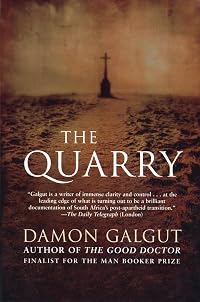
I have read the author's [The Quarry] and [The Good Doctor], and this book seemed somewhat a departure from those, although it has been a number of years and I can't quite put my finger on why I think that.
I have read the author's [The Quarry] and [The Good Doctor], and this book seemed somewhat a departure from those, although it has been a number of years and I can't quite put my finger on why I think that.
Members
- Recently Added By
Author Information

13+ Works 3,852 Members
Awards and Honors
Common Knowledge
- Canonical title
- The Impostor
- Original publication date
- 2008
- People/Characters
- Adam Napier; Kenneth Canning; Baby
- Important places
- South Africa
- First words
- The journey was almost over; they were nearly at their destination.
- Last words
- (Click to show. Warning: May contain spoilers.)Then he started to rush on, through the shadow cast by a statue, rusting and discoloured and streaked with bird-shit, of some forgotten hero.
- Blurbers
- McCann, Colum
Classifications
Statistics
- Members
- 234
- Popularity
- 138,708
- Reviews
- 14
- Rating
- (3.58)
- Languages
- 8 — Dutch, English, French, German, Portuguese, Spanish, Swedish, Turkish
- Media
- Paper, Audiobook, Ebook
- ISBNs
- 30
- ASINs
- 9