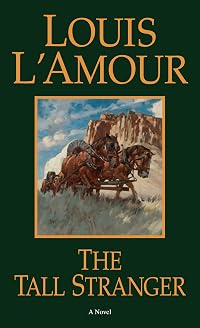
The Tall Stranger
by Louis L'Amour
On This Page
Description
Fiction. Western. Thriller. Historical Fiction. HTML:Wagon trains heading west were forced to defend themselves against Indians, cope with injuries and illness, and struggle to find food. The group of easterners Rock Bannon was scouting for faced another problem. They were being deceived. When he warned them to remain on the Humboldt Trail, Sharon Crockett and the others refused to listen. Mort Harper, a stranger riding a beautiful black mare, had dazzled them with his charm and good looks. show more The southern route was the best way to go, Harper told them. But best for whom? Bannon wondered. That route led straight to the Salt Lake Desert. The conditions would be brutal. And if Harper wasn’t steering them toward those deadly alkali flats, where were they headed? And what would happen once they got there? show lessTags
Recommendations










Member Reviews
This book, like most L'amour books, falls into the "junk food for the mind" category. It's quick, tasty and fun but has no nutritional value. And like most junk food, I love it! There's nothing like escaping into a simple story of love, hate and heroism. The good guys are good, the bad guys are bad and everyone in between runs for the hills (literally, in this case).
My only problem is the last few sentences. I don't know if they were meant to be funny or serious, but either way they don't fit the character's personality, even if he doesn't know how to talk to women.
My only problem is the last few sentences. I don't know if they were meant to be funny or serious, but either way they don't fit the character's personality, even if he doesn't know how to talk to women.
Settlers heading west listen to a slick sales pitch, and soon find themselves in a land grab war. Standard L'Amour tale, worth a read but far from his best work.
This is a rip roaring L'Amour story. Rock Bannon is rescued by the people in a wagon train moving west. To show his gratitude, he rides along with them to assist then safely to their destination. When a shyster convinces them to take a new trail despite Bannon's warnings, things fall apart. Even though he love's a young woman in the traveling party, Bannon moves on because he is no longer welcome. The righteous members of the wagon train resent him after they learn he has killed a man in a fair fight in another town. The rest of the story revolves around the settlers discovering that the shyster is their enemy and not the taciturn Bannon and how he saves them from themselves/ Vintage L'Amour.
Author Readalike (Novelist) L'Amour considered himself a storyteller in the tradition of Chaucer and the troubadours, and although he didn't wander from place to place, his stories did, across western landscapes and around the world. Critics complained of his cardboard characters, stilted dialog, and rough prose, but L'Amour refused to revise his works, saying that they fit in the oral tradition, meant to be read aloud and enjoyed for the story, not dissected and analyzed for their style.
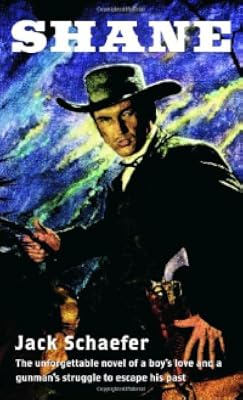
Although L'Amour's characters may be stereotypes, they are not without appeal. His heroes, natural men in the James Fenimore Cooper tradition, are strong, sometimes silent men, fighting for justice and bringing civilization to a savage land. Unlike the show more paladin hero of Jack Schaefer's Shane, who brings justice and moves on, L'Amour's heroes know they need to stay and teach, to settle down and pass on traditions. While his men are often dreamers, looking for that place where men could be whatever they are man enough to be, his women are more matter-of-fact. History doesn't allow them the independence of men, but they do, as the first Sackett dreamed, walk beside their men, not behind, and their fierce independence, skill, and ingenuity often save the day. show less
Although L'Amour's characters may be stereotypes, they are not without appeal. His heroes, natural men in the James Fenimore Cooper tradition, are strong, sometimes silent men, fighting for justice and bringing civilization to a savage land. Unlike the show more paladin hero of Jack Schaefer's Shane, who brings justice and moves on, L'Amour's heroes know they need to stay and teach, to settle down and pass on traditions. While his men are often dreamers, looking for that place where men could be whatever they are man enough to be, his women are more matter-of-fact. History doesn't allow them the independence of men, but they do, as the first Sackett dreamed, walk beside their men, not behind, and their fierce independence, skill, and ingenuity often save the day. show less
Don’t ever say I don’t venture out from my comfort zone in my reading. I finished my first real Western (unless Lonesome Dove counts). And it’s a Louis L’Amour, the John Wayne of Western writers. I knew where this book was going from page one. No doubt about it…it’s a guy book, through and through. Fellow (Mercy! His name is ROCK Banyon…please!) joins up with a wagon train headed west. The man who’s guiding the wagon train is Mort Harper. Harper has persuaded the train to take a southern route, a route that Rock Banyon knows will lead straight to the Salt Lake Desert. Harper and Banyon both fall for the same girl and they squabble back and forth until they reach a tranquil valley owned by a rancher Banyon knows won’t show more take kindly to having strangers move in. Banyon can’t quite figure out what Harper’s scheme is, but he lurks around on the fringes as the wagon train decides to appropriate some of the rancher’s land. There’s some gun fights, some fist fights, a saloon, beautiful farm land, and a pretty girl. You feel pretty confident early on that the good guy’s gonna win out. And, apparently, that’s a Western. show less
Passable but bland. The plot includes a few quirks of [il]logic, while the narrator offhandedly and disparagingly refers to one of the story's villain's as a squinty-eyed 'half-breed'.
Members
- Recently Added By
Author Information

871+ Works 100,119 Members
Born in Jamestown, North Dakota on March 22, 1908, Louis L'Amour's adventurous life could have been the subject of one of his novels. Striking out on his own in 1923, at age 15, L'Amour began a peripatetic existence, taking whatever jobs were available, from skinning dead cattle to being a sailor. L'Amour knew early in life that he wanted to be a show more writer, and the experiences of those years serve as background for some of his later fiction. During the 1930s he published short stories and poetry; his career was interrupted by army service in World War II. After the war, L'Amour began writing for western pulp magazines and wrote several books in the Hopalong Cassidy series using the pseudonym Tex Burns. His first novel, Westward the Tide (1950), serves as an example of L'Amour's frontier fiction, for it is an action-packed adventure story containing the themes and motifs that he uses throughout his career. His fascination with history and his belief in the inevitability of manifest destiny are clear. Also present and typical of L'Amour's work are the strong, capable, beautiful heroine who is immediately attracted to the equally capable hero; a clear moral split between good and evil; reflections on the Native Americans, whose land and ways of life are being disrupted; and a happy ending. Although his work is somewhat less violent than that of other western writers, L'Amour's novels all contain their fair share of action, usually in the form of gunfights or fistfights. L'Amour's major contribution to the western genre is his attempt to create, in 40 or more books, the stories of three families whose histories intertwine as the generations advance across the American frontier. The novels of the Irish Chantry, English Sackett, and French Talon families are L'Amour's most ambitious project, and sadly were left unfinished at his death. Although L'Amour did not complete all of the novels, enough of the series exists to demonstrate his vision. L'Amour's strongest attribute is his ability to tell a compelling story; readers do not mind if the story is similar to one they have read before, for in the telling, L'Amour adds enough small twists of plot and detail to make it worth the reader's while. L'Amour fans also enjoy the bits of information he includes about everything from wilderness survival skills to finding the right person to marry. These lessons give readers the sense that they are getting their money's worth, that there is more to a L'Amour novel than sheer escapism. With over 200 million copies of his books in print worldwide, L'Amour must be counted as one of the most influential writers of westerns in this century. He died from lung cancer on June 10, 1988. (Bowker Author Biography) Louis L'Amour, truly America's favorite storyteller, was the first fiction writer ever to receive the Congressional Gold Medal from the United States Congress in honor of his life's work, & was also awarded the Medal of Freedom. There are over 260 million copies of his books in print worldwide. (Publisher Provided) show less
Common Knowledge
- Canonical title
- The Tall Stranger
- Original publication date
- 1957
- People/Characters
- Rock Bannon; Morton Harper; Sharon Crockett; Tom Crockett; Hardy Bishop; Dud Kitchen (show all 8); Pete Zapata; Mary Pagones
- Epigraph
- [None]
- Dedication
- [None]
- First words
- With slow, ponderously rhythmical steps the oxen moved, each step a pause and an effort, each movement a deadening drag.
- Last words
- (Click to show. Warning: May contain spoilers.)Things were being altogether too quiet. He wasn't used to it.
Classifications
Statistics
- Members
- 696
- Popularity
- 41,268
- Reviews
- 11
- Rating
- (3.65)
- Languages
- Czech, English, French
- Media
- Paper, Audiobook, Ebook
- ISBNs
- 18
- ASINs
- 18