On This Page
Description
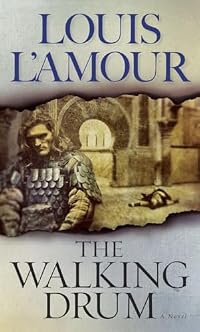
Louis L'Amour has been best known for his ability to capture the spirit and drama of the authentic American West. Now he guides his readers to an even more distant frontier—the enthralling lands of the twelfth century.Warrior, lover, and scholar, Kerbouchard is a daring seeker of knowledge and fortune bound on a journey of enormous challenge, danger, and revenge. Across Europe, over the Russian steppes, and through the Byzantine wonders of Constantinople, Kerbouchard is thrust into the show more treacheries, passions, violence, and dazzling wonders of a magnificent time.
From castle to slave galley, from sword-racked battlefields to a princess's secret chamber, and ultimately, to the impregnable fortress of the Valley of Assassins, The Walking Drum is a powerful adventure in an ancient world that you will find every bit as riveting as Louis L'Amour's stories of the American West. show less
Tags
Recommendations








Member Reviews
What an absolutely fabulous historical fiction read. I read this book many years ago, in my late teens, but had forgotten much about it, and I am so glad I revisited it. It is full of adventures and interesting characters, quests and battles, friends and foes, but it is also full of fascinating bits of knowledge and philosophy. Mathurin Kerbouchard, our point of view character, is not a perfect man--he is driven by revenge and passion--but he is an interesting character, and his unceasing quest for knowledge really resonated with me. The insatiable desire to learn and explore the world that he exhibits is something that I really relate to. I highly recommend this book to anyone who enjoys epic historical fiction or adventure tales.
Fave show more Line: “My ignorance was enormous. Beside it my knowledge was nothing. My hunger for learning, not so much to improve my lot as to understand my world, had led me to study and to thought. Reading without thinking is as nothing, for a book is less important for what it says than for what it makes you think.” show less
Fave show more Line: “My ignorance was enormous. Beside it my knowledge was nothing. My hunger for learning, not so much to improve my lot as to understand my world, had led me to study and to thought. Reading without thinking is as nothing, for a book is less important for what it says than for what it makes you think.” show less
Mathurin Kerbouchard, son of a famous corsair, is thrust into manhood when his father's enemies kill his mother and burn his home. Kerbouchard sets out on a quest to find his father, who is rumored to be dead or enslaved, and to avenge his mother's murder. As a galley slave, student, merchant, and soldier, Kerbouchard travels across 12th century Europe learning all he can soak up with his Druid-trained memory. Always on the lookout for his father, a beautiful woman, or a good fight, he explores Moorish Spain, Christian Europe, and the Byzantine Empire on his mission of revenge and his quest for knowledge.
A fascinating story, beautifully and suspensefully written, it bursts with swashbuckling adventure, but Louis L'Amour captures little show more kernels of truth, poetry, and some fantastic one-liners as well. The author researched the period, the history, and the thinkers of a vast number of places and brought them to life through the eyes of his hero who describes his wanderings in rich (and accurate) historic detail. Lamenting the Western/Euro-centric focus of history in schools, L'Amour presents the importance of the Muslim world to the development of culture, philosophy and knowledge. Unfortunately L'Amour died before finishing the proposed trilogy about Kerbouchard's travels in India and China, but this novel stands alone as a fascinating introduction to an oft-neglected aspect of medieval Europe and civilization.
Brilliant. A definite keeper. show less
A fascinating story, beautifully and suspensefully written, it bursts with swashbuckling adventure, but Louis L'Amour captures little show more kernels of truth, poetry, and some fantastic one-liners as well. The author researched the period, the history, and the thinkers of a vast number of places and brought them to life through the eyes of his hero who describes his wanderings in rich (and accurate) historic detail. Lamenting the Western/Euro-centric focus of history in schools, L'Amour presents the importance of the Muslim world to the development of culture, philosophy and knowledge. Unfortunately L'Amour died before finishing the proposed trilogy about Kerbouchard's travels in India and China, but this novel stands alone as a fascinating introduction to an oft-neglected aspect of medieval Europe and civilization.
Brilliant. A definite keeper. show less
Although (or maybe because) I grew up in the western U.S., I have never been a great fan of L'Amour. So when my grandfather gave me this book, I was a little skeptical, even though he and I usually have similar tastes. But as I started to read it, I found that I really enjoyed it. The setting was 12th century Europe/Central Asia rather than 19th century America, and the characters were engaging. I couldn't wait to see what the the protagonist, Mathurin Kerbouchard, did next.
That said, some of the scholarship was a tad wonky. You could tell that Mr. L'Amour had done research, but he'd done it out of books that are now considered hopelessly outdated. And Mathurin comes off as a bit unbelievable.... He travels from one end of the known show more world to the other, he defeats all challengers, romances all ladies, is a born leader, natural scholar, brilliant orator, etc, etc... after a while you start hoping he'll fail at something, just to see if he can.
Still, I like the book quite a lot, and every so often I get the urge to re-read it, which is a good sign. Recommended for armchair historians, L'Amour fans, and people who like engaging narratives about super-humans. ^_~ show less
That said, some of the scholarship was a tad wonky. You could tell that Mr. L'Amour had done research, but he'd done it out of books that are now considered hopelessly outdated. And Mathurin comes off as a bit unbelievable.... He travels from one end of the known show more world to the other, he defeats all challengers, romances all ladies, is a born leader, natural scholar, brilliant orator, etc, etc... after a while you start hoping he'll fail at something, just to see if he can.
Still, I like the book quite a lot, and every so often I get the urge to re-read it, which is a good sign. Recommended for armchair historians, L'Amour fans, and people who like engaging narratives about super-humans. ^_~ show less
Adventure across Medieval Europe that really doesn’t go anywhere. There are some overarching plot threads but they really don’t matter and when they are addressed it feels anticlimactic.
Basically the book repeats the pattern of hero goes to new city, becomes established, reads classic works, makes enemies, meets a ye olde chick, has to escape the city, rinse and repeat for 500 pages. There’s a lot of action but it all feels repetitive and nothing really occurs with impact.
On the positive side there is some interesting detail about the time period and there are historical figures throughout. Also this book is packed with one liner sayings and phrases which was entertaining.
Overall a monotonous adventure in an interesting period show more with clever lines. show less
Basically the book repeats the pattern of hero goes to new city, becomes established, reads classic works, makes enemies, meets a ye olde chick, has to escape the city, rinse and repeat for 500 pages. There’s a lot of action but it all feels repetitive and nothing really occurs with impact.
On the positive side there is some interesting detail about the time period and there are historical figures throughout. Also this book is packed with one liner sayings and phrases which was entertaining.
Overall a monotonous adventure in an interesting period show more with clever lines. show less
Not a Western, but L’Amour knocks it out of the park.
The walking drum in the title is a drum used to set the pace for caravans traveling Europe and Asia in the 12th century. The main character escapes murder at the hands of a family rival when word comes to their region that his father has been killed. Vowing to avenge his mother’s death and find his father, if he lives, Maturin travels southern Europe to fulfill his vows.
The descriptions of lands he travels are good, but the clear winner is characters. In addition to Maturin, L’Amour beings to life the allies, enemies, and women who share his journey.
The walking drum in the title is a drum used to set the pace for caravans traveling Europe and Asia in the 12th century. The main character escapes murder at the hands of a family rival when word comes to their region that his father has been killed. Vowing to avenge his mother’s death and find his father, if he lives, Maturin travels southern Europe to fulfill his vows.
The descriptions of lands he travels are good, but the clear winner is characters. In addition to Maturin, L’Amour beings to life the allies, enemies, and women who share his journey.
As a Louis L'Amour fan and medieval history buff, this novel disappointed me. I love reading his westerns, and his mysteries are just as good. Going into them, I know they're going to be formulaic, cliched, with predictable characters. But they're a great escape from my academic reading.
It's obvious he did a lot of research and reading for the novel, and he clearly must've visited most of the locations where the story takes place. However, many of the facts in the book are based on outdated scholarship, even during the time he wrote it. I don't blame him for not being able to keep abreast of new developments in Crusade and medieval history. Many current college textbooks have the same problem.
The protagonist is simply too great for one show more human being. Not only is he a matchless warrior and a scholar, everybody can't help but be impressed by him–especially the ladies. His athletic ability, skill with weapons, ease of learning languages, good looks, and yes, Druid-trained photographic memory, allow him to go from rags to riches–several times. In situation after situation, he somehow loses everything, only to slowly rise up again to hobnob with the rich and powerful.
One of the most annoying aspects of this book is the constant, often pretentious, name-dropping of ancient and medieval writers. He describes several well-known and less popular works, but many times, he does no more than list their titles. The only saving grace of this novel is L'Amour's masterful storytelling ability. For all its flaws, it was still a fun read. show less
It's obvious he did a lot of research and reading for the novel, and he clearly must've visited most of the locations where the story takes place. However, many of the facts in the book are based on outdated scholarship, even during the time he wrote it. I don't blame him for not being able to keep abreast of new developments in Crusade and medieval history. Many current college textbooks have the same problem.
The protagonist is simply too great for one show more human being. Not only is he a matchless warrior and a scholar, everybody can't help but be impressed by him–especially the ladies. His athletic ability, skill with weapons, ease of learning languages, good looks, and yes, Druid-trained photographic memory, allow him to go from rags to riches–several times. In situation after situation, he somehow loses everything, only to slowly rise up again to hobnob with the rich and powerful.
One of the most annoying aspects of this book is the constant, often pretentious, name-dropping of ancient and medieval writers. He describes several well-known and less popular works, but many times, he does no more than list their titles. The only saving grace of this novel is L'Amour's masterful storytelling ability. For all its flaws, it was still a fun read. show less
Members
- Recently Added By
Lists

Best Historical Fiction
620 works; 257 members

Overdue Podcast
803 works; 9 members
Author Information

870+ Works 99,425 Members
Born in Jamestown, North Dakota on March 22, 1908, Louis L'Amour's adventurous life could have been the subject of one of his novels. Striking out on his own in 1923, at age 15, L'Amour began a peripatetic existence, taking whatever jobs were available, from skinning dead cattle to being a sailor. L'Amour knew early in life that he wanted to be a show more writer, and the experiences of those years serve as background for some of his later fiction. During the 1930s he published short stories and poetry; his career was interrupted by army service in World War II. After the war, L'Amour began writing for western pulp magazines and wrote several books in the Hopalong Cassidy series using the pseudonym Tex Burns. His first novel, Westward the Tide (1950), serves as an example of L'Amour's frontier fiction, for it is an action-packed adventure story containing the themes and motifs that he uses throughout his career. His fascination with history and his belief in the inevitability of manifest destiny are clear. Also present and typical of L'Amour's work are the strong, capable, beautiful heroine who is immediately attracted to the equally capable hero; a clear moral split between good and evil; reflections on the Native Americans, whose land and ways of life are being disrupted; and a happy ending. Although his work is somewhat less violent than that of other western writers, L'Amour's novels all contain their fair share of action, usually in the form of gunfights or fistfights. L'Amour's major contribution to the western genre is his attempt to create, in 40 or more books, the stories of three families whose histories intertwine as the generations advance across the American frontier. The novels of the Irish Chantry, English Sackett, and French Talon families are L'Amour's most ambitious project, and sadly were left unfinished at his death. Although L'Amour did not complete all of the novels, enough of the series exists to demonstrate his vision. L'Amour's strongest attribute is his ability to tell a compelling story; readers do not mind if the story is similar to one they have read before, for in the telling, L'Amour adds enough small twists of plot and detail to make it worth the reader's while. L'Amour fans also enjoy the bits of information he includes about everything from wilderness survival skills to finding the right person to marry. These lessons give readers the sense that they are getting their money's worth, that there is more to a L'Amour novel than sheer escapism. With over 200 million copies of his books in print worldwide, L'Amour must be counted as one of the most influential writers of westerns in this century. He died from lung cancer on June 10, 1988. (Bowker Author Biography) Louis L'Amour, truly America's favorite storyteller, was the first fiction writer ever to receive the Congressional Gold Medal from the United States Congress in honor of his life's work, & was also awarded the Medal of Freedom. There are over 260 million copies of his books in print worldwide. (Publisher Provided) show less
Awards and Honors
Distinctions
Series

Common Knowledge
- Canonical title
- The Walking Drum
- Original title
- The Walking Drum
- Original publication date
- 1984
- People/Characters
- Mathurin Kerbouchard (Talon); Kerbouchard; Abu-Yusuf Ya'kub; Andronicus (Comnenus); Manuel I (Comnenus); Tournemine (show all 9); Khatib; Mahmoud; Sofia
- Important places
- Spain; Constantinople, Byzantine Empire; Brittany, France; Medieval Europe; Paris, France; Southwest Asia (show all 8); Russian steppes; Russian Steppes
- Epigraph
- [None]
- Dedication
- To Lou and Emily Wolfe
- First words
- Nothing moved but the wind and only a few last, lingering drops of rain, only blowin of water off the ruined wall.
Nothing moved but the wind and only a few last, lingering drops of rain, only a blowing of water off the ruined wall. - Last words
- (Click to show. Warning: May contain spoilers.)"Sundari," I whispered, "Sundari, I come! I come..."
Classifications
- Genres
- Fiction and Literature, General Fiction, Historical Fiction
- DDC/MDS
- 813.52 — Literature & rhetoric American literature in English American fiction in English 1900-1999 1900-1945
- LCC
- PS3523 .A446 .W27 — Language and Literature American literature American literature Individual authors 1900-1960
- BISAC
Statistics
- Members
- 1,571
- Popularity
- 14,418
- Reviews
- 28
- Rating
- (4.05)
- Languages
- English, Finnish, Russian, Swedish
- Media
- Paper, Audiobook, Ebook
- ISBNs
- 30
- ASINs
- 18