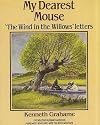
My Dearest Mouse: The Wind in the Willows Letters
by Kenneth Grahame
On This Page
Description
Kenneth Grahame's classic book began as a series of letters written in 1907 to his seven year-old son Alastair, who was known as 'Mouse'. The original letters are reproduced in their entirety.Tags
Recommendations


















Member Reviews
This book contains facsimiles of the complete set of letters Kenneth Grahame wrote to his absent son in the summer of 1907. These are the seed from which his book The Wind in the Willows grew. It’s said to have been published in association with Oxford’s Bodleian Library, so perhaps it accompanied an exhibition there. The book also contains illustrations from various artists that appeared in successive editions of the book, most notably Ernest Shepard and Arthur Rackham.
The introduction, by playwright David Gooderson, serves as a welcome counterpoint to the idealized portrayal of father and son painted by Elspeth Grahame in First Whisper of ‘The Wind in the Willows. The marriage, apparently, was a strain on two very different show more personalities, the only child spoiled and given to violence, a trait ultimately turned inward when he threw himself under a train as an undergraduate. It seems that young Alistair had more than a little of Toad of Toad Hall in him, and the tales his father spun may have been meant in part as admonitory.
Perhaps not for the son alone; one of the sparing but enlightening annotations to the letters suggests the story of Toad’s adventures, leading to enforced restraint imposed by his friends, can also be read as “the cry of a repressed hedonist, who in his fantasy allows his instincts to run wild, only to demonstrate, as much to himself as to others, how vital it is that reckless self-expression be reined in.”
These revelations and speculations do not diminish my appreciation of Wind in the Willows at all. On the contrary, it’s a reminder that all good literature, whether aimed at adults or children, helps us grapple with the contradictory drives we find within ourselves and imagine outcomes that following one path or another might bring.
I also enjoyed learning that Grahame was a meticulous prose stylist who spoke of “the pleasurable agony of attempting stately sentences” and who believed in writing for the ear. Good advice, whether your intended audience is a child or an adult. This care finds its visual correlate in the careful penmanship of the letters (although, to my eye, the script is too careful and lacking in personality). show less
The introduction, by playwright David Gooderson, serves as a welcome counterpoint to the idealized portrayal of father and son painted by Elspeth Grahame in First Whisper of ‘The Wind in the Willows. The marriage, apparently, was a strain on two very different show more personalities, the only child spoiled and given to violence, a trait ultimately turned inward when he threw himself under a train as an undergraduate. It seems that young Alistair had more than a little of Toad of Toad Hall in him, and the tales his father spun may have been meant in part as admonitory.
Perhaps not for the son alone; one of the sparing but enlightening annotations to the letters suggests the story of Toad’s adventures, leading to enforced restraint imposed by his friends, can also be read as “the cry of a repressed hedonist, who in his fantasy allows his instincts to run wild, only to demonstrate, as much to himself as to others, how vital it is that reckless self-expression be reined in.”
These revelations and speculations do not diminish my appreciation of Wind in the Willows at all. On the contrary, it’s a reminder that all good literature, whether aimed at adults or children, helps us grapple with the contradictory drives we find within ourselves and imagine outcomes that following one path or another might bring.
I also enjoyed learning that Grahame was a meticulous prose stylist who spoke of “the pleasurable agony of attempting stately sentences” and who believed in writing for the ear. Good advice, whether your intended audience is a child or an adult. This care finds its visual correlate in the careful penmanship of the letters (although, to my eye, the script is too careful and lacking in personality). show less
An excellent source for the background to Grahame's classic work. Letters from Grahame to his children when he was away. Shows the beginning of many of the story threads that eventually were woven together into "The Wind in the Willows"
Ratings
Members
- Recently Added By
Author Information

319+ Works 36,540 Members
Kenneth Grahame was born in Edinburgh on March 3, 1859. When he was five years old, his mother died of scarlet fever and he nearly died himself, of the same disease. His father became an alcoholic and sent the children to Berkshire to live with relatives. They were later reunited with their father, but after a failed year, the children never heard show more from him again. Sometime later, one of his brothers died at the age of fifteen. He attended St. Edward's School as a child and intended to go on to Oxford University, but his relatives wanted him to go into banking. He worked in his uncle's office, in Westminster, for two years then went to work at the Bank of England as a clerk in 1879. He spent nearly thirty years there and became the Secretary of the Bank at the age of thirty-nine. He retired from the bank right before The Wind in the Willows was published in 1908. He wrote essays on topics that included smoking, walking and idleness. Many of the essays were published as the book Pagan Papers (1893) and the five orphan characters featured in the papers were developed into the books The Golden Age (1895) and Dream Days (1898). The Wind in the Willows (1908) was based on bedtime stories and letters to his son and it is where the characters Rat, Badger, Mole and Toad were created. In 1930, Milne's stage version was brought to another audience in Toad of Toad Hall. Grahame died on July 6, 1932. (Bowker Author Biography) show less
All Editions
Some Editions
Classifications
Statistics
- Members
- 32
- Popularity
- 877,975
- Reviews
- 2
- Rating
- (4.17)
- Languages
- English
- Media
- Paper
- ISBNs
- 1
- ASINs
- 1