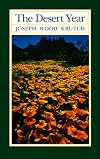
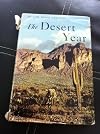
The Desert Year
by Joseph Wood Krutch
On This Page
Description
Now back in print, Joseph Wood Krutch's Burroughs Award-winning The Desert Year is as beautiful as it is philosophically profound. Although Krutch-often called the Cactus Walden-came to the desert relatively late in his life, his curiosity and delight in his surroundings abound throughout The Desert Year, whether he is marveling at the majesty of the endless dry sea, at flowers carpeting the desert floor, or at the unexpected appearance of an army of frogs after a heavy rain. Krutch's show more trenchant observations about life prospering in the hostile environm show lessTags
Recommendations
















Member Reviews
There are passages in this book that make it worthwhile to read, in particular, the amateur naturalist's observations about the desert and humans. It has the feeling of a book that Edward Abbey might have written if he had been writing in 1951.
But it is also infused with a distracting and naive pantheism and anthropomorphism from an earlier time. It could also stand editing to remove some of the more random unrelated thoughts. I had higher expectations.
I recommend that you read it and mark the best passages with Book Darts. Don't worry about the other parts. The book is short.
But it is also infused with a distracting and naive pantheism and anthropomorphism from an earlier time. It could also stand editing to remove some of the more random unrelated thoughts. I had higher expectations.
I recommend that you read it and mark the best passages with Book Darts. Don't worry about the other parts. The book is short.
This is a memoir of sorts, of a year spent living in the desert of the southwestern United States of America. It holds lots of introspection, inspiration, philosophy and quiet reflections, less so of the description of the actual desert; although some of that is included as well.
I approve and enjoyed the line drawings at the beginning of each chapter. In a book about the deserts of the southwest, not one drawing is a snake, nor are they mentioned much in the book. I wonder if the author has the same aversion to them as I do?
In speaking of "finding God" in nature, he says, "...what I am after is less to meet God face to face than really to take in a beetle, a frog or a mountain when I meet one." He speaks of the uncaring essence of show more "Nature" towards the individual compared to the species. Using a single drowning bat vs. the hoards of bats found in Carlsbad Caverns as an illustration. "Nature" would not save the single bat, nor care much whether it survived, whereas it does its best to ensure survival of the species "bat." He then says this is what separates humanity from "Nature." Humanity cares for the individual (he saved the bat), sometimes to the detriment of the species. I don't know, but it's interesting to think about as are many of his other postulations on Life, the Universe and Everything.
Some of the mystical thinking was a bit opaque for me, but I enjoyed listening to him as he reasoned things out, whether I agreed with him or not. show less
I approve and enjoyed the line drawings at the beginning of each chapter. In a book about the deserts of the southwest, not one drawing is a snake, nor are they mentioned much in the book. I wonder if the author has the same aversion to them as I do?
In speaking of "finding God" in nature, he says, "...what I am after is less to meet God face to face than really to take in a beetle, a frog or a mountain when I meet one." He speaks of the uncaring essence of show more "Nature" towards the individual compared to the species. Using a single drowning bat vs. the hoards of bats found in Carlsbad Caverns as an illustration. "Nature" would not save the single bat, nor care much whether it survived, whereas it does its best to ensure survival of the species "bat." He then says this is what separates humanity from "Nature." Humanity cares for the individual (he saved the bat), sometimes to the detriment of the species. I don't know, but it's interesting to think about as are many of his other postulations on Life, the Universe and Everything.
Some of the mystical thinking was a bit opaque for me, but I enjoyed listening to him as he reasoned things out, whether I agreed with him or not. show less
Essays about the desert illustrate the meaning a Pantheist derives from nature.
Ratings
Members
- Recently Added By
Author Information

44+ Works 1,263 Members
Joseph Wood Krutch demonstrated that the Renaissance man was not someone merely to read about. Born in Knoxville, Tennessee, he studied science and received his B.A. from the University of Tennessee. Afraid that society's emphasis on science and technology was a threat to our wilderness and wildlife, he went on to study humanities. After receiving show more his M.A. and Ph.D. degrees from Columbia University, he remained there to teach as a member of the English department and later occupied an endowed chair of dramatic literature. He was also an editor and a drama critic. When Krutch retired in 1952 because of respiratory problems, he moved to the southern Arizona desert, where, inspired by the natural beauty of the desert and its wildlife, he began to write about nature and conservation. Although his biographical work includes books on Edgar Allan Poe, Samuel Johnson, and Henry David Thoreau, here we will be concerned with some of his writings in natural history. (Bowker Author Biography) show less
All Editions
Awards and Honors
Awards
Distinctions
Notable Lists
Common Knowledge
- Original publication date
- 1951
- Important places
- Sonoran Desert; American Southwest
Classifications
Statistics
- Members
- 136
- Popularity
- 241,851
- Reviews
- 3
- Rating
- (4.12)
- Languages
- English
- Media
- Paper, Ebook
- ISBNs
- 7
- ASINs
- 6