On This Page
Description
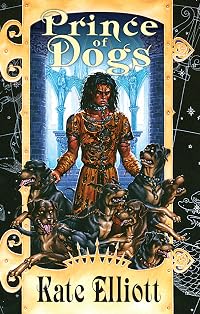
Prince of Dogs returns listeners to the war-torn kingdoms of Wendar and Varre, and the intertwined destinies of Alain, raised in humble surroundings but now the Count's heir; Liath, who struggles to unravel the secrets of her past while evading the traps set for her by those seeking the treasure she hides; Sanglant, believed dead by those who could save him, but actually a prisoner in the city of Gent; and Fifth Son, who now builds an army to do his father's bidding-or his own!Tags
Recommendations


Member Reviews
In the sequel to King's Dragon, the primary trio of characters tries to come to grips with their new roles. Alain adjusts to life as a newly legitimized lord, Liath attempts to escape the unchecked abuse of her former owner, and Sanglant tries to retain his sanity while imprisoned by an inhuman enemy. Meanwhile, a full company of clerics, scholars, novices, and orphans witness the complications of war, kinship, and inheritance.
I'm impressed by the entrenched consistency of Prince of Dog's medieval milieu. Minus the obvious (and intentional) aspect of gender equality in the novel, Prince of Dogs avoids the common problems of Technicolor serfs and Andrew Lang princesses. Everything is very dirty and very unfair. The novel is not an show more epic-fantasy spray-paint job, particularly in regards to rigid social castes and how they were read as a divine signal of competence and righteousness.
The plot of Prince of Dogs knits more tightly together than the previous story: Liath and Alain actually meet each other. My favorite character is still Count Lavastine, who is a vulnerable brute. And I can't wait to see the horrors of Alain and Tallia coming together. Prince of Dogs ends with Alain misty-eyed about their upcoming nuptials, but he has no inkling about the strength of Tallia's religious convictions. (It's not clear how Tallia will react to the betrothal: she was approving of Alain in King's Dragon but she had definite non-Alain plans for her future. I predict agony and death.) show less
I'm impressed by the entrenched consistency of Prince of Dog's medieval milieu. Minus the obvious (and intentional) aspect of gender equality in the novel, Prince of Dogs avoids the common problems of Technicolor serfs and Andrew Lang princesses. Everything is very dirty and very unfair. The novel is not an show more epic-fantasy spray-paint job, particularly in regards to rigid social castes and how they were read as a divine signal of competence and righteousness.
The plot of Prince of Dogs knits more tightly together than the previous story: Liath and Alain actually meet each other. My favorite character is still Count Lavastine, who is a vulnerable brute. And I can't wait to see the horrors of Alain and Tallia coming together. Prince of Dogs ends with Alain misty-eyed about their upcoming nuptials, but he has no inkling about the strength of Tallia's religious convictions. (It's not clear how Tallia will react to the betrothal: she was approving of Alain in King's Dragon but she had definite non-Alain plans for her future. I predict agony and death.) show less
Can't remember what exactly inspired me to start a re-read of this series but I'm not sorry I did. It's a fantastic medieval European fantasy series (truly a great depiction of a medieval Europe -inspired setting) that feels so real; from the most desperate of war refugees to the daimones of the Upper Spheres to the working economy... Do yourself a favor and read this series if you haven't already.
Book Two shows rebellion brewing in the kingdom but relief has come for Liath (mostly, Hugh is a sneaky bastard). Now it's Sanglant who is trapped with no one knowing he is a prisoner. By the way, Liath's vow re Sanglant is a perfect illustration of Elliott's theme of consequences. There is no choice made by a character that won't have show more ramifications that must be dealt with. Whether that is 10 pages, 10 chapters or 10 years later consequences catch up to everyone.
We see that very clearly for Alain, as well. His pure heart and inability to escape his own sincerity links him in a very immediate way to their Eika enemy but also, it's hinted, to humanity more broadly. But he is very much seen as a pawn by the Lady of Battles and possibly some powerful folks in the kingdom who don't necessarily honor his innate compassion. show less
Book Two shows rebellion brewing in the kingdom but relief has come for Liath (mostly, Hugh is a sneaky bastard). Now it's Sanglant who is trapped with no one knowing he is a prisoner. By the way, Liath's vow re Sanglant is a perfect illustration of Elliott's theme of consequences. There is no choice made by a character that won't have show more ramifications that must be dealt with. Whether that is 10 pages, 10 chapters or 10 years later consequences catch up to everyone.
We see that very clearly for Alain, as well. His pure heart and inability to escape his own sincerity links him in a very immediate way to their Eika enemy but also, it's hinted, to humanity more broadly. But he is very much seen as a pawn by the Lady of Battles and possibly some powerful folks in the kingdom who don't necessarily honor his innate compassion. show less
Sanglant, King Henry's bastard son and the former Captain of his guards, the King's Dragons, is now the prisoner of Bloodheart, of 'the rock people, the Eika' -- is chained in the Cathedral of fallen Gent. Henry believe him dead and is being pressured to choose his heir. Alain is stepping up to his 'new' father's expectations, Liath has joined the Eagles, the king's messengers and, for now, is free of Hugh, but he is always lurking in the background. The challenge here for Elliott was to portray Sanglant's suffering and gradual identification with the 'Eika' dogs that he masters. It's so well done and one of the things that drew me back to rereading. Sanglant's mother laid a geas on him that he could not be killed by anything 'earthly' show more -- so even after receiving death wounds, he lives and suffers.
Another reread -- I just loved this series the first time around and I think I'm approaching that 'time of life' when I'd rather reread something I enjoyed than spend time on things iffy. I still try new things, but I never used to have such a strong longing to revisit.
CoS--the whole series--is terrifically complex, parallel worlds and dimensions, suspicion, intolerance, ambition, it's all there and more plus very appealing characters, from Alain a young man of mysterious birth who turns out to probably be the son of the local count to Liathano, a beautiful young woman, also of mysterious birth, whose father was a sorcerer and who falls prey to the ambitions of a frater (priest in this world), a vulnerable king who has to decide between three legitimate children or his bastard son as his heir--and the bastard son himself, Sanglant, yet a third of mysterious birth, at least, as far as who his mother was, and the king prefers his bastard son who is a great warrior. In this culture men and women have different but important, crucial roles to play, different sources of power, but some things don't change, like lust (not just for sex either, but power). On to book 3! **** show less
Another reread -- I just loved this series the first time around and I think I'm approaching that 'time of life' when I'd rather reread something I enjoyed than spend time on things iffy. I still try new things, but I never used to have such a strong longing to revisit.
CoS--the whole series--is terrifically complex, parallel worlds and dimensions, suspicion, intolerance, ambition, it's all there and more plus very appealing characters, from Alain a young man of mysterious birth who turns out to probably be the son of the local count to Liathano, a beautiful young woman, also of mysterious birth, whose father was a sorcerer and who falls prey to the ambitions of a frater (priest in this world), a vulnerable king who has to decide between three legitimate children or his bastard son as his heir--and the bastard son himself, Sanglant, yet a third of mysterious birth, at least, as far as who his mother was, and the king prefers his bastard son who is a great warrior. In this culture men and women have different but important, crucial roles to play, different sources of power, but some things don't change, like lust (not just for sex either, but power). On to book 3! **** show less
I'm sorry for giving a low rating to a well-written series like this. But I grew frustrated with it and after book 2 I decided not to continue.
Make no mistake, this series is very good in some senses. It is well-written, and Kate Elliott is a master worldbuilder. She bases her books on medieval Europe, which is a trick used by many fantasy writers to help them in their worldbuilding, but she uses that technique very well, making her secondary world strange and magical enough that this never feels like a historical novel. It's a complex and intriguing world, that always invited me to find out more about it.
The characters are also good. Not perhaps the best feature (that would be the worldbuilding) but interesting and perfectly show more serviceable.
So if the writing, the worldbuilding and the characters are good, then what's the problem? The problem is the storytelling. Mostly, the pacing. This series includes 7 very fat novels, and the payoff after reading one of these massive doorstoppers often feels slight. The plot advances at a slow pace, things do happen, but it does not feel like the overall plot moves much.
After two books I took a break, and when it was time to return to the series I found the prospect daunting. Since reading is supposed to be a pleasure, not to feel like a duty, I decided to let it go. It did not help that I couldn't find anywhere on the internet or at the start of the books themselves a good recap of the previous books so that I might refresh my memory before starting book three.
All in all, there are many worse things to read, but there are better things too. You can give it a try, you may well find that immersing yourself in this complex, fascinating world is a real pleasure for you, and that you do not mind the pacing. But it did not work completely for me. I'm always sorrowful when I don't complete an attractive story, but it was just too many pages, too many fat novels, for too little real advance of the story. show less
Make no mistake, this series is very good in some senses. It is well-written, and Kate Elliott is a master worldbuilder. She bases her books on medieval Europe, which is a trick used by many fantasy writers to help them in their worldbuilding, but she uses that technique very well, making her secondary world strange and magical enough that this never feels like a historical novel. It's a complex and intriguing world, that always invited me to find out more about it.
The characters are also good. Not perhaps the best feature (that would be the worldbuilding) but interesting and perfectly show more serviceable.
So if the writing, the worldbuilding and the characters are good, then what's the problem? The problem is the storytelling. Mostly, the pacing. This series includes 7 very fat novels, and the payoff after reading one of these massive doorstoppers often feels slight. The plot advances at a slow pace, things do happen, but it does not feel like the overall plot moves much.
After two books I took a break, and when it was time to return to the series I found the prospect daunting. Since reading is supposed to be a pleasure, not to feel like a duty, I decided to let it go. It did not help that I couldn't find anywhere on the internet or at the start of the books themselves a good recap of the previous books so that I might refresh my memory before starting book three.
All in all, there are many worse things to read, but there are better things too. You can give it a try, you may well find that immersing yourself in this complex, fascinating world is a real pleasure for you, and that you do not mind the pacing. But it did not work completely for me. I'm always sorrowful when I don't complete an attractive story, but it was just too many pages, too many fat novels, for too little real advance of the story. show less
Picking up where King's Dragon left off, with Prince Sanglant held captive, King Henry gathering allies to retake Gent, and Liath and Alain caught in their own internal struggles, Prince of Dogs immerses one in the turbulent kingdoms of Wendar and Varre. A very enjoyable series, so far and one I look forward to continuing, even if Hugh keeps turning up!
This book isn't bad, but it certainly is bland. As fresh and interesting as the world is, Elliott relies on the same old fantasy tropes that have been making the literary rounds for years now.
Reluctant hero who believes in "justice" and regrets his rise to power? Check.
Mysterious heroine with a power she never knew she had? Check.
Ham-fisted political "intrigue" that boils down to "evil relative wants to take over the country"? Double check.
These things aren't bad - just boring. That's the best description for this book. It's very, very boring. I can only read Alain lamenting his good fortune for so long until I get the old "wheel of time" syndrome. Reluctant heroes aren't interesting. Fantasy needs to move past them and evolve.
Reluctant hero who believes in "justice" and regrets his rise to power? Check.
Mysterious heroine with a power she never knew she had? Check.
Ham-fisted political "intrigue" that boils down to "evil relative wants to take over the country"? Double check.
These things aren't bad - just boring. That's the best description for this book. It's very, very boring. I can only read Alain lamenting his good fortune for so long until I get the old "wheel of time" syndrome. Reluctant heroes aren't interesting. Fantasy needs to move past them and evolve.
While I find the "religion" in this book to be a far to near copy of Catholicism and therefore uninspired the story and the lead characters are so likable that I can't help but keep reading (and late into the night, as well.) This second book was a great follow up to the King's Dragon. I find Hugh to be one of the creepiest most horrid antagonists I've ever read. My whole body chills when he enters the page. I love the use of dogs both with Alain and Sanglant, the nice contrast between the two packs. The Eika prince played a larger role and I found his culture to be very interesting and him to be very likable. I am looking forward to seeing how he weaves in and out of Alain's story. It is an engaging book and I am still hooked on the show more series. show less
Members
- Recently Added By
Lists

Epic Fantasy of the 90s
111 works; 4 members
Author Information

80+ Works 19,194 Members
Some Editions
Series

Belongs to Publisher Series
DAW Book Collectors (1078)
Work Relationships
Is contained in
Common Knowledge
- Canonical title
- Prince of Dogs
- Original publication date
- 1998
- People/Characters
- Sanglant; Liath; Bloodheart; Alain; Fifth Brother; King Henry (show all 8); Frater Hugh; Hathui
- Important places
- Gent
- Dedication
- To Jay
- First words
- All spring they managed to stay alive by hiding in the abandoned tannery quarter, coming out only at night to scrounge for food.
- Last words
- (Click to show. Warning: May contain spoilers.)But she couldn't speak to tell him.
- Blurbers
- Kerr, Katharine
- Disambiguation notice
- The German translation of this work was split into two books. Please do not combine either of these into the main work:
03: Auf den Flügeln des Sturms
04: Die Kathedrale der Hoffnung
Classifications
Statistics
- Members
- 1,357
- Popularity
- 17,708
- Reviews
- 20
- Rating
- (3.87)
- Languages
- English, French, German, Spanish
- Media
- Paper, Audiobook, Ebook
- ISBNs
- 14
- ASINs
- 9