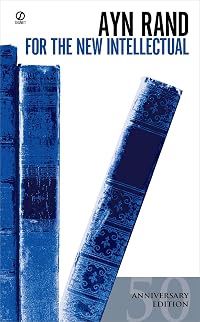
For the New Intellectual: The Philosophy of Ayn Rand
by Ayn Rand 
On This Page
Description
One of the most controversial figures on the intellectual scene, Ayn Rand was the proponent of a moral philosophy of rational self-interest that stands in sharp opposition to the ethics of altruism and self-sacrifice. Her unique philosophy, objectivism, has gained a worldwide following. The fundamentals of this morality are here vibrantly set forth by this spokesman for a new class of intellectual. For the New Intellectual is Ayn Rand's challenge to the prevalent philosophical doctrines of show more our time and the "atmosphere of guilt, of panic, of despair, of boredom, and of all-pervasive evasion" that they create. show lessTags
Recommendations









Member Reviews
The first 25 pages of this completely enthralled me. Rand's no-nonsense style deftly conveys a philosophy that seems both wise and clever. Her summarization of modern history places the center of an hourglass around the founding of America by the first "thinkers who were men of action." Current intellectuals have failed to keep pace with the advancements made by the producers in our modern world of the past 250 years. Humans are distinct from other animals because of our ability to conceptualize and we have a need to do so in order to survive in our world. The short history of the man includes an Attila class and a Witch Doctor class who eventually became obsolete with the advent of the business producer and the intellectual. As man show more learned to understand nature and science he also learned to use it, leading to rapid economic advancement. The Attila conquered without understanding the "somehow" of production. The Witch Doctor controls the Attila through the fear implied by alleged supernatural knowledge. "The first society in history whose leaders were neither Attials nor Witch Doctors, a society led, dominated, and created by the Producers, was the United States of America. The moral code implicit in its political principles was not the Witch Doctor's code of self-sacrifice. The political principles embodied in the Constitution were not Attila's blank check on brute force, but men's protection against any future Attila's ambition. The Founding Fathers were neither passive, death-worshipping mystics nor mindless, power-seeking looters; as a political group, they were a phenomenon unprecedented in history; they were thinkers who were also men of action. They had rejected the soul-body dichotomy, with its two corollaries; the impotence of man's mind and the damnation of this earth; thye had rejected the doctrine of suffering as man's metaphysical fate, tey proclaimed man's right to the pursuit of happiness and were determined to establish on earth the conditions required for man's proper existence, by the 'unaided' pwer of their intellect. A society based on and geared to the conceptual level of man's consciousness, a society dominated by a philosophy of reason, has no places for the rule of fear and guilt. Reason requires freedom, self-confidence, and self-esteem. It requires the right to think and to act on the guidance of one's thinking -- the right to live by one's own independent judgement. Intellectual freedom cannot exist without political freedom; political freedom cannot exist without economic freedom; a fee mind and a free market are corollaries." My only reservation involved Rand's apparent view on religion. show less
Absolutely did not agree with much of the content, but this is a great assessment of the author's opinions in her own words from an array of selections. Wordy (as is her style) and disagreeable (as is my opinion), but otherwise effective in portraying her point of view.
I rather sympathize (if not really agree with) a LibraryThing reviewer who gave this a half star and complained this was a cut and paste job. That is true of three-quarters of this book, which consists of excerpts from Rand's novels. Thus my relatively low rating. Her novels certainly should be read before For the New Intellectual--and if you're not taken by her novels, I do find it hard to believe you're going to like this book. There is an introductory essay though, "For the New Intellectual" you won't find in those novels, and I found the concept of the place in history of "Attila and the Witch Doctor" interesting. And I did find value in having the more philosophically oriented sections of the novels--the ones she chose as most show more important--in one slim volume. show less
For the New Intellectual is Ayn Rand's is Non-fiction book.. AYN RAND challenged the prevalent philosophical doctrines of our time and the "atmosphere of guilt, of panic, of despair, of boredom, and of all-pervasive evasion" which they created. One of the most controversial figures on the intellectual scene, Ayn Rand was the proponent of a new moral philosophy -- an ethic of rational self-interest -- that stands in sharp opposition to the ethics of altruism and self-sacrifice.
more @ http://toogood2read.blogspot.com/2006/08/for-new-intellectual-by-ayn-rand.html
more @ http://toogood2read.blogspot.com/2006/08/for-new-intellectual-by-ayn-rand.html
a new-comer to the works of ayn rand, I enjoyed having these snippets of her larger works partially because I get the gist of all her philosophies and because it's easier to swallow in small portions when one isn't used to heavy content.
Short and sweet, it has exactly what you need if you want an introduction to her work and a subtle look at objectivism.
For more: http://www.aynrand.org
Short and sweet, it has exactly what you need if you want an introduction to her work and a subtle look at objectivism.
For more: http://www.aynrand.org
The main philosophic passages from Ayn Rand's novels, targeted at "those who wish to assume the responsibility of becoming the new intellectuals."
Members
- Recently Added By
Author Information

181+ Works 76,829 Members
Ayn Rand, 1905 - 1982 Novelist and philosopher Ayn Rand was born Alice Rosenbaum on February 2, 1905 in St. Petersburg, Russia. She graduated with highest honors in history from the University of Petrograd in 1924, and she came to the United States in 1926 with dreams of becoming a screenwriter. In 1929, she married actor Charles "Frank" O'Connor. show more After arriving in Hollywood, Rand was spotted by Cecil B. DeMille standing at the gate of his studio and gave her a job as an extra in King of Kings. She also worked as a script reader and a wardrobe girl and, in 1932, she sold Red Pawn to Universal Studios. In the 1950's, she returned to New York City where she hosted a Saturday night group she called "the collective." It was also during this time that Rand received a fan letter from a young man, Nathaniel Branden. She was impressed with his letter, and she wrote him back. Her correspondence with him eventually led to an affair that lasted over a decade. He became her chief spokesperson and codified the principles of her novels into a strict philosophical system (objectivism) and founded an institute bearing his name. Their affair ended in 1968 when Branden got involved with another one of Rand's disciples. According to Rand, people are inherently selfish and act only out of personal interest making a selfish act, a rational one. It is from this belief that her characters play out their lives. Rand's first novel was "We the Living" (1936) and was followed by "Anthem" (1938), "The Fountainhead" (1943), and "Atlas Shrugged" (1957). All four of her novels made the top ten of the controversial list of the 100 Best Novels of the 20th Century. On March 6, 1982, Ayn Rand died in her New York City apartment. (Bowker Author Biography) show less
Ayn Rand has a Legacy Library. Legacy libraries are the personal libraries of famous readers, entered by LibraryThing members from the Legacy Libraries group.
Work Relationships
Common Knowledge
- Original publication date
- 1961
- First words
- (Preface): This book is intended for those who wish to assume the responsibility of becoming the new intellectuals.
When a man, a business corporation, or an entire society is approaching bankruptcy, there are two courses that those involved can follow: they can evade the reality of their situation and act on a frantic, blind, range-of-the... (show all)-moment expediency -- not daring to look ahead, wishing no one would name the truth, yet desperately hoping that something will save them somehow -- or they identify the situation, check their premises, discover their hidden assets and start rebuilding. - Last words
- (Click to show. Warning: May contain spoilers.)"I swear -- by my life and my love of it -- that I will never live for the sake of another man, nor ask another man to live for mine.
- Canonical DDC/MDS
- 814.52
- Canonical LCC
- PS3535.A547
Classifications
Statistics
- Members
- 1,451
- Popularity
- 16,262
- Reviews
- 9
- Rating
- (3.65)
- Languages
- 5 — Chinese, English, German, Spanish, Turkish
- Media
- Paper, Audiobook, Ebook
- ISBNs
- 29
- UPCs
- 1
- ASINs
- 23