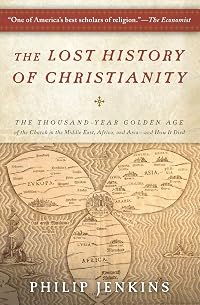
The Lost History of Christianity: The Thousand-Year Golden Age of the Church in the Middle East, Africa, and Asia--and How It Died
by Philip Jenkins
On This Page
Description
A lost history revealing that, for centuries, Christianity's center was actually in the Middle East, Asia, and Africa, with significant communities extending as far as China.Tags
Recommendations




Member Reviews
Where was Christianity a dominant religion in 700 or 1100 CE? You would certainly look to Western Europe, and by 1100, even Eastern Europe. Maybe you’d think of the Byzantine Empire. Perhaps you even know there were Christians in Egypt, Nubia, and Ethiopia.
But what about the large number of Christians in the Middle East, all the way to China and India?
In The Lost History of Christianity: The Thousand-Year Golden Age of the Church in the Middle East, Africa, and Asia - and How it Died, Philip Jenkins attempts to correct the record and the impressions of Christians and others about the nature of Christian history. We all understand how Christianity started in the Middle East, but in our minds Christianity “shifts” to Europe with show more the rise of Islam. No one attempts to dismiss the “Christianization” of Western and Eastern Europe during the first millennium as an important event and factor. But if one could have an overall perspective of Christianity at 700 or 1100, one would not think of it as primarily centered in Europe. The author presents what can be known of the history of Christianity in Africa and Asia, predominantly before the later Western European missions after 1400. He is able to tell the story of the Church of the East (Nestorians) and the Syrian Orthodox Church (Jacobites) and their pervasive spread and influence in the Middle East, even to China.
But he also tells the story of how and why Christianity has been eliminated from those regions. It does involve the spread of Islam, but not as often imagined. The author well demonstrates how much of how Islam developed was on account of its interaction with, and appropriation of, many aspects of Christianity; Christian practice in the area was also influenced by Islam. It was not a story of immediate conquest and assimilation; Christianity persevered, and even flourished, in the Middle East even in the face of Islam. It would involve later events - the persecutions of the Turks, the fact some of the Mongols had been Christianized and seemed to prefer Christians to Muslims at the beginning, but then ultimately going over to Islam and providing the final blow to the hopes of Christianity remaining pervasive in the Middle East. Whereas a significant number of Christians existed across the Middle East in 1100, by 1400 there were precious few in a few restricted areas. In a sad irony, it has been modern events in the Middle East, with the creation of modern-day Iraq, etc., which has led to the final end of the Christian communities in the Middle East.
The author invites the reader to consider what would have happened if the Mongols had decided to favor Christianity and become Christian: the Middle East would be Christian predominantly, not Muslim. But that’s not how it worked out. And so the author compels the reader to consider how a faith tradition basically dies out in a land, and what that might mean for the generally triumphalist posturing a lot of Christians would manifest about their faith. Even though the areas might no longer be Christian, traces of that Christianity remain. And no one knows what might become or be in the future.
This is a very important book for Christians to consider in order to re-calibrate their understanding of the spread of Christianity and their triumphalist priors. show less
But what about the large number of Christians in the Middle East, all the way to China and India?
In The Lost History of Christianity: The Thousand-Year Golden Age of the Church in the Middle East, Africa, and Asia - and How it Died, Philip Jenkins attempts to correct the record and the impressions of Christians and others about the nature of Christian history. We all understand how Christianity started in the Middle East, but in our minds Christianity “shifts” to Europe with show more the rise of Islam. No one attempts to dismiss the “Christianization” of Western and Eastern Europe during the first millennium as an important event and factor. But if one could have an overall perspective of Christianity at 700 or 1100, one would not think of it as primarily centered in Europe. The author presents what can be known of the history of Christianity in Africa and Asia, predominantly before the later Western European missions after 1400. He is able to tell the story of the Church of the East (Nestorians) and the Syrian Orthodox Church (Jacobites) and their pervasive spread and influence in the Middle East, even to China.
But he also tells the story of how and why Christianity has been eliminated from those regions. It does involve the spread of Islam, but not as often imagined. The author well demonstrates how much of how Islam developed was on account of its interaction with, and appropriation of, many aspects of Christianity; Christian practice in the area was also influenced by Islam. It was not a story of immediate conquest and assimilation; Christianity persevered, and even flourished, in the Middle East even in the face of Islam. It would involve later events - the persecutions of the Turks, the fact some of the Mongols had been Christianized and seemed to prefer Christians to Muslims at the beginning, but then ultimately going over to Islam and providing the final blow to the hopes of Christianity remaining pervasive in the Middle East. Whereas a significant number of Christians existed across the Middle East in 1100, by 1400 there were precious few in a few restricted areas. In a sad irony, it has been modern events in the Middle East, with the creation of modern-day Iraq, etc., which has led to the final end of the Christian communities in the Middle East.
The author invites the reader to consider what would have happened if the Mongols had decided to favor Christianity and become Christian: the Middle East would be Christian predominantly, not Muslim. But that’s not how it worked out. And so the author compels the reader to consider how a faith tradition basically dies out in a land, and what that might mean for the generally triumphalist posturing a lot of Christians would manifest about their faith. Even though the areas might no longer be Christian, traces of that Christianity remain. And no one knows what might become or be in the future.
This is a very important book for Christians to consider in order to re-calibrate their understanding of the spread of Christianity and their triumphalist priors. show less
Jenkins spills a lot of ink on lamenting the loss of the Christian churches of the Middle East and North Africa to be Muslim onslaught, and he bemoans present-day Christians' ignorance of this history and failure to draw lessons from it. This book is valuable for presenting a much more complete picture of how these churches disappeared, or almost disappeared. He counters the views of modern historians who often seem to portray Muslims as benevolent rulers, showing that while there were periods of peace and cohabitation, there were also horrendous massacres and forced conversions, extending into the 20th century with Muslim Turkey's genocide of half the Christian Armenian population. Jenkins rightly acknowledges that Christians (and show more biblical Jews) have also massacred Muslims (and other sects of Christians, for that matter). In the end, Jenkins' message is rather muddled. He offers hope for things to change in the long-term, pointing out how unimaginable it was to image the Jews returning to Israel after 1800 years. But the same history he has written about the decline of Christianity in parts of the world could be written by Muslims about their loss of Spain, Hungary, or other places. Although shot through with faith, Jenkins' book should make any intelligent person draw the logical conclusion: there is no god. While most humans seem to undeniably need belief in a higher power, the shape of that power differs significantly. It is ridiculous to think that one religion, whether it is Christianity, Islam, Buddhism, Hinduism, or any other holds any exclusive place in the heart of an imagined deity. show less
A very impressive book...though maybe a tad repetitive. Basically he makes the point that those of us who follow the western tradition of Christianity have only about one third of the story. we are missing the great expansion and development and subsequent crushing of the Christian movement in the east. Certainly, he has opened my eyes, even though I was aware of early Christian missions in India. Jenkins doesn't just explain the history in terms of numbers etc but examines the circumstances where the Christians survived for very long periods and how they managed to do this. He points to the fact that even with modern religions such as Islam, some of their beliefs can be traced back to Jewish and Christian antecedents. I've extracted show more some of the sections that particularly appealed to meat follows:
Many Easterners followed the Patriarch Nestorius, who accepted the two natures but held that these were not absolutely united in the mystical sense taught by the Orthodox. This meant that the Virgin Mary could not rightly be called the Mother of God. Following bitter struggles, these Nestorians were cast out of the fold at Ephesus in 431.
Most Egyptians and Easterners, however, held that Christ had only one nature, so that the divine overwhelmed the human. They thus became known as Monophysites, believers in “one nature.” In 451, the ecumenical council at Chalcedon defeated the Monophysites and declared them heretical.
Egypt and Syria, Monophysites were so commonplace that they were known simply as Egyptians (Copts) and Syrians (Suriani ), respectively. In the sixth century, a Syrian leader named Jacobus Baradaeus organized the Monophysites into an underground parallel church thatbecame known as the Jacobites.
By the time of the Arab conquests in the seventh century, the Jacobites probably held the loyalty of most Christians in greater Syria, while the Nestorians dominated the eastern lands, in what we now call Iraq and Iran. The West Syrian church was Jacobite; East Syrians were Nestorian.....Technically, the modern heirs to the Jacobites are “Syrian Orthodox,”
The Nestorian church evolved into the Assyrian Church of the East, with a questionable emphasis on the Assyrian racial heritage.
Christianity, too, has on several occasions been destroyed in regions where it once flourished....As late as the eleventh century, Asia was still home to at least a third of the world’s Christians, and perhaps a tenth of all Christians still lived in Africa—
About 780, the bishop Timothy became patriarch, or catholicos, of the Church of the East, which was then based at the ancient Mesopotamian city of Seleucia......In terms of his prestige, and the geographical extent of his authority, Timothy was arguably the most significant Christian spiritual leader of his day, much more influential than the Western pope, in Rome, and on a par with the Orthodox patriarch in Constantinople.
Perhaps a quarter of the world’s Christians looked to Timothy as both spiritual and political head. At least as much as the Western pope, he could claim to head the successor of the ancient apostolic church.
When they think about Christian history, most modern Westerners follow the book of Acts
But while some early Christians were indeed moving west, many other believers—probably in greater numbers—journeyed east along the land routes, through what we today call Iraq and Iran, where they built great and enduring churches......Iraq and Syria were the bases for two great transnational churches deemed heretical by the Catholic and Orthodox—namely, the Nestorians and Jacobites......In their scholarship, their access to classical learning and science, the Eastern churches in 800 were at a level that Latin Europe would not reach at least until the thirteenth century.
From Timothy’s point of view, the culture and learning of the ancient world had never been lost; nor, critically, had the connection with the primitive church.....As late as the thirteenth century, they still called themselves Nasraye, “Nazarenes,” a form that preserves the Aramaic term used by the apostles; and they knew Jesus as Yeshua. Monks and priests bore the title rabban, teacher or master, which is of course related to the familiar rabbi. Church thinkers used literary approaches that have as much to do with the Talmud as with the theologies of Latin Europe.
Repeatedly, we find Timothy’s churches using texts that, according to most Western accounts, should have been forgotten long since. Eastern scholars had access to abundant alternative scriptures and readings, some of them truly ancient—
Our accepted chronology of the ancient church is wrong: ancient Semitic Christianity dies out not in the fourth century, but in the fourteenth......Eastern Christians also continued to pursue mystical quests in ways that were familiar in the early church, and they did so long after the fourth century.
Timothy himself was committed to the church’s further expansion, and he commissioned monks to carry the faith to the shores of the Caspian Sea, even into China......The church operated in multiple languages: in Syriac, Persian, Turkish, Soghdian, and Chinese, but not Latin, which scarcely mattered outside western Europe
In 782, the Indian Buddhist missionary Prajna arrived in the Chinese imperial capital of Chang’an, but was unable to translate the Sanskrit sutras he had brought with him into either Chinese or any other familiar tongue. He duly consulted the bishop named Adam; Adam had already translated parts of the Bible into Chinese, Together, Buddhist and Nestorian scholars worked amiably together for some years to translate seven copious volumes of Buddhist wisdom.
Adam’s efforts bore fruit far beyond China. Other residents of Chang’an at this time included Japanese monks, who took these very translations back with them to their homeland. In Japan, these works became the founding texts of the two great Buddhist schools—respectively, Shingon and Tendai; and all the famous Buddhist movements of later Japanese history, including Zen and Pure Land, can be traced to one of those two schools.
It was Christians—Nestorian, Jacobite, Orthodox, and others—who preserved and translated the cultural inheritance of the ancient world—the science, philosophy, and medicine—and who transmitted it to centers like Baghdad and Damascus....Much of what we call Arab scholarship was in reality Syriac, Persian, and Coptic, and it was not necessarily Muslim......Timothy himself translated Aristotle’s Topics from Syriac into Arabic, at the behest of the caliph.....Syriac Christians even make the first reference to the efficient Indian numbering system that we know today as “Arabic,” and long before this technique gained currency among Muslim thinkers.
During the Middle Ages, and especially during the fourteenth century, church hierarchies were destroyed, priests and monks were killed, enslaved, or expelled, and monasteries and cathedrals fell silent. As church institutions fell, so Christian communities shrank, the result of persecution or ethnic and religious cleansing. Survivors found it all but impossible to practice their faith without priests or churches, especially when rival religions offered such powerful attractions.....According to one estimate, the number of Asian Christians fell, between 1200 and 1500, from 21 million to 3.4 million.....In the same years, the proportion of the world’s Christians living in Africa and Asia combined fell from 34 percent to just 6 percent
Only by stressing the fully Christian credentials of these Asian-based movements can we appreciate the abundant fullness and diversity of the global church during the millennium after the Council of Nicea.
Repeatedly, we find that what we think of as the customs or practices of the Western churches were rooted in Syria or Mesopotamia. Eastern churches, for instance, had a special devotion to the Virgin Mary, derived partly from popular apocryphal Gospels. This enthusiasm gave rise to a number of new feasts such as the Purification and the Annunciation, as well as the commemorations of Mary’s birth and passing, or Dormition. At the end of the seventh century, all these feasts were popularized in Rome by Pope Sergius, whose family was from Antioch. From there, the new Marian devotion spread across western Europe
While the Western church based its authority on the inheritance of Peter and his successors, Asian Christians venerated the apostle Addai, or Thaddeus......According to a widely credited legend, when Abgar, king of Edessa, was suffering from an incurable disease, he wrote seeking the help of “Jesus, the Good Physician Who has appeared in the country of Jerusalem.”.....Jesus replied with his own letter, saying that he could not come personally, but that he would send his apostle Addai.
We need not believe in the literal truth of these traditions, but the Syriac-speaking churches had a surprisingly plausible claim to a direct link with Jesus’s first followers, and with the very earliest leadership of the emerging church....What this account claims is that Christianity reached Edessa very soon after the death of Jesus, and that the earliest missionaries stemmed from Antioch. Given the relationship of the cities and trade routes, that general pattern is overwhelmingly likely.
Around the year 170, Tatian created a Syriac version of the four canonical Gospels combined into a single harmony, the Diatessaron, the “Through Four.” This was the moment at which “Christianity began to spread outside the Greek-speaking cities into the Asian countryside….the Eastern churches had a long familiarity with the rival scriptures, but rejected them.... Although they did not include them in the canon of scripture, all the Eastern churches knew many ancient Christian texts, including apocryphal Gospels and apocalypses, and many scholars quote from now-lost patristic texts and commentaries.
Muslims were slow to identify themselves as a distinct religion wholly separate from Jews and Christians. Matters were seen rather in ethnic terms, and early chronicles speak not of Muslims and Christians but of Arabs and Syrians.
Church leaders became important figures at the different Muslim courts, so that Christian primates “were often used as ambassadors, consulted for political advice, or even solicited for prayer.” From the eighth century, the patriarchs usually lived at the new Muslim capital of Fustat, and about 1080 they formally moved their seat to the rising center of Cairo.
From the 1290s, Muslim jurists produced ever-harsher interpretations of the laws governing minorities, particularly through the work of militant and puritanical scholars like Ibn Taymiyyah..... His work has had a long afterlife. Ibn Taymiyyah is regarded as the spiritual godfather of the Wahhabi movement, and of most modern extremist and jihadi groups. Among many others, Osama bin Laden cites him as a special hero.
The chronology of Christian sufferings under Islam closely mirrors that of Jews in Christian states. It was in 1290 that England expelled all its Jews, followed by France in 1306, and pogroms reached appalling heights across western Europe during the 1330s and 1340s......
In the late thirteenth century, however, Europe and the Middle East entered what has been described as the Little Ice Age,......The world could no longer sustain the population it had gained during the boom years. Europe suffered its horrific Great Famine between 1315 and 1317.....Aggravating matters was the environmental collapse in large sections of the Middle East with irrigation as the critical weapon.....Incessant wars and massacres, social and governmental breakdown all took their toll, making it impossible to maintain irrigation, and thus to defend the arable lands won a thousand years earlier......This was a world that directly attributed changes in weather or harvest to the divine will, and it seemed natural to blame catastrophes on the misdeeds of deviant minorities who angered God.
When the patriarch Timothy debated religion with the caliph, he lauded Muhammad as one who “separated his people from idolatry and polytheism, and attached them to the cult and the knowledge of one God.” Others suggested a much closer Christian connection. Earlier in the eighth century, indeed, Saint John Damascene saw Islam not as a new religion but as a Christian heresy, the sect of the Ishmaelites or Hagarenes......Throughout the Middle Ages, Christians saw Muhammad as a schismatic rather than the leader of an alien faith...... Muslims take the Quran to be the directly inspired word of God, transcribed (emphatically, not composed) by the Prophet Muhammad from about the year 610 onward. But for scholars who do not accept that interpretation, and who try to trace the origins of that text, the Quran seems to grow out of Christian and Jewish sources, and it is often difficult to separate the two influences.........Most of the Quranic stories about Mary and Jesus find their parallels not in the canonical four Gospels but in apocryphal texts that circulated widely in the East, such as the Protevangelium of James and the Arabic Infancy Gospel.
Muslim regimes over the centuries succeeded wonderfully in creating societies and cultures that exercised overwhelming pressures toward religious conformity, ....Full membership of society was open only to Muslims, while all others faced burdens of varying intensity.
As the fourteenth-century scholar Ibn Khaldun observed, "The vanquished always want to imitate the victor in his distinctive marks, his dress, his occupation, and all his other conditions and customs.".....Clarence Darrow famously noted that the great lesson he had learned in his life was that "every advantage in the world goes with power."
Cities could have a sound-scape based on the Muslim muezzin or Christian bells, but not both. Several times a day, the call to prayer sent a straightforward message about who held political power.....Systematic discrimination limited the rights of non-Muslims in all their interactions with Muslims. In legal disputes, unbelievers could not testify against believers.
These rules were not enforced universally, but they were certainly imposed at particular times and places. "As late as 1820, no Christian in Damascus could wear anything but black, or could ride a horse."
From the earliest years of the Muslim era, the Arabic language and its attendant culture exercised a magnetic pull for non-Muslims, even for church leaders. "[Ultimately, it was the victory of Arabic which opened the doors to Islamization. "At the start of the eighth century, the caliph Walid I took the historic step of replacing Greek by Arabic in the language of official documents at his court at Damascus.
Church writers pointed to miracles and healings to vouch for the power of Christ, and such events often explained important conversions. Though such claims continued to be made, they were increasingly outweighed by the obvious successes of Muslim states and armies.
If God had not been on his side, how could Muhammad's followers possibly have won such stunning victories over ancient empires?
Instead of trying to understand why religions perish, we should perhaps be asking why they survive at all under such difficult circumstances.
Latin Christian traditions developed in Carthage rather than Rome, and Africa was the home of such great early leaders as Tertullian, Cyprian, and Augustine......Yet within fifty years of the completion of the Arab conquest in 698, local Muslim rulers were apologizing to the caliphs that they could no longer supply Christian slaves, since Christians were now so scarce
Africa was divided between Latin-speaking provincials and old-stock natives, who spoke their ancient languages.....-in this case, varieties of Berber. Unlike these other provinces, though, the African church had made next to no progress in taking the faith to the villages and the neighbouring tribes,
[Augustine] expressed no interest in the rural areas or peoples of his diocese. .... Christianity in this region remained as much a colonists' religion as it would be once again during the French Empire of the twentieth century....... The African churches were destroyed not because they were corrupt but because they failed to reach the hearts of the true natives of the province...
In vivid contrast, the Egyptian churches certainly did reach the hearts of their natives, and from early times.
Across Europe and the Middle East, minority faiths flourish best in upland settings, where dissidents can take refuge in the hills in time of trouble.... Farmers' lives may be more prosperous and stable than those of hill people, but they are also much easier for governments to control....... The longest-enduring communities of northern Mesopotamia survived in regions at two or three thousand feet........ Mountainous Lebanon, for example, is home not just to Maronite Christians but also to Shiites and Druze, both of which suffered severely at the hands of orthodox Sunni Muslim regimes.
Historically, Christians faced the issue of whether to speak and think in the language of their anti-Christian rulers.......... Christians still face the dilemma of speaking the languages of power, of presenting their ideas in the conceptual framework of modern physics and biology, of social and behavioural science........ Too little adaptation means irrelevance; too much leads to assimilation and, often, disappearance.
One might even see the failure of churches as a potent argument against the truth of Christianity. If in fact the religion is true, if God intends his church to carry a message to the utmost ends of the earth, why would he ever allow that church to die?.
China offers an amazing example of long-term continuity. The Christian faith has established itself in that nation on at least four occasions, and the first three missions ended in ruin.... For Christians, the destruction of churches also focuses attention on the role of other religions in the divine plan, assuming that such exists...... Islam is commonly seen as the alien force that God, for whatever mysterious reasons, permits to scourge or destroy his church. Little thought is given to those Christians, individuals or communities, who accept other religions: they just drop off the map of faith.
Overall, I found it quite fascinating and he scores an easy five stars from me. show less
Many Easterners followed the Patriarch Nestorius, who accepted the two natures but held that these were not absolutely united in the mystical sense taught by the Orthodox. This meant that the Virgin Mary could not rightly be called the Mother of God. Following bitter struggles, these Nestorians were cast out of the fold at Ephesus in 431.
Most Egyptians and Easterners, however, held that Christ had only one nature, so that the divine overwhelmed the human. They thus became known as Monophysites, believers in “one nature.” In 451, the ecumenical council at Chalcedon defeated the Monophysites and declared them heretical.
Egypt and Syria, Monophysites were so commonplace that they were known simply as Egyptians (Copts) and Syrians (Suriani ), respectively. In the sixth century, a Syrian leader named Jacobus Baradaeus organized the Monophysites into an underground parallel church thatbecame known as the Jacobites.
By the time of the Arab conquests in the seventh century, the Jacobites probably held the loyalty of most Christians in greater Syria, while the Nestorians dominated the eastern lands, in what we now call Iraq and Iran. The West Syrian church was Jacobite; East Syrians were Nestorian.....Technically, the modern heirs to the Jacobites are “Syrian Orthodox,”
The Nestorian church evolved into the Assyrian Church of the East, with a questionable emphasis on the Assyrian racial heritage.
Christianity, too, has on several occasions been destroyed in regions where it once flourished....As late as the eleventh century, Asia was still home to at least a third of the world’s Christians, and perhaps a tenth of all Christians still lived in Africa—
About 780, the bishop Timothy became patriarch, or catholicos, of the Church of the East, which was then based at the ancient Mesopotamian city of Seleucia......In terms of his prestige, and the geographical extent of his authority, Timothy was arguably the most significant Christian spiritual leader of his day, much more influential than the Western pope, in Rome, and on a par with the Orthodox patriarch in Constantinople.
Perhaps a quarter of the world’s Christians looked to Timothy as both spiritual and political head. At least as much as the Western pope, he could claim to head the successor of the ancient apostolic church.
When they think about Christian history, most modern Westerners follow the book of Acts
But while some early Christians were indeed moving west, many other believers—probably in greater numbers—journeyed east along the land routes, through what we today call Iraq and Iran, where they built great and enduring churches......Iraq and Syria were the bases for two great transnational churches deemed heretical by the Catholic and Orthodox—namely, the Nestorians and Jacobites......In their scholarship, their access to classical learning and science, the Eastern churches in 800 were at a level that Latin Europe would not reach at least until the thirteenth century.
From Timothy’s point of view, the culture and learning of the ancient world had never been lost; nor, critically, had the connection with the primitive church.....As late as the thirteenth century, they still called themselves Nasraye, “Nazarenes,” a form that preserves the Aramaic term used by the apostles; and they knew Jesus as Yeshua. Monks and priests bore the title rabban, teacher or master, which is of course related to the familiar rabbi. Church thinkers used literary approaches that have as much to do with the Talmud as with the theologies of Latin Europe.
Repeatedly, we find Timothy’s churches using texts that, according to most Western accounts, should have been forgotten long since. Eastern scholars had access to abundant alternative scriptures and readings, some of them truly ancient—
Our accepted chronology of the ancient church is wrong: ancient Semitic Christianity dies out not in the fourth century, but in the fourteenth......Eastern Christians also continued to pursue mystical quests in ways that were familiar in the early church, and they did so long after the fourth century.
Timothy himself was committed to the church’s further expansion, and he commissioned monks to carry the faith to the shores of the Caspian Sea, even into China......The church operated in multiple languages: in Syriac, Persian, Turkish, Soghdian, and Chinese, but not Latin, which scarcely mattered outside western Europe
In 782, the Indian Buddhist missionary Prajna arrived in the Chinese imperial capital of Chang’an, but was unable to translate the Sanskrit sutras he had brought with him into either Chinese or any other familiar tongue. He duly consulted the bishop named Adam; Adam had already translated parts of the Bible into Chinese, Together, Buddhist and Nestorian scholars worked amiably together for some years to translate seven copious volumes of Buddhist wisdom.
Adam’s efforts bore fruit far beyond China. Other residents of Chang’an at this time included Japanese monks, who took these very translations back with them to their homeland. In Japan, these works became the founding texts of the two great Buddhist schools—respectively, Shingon and Tendai; and all the famous Buddhist movements of later Japanese history, including Zen and Pure Land, can be traced to one of those two schools.
It was Christians—Nestorian, Jacobite, Orthodox, and others—who preserved and translated the cultural inheritance of the ancient world—the science, philosophy, and medicine—and who transmitted it to centers like Baghdad and Damascus....Much of what we call Arab scholarship was in reality Syriac, Persian, and Coptic, and it was not necessarily Muslim......Timothy himself translated Aristotle’s Topics from Syriac into Arabic, at the behest of the caliph.....Syriac Christians even make the first reference to the efficient Indian numbering system that we know today as “Arabic,” and long before this technique gained currency among Muslim thinkers.
During the Middle Ages, and especially during the fourteenth century, church hierarchies were destroyed, priests and monks were killed, enslaved, or expelled, and monasteries and cathedrals fell silent. As church institutions fell, so Christian communities shrank, the result of persecution or ethnic and religious cleansing. Survivors found it all but impossible to practice their faith without priests or churches, especially when rival religions offered such powerful attractions.....According to one estimate, the number of Asian Christians fell, between 1200 and 1500, from 21 million to 3.4 million.....In the same years, the proportion of the world’s Christians living in Africa and Asia combined fell from 34 percent to just 6 percent
Only by stressing the fully Christian credentials of these Asian-based movements can we appreciate the abundant fullness and diversity of the global church during the millennium after the Council of Nicea.
Repeatedly, we find that what we think of as the customs or practices of the Western churches were rooted in Syria or Mesopotamia. Eastern churches, for instance, had a special devotion to the Virgin Mary, derived partly from popular apocryphal Gospels. This enthusiasm gave rise to a number of new feasts such as the Purification and the Annunciation, as well as the commemorations of Mary’s birth and passing, or Dormition. At the end of the seventh century, all these feasts were popularized in Rome by Pope Sergius, whose family was from Antioch. From there, the new Marian devotion spread across western Europe
While the Western church based its authority on the inheritance of Peter and his successors, Asian Christians venerated the apostle Addai, or Thaddeus......According to a widely credited legend, when Abgar, king of Edessa, was suffering from an incurable disease, he wrote seeking the help of “Jesus, the Good Physician Who has appeared in the country of Jerusalem.”.....Jesus replied with his own letter, saying that he could not come personally, but that he would send his apostle Addai.
We need not believe in the literal truth of these traditions, but the Syriac-speaking churches had a surprisingly plausible claim to a direct link with Jesus’s first followers, and with the very earliest leadership of the emerging church....What this account claims is that Christianity reached Edessa very soon after the death of Jesus, and that the earliest missionaries stemmed from Antioch. Given the relationship of the cities and trade routes, that general pattern is overwhelmingly likely.
Around the year 170, Tatian created a Syriac version of the four canonical Gospels combined into a single harmony, the Diatessaron, the “Through Four.” This was the moment at which “Christianity began to spread outside the Greek-speaking cities into the Asian countryside….the Eastern churches had a long familiarity with the rival scriptures, but rejected them.... Although they did not include them in the canon of scripture, all the Eastern churches knew many ancient Christian texts, including apocryphal Gospels and apocalypses, and many scholars quote from now-lost patristic texts and commentaries.
Muslims were slow to identify themselves as a distinct religion wholly separate from Jews and Christians. Matters were seen rather in ethnic terms, and early chronicles speak not of Muslims and Christians but of Arabs and Syrians.
Church leaders became important figures at the different Muslim courts, so that Christian primates “were often used as ambassadors, consulted for political advice, or even solicited for prayer.” From the eighth century, the patriarchs usually lived at the new Muslim capital of Fustat, and about 1080 they formally moved their seat to the rising center of Cairo.
From the 1290s, Muslim jurists produced ever-harsher interpretations of the laws governing minorities, particularly through the work of militant and puritanical scholars like Ibn Taymiyyah..... His work has had a long afterlife. Ibn Taymiyyah is regarded as the spiritual godfather of the Wahhabi movement, and of most modern extremist and jihadi groups. Among many others, Osama bin Laden cites him as a special hero.
The chronology of Christian sufferings under Islam closely mirrors that of Jews in Christian states. It was in 1290 that England expelled all its Jews, followed by France in 1306, and pogroms reached appalling heights across western Europe during the 1330s and 1340s......
In the late thirteenth century, however, Europe and the Middle East entered what has been described as the Little Ice Age,......The world could no longer sustain the population it had gained during the boom years. Europe suffered its horrific Great Famine between 1315 and 1317.....Aggravating matters was the environmental collapse in large sections of the Middle East with irrigation as the critical weapon.....Incessant wars and massacres, social and governmental breakdown all took their toll, making it impossible to maintain irrigation, and thus to defend the arable lands won a thousand years earlier......This was a world that directly attributed changes in weather or harvest to the divine will, and it seemed natural to blame catastrophes on the misdeeds of deviant minorities who angered God.
When the patriarch Timothy debated religion with the caliph, he lauded Muhammad as one who “separated his people from idolatry and polytheism, and attached them to the cult and the knowledge of one God.” Others suggested a much closer Christian connection. Earlier in the eighth century, indeed, Saint John Damascene saw Islam not as a new religion but as a Christian heresy, the sect of the Ishmaelites or Hagarenes......Throughout the Middle Ages, Christians saw Muhammad as a schismatic rather than the leader of an alien faith...... Muslims take the Quran to be the directly inspired word of God, transcribed (emphatically, not composed) by the Prophet Muhammad from about the year 610 onward. But for scholars who do not accept that interpretation, and who try to trace the origins of that text, the Quran seems to grow out of Christian and Jewish sources, and it is often difficult to separate the two influences.........Most of the Quranic stories about Mary and Jesus find their parallels not in the canonical four Gospels but in apocryphal texts that circulated widely in the East, such as the Protevangelium of James and the Arabic Infancy Gospel.
Muslim regimes over the centuries succeeded wonderfully in creating societies and cultures that exercised overwhelming pressures toward religious conformity, ....Full membership of society was open only to Muslims, while all others faced burdens of varying intensity.
As the fourteenth-century scholar Ibn Khaldun observed, "The vanquished always want to imitate the victor in his distinctive marks, his dress, his occupation, and all his other conditions and customs.".....Clarence Darrow famously noted that the great lesson he had learned in his life was that "every advantage in the world goes with power."
Cities could have a sound-scape based on the Muslim muezzin or Christian bells, but not both. Several times a day, the call to prayer sent a straightforward message about who held political power.....Systematic discrimination limited the rights of non-Muslims in all their interactions with Muslims. In legal disputes, unbelievers could not testify against believers.
These rules were not enforced universally, but they were certainly imposed at particular times and places. "As late as 1820, no Christian in Damascus could wear anything but black, or could ride a horse."
From the earliest years of the Muslim era, the Arabic language and its attendant culture exercised a magnetic pull for non-Muslims, even for church leaders. "[Ultimately, it was the victory of Arabic which opened the doors to Islamization. "At the start of the eighth century, the caliph Walid I took the historic step of replacing Greek by Arabic in the language of official documents at his court at Damascus.
Church writers pointed to miracles and healings to vouch for the power of Christ, and such events often explained important conversions. Though such claims continued to be made, they were increasingly outweighed by the obvious successes of Muslim states and armies.
If God had not been on his side, how could Muhammad's followers possibly have won such stunning victories over ancient empires?
Instead of trying to understand why religions perish, we should perhaps be asking why they survive at all under such difficult circumstances.
Latin Christian traditions developed in Carthage rather than Rome, and Africa was the home of such great early leaders as Tertullian, Cyprian, and Augustine......Yet within fifty years of the completion of the Arab conquest in 698, local Muslim rulers were apologizing to the caliphs that they could no longer supply Christian slaves, since Christians were now so scarce
Africa was divided between Latin-speaking provincials and old-stock natives, who spoke their ancient languages.....-in this case, varieties of Berber. Unlike these other provinces, though, the African church had made next to no progress in taking the faith to the villages and the neighbouring tribes,
[Augustine] expressed no interest in the rural areas or peoples of his diocese. .... Christianity in this region remained as much a colonists' religion as it would be once again during the French Empire of the twentieth century....... The African churches were destroyed not because they were corrupt but because they failed to reach the hearts of the true natives of the province...
In vivid contrast, the Egyptian churches certainly did reach the hearts of their natives, and from early times.
Across Europe and the Middle East, minority faiths flourish best in upland settings, where dissidents can take refuge in the hills in time of trouble.... Farmers' lives may be more prosperous and stable than those of hill people, but they are also much easier for governments to control....... The longest-enduring communities of northern Mesopotamia survived in regions at two or three thousand feet........ Mountainous Lebanon, for example, is home not just to Maronite Christians but also to Shiites and Druze, both of which suffered severely at the hands of orthodox Sunni Muslim regimes.
Historically, Christians faced the issue of whether to speak and think in the language of their anti-Christian rulers.......... Christians still face the dilemma of speaking the languages of power, of presenting their ideas in the conceptual framework of modern physics and biology, of social and behavioural science........ Too little adaptation means irrelevance; too much leads to assimilation and, often, disappearance.
One might even see the failure of churches as a potent argument against the truth of Christianity. If in fact the religion is true, if God intends his church to carry a message to the utmost ends of the earth, why would he ever allow that church to die?.
China offers an amazing example of long-term continuity. The Christian faith has established itself in that nation on at least four occasions, and the first three missions ended in ruin.... For Christians, the destruction of churches also focuses attention on the role of other religions in the divine plan, assuming that such exists...... Islam is commonly seen as the alien force that God, for whatever mysterious reasons, permits to scourge or destroy his church. Little thought is given to those Christians, individuals or communities, who accept other religions: they just drop off the map of faith.
Overall, I found it quite fascinating and he scores an easy five stars from me. show less
I enjoyed learning about this "lost" Christianity, the Christianity that thrived in Africa, the Middle East and Asia during the first millennium. In spite of the fact that much of the records have been lost, the author did a good job of painting a picture of this early and truly Eastern (not just Eastern Orthodox) Christianity. I was so intrigued to learn how much mixing there was in this early time among the different religions and languages, and how much Judaism, Christianity and Islam influenced each other liturgically and theologically. I also think the author illuminated the foundation of many of our modern conflicts with the Middle East and other parts of the world.Finally, Jenkins took time to discuss the broader implications of show more a dying church, and contrasted the reasons some churches and religions thrive.A good read for students of religion and those wanting a good book that discusses some of the fundamental issues between East and West. show less
This is an outstanding synthesis of several specialized studies to produce a large historical overview of the phenomenon of the disappearance of Christians from the Middle East, Asia, and North Africa. It is written for the general but educated Christian reader in the European strands of Christian tradition. Because such readers are in the main not knowledgeable about eastern church histories, the cases presented in this book will make heavy going with their large number of unfamiliar names and places. The author, Philip Jenkins, has written the book precisely to fill in this lack of knowledge. The reader who perseveres with the unfamiliar history and names will be well rewarded.
Neither western nor eastern church history seems well show more known among Christians in the European-North American tradition, and particularly among Protestants, who have long emphasized the Bible as the highest authority and thus have largely ignored the lessons for their faith of the 2000 year global accumulation of Christian experiences. The result of this historical neglect is a tendency for European-North American Christians to regard current Christian expressions of faith as inevitably the best possible such expressions, the ones God intended all along to be true. When faced with a decline in the presence of Christians, whether by choice or by force, such a view of one's own tradition is severely challenged. It will help, thinks Jenkins, to reflect deeply on this historical rise and fall and re-rise of churches, and the reappearance of forms, and the connections between religious traditions, to make sense of one's own religious place in the world.
Christian communities have disappeared historically for two basic reasons: either by attrition, because local people found other traditions more attractive or convenient, or by coercion. The author supplies examples of both, with coercion receiving rather more attention.
Jenkins wants us to know in particular about the history of the Nestorian Church, or Syriac Christianity coming out of Mesopotamia, which for more than one thousand years covered large areas of the Middle East and Asia. At its height it well surpassed Christian movements in Europe in terms of numbers of adherents and levels of scholarship and liturgy. An observer of the time would not have predicted it would be this movement that would disappear and the European one that would grow. And the reasons that this did happen seem contingent on political and geographical developments rather than on points of theology or scripture. Although he uses Syriac Christianity as his dramatic centerpiece for the Christian disappearance phenomenon, he also points out the ways it has not disappeared -- he uses the term "ghosts"-- and the various ways in which Christian communities have survived in non-Christian areas, such as the Coptic Church, the Ethiopian Church, and the Syriac Church in India, or where they have re-appeared, as in China and Japan.
The author concludes his book by drawing lessons for Christians about how to understand these phenomena and not become trapped in discouragement. He supplies valuable clues for how Christians might begin to reflect theologically on the history he describes, clues that are valuable in today's more pluralist religious settings. Although this book is written for Christians the author seems well aware that his interpretations could be applied equally well to Buddhists, Muslims, or members of any faith tradition.
There are some maps, but the book could use further such aids for the general educated reader. The notes are copious but a bibliography would be a helpful addition. show less
Neither western nor eastern church history seems well show more known among Christians in the European-North American tradition, and particularly among Protestants, who have long emphasized the Bible as the highest authority and thus have largely ignored the lessons for their faith of the 2000 year global accumulation of Christian experiences. The result of this historical neglect is a tendency for European-North American Christians to regard current Christian expressions of faith as inevitably the best possible such expressions, the ones God intended all along to be true. When faced with a decline in the presence of Christians, whether by choice or by force, such a view of one's own tradition is severely challenged. It will help, thinks Jenkins, to reflect deeply on this historical rise and fall and re-rise of churches, and the reappearance of forms, and the connections between religious traditions, to make sense of one's own religious place in the world.
Christian communities have disappeared historically for two basic reasons: either by attrition, because local people found other traditions more attractive or convenient, or by coercion. The author supplies examples of both, with coercion receiving rather more attention.
Jenkins wants us to know in particular about the history of the Nestorian Church, or Syriac Christianity coming out of Mesopotamia, which for more than one thousand years covered large areas of the Middle East and Asia. At its height it well surpassed Christian movements in Europe in terms of numbers of adherents and levels of scholarship and liturgy. An observer of the time would not have predicted it would be this movement that would disappear and the European one that would grow. And the reasons that this did happen seem contingent on political and geographical developments rather than on points of theology or scripture. Although he uses Syriac Christianity as his dramatic centerpiece for the Christian disappearance phenomenon, he also points out the ways it has not disappeared -- he uses the term "ghosts"-- and the various ways in which Christian communities have survived in non-Christian areas, such as the Coptic Church, the Ethiopian Church, and the Syriac Church in India, or where they have re-appeared, as in China and Japan.
The author concludes his book by drawing lessons for Christians about how to understand these phenomena and not become trapped in discouragement. He supplies valuable clues for how Christians might begin to reflect theologically on the history he describes, clues that are valuable in today's more pluralist religious settings. Although this book is written for Christians the author seems well aware that his interpretations could be applied equally well to Buddhists, Muslims, or members of any faith tradition.
There are some maps, but the book could use further such aids for the general educated reader. The notes are copious but a bibliography would be a helpful addition. show less
Generally, it’s taught that Jesus lived then Pope Urban II called for the Crusades a thousand years later. Obviously something happened in between. That’s the subject of Philip Jenkins’ new book, The Lost History of Christianity.
It is a dense, if short, book. Every line is packed with facts making it one of those books I couldn’t read at any great length. But Jenkins is correct that this is a part of Christian history that is overlooked by the vast majority of people, and it’s a shame. In 12 years of Catholic school I never learned this history. And if it’s not being taught there it can’t be being taught anywhere, save at the university level.
Contrary to other reviews here, this is hardly a screed against Islam. Jenkins show more goes out of his way to show that there were waves of tolerance and oppression by the Muslim conquerors of the formerly Christian lands. And for balance he repeatedly cites corresponding waves of oppression by Christians against European Jews. Religious oppression is nothing new to the world. And it will never end until the eschaton.
This book is, however, very much about Islam, because it was Islam that conquered the Middle East and northern Africa. This didn’t happen by accident. Some argue that Islam spread as a consequence of Arab conquests, and others that Islamic jihad was present from the beginning. Jenkins is in the former camp, and I disagree with him here, though it’s a qualified disagreement. The marriage of politics and faith has been part of Islam since its inception and it’s hard to argue that there wasn’t a religious motivation behind the Muslim conquests. Just because once the Christians were conquered they weren’t forcibly converted to Islam right away does not mean that wasn’t the ultimate goal. And that goal was largely achieved except for pockets of Christian hold outs such as the Coptics in Egypt.
This is not a religious book. Jenkins, a former Catholic (he’s some sort of non-evangelical Protestant now), is not out to make the argument that Christianity is true and will ultimately prevail. Of course, it will. Rather, his point is that there are ebbs and flows in religious dominance. For centuries, the Middle East was a Christian land. That may not always be the case. Africa was for centuries a tribal continent, but Christianity is booming across the continent now. China is now between five and ten percent Christian.
The Catholic Church often says that it thinks in terms of centuries. There’s no telling how the story of Christianity will continue to unravel over the coming centuries. But, to forget its early history will ensure that Christianity will have a much rougher road than if it can learn what went wrong and ensure that the faith is much deeper rooted so that the setback described by Jenkins don’t happen again. show less
It is a dense, if short, book. Every line is packed with facts making it one of those books I couldn’t read at any great length. But Jenkins is correct that this is a part of Christian history that is overlooked by the vast majority of people, and it’s a shame. In 12 years of Catholic school I never learned this history. And if it’s not being taught there it can’t be being taught anywhere, save at the university level.
Contrary to other reviews here, this is hardly a screed against Islam. Jenkins show more goes out of his way to show that there were waves of tolerance and oppression by the Muslim conquerors of the formerly Christian lands. And for balance he repeatedly cites corresponding waves of oppression by Christians against European Jews. Religious oppression is nothing new to the world. And it will never end until the eschaton.
This book is, however, very much about Islam, because it was Islam that conquered the Middle East and northern Africa. This didn’t happen by accident. Some argue that Islam spread as a consequence of Arab conquests, and others that Islamic jihad was present from the beginning. Jenkins is in the former camp, and I disagree with him here, though it’s a qualified disagreement. The marriage of politics and faith has been part of Islam since its inception and it’s hard to argue that there wasn’t a religious motivation behind the Muslim conquests. Just because once the Christians were conquered they weren’t forcibly converted to Islam right away does not mean that wasn’t the ultimate goal. And that goal was largely achieved except for pockets of Christian hold outs such as the Coptics in Egypt.
This is not a religious book. Jenkins, a former Catholic (he’s some sort of non-evangelical Protestant now), is not out to make the argument that Christianity is true and will ultimately prevail. Of course, it will. Rather, his point is that there are ebbs and flows in religious dominance. For centuries, the Middle East was a Christian land. That may not always be the case. Africa was for centuries a tribal continent, but Christianity is booming across the continent now. China is now between five and ten percent Christian.
The Catholic Church often says that it thinks in terms of centuries. There’s no telling how the story of Christianity will continue to unravel over the coming centuries. But, to forget its early history will ensure that Christianity will have a much rougher road than if it can learn what went wrong and ensure that the faith is much deeper rooted so that the setback described by Jenkins don’t happen again. show less
To speak of Christianity is almost necessarily to turn our imaginations toward Western Europe, where Christianity flourished for centuries in the midst of religious wars, social turmoil, and even Islamic competition for economic and military power. However, the “thousand-year Golden Age” referred to in the subtitle of Philip Jenkins’ book refers not to the West, but the various Christianities that arose all over northern Africa, the Levant, the Middle East, and the far East. Instead of the Latin that dominated the West, Christianity in the rest of the world was conducted in a number of languages, including Syriac and the Koine Greek of Saint Paul. While Jenkins looks at Christianity in various parts of the East, he largely clumps show more them together as “Syriac-Nestorian,” referring to the language and Nestorianism, a brand of Christian theology long considered a heresy in the West but that held on in the East.
Jenkins spends most of his time talking about Christianity in different parts of the Eastern world, instead of, as the subtitle hints, telling us “how it died.” This is much more a book, in fact, of how these communities flourished and lived side-by-side with people of other religions. We get vignettes of how, in the East, Christians lived next to Jews and especially Muslims for centuries. Around the thirteenth or fourteenth century, however, Muslims – who almost always were the power-holding elites in these regions – began to grow increasingly intolerant toward religious minorities. Why? Jenkins never really says. He offers a number of explanations, which I believe were meant to be the heart of the book, including the marginalization of certain languages, and the rise of a powerful, political Islam, but he never makes it seem like he is convinced of any of them.
I found this to be a confusing, or rather confused, book that wasn’t aware of what it wanted to say. It would have been much better with a different (sub)title, and a thesis – any thesis. Instead, the reader gets a mishmash that tries to convey the importance of Christianity in the East and to some extent succeeds. But if you want an explanation of why Christianity survived in the West, but was nearly totally decimated in the East, you won’t find much of an explanation here. I might suggest this to someone for whom the Christian East is a wholly new concept, but there are sure to be better resources out there than what this book has to offer. show less
Jenkins spends most of his time talking about Christianity in different parts of the Eastern world, instead of, as the subtitle hints, telling us “how it died.” This is much more a book, in fact, of how these communities flourished and lived side-by-side with people of other religions. We get vignettes of how, in the East, Christians lived next to Jews and especially Muslims for centuries. Around the thirteenth or fourteenth century, however, Muslims – who almost always were the power-holding elites in these regions – began to grow increasingly intolerant toward religious minorities. Why? Jenkins never really says. He offers a number of explanations, which I believe were meant to be the heart of the book, including the marginalization of certain languages, and the rise of a powerful, political Islam, but he never makes it seem like he is convinced of any of them.
I found this to be a confusing, or rather confused, book that wasn’t aware of what it wanted to say. It would have been much better with a different (sub)title, and a thesis – any thesis. Instead, the reader gets a mishmash that tries to convey the importance of Christianity in the East and to some extent succeeds. But if you want an explanation of why Christianity survived in the West, but was nearly totally decimated in the East, you won’t find much of an explanation here. I might suggest this to someone for whom the Christian East is a wholly new concept, but there are sure to be better resources out there than what this book has to offer. show less
Members
- Recently Added By
Author Information

30+ Works 4,821 Members
Classifications
- Genres
- Religion & Spirituality, History, Nonfiction, General Nonfiction
- DDC/MDS
- 270.1 — Religion History of Christianity History, geographic treatment, biography of Christianity Apostolic; Nativity to Constantine
- LCC
- BR165 .J52 — Philosophy, Psychology and Religion Christianity Christianity History By period Early and medieval
- BISAC
Statistics
- Members
- 979
- Popularity
- 26,845
- Reviews
- 19
- Rating
- (3.91)
- Languages
- Dutch, English, German, Italian
- Media
- Paper, Audiobook, Ebook
- ISBNs
- 14
- ASINs
- 4