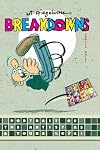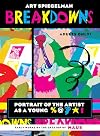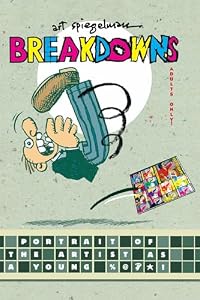
Breakdowns: Portrait of the Artist as a Young %@&*!
by Art Spiegelman
On This Page
Description
The creator of the Pulitzer Prize-winning Maus reflects on the comics form and its influence on his life and art as he traces his evolution from comics obsessed boy to a neurotic adult exploring the effects of his parents' memories of Auschwitz on his own son, in a volume that includes a facsimile of Breakdowns, the artist's comics from the 1970s.Tags
Recommendations















Member Reviews
The creator of the Pulitzer Prize-winning Maus explores the comics form...and how it formed him!
This book opens with Portrait of the Artist as a Young %@&*!, creating vignettes of the people, events, and comics that shaped Art Spiegelman. It traces the artist's evolution from a MAD-comics obsessed boy in Rego Park, Queens, to a neurotic adult examining the effect of his parents' memories of Auschwitz on his own son.
The second part presents a facsimile of Breakdowns, the long-sought after collection of the artist's comics of the 1970s, the book that triggers these memories. Breakdowns established the mode of formally sophisticated comics that transformed the medium, and includes the prototype of Maus, cubist experiments, an essay on show more humor, and the definitive genre-twisting pulp story "Ace Hole-Midget Detective."
Pulling all this together is an illustrated essay that looks back at the sixties as the artist pushes sixty, and explains the obsessions that brought these works into being. Poignant, funny, complex, and innovative, Breakdowns alters the terms of what can be accomplished in a memoir. show less
This book opens with Portrait of the Artist as a Young %@&*!, creating vignettes of the people, events, and comics that shaped Art Spiegelman. It traces the artist's evolution from a MAD-comics obsessed boy in Rego Park, Queens, to a neurotic adult examining the effect of his parents' memories of Auschwitz on his own son.
The second part presents a facsimile of Breakdowns, the long-sought after collection of the artist's comics of the 1970s, the book that triggers these memories. Breakdowns established the mode of formally sophisticated comics that transformed the medium, and includes the prototype of Maus, cubist experiments, an essay on show more humor, and the definitive genre-twisting pulp story "Ace Hole-Midget Detective."
Pulling all this together is an illustrated essay that looks back at the sixties as the artist pushes sixty, and explains the obsessions that brought these works into being. Poignant, funny, complex, and innovative, Breakdowns alters the terms of what can be accomplished in a memoir. show less
I probably started checking out Underground Comix in the early 1970s when I was a teenager. Given that I was growing out of reading the Marvel Comics (& such-like) & Mad Magazines that had been so central to my childhood, I don't think I was really much in the mood to be impressed by any comics anymore. I reckon I had hopes that underground comics wd provide more profoundly current philosophical perspectives & I reckon that they probably did - but I still don't recall being impressed enuf to acquire many. The few that I have left from that era include "Zap" & "Up from the Deep". Maybe I was just bored by 'hippie' culture: dope & sex, blah, blah - even though I was a guy w/ very long hair who eventually explored expanded (& contracted) show more consciousness thru drugs & who embraced sex, uh, enthusiastically. I must've found literature to provide the depth I was seeking.
ANYWAY, it seems to me that it wasn't until I discovered RAW, "The Graphix Magazine for your Bomb Shelter's Coffee Table" as issue 4's subheading read, that I finally felt like I'd found what interested me. Art Spiegelman & Françoise Mouly edited this mag & the production values were.. spectacular. This might just mean that they were lucky enuf to get access to better financing than most but it seems that they also had the ideas to make the spending worthwhile. RAW is still a magazine wch has graphic variety & quality & concepts that make it highly worth referencing almost 30 yrs later.
SO, it was a delight to find this collection of early Spiegelman work in this high production values large format bk in a New Paltz, NY, bkstore for a very reasonable price. Spiegelman's self-depiction as a sortof whining comics-nerd loser gets a bit tiresome but, then again, egomania wd be even worse. At any rate, the work is wonderful &, once again, Spiegelman doesn't let me down.
Ironically, in the long-run, underground comics / graphic novels are usually a pretty conventional art form precisely b/c they ARE an art form & Spiegelman's very conscious of trying to get his work accepted as 'high art'. As I often say, I think people's work wd be much stronger if they threw away such frameworks entirely - but few people (or, perhaps, NO-ONE?) ever seem(s) to agree w/ me.
I'm reminded of the hate that underground cartoonist Paul Mavrides had for my 1988 movie "Homeless Movies". Apparently it was too 'artsy' for him or some such. This struck me as odd given that Mavrides' own work is conventional representational narrative that is formally exactly what yer Average Joe thinks is art - & I reckon Mavrides' skills were art school honed - but I cd be wrong about that. I, on the other hand, have been rejecting being labeled an artist since 1978 & DIDN'T attend art school.
I'm further reminded of my brief correspondence w/ underground cartoonist/painter Robert Williams. I sent him a "Mike Film Form Letter" wch contained individual frames of super-8 film that I'd shot of the art works that I'd made before pronouncing myself a Mad Scientist in 1978. The letter further included stories of what people had done w/ the frames of film. Williams replied w/ a sarcastic piece of hate mail railing against "dadaism". Given that the MFFL had nothing to do w/ dadaism, his response was particularly stupid. In the end, I think he just didn't like 'art' that wasn't PICTURES - a drearily conventional notion despite how wacky his pictorial content might be otherwise. Still, Williams is a very talented painter, so what the fuck. show less
ANYWAY, it seems to me that it wasn't until I discovered RAW, "The Graphix Magazine for your Bomb Shelter's Coffee Table" as issue 4's subheading read, that I finally felt like I'd found what interested me. Art Spiegelman & Françoise Mouly edited this mag & the production values were.. spectacular. This might just mean that they were lucky enuf to get access to better financing than most but it seems that they also had the ideas to make the spending worthwhile. RAW is still a magazine wch has graphic variety & quality & concepts that make it highly worth referencing almost 30 yrs later.
SO, it was a delight to find this collection of early Spiegelman work in this high production values large format bk in a New Paltz, NY, bkstore for a very reasonable price. Spiegelman's self-depiction as a sortof whining comics-nerd loser gets a bit tiresome but, then again, egomania wd be even worse. At any rate, the work is wonderful &, once again, Spiegelman doesn't let me down.
Ironically, in the long-run, underground comics / graphic novels are usually a pretty conventional art form precisely b/c they ARE an art form & Spiegelman's very conscious of trying to get his work accepted as 'high art'. As I often say, I think people's work wd be much stronger if they threw away such frameworks entirely - but few people (or, perhaps, NO-ONE?) ever seem(s) to agree w/ me.
I'm reminded of the hate that underground cartoonist Paul Mavrides had for my 1988 movie "Homeless Movies". Apparently it was too 'artsy' for him or some such. This struck me as odd given that Mavrides' own work is conventional representational narrative that is formally exactly what yer Average Joe thinks is art - & I reckon Mavrides' skills were art school honed - but I cd be wrong about that. I, on the other hand, have been rejecting being labeled an artist since 1978 & DIDN'T attend art school.
I'm further reminded of my brief correspondence w/ underground cartoonist/painter Robert Williams. I sent him a "Mike Film Form Letter" wch contained individual frames of super-8 film that I'd shot of the art works that I'd made before pronouncing myself a Mad Scientist in 1978. The letter further included stories of what people had done w/ the frames of film. Williams replied w/ a sarcastic piece of hate mail railing against "dadaism". Given that the MFFL had nothing to do w/ dadaism, his response was particularly stupid. In the end, I think he just didn't like 'art' that wasn't PICTURES - a drearily conventional notion despite how wacky his pictorial content might be otherwise. Still, Williams is a very talented painter, so what the fuck. show less
A reprint of a fairly groundbreaking but ignored comic from the late 1970s by Art Spiegelman, with a graphic introduction and a textual afterword. I found much of the content of Breakdowns inaccessible but I enjoyed the autobiographical foreword and afterword.
Interesting glimpse into Spiegelman's creative journey.
Really high highs and really low lows. Not for the faint of heart or the impatient.
A great collection of comic strips from the creator of Maus. Part autobiographical, mostly in colour, with references to his influences, such as Robert Crumb, Lewis Carroll, Ken Jacobs and Picasso. Also included at the end of the book is the afterword by Spiegelman which includes some of his leaflet and flyer designs.
This book as Spiegelman is not as enduring as Maus but a must see, more than a must see.
Members
- Recently Added By
Author Information

67+ Works 35,945 Members
Art Spiegelman was born in Stockholm, Sweden on February 15, 1948. He is the son of Polish Jews who survived imprisonment in Auschwitz. His family immigrated to the United States. He became a professional cartoonist at the age of 16. He studied art and philosophy at Harpur College. He became a creative consultant, designer, and writer for Topps show more Chewing Gum, Inc., where he created Wacky Packages, Garbage Pail Kids and other novelty items. The Complete Mr. Infinity was published in 1970 and won the Joel M. Cavior Award for Jewish Writing. In 1980, Spiegelman and his wife, Françoise Mouly founded the avant-garde comics magazine RAW. His best known work Maus: A Survivor's Tale, was published in 1986 and won the Pulitzer Prize in 1992. His other works include Maus: A Survivor's Tale II, In the Shadow of No Towers, Breakdowns, Jack and the Box, Be a Nose, and The Ghosts of Ellis Island. MetaMaus won the 2011 National Jewish Book Award in the Biography, Autobiography, and Memoir category. (Bowker Author Biography) show less
Awards and Honors
Series
Belongs to Publisher Series
Common Knowledge
- Canonical title
- Breakdowns: Portrait of the Artist as a Young %@&*!
- Original title
- Breakdowns: Portrait of the Artist as a Young %@&*!
- Original publication date
- 1978
- Dedication
- For Francoise
(And in memory of Woody Gelman)
Classifications
- Genre
- Graphic Novels & Comics
- DDC/MDS
- 741.5973 — Arts & recreation Drawing & decorative arts Drawing and drawings Comic books, graphic novels, fotonovelas, cartoons, caricatures, comic strips History, geographic treatment, biography North American United States (General)
- LCC
- PN6727 .S6 .A6 — Language and Literature Literature (General) Literature (General) Collections of general literature Comic books, strips, etc.
- BISAC
Statistics
- Members
- 334
- Popularity
- 94,175
- Reviews
- 9
- Rating
- (3.57)
- Languages
- 5 — English, French, German, Portuguese (Brazil), Spanish
- Media
- Paper
- ISBNs
- 12
- ASINs
- 4