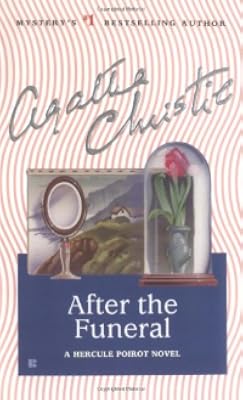
On This Page
Description
Hercule Poirot is called on to investigate the murder of a brother and sister, in this classic Agatha Christie mystery now available in an updated edition with a foreword Sophie Hannah."He was murdered, wasn't he?"
When Cora Lansquenet is savagely murdered, the extraordinary remark she had made the previous day at her brother Richard's funeral suddenly takes on a chilling significance. At the reading of Richard's will, Cora was clearly heard to say, "It's been hushed up very nicely, hasn't show more it. But he was murdered, wasn't he?"
Did Cora's accusation a dark truth that sealed her own fate? Or are the siblings' deaths just tragic coincidences?
Desperate to know the truth, the Lansquenet's solicitor turns to Hercule Poirot to unravel the mystery. For even after the funeral, death isn't finished yet . . .
. Historical Fiction. Fiction. Mystery. show less
Tags
Recommendations












Member Reviews
Richard Abernethie has died suddenly. Well, not too suddenly -- he was ill, after all -- but sooner than was expected. After the funeral, his remaining siblings and nieces and nephews gather at the old Abernethie house to find out the contents of the will. As they discuss Richard's demise, the youngest sister, Cora, says "But he was murdered, wasn't he?" Consternation! Uproar! Even more consternation and uproar when Cora herself dies as well. A murderer is on the loose!
Hercule Poirot is in fine form here. Hastings is not here to provide narration and detective assistance, but the Abernethie solicitor, Mr. Entwhistle, proves capable in that regard. My attention was held throughout and I could not possibly guess whodunnit. A couple of the show more clues may have been a bit subtle, but the subtlety or fairness of clues is not really an issue for me. It was a really ingenious solution once it was finally revealed. I enjoyed this very much and would definitely recommend it if you're looking for a particularly satisfying Agatha Christie novel. show less
Hercule Poirot is in fine form here. Hastings is not here to provide narration and detective assistance, but the Abernethie solicitor, Mr. Entwhistle, proves capable in that regard. My attention was held throughout and I could not possibly guess whodunnit. A couple of the show more clues may have been a bit subtle, but the subtlety or fairness of clues is not really an issue for me. It was a really ingenious solution once it was finally revealed. I enjoyed this very much and would definitely recommend it if you're looking for a particularly satisfying Agatha Christie novel. show less
from my blog, where it is much easier to give links, pictures and half-stars at https://clsiewert.wordpress.com/2015/04/30/after-the-funeral-by-agatha-christie/
Goodness, but I’m a reading disaster when it comes to Christie books. At one point in After the Funeral, I felt I knew who the murderer was, and when I flipped to check if I was right (oh, the horror!)–yes, I did that—I was. But I got no pleasure out of my powers of deduction, as I’m almost positive I’ve read this at least once before. Possibly twice. So that’s a sad statement of my mental affairs that I’m almost pleased by solving the murderer of a book I’ve read twice before. Sigh–if it doesn’t pertain to biology, it likely doesn’t stick in my brain. So I show more find I’m unable to advise if it was a ‘fair’ or ‘solvable’ mystery, for those who look for that sort of thing. I rather think it wasn’t. But at any rate, murderer identified, I was able to settle down and concentrate on Christie’s fine storytelling. That Dame sure can tell a tale, because it remained no less suspenseful.
I’m working on a theory that Christie was a master mystery writer. Oh, I know; the British Empire already figured that out in 1971. But really, the woman could write. I am so amazed, sometimes, how she created so much character in a handful of words. I know I’ve said this before, but it’s something that bears examining. Why is it that Rothfuss and Sanderson get heaps of accolades when they describe every single jewel someone is wearing, taking 700 pages to tell their story about a journey of a thousand steps? I think–and now that I spell this out, I think there’s something really quite valid to my instinct here–that I prefer the character of a story, the sense of it. I don’t need the high-def, cinematic version–I want the emotion of it, the presence of it. Max Gladstone recently wrote a fascinating post about action scenes (“Fighting Words”), and at the very bottom, in the comments section, Kameron Hurley comments: “Yup, this is how I think about it: it’s not my job to give the literal then this, then that, then this, but to infer enough of the scene through the emotion I convey for the reader to *fill in the gaps.* ”
^This.
If I may move from the discussion of writing action to the concept of writing, period, Christie doesn’t (exhaustively) describe how each person walks, the sound of their voice, their dress, their mannerisms; she picks out the part that identifies them most, includes that description in an action, and lets the reader draw the conclusion. For me, to mix my metaphors again, it’s the difference between 17th century Dutch paintings and cubism, particularly Braque, one of my favorite painters (although not this one):
versus
I think that’s why Christie works for me. There’s a combination of specificity and ambiguity that gives an impression, with out the need to delineate every shadow. She allows my own interpretation, and yet every single time, I end up exactly where she wants me. More or less.
In After the Funeral, everyone gathers at the estate for the funeral of Richard Abernethie, and imagine the surprise among the clan when dotty, arty Aunt Cora says, “But he was murdered, wasn’t he?” Elderly solicitor Entwistle remains bothered, her remark nagging at him, and imagine his surprise when he receives a phone call the next day from the police. I won’t spoil any more, but Christie does trot in her favorites: the ancient family butler, the motherly wife, the gambler, the hypochondriac, the actress, the scatty matron, the stockbroker of questionable values. And, of course, the Monsieur himself:
“‘Hercule Poirot–at your service.’
Poirot bowed.
There were no gasps of astonishment or of apprehension.”
And such a snicker we all had at Poirot’s expense, did we not? And with virtually no set-up, we laughed. Now try this brief character appearance on for size:
” Mr. Entwistle passed a very restless night. He felt so tired and so unwell in the morning that he did not get up.
His sister who kept house for him brought up his breakfast on a tray and explained to him severely how wrong he had been to go gadding off to the North of England at his age and in his frail state of health.
Mr. Entwistle contented himself with saying that Richard Abernethie had been a very old friend.
‘Funerals!’ said his sister with deep disapproval. ‘Funerals are absolutely fatal for a man your age!”
In four very brief paragraphs, we have the entire sense of Mr. Entwistle’s sister, do we not? And their decades of interaction? And had another little snicker at his sister’s comment? Even more surprising: there were three more paragraphs to follow, all on a chapter heading page. Eat your heart out, Way of Kings!
This book? I recommend it, for fans of both Christie and Poirot. It feels a little routine for her at this point, but it is a well-polished routine, with a nice twist. Even more, I recommend Dame Christie. Period. show less
Goodness, but I’m a reading disaster when it comes to Christie books. At one point in After the Funeral, I felt I knew who the murderer was, and when I flipped to check if I was right (oh, the horror!)–yes, I did that—I was. But I got no pleasure out of my powers of deduction, as I’m almost positive I’ve read this at least once before. Possibly twice. So that’s a sad statement of my mental affairs that I’m almost pleased by solving the murderer of a book I’ve read twice before. Sigh–if it doesn’t pertain to biology, it likely doesn’t stick in my brain. So I show more find I’m unable to advise if it was a ‘fair’ or ‘solvable’ mystery, for those who look for that sort of thing. I rather think it wasn’t. But at any rate, murderer identified, I was able to settle down and concentrate on Christie’s fine storytelling. That Dame sure can tell a tale, because it remained no less suspenseful.
I’m working on a theory that Christie was a master mystery writer. Oh, I know; the British Empire already figured that out in 1971. But really, the woman could write. I am so amazed, sometimes, how she created so much character in a handful of words. I know I’ve said this before, but it’s something that bears examining. Why is it that Rothfuss and Sanderson get heaps of accolades when they describe every single jewel someone is wearing, taking 700 pages to tell their story about a journey of a thousand steps? I think–and now that I spell this out, I think there’s something really quite valid to my instinct here–that I prefer the character of a story, the sense of it. I don’t need the high-def, cinematic version–I want the emotion of it, the presence of it. Max Gladstone recently wrote a fascinating post about action scenes (“Fighting Words”), and at the very bottom, in the comments section, Kameron Hurley comments: “Yup, this is how I think about it: it’s not my job to give the literal then this, then that, then this, but to infer enough of the scene through the emotion I convey for the reader to *fill in the gaps.* ”
^This.
If I may move from the discussion of writing action to the concept of writing, period, Christie doesn’t (exhaustively) describe how each person walks, the sound of their voice, their dress, their mannerisms; she picks out the part that identifies them most, includes that description in an action, and lets the reader draw the conclusion. For me, to mix my metaphors again, it’s the difference between 17th century Dutch paintings and cubism, particularly Braque, one of my favorite painters (although not this one):
versus
I think that’s why Christie works for me. There’s a combination of specificity and ambiguity that gives an impression, with out the need to delineate every shadow. She allows my own interpretation, and yet every single time, I end up exactly where she wants me. More or less.
In After the Funeral, everyone gathers at the estate for the funeral of Richard Abernethie, and imagine the surprise among the clan when dotty, arty Aunt Cora says, “But he was murdered, wasn’t he?” Elderly solicitor Entwistle remains bothered, her remark nagging at him, and imagine his surprise when he receives a phone call the next day from the police. I won’t spoil any more, but Christie does trot in her favorites: the ancient family butler, the motherly wife, the gambler, the hypochondriac, the actress, the scatty matron, the stockbroker of questionable values. And, of course, the Monsieur himself:
“‘Hercule Poirot–at your service.’
Poirot bowed.
There were no gasps of astonishment or of apprehension.”
And such a snicker we all had at Poirot’s expense, did we not? And with virtually no set-up, we laughed. Now try this brief character appearance on for size:
” Mr. Entwistle passed a very restless night. He felt so tired and so unwell in the morning that he did not get up.
His sister who kept house for him brought up his breakfast on a tray and explained to him severely how wrong he had been to go gadding off to the North of England at his age and in his frail state of health.
Mr. Entwistle contented himself with saying that Richard Abernethie had been a very old friend.
‘Funerals!’ said his sister with deep disapproval. ‘Funerals are absolutely fatal for a man your age!”
In four very brief paragraphs, we have the entire sense of Mr. Entwistle’s sister, do we not? And their decades of interaction? And had another little snicker at his sister’s comment? Even more surprising: there were three more paragraphs to follow, all on a chapter heading page. Eat your heart out, Way of Kings!
This book? I recommend it, for fans of both Christie and Poirot. It feels a little routine for her at this point, but it is a well-polished routine, with a nice twist. Even more, I recommend Dame Christie. Period. show less
3.5*
Should murder make sense? Mr Entwhistle wondered. Academically the answer was yes. But many pointless crimes were on record. It depended, Mr Entwhistle reflected, on the mentality of the murderer.
This was my first time reading After the Funeral, but, of course, it is the story that is loosely used as the story in Murder at the Gallop, that classic Marple film starring the incomparable Margaret Rutherford.
This is all wrong, of course. After the Funeral is a Poirot mystery, not a Marple.
But other than this, the main plot is the same: a family gathering, a vague accusation, a brutal murder. Poirot joins the plot relatively late, and then potters about as Poirot does.
Which brings me to following: Poirot is the worst person to ever try show more and disguise himself. This is not the first time he does it, and every time I've seen him do it, it is just ridiculous.
Surely, Christie wrote this "disguise" malarkey as a bit of fun with the oh so famous and infallible Belgian.
And his name isn’t Pontarlier – it’s Hercules something.’ ‘Hercule Poirot – at your service.’ Poirot bowed. There were no gasps of astonishment or of apprehension. His name seemed to mean nothing at all to them. They were less alarmed by it than they had been by the single word ‘detective’.
After the Funeral is a fairly standard Poirot story, not the best, not the worst. There are a couple of things that do not work, like Poirot's attempt at making people confess to him. That was just plain silly.
However, I liked disliking most of the characters. It's a bit of dark satire, more than a murder mystery, but it isn't as good as other Poirot stories. show less
Should murder make sense? Mr Entwhistle wondered. Academically the answer was yes. But many pointless crimes were on record. It depended, Mr Entwhistle reflected, on the mentality of the murderer.
This was my first time reading After the Funeral, but, of course, it is the story that is loosely used as the story in Murder at the Gallop, that classic Marple film starring the incomparable Margaret Rutherford.
This is all wrong, of course. After the Funeral is a Poirot mystery, not a Marple.
But other than this, the main plot is the same: a family gathering, a vague accusation, a brutal murder. Poirot joins the plot relatively late, and then potters about as Poirot does.
Which brings me to following: Poirot is the worst person to ever try show more and disguise himself. This is not the first time he does it, and every time I've seen him do it, it is just ridiculous.
Surely, Christie wrote this "disguise" malarkey as a bit of fun with the oh so famous and infallible Belgian.
And his name isn’t Pontarlier – it’s Hercules something.’ ‘Hercule Poirot – at your service.’ Poirot bowed. There were no gasps of astonishment or of apprehension. His name seemed to mean nothing at all to them. They were less alarmed by it than they had been by the single word ‘detective’.
After the Funeral is a fairly standard Poirot story, not the best, not the worst. There are a couple of things that do not work, like Poirot's attempt at making people confess to him. That was just plain silly.
However, I liked disliking most of the characters. It's a bit of dark satire, more than a murder mystery, but it isn't as good as other Poirot stories. show less
Another post-war Poirot, where the changing times are a backdrop to murder. The younger generation gather for the funeral of Richard Abernathie, businessman and heir to a family fortune founded on Victorian era corn plasters. The big house is now run by three servants, the family are more interested in the money than family feeling. Richard's younger sister Cora who is known for speaking inconvenient truths throws out a suggestion of murder and the next day is brutally murdered herself. Aged family solicitor Entwhistle brings in Poirot to discretely find out the truth - which of the heirs may've bumped off uncle Richard? or is the solution elsewhere? And, as the excellent "All about Agatha" podcast reminds us "never discount the show more "help"". A good Poirot, and the repeated phrase "the rough" has entered our family lexicon! show less
After the Funeral – A. Christie
Audio performance by Hugh Fraser
4 stars
Hercule Poirot and an ax murderer! What could be better?
The story begins as a post WW2 country house mystery. Along with the loss of lives, it is clear that a way of life is also coming to an end amid the financial woes of a once wealthy family. After the funeral, the not-so-grieving relatives gather like the vultures they are, for a reading of the will. After the ax murder, Poirot appears in the guise of a prospective buyer of the family pile. Poirot has a rather long conversation with the old butler regarding, England, the war, refugees and the end of the golden age of country estates. Agatha Christie creates atmosphere along with a bit of social commentary.
I show more liked the butler. I was glad he didn’t do it. show less
Audio performance by Hugh Fraser
4 stars
Hercule Poirot and an ax murderer! What could be better?
The story begins as a post WW2 country house mystery. Along with the loss of lives, it is clear that a way of life is also coming to an end amid the financial woes of a once wealthy family. After the funeral, the not-so-grieving relatives gather like the vultures they are, for a reading of the will. After the ax murder, Poirot appears in the guise of a prospective buyer of the family pile. Poirot has a rather long conversation with the old butler regarding, England, the war, refugees and the end of the golden age of country estates. Agatha Christie creates atmosphere along with a bit of social commentary.
I show more liked the butler. I was glad he didn’t do it. show less
Funerals Are Fatal (1953) (Hercule Poirot #31) by Agatha Christie. Richard Abernethie was old and rich and had a brother, sister-in-law and cousin who were all needing of money. This also applies to their adult children and their spouses. So they were not too unhappy when the old man died “very suddenly.” A quick look into the Oxford Standard Book of the ole’ tech sprech says this is a euphemism for murdered in 98% of all usages. The other two percent are given out as “Red” herrings or some such thing.
So the old man is dead and there is a funeral, cremation, and everyone goes home to the vast manor house for the reading of the will. Everyone knows the the entire lot will go to George, Richard’s nephew by way of his late show more brother Leo, but instead the moola and property is to be divided up between everyone but George. He has been written out altogether.
But Cora, in her usual tipsy manner, says how lucky they all were that no mention of murder has echoed within the hallowed walls.
Then Cora is butchered in a most horrible fashion. Soon after her “companion’ is slightly poisoned. Mr. Entwhistle, now suspecting something, asks Poirot to look into things.
This he does and in usual, but brilliant, Christie fashion, he unravels a plot more puzzling than the lawn maze that must grace the estate grounds somewhere.
And the answer has a stunning revelation or three that you won’t see coming.
This is one of the top five or six Poirot novels and somehow I’ve missed it up till now. It seems something good has come out of this pandemic, although, given my druthers, I would gladly have skipped this in favor of what we had.
Remember, “Stay Healthy, Stay Sane, and Stay Away From Me.” I thank you, my wife thanks you, my kids thank you, the grand babies thank you and our new German Shepard grand baby dog thanks you.
By the way, my American copy offers this title in lieu of the Brit one. show less
So the old man is dead and there is a funeral, cremation, and everyone goes home to the vast manor house for the reading of the will. Everyone knows the the entire lot will go to George, Richard’s nephew by way of his late show more brother Leo, but instead the moola and property is to be divided up between everyone but George. He has been written out altogether.
But Cora, in her usual tipsy manner, says how lucky they all were that no mention of murder has echoed within the hallowed walls.
Then Cora is butchered in a most horrible fashion. Soon after her “companion’ is slightly poisoned. Mr. Entwhistle, now suspecting something, asks Poirot to look into things.
This he does and in usual, but brilliant, Christie fashion, he unravels a plot more puzzling than the lawn maze that must grace the estate grounds somewhere.
And the answer has a stunning revelation or three that you won’t see coming.
This is one of the top five or six Poirot novels and somehow I’ve missed it up till now. It seems something good has come out of this pandemic, although, given my druthers, I would gladly have skipped this in favor of what we had.
Remember, “Stay Healthy, Stay Sane, and Stay Away From Me.” I thank you, my wife thanks you, my kids thank you, the grand babies thank you and our new German Shepard grand baby dog thanks you.
By the way, my American copy offers this title in lieu of the Brit one. show less
When the family of the late Richard Abernethie gathers in the library of Enderby to hear the reading of the will, the deceased's sister, Cora Lansquenet, voices her suspicion that her brother was murdered. The following day, she herself is found dead in her cottage, brutally killed with a hatchet. The solicitor and old friend of Mr Abernethie's, Mr Entwhistle, then contacts Hercule Poirot, mainly to assuage his doubts in view of recent events that Cora's death was just a coincidence and that Richard had died a natural death. Intrigued by the case, Poirot begins his investigations ...
It's been a long time since I've read an Agatha Christie novel and I'd forgotten how much fun they can be. The enjoyment mainly derives from trying to work show more out the puzzle before Poirot (or Miss Marple) announces the solution to the assembled suspects, and sifting the liberally strewn red herrings from the real clues. Poirot doesn't feature prominently in this mystery, and is mainly there to set a few wheels in motion and to pull the threads together at the end. As Sophie Hannah rightly observes in the Introduction, Agatha Christie wasn't concerned with plausibility, but intent on creating an entertaining, and cleverly crafted, murder mystery; in this she has entirely succeeded, with a very neat twist. Of course the upper middle-class structure of society, so often depicted in her writings, appears terribly dated these days, but the insights into human psychology are universal. Not world literature, but excellent value as a brain teaser. show less
It's been a long time since I've read an Agatha Christie novel and I'd forgotten how much fun they can be. The enjoyment mainly derives from trying to work show more out the puzzle before Poirot (or Miss Marple) announces the solution to the assembled suspects, and sifting the liberally strewn red herrings from the real clues. Poirot doesn't feature prominently in this mystery, and is mainly there to set a few wheels in motion and to pull the threads together at the end. As Sophie Hannah rightly observes in the Introduction, Agatha Christie wasn't concerned with plausibility, but intent on creating an entertaining, and cleverly crafted, murder mystery; in this she has entirely succeeded, with a very neat twist. Of course the upper middle-class structure of society, so often depicted in her writings, appears terribly dated these days, but the insights into human psychology are universal. Not world literature, but excellent value as a brain teaser. show less
Members
- Recently Added By
Lists

British Mystery
469 works; 14 members

Crime and Mysteries to Read
746 works; 31 members

Agatha Christie Poirot
43 works; 2 members

Books About Murder
313 works; 7 members

Favorite Books from the 1950s
33 works; 2 members

Detective Stories
343 works; 5 members

Books available on Open Library
171 works; 4 members

1950s
340 works; 22 members

Books Read in 2023
5,638 works; 147 members

TBR
77 works; 1 member
Must Read Detective Stories (Nick Fuller)
278 works; 2 members

Agatha Christie Chronology
93 works; 1 member
Author Information

2,196+ Works 442,374 Members
One of the most successful and beloved writer of mystery stories, Agatha Mary Clarissa Christie was born in 1890 in Torquay, County Devon, England. She wrote her first novel, The Mysterious Affair at Styles, in 1920, launching a literary career that spanned decades. In her lifetime, she authored 79 crime novels and a short story collection, 19 show more plays, and six novels written under the name of Mary Westmacott. Her books have sold over a billion copies in the English language with another billion in 44 foreign languages. Some of her most famous titles include Murder on the Orient Express, Mystery of the Blue Train, And Then There Were None, 13 at Dinner and The Sittaford Mystery. Noted for clever and surprising twists of plot, many of Christie's mysteries feature two unconventional fictional detectives named Hercule Poirot and Miss Jane Marple. Poirot, in particular, plays the hero of many of her works, including the classic, The Murder of Roger Ackroyd (1926), and Curtain (1975), one of her last works in which the famed detective dies. Over the years, her travels took her to the Middle East where she met noted English archaeologist Sir Max Mallowan. They married in 1930. Christie accompanied Mallowan on annual expeditions to Iraq and Syria, which served as material for Murder in Mesopotamia (1930), Death on the Nile (1937), and Appointment with Death (1938). Christie's credits also include the plays, The Mousetrap and Witness for the Prosecution (1953; film 1957). Christie received the New York Drama Critics' Circle Award for 1954-1955 for Witness. She was also named Dame Commander of the Order of the British Empire in 1971. Christie died in 1976. (Bowker Author Biography) show less
Some Editions
Awards and Honors
Distinctions
Series

Belongs to Publisher Series
SaPo (21)
Work Relationships
Is contained in
Poirot: The Post-War Years: After the Funeral, Hickory Dickory Dock, Cat Among the Pigeons, The Clocks by Agatha Christie
Agatha Christie Crime Collection: After the Funeral / Death on the Nile / Towards Zero by Agatha Christie
A Poirot Quintet: The Murder of Roger Ackroyd; The Mystery of the Blue Train; Dumb Witness; After the Funeral; Death on the Nile by Agatha Christie
After the Funeral / Death in the Clouds / Murder on the Orient Express / Why Didn’t They Ask Evans? by Agatha Christie
Three Puzzles for Poirot: Third girl + Poirot Loses a Client + Funerals Are Fatal by Agatha Christie
Has the adaptation
Common Knowledge
- Canonical title
- After the Funeral
- Original title
- After the Funeral
- Alternate titles
- Funerals Are Fatal; Murder at the Gallop
- Original publication date
- 1953-03-01
- People/Characters
- Hercule Poirot; Lanscombe; Helen Abernethie; Mr. Entwhistle; Maude Abernethie; George Crossfield (show all 21); Rosamund Shane; Michael Shane; Susan Banks; Gregory Banks; Cora Lansquenet; Miss Gilchrist; Timothy Abernethie; Alexander Guthrie; Mr. Goby; Miss Entwhistle; Inspector Morton; Dr. Larraby; Janet; Marjorie; Mrs. Jones
- Important places
- Enderby, England, UK; Lytchett St Mary, England, UK; London, England, UK
- Related movies
- Murder at the Gallop (1963 | IMDb); After the Funeral (2006 | IMDb)
- Dedication
- For James: In memory of happy days at Abney
- First words
- Old Lanscombe moved totteringly from room to room, pulling up the blinds.
- Last words
- (Click to show. Warning: May contain spoilers.)They were silent—and Poirot thought of murderers he had known....
- Blurbers*
- Richard Abernathie, hoofd van een familieconcern, stierf als een zeer gefortuneerd man. Alle familieleden die bij zijn begrafenis aanwezig waren, werden financiëel begunstigd. Hoewel de rouwadvertenties omtrent zijn dood meldden: "Onverwachts ontviel ons...." was er geen reden om aan te nemen dat hij geen natuurlijke dood gestorven was..... of misschien toch wel? Gekke tante Cora vond het nodig om te zeggen: "Maar hij is immers toch vermoord, is het niet?" De notaris van de familie, opgeschrikt door nog een overlijden, roept de hulp in van zijn oude vriend Hercule Poirot.
- Original language
- English UK
- Disambiguation notice
- aka Funerals Are Fatal. Although the book on which it is based featured Hercule Poirot as the detective, the movie Murder at the Gallop featured Margaret Rutherford as Miss Jane Marple.
*Some information comes from Common Knowledge in other languages. Click "Edit" for more information.
Classifications
Statistics
- Members
- 4,606
- Popularity
- 3,161
- Reviews
- 82
- Rating
- (3.69)
- Languages
- 24 — Catalan, Chinese, Czech, Danish, Dutch, English, Finnish, French, German, Greek, Hungarian, Italian, Japanese, Lithuanian, Norwegian (Bokmål), Norwegian, Polish, Portuguese, Serbian, Croatian, Slovenian, Spanish, Swedish, Turkish
- Media
- Paper, Audiobook, Ebook
- ISBNs
- 160
- UPCs
- 2
- ASINs
- 94