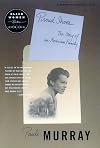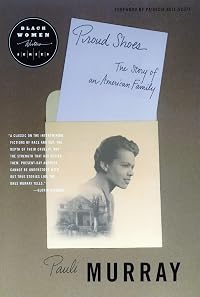
Proud Shoes
by Pauli Murray
On This Page
Description
First published in 1956, Proud Shoes is the remarkable true story of slavery, survival, and miscegenation in the South from the pre-Civil War era through the Reconstruction. Written by Pauli Murray the legendary civil rights activist and one of the founders of NOW, Proud Shoes chronicles the lives of Murray's maternal grandparents. From the birth of her grandmother, Cornelia Smith, daughter of a slave whose beauty incited the master's sons to near murder to the story of her grandfather show more Robert Fitzgerald, whose free black father married a white woman in 1840, Proud Shoes offers a revealing glimpse of our nation's history. show lessTags
Recommendations






Member Reviews
Amazing -- The structure of the book, where you first meet the author's grandparents through her memories as a young girl, and then she pulls the layers back; the strength of the writing and descriptions; but most of all, the stories of her grandparents and great-grandparents and the context of the world within which they were thwarted and yet thrived -- great grandfather Thomas, born a slave, a successful farmer in a state where, if he left for over two months, as a black man he wouldn't be allowed to return -- grandfather Robert, who served the Union in the civil war in three services (Quartermaster, Navy, Army), was blinded by his service, devoted his life to educating the freedman -- great grandmother Harriett, enslaved by great show more aunt Mary, raped by great grandfather Sydney -- mother Cornelia, enslaved, yet raised as a pseudo-daughter in her father's house -- the stories of fugitive slaves on the underground railroad hiding on great-grandfather Thomas's farm on their way North -- the kidnappings of free slaves in free states, and how they were sent south into slavery -- the experiences of black men serving with the Union in the Civil War, and the context of the battles in which they fought -- the KKK terrorizing teachers of freedmen --
When Thomas was freed, How hazardous was the journey from the state of a freedman to that of a free man! Great-Grandfather Thomas could now come and go at will; he could marry and have legitimate children; he could receive the wages of his own labor and buy and sell property. But Delaware law left him like a man on the edge of quicksand; a misstep and he would be sucked back into servitude. The law declared that free Negroes and mulattoes "are idle and slothful, and often prove burdensome to the neighborhood wherein they live, and are of evil example to slaves." It excluded him and his children from state-supported education and denied him the right to vote. In fact, if he were caught within a half mile of a polling place on election day without an acceptable excuse that some unforeseen emergency had brought him there, he would be thrown in jail for twenty-four hours. The one thing he must not do was run afoul of the law in any way. He could not testify in court on any matter unless no competent white witness could be found. A staggering fine would be imposed upon him for a minor offense and if he could not pay his fine he would be sold at public auction back into slavery for periods up to seven years. If he left his native state for more than two months the law declared him a nonresident and he could not re-enter it to live, since Delaware barred free Negroes from coming into the state. show less
When Thomas was freed, How hazardous was the journey from the state of a freedman to that of a free man! Great-Grandfather Thomas could now come and go at will; he could marry and have legitimate children; he could receive the wages of his own labor and buy and sell property. But Delaware law left him like a man on the edge of quicksand; a misstep and he would be sucked back into servitude. The law declared that free Negroes and mulattoes "are idle and slothful, and often prove burdensome to the neighborhood wherein they live, and are of evil example to slaves." It excluded him and his children from state-supported education and denied him the right to vote. In fact, if he were caught within a half mile of a polling place on election day without an acceptable excuse that some unforeseen emergency had brought him there, he would be thrown in jail for twenty-four hours. The one thing he must not do was run afoul of the law in any way. He could not testify in court on any matter unless no competent white witness could be found. A staggering fine would be imposed upon him for a minor offense and if he could not pay his fine he would be sold at public auction back into slavery for periods up to seven years. If he left his native state for more than two months the law declared him a nonresident and he could not re-enter it to live, since Delaware barred free Negroes from coming into the state. show less
A groundbreaking work not only of African American history, but of American history, by a pioneer of the civil rights movement.
Murray's prose is compulsively readable; she writes with sensitivity and insight about her maternal grandparents' (incredibly dramatic!) early lives, their mixed-race family origins in antebellum Pennsylvania and North Carolina, and her own vivid memories of growing up in Durham, NC during the Jim Crow era.
I'm looking forward to reading more by Murray and to visiting the museum that's slated to be opened in her Durham family home in the next few years.
Murray's prose is compulsively readable; she writes with sensitivity and insight about her maternal grandparents' (incredibly dramatic!) early lives, their mixed-race family origins in antebellum Pennsylvania and North Carolina, and her own vivid memories of growing up in Durham, NC during the Jim Crow era.
I'm looking forward to reading more by Murray and to visiting the museum that's slated to be opened in her Durham family home in the next few years.
In Proud Shoes, Pauli Murray tells us about the history of her mother's parents. Her white grandmother grew up southern, while her black grandfather grew up in Delaware and Pennsylvania. Murray offers insights into the ways in which blacks and whites (and people of the many shades between) thought about and acted toward each other in the years between 1850 and 1915. She shows us white slaveowners begetting children with their slaves, including in her grandmother's family.
The great bulk of the book is a virtual hagiography of Murray's grandfather, Robert Fitzgerald. We learn of his upbringing, his desperate desire to join the union army, his injury while serving in a supporting role, his eventual success in gaining a commission. Blacks show more are discriminated against at every turn during his story, but they, especially Robert, are consistently patient and polite while waiting for their opportunities. Despite his frail body and deteriorating eyesight, Robert takes a position after the war as a teacher of the newly free black children in North Carolina. His efforts as described by Murray are selfless and heroic.
Murray's descriptions of how conditions worsened for many blacks in the latter years of the nineteenth century were interesting. I would have liked to hear more about Murray's life after the death of her grandparents. It would have been interesting to hear more about the research she performed in order to dig out the details that she presents. However, the purpose of this book seems to have been to come to terms with her origins: black and white, union soldier and southern lady. For the fascinating story of what Murray became later, we'll have to look elsewhere. show less
The great bulk of the book is a virtual hagiography of Murray's grandfather, Robert Fitzgerald. We learn of his upbringing, his desperate desire to join the union army, his injury while serving in a supporting role, his eventual success in gaining a commission. Blacks show more are discriminated against at every turn during his story, but they, especially Robert, are consistently patient and polite while waiting for their opportunities. Despite his frail body and deteriorating eyesight, Robert takes a position after the war as a teacher of the newly free black children in North Carolina. His efforts as described by Murray are selfless and heroic.
Murray's descriptions of how conditions worsened for many blacks in the latter years of the nineteenth century were interesting. I would have liked to hear more about Murray's life after the death of her grandparents. It would have been interesting to hear more about the research she performed in order to dig out the details that she presents. However, the purpose of this book seems to have been to come to terms with her origins: black and white, union soldier and southern lady. For the fascinating story of what Murray became later, we'll have to look elsewhere. show less
A classic and a must read!
dust jacket
Ratings
Members
- Recently Added By
Lists

500 Great Books by Women
507 works; 60 members
Author Information

13+ Works 586 Members
Pauli Murray (1910-1985) was born in Baltimore and raised in Durham, North Caroline.
Awards and Honors
Notable Lists
Series
Belongs to Publisher Series
Work Relationships
Common Knowledge
- Canonical title
- Proud Shoes
- Original publication date
- 1956
Classifications
- Genres
- Nonfiction, Biography & Memoir, History
- DDC/MDS
- 306.85 — Society, government, & culture Social sciences, sociology & anthropology Social Behavior - Dating, Marriage, Divorce Marriage, partnerships, unions; family Family
- LCC
- E185.97 .F47 .M87 — History of the United States United States Elements in the population Afro-Americans Biography. Genealogy
- BISAC
Statistics
- Members
- 196
- Popularity
- 167,534
- Reviews
- 5
- Rating
- (4.32)
- Languages
- English
- Media
- Paper, Ebook
- ISBNs
- 12
- UPCs
- 1
- ASINs
- 2