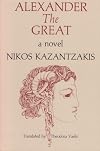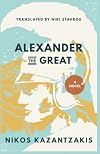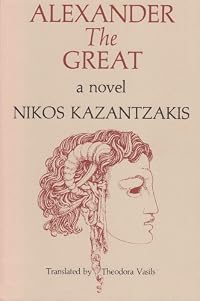
Alexander the Great
by Níkos Kazantzákis
On This Page
Description
Nikos Kazantzakis is no stranger to the heroes of Greek antiquity. In this historical novel based on the life of Alexander the Great, Kazantzakis has drawn on both the rich tradition of Greek legend and the documented manuscripts from the archives of history to recreate an Alexander in all his many-faceted images--Alexander the god; Alexander the descendant of Heracles performing the twelve labors; Alexander the mystic, the daring visionary destined to carry out a divine mission; Alexander show more the flesh-and-blood mortal who, on occasion, is not above the common soldier's brawling and drinking. The novel, which resists the temptation to portray Alexander in the mantle of purely romantic legend, covers his life from age fifteen to his death at age thirty-two. It opens with Alexander's first exploit, the taming of the horse, Bucephalas, and is seen in great part through the eyes of his young neighbor who eventually becomes an officer in his army and follows him on his campaign to conquer the world. The book, which was written primarily as an educational adjunct for young readers, is intended for the adult mind as well, and like the legends of old, is entertaining as well as instructive for readers of all ages. It was originally published in Greece in serial form in 1940, and was republished in a complete volume in 1979. show lessTags
Recommendations



















Member Reviews
Before I started this book, I did not realize that it was written for children (in 1940). It states that it is intended for adults as well, but I'm not sure that too many adults would enjoy it. This book is clearly intended for 10-12 year olds, and is a rather lite novel of Alexander's life. There isn't much detail, and there is another "main" character in the book who disappears at times.
I know that it is a fictionalized story, and written more than 80 years ago, but even taking that into account I couldn't give it more than two stars, even for children.
I know that it is a fictionalized story, and written more than 80 years ago, but even taking that into account I couldn't give it more than two stars, even for children.
Smoothly written, can't blame the translator for this. It is a YA book, that whitewashes and romanticizes Alexander.
No conflict with Philip - except one scene for which Philip eventually apologizes
No conflict with Olympias
No conflict between Olympias and Philip
No 'relationship' with Hephastion, other than special friend
No son from Philip's second marriage
Philip's murder was due to 'verbal insult' to Pausanias
No Roxanne at all
No relationship with Bogoas, he becomes a local somewhere who alerts Alexander to a plot
No political killings
No conflict with Aristotle over his adopting barbarian ways
No destruction of Persepolis
Many times the characters talk about 'Greece' a political/national concept that was unlikely to exist at that time.
They show more also often talk about 'God' or 'God of Greece' when they were polytheists. Christianity sneaks in.
The barbarian ways that have softened the Persians, and that Alexander adopts are called 'Anatolian' ie: Turkish. Modern bias seeps in, with the Greeks blaming the Turks for bad things, when neither entities even exist yet.
Alka the daughter of the admiral and 'friend' of Stephan, behaves and is treated like a modern girl/woman.
At times almost too sweet to get through. show less
No conflict with Philip - except one scene for which Philip eventually apologizes
No conflict with Olympias
No conflict between Olympias and Philip
No 'relationship' with Hephastion, other than special friend
No son from Philip's second marriage
Philip's murder was due to 'verbal insult' to Pausanias
No Roxanne at all
No relationship with Bogoas, he becomes a local somewhere who alerts Alexander to a plot
No political killings
No conflict with Aristotle over his adopting barbarian ways
No destruction of Persepolis
Many times the characters talk about 'Greece' a political/national concept that was unlikely to exist at that time.
They show more also often talk about 'God' or 'God of Greece' when they were polytheists. Christianity sneaks in.
The barbarian ways that have softened the Persians, and that Alexander adopts are called 'Anatolian' ie: Turkish. Modern bias seeps in, with the Greeks blaming the Turks for bad things, when neither entities even exist yet.
Alka the daughter of the admiral and 'friend' of Stephan, behaves and is treated like a modern girl/woman.
At times almost too sweet to get through. show less
Ratings
Members
- Recently Added By
Author Information

This distinguished novelist, poet, and translator was born in Crete and educated in Athens, Germany, Italy, and Paris, where he studied philosophy. He found time to write some 30 novels, plays, and books on philosophy, to serve his government, and to travel widely. He ran the Greek ministry of welfare from 1919 to 1921 and was minister of state show more briefly in 1945. A political activist, he spent his last years in France and died in Germany. Kazantzakis's character Zorba has been called "one of the great characters of modern fiction," in a novel that "reflects Greek exhilaration at its best" (TLS). A film version of 1965, starring Anthony Quinn, made Kazantzakis widely known in the West. Intensely religious, he imbued his novels with the passion of his own restless spirit, "torn between the active and the contemplative, between the sensual and the aesthetic, between nihilism and commitment" (Columbia Encyclopedia). Judas, the hero of The Last Temptation of Christ (1951) is asked by Christ to betray him so that he can fulfill his mission through the crucifixion. For this book Kazantzakis was excommunicated from the Greek Orthodox Church. The Fratricides, Kazantzakis's last novel, portrays yet another religious hero, a priest caught between Communists and Royalists in the Greek Civil War. (Bowker Author Biography) show less
Some Editions
Series
Belongs to Publisher Series
Common Knowledge
- Canonical title
- Alexander the Great
- People/Characters
- Alexander III the Great, 326-253 BC; Aristotle, 384-322; Alka; Hephaestion; Olympias; Philip II of Macedon (as King Phillip of Macedonia) (show all 7); Stephan
- Important places
- Macedonia
Classifications
- Genres
- Fiction and Literature, Historical Fiction, General Fiction
- DDC/MDS
- 889.332 — Literature & rhetoric Classical & modern Greek literatures Modern Greek literature Fiction 20th century 1941-1944
- LCC
- PA5610 .K39 .M413 — Language and Literature Greek language and literature. Latin language and literature Byzantine and modern Greek literature Individual authors
- BISAC
Statistics
- Members
- 103
- Popularity
- 312,903
- Reviews
- 2
- Rating
- (3.69)
- Languages
- English, German, Greek
- Media
- Paper, Ebook
- ISBNs
- 7
- ASINs
- 2