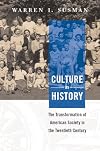
Culture as History: The Transformation of American Society in the Twentieth Century
by Warren Susman
On This Page
Description
Bringing together for the first time the best of twenty-five years of unique critical work, Warren Susman takes Us on a startling tour through the conflicts and events which have transformed the social, political, and cultural face of America in this century. Probing a rich panoply of images from the mass media and advertising, testing prevalent intellectual and economic theories, linking the revolutions in communications and technology to the rise of a new pantheon of popular heroes, Susman show more documents and analyzes the process through which the older, Puritan-republican, producer-capitalist culture has given way to the leisure-oriented, consumer society we now inhabit the culture of abundance. show lessTags
Recommendations































Member Reviews
Susman provides some interesting comments on American culture, arguing that the battles taking place in America often have little to with politics. The cultural realm has seen more dramatic combat. One is between the older culture that emphasized moral rectitude while the other is more consumer driven. New forms of culture, centered around mass media and communication, have driven the new American culture.
The two strains of culture was contradictory, but not mutually exclusive. Most americans have loyalties to both to come degree. Susman looks at the interwar period and people like Henry Ford, who mass produced automobiles but also sought a simpler way of life as he aged. Susman sees these tensions as inherent in any society, but show more American society took a slightly different turn because the consumer-identity gained such strength.
One interesting point at the end of his work is a warning against too much ivory tower analysis. Academics who analyze American culture tend to condemn the mass produced, conformists mentality. Susman is concerned that this will lead to a condemnation of the consumers that make up American society. He fears that they would then be even further cut off in their analysis. show less
The two strains of culture was contradictory, but not mutually exclusive. Most americans have loyalties to both to come degree. Susman looks at the interwar period and people like Henry Ford, who mass produced automobiles but also sought a simpler way of life as he aged. Susman sees these tensions as inherent in any society, but show more American society took a slightly different turn because the consumer-identity gained such strength.
One interesting point at the end of his work is a warning against too much ivory tower analysis. Academics who analyze American culture tend to condemn the mass produced, conformists mentality. Susman is concerned that this will lead to a condemnation of the consumers that make up American society. He fears that they would then be even further cut off in their analysis. show less
The book looks at culture, sometimes unconscious culture, both high brow and low brow as a driving force in civilization. His analysis is of American History, primarily from its inception to 1950 or so. He also points out that our view of history is also a function of the present culture.
I found it an interesting book although I did not know many of the references made.
I found it an interesting book although I did not know many of the references made.
Ratings
Members
- Recently Added By
Author Information
3+ Works 192 Members
Warren Susman (1927-1985) was a professor of history at Rutgers University.
Common Knowledge
- Canonical title
- Culture as History: The Transformation of American Society in the Twentieth Century
- Original publication date
- 1984
- Important places
- USA
- Original language
- English
Classifications
Statistics
- Members
- 172
- Popularity
- 189,804
- Reviews
- 2
- Rating
- (3.93)
- Languages
- English
- Media
- Paper, Ebook
- ISBNs
- 4
- ASINs
- 4