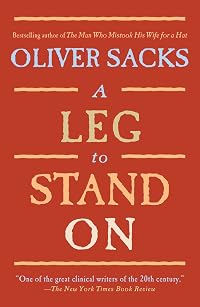
A Leg to Stand On
by Oliver Sacks
On This Page
Description
When Oliver Sacks, a physician by profession, injured his leg while climbing a mountain, he found himself in an unusual position, that of patient. The injury itself was severe, but straightforward to fix; the psychological effects, however, were far less easy to predict, explain, or resolve: Sacks experienced paralysis and an inability to perceive his leg as his own, instead seeing it as some kind of alien and inanimate object, over which he had no control. A Leg to Stand On is both an show more account of Sacks's ordeal and subsequent recovery, and an exploration of the ways in which mind and body are inextricably linked. show lessTags
Recommendations


















Member Recommendations
wester Doctors that have turned patient and shared their insight on this experience.
Member Reviews
Wow, what a marvelous book! I'd always thought: "how can even the brilliant Oliver Sacks write a 200-page book about his own leg?" That would have to be one of the great works of solipsism, wouldn't it? And it is, it is--the book is among other things a fascinating investigation of self, but it goes beyond that. In 1974 Dr. Sacks (a shy bookish man by temperament) went for a friendly climb of a 7,000 foot mountain in Norway. I don't know if you can say that Dr. Sacks does anything thoughtlessly, but when he clambers into the paddock of a bull despite ample signage warning him away, you wonder. In due course, he comes across the bull, which really does nothing more than raise it massive horned head. The animal never pursues Sacks. Yet show more the good doctor panics, bolts madly across a meadow, falls and brutally severs the quadriceps of his left leg. He is lucky he doesn't die on the mountain for he is miles from his village lodging and the nights even in summer are freezing. Almost miraculously he is found crawling back to town by a couple of hunters, a father and son. In short order he is flown to London where he proceeds to experience a profound sense of "alienation" from his leg. He excoriates his surgical team for their lack of bedside manner. That is itself something you rarely see in print or in life: one doctor criticizing another. But the fair-minded Sacks soon comes to realize that the problem goes deeper than his surgeon. It's symtomatic of the healthcare juggernaut as a whole. Sacks has been deliberately left alone with his thoughts and what ensues is a profound dissociation from his leg. He feels it is "no longer part of him," that the leg is "dead," that it will never return to full use. He undergoes a clinically pure example of loss of proprioception. This is the sense we all have of our bodily posture. Nurse Sulu enters Sacks's hospital room one day in alarm. His leg has fallen out of bed and splayed itself at a strange angle. Yet Sacks lies in bed with the distinct impression that the leg is still in bed with him, tidily tucked away. He is shocked upon lifting his head from the pillow. He exhorts Nurse Sulu to move the leg this way and that. He is unable to tell what position she has put the leg in with his eyes closed. In the first half of the book Sacks worked from his own journal and he was careful to leave the fear and exclamations in, his at times irrational circular reasoning. He wants us to know how frightening the whole experience is, not just for himself, but for those in the same predicament. The moment on the mountain pales in comparison to the horrors he experiences in the hospital. Sacks undergoes a profound alteration of body image. The injury, subsequent surgery and casting of his leg has led to desensitization and atrophy until he "forgets" how to use it. He is left abed for 14 days. The second half of the book is a consideration of his experience from a clinical perspective. I don't mean to say that the first part of the book is not of interest, but it is when Sacks begins his consideration of the neurological reasons for his experience that for me the book began to sing. There are fascinating explications of how the brain "sees" the body, as well as the neural correlates for all this. The section of the brain dedicated to body-image, as it turns out, is the somatosensory cortex, part of the parietal lobe. Eventually Sacks leads the reader thoughtfully through the available literature on body image. There isn't much, to be sure. Among these is a work entitled Reflex Paralysis generated by surgeons of the hand during the American Civil War (1861-65). I am glossing over a lot here. The book is an intellectual feast on many levels. It is almost unbelievably rich feast for the thorough reader. In the end though it's a very human book, a book about all of us. Highly recommended. show less
A tale about strange neurobiology, as is most of his including the famous The Man Who Mistook His Wife for a Hat and Other Clinical Tales, but this time deeply autobiographical and much worse. Sacks penchant for putting makeup on reality was far less egregious in his other books where he's not the star - when given a chance to tell the tale of hurting his leg on a hike, he's supposedly not screaming OW FUCK MY LEG HOW WILL I GET DOWN in his head, but quoting scripture and poets and waxing philosophical to turn a phrase. Call me a skeptic but this smells a whole lot of rewriting reality - not just an Oppenheimer casually referencing the Gita in his head when retelling the story, but having another good reference in the car ride home, as show more he sat down to eat, laid down to sleep and while taking his morning constitutional.
It's also a tale about doctors making the worst patients as Sacks is seemingly shocked and puzzled as to how the routine treatment of a patient actually works - how could he be treated so brusquely when he has questions and requests? This is presented as a deep insight, but reflects more so on the unexamined arrogance preceding his revelations.
The redeeming part of the book is Sacks' piecing together his anosognosia - being unable to mentally connect with, feel and move his leg; how alien it seems to him, and how this relates to previous cases he's encountered. His road to therapy and breakthrough in unconscious reconnection with the limb are also very interesting. If not for the embellishments the case study could have been covered in 100 pages as part of a book more in the style of his better work. show less
It's also a tale about doctors making the worst patients as Sacks is seemingly shocked and puzzled as to how the routine treatment of a patient actually works - how could he be treated so brusquely when he has questions and requests? This is presented as a deep insight, but reflects more so on the unexamined arrogance preceding his revelations.
The redeeming part of the book is Sacks' piecing together his anosognosia - being unable to mentally connect with, feel and move his leg; how alien it seems to him, and how this relates to previous cases he's encountered. His road to therapy and breakthrough in unconscious reconnection with the limb are also very interesting. If not for the embellishments the case study could have been covered in 100 pages as part of a book more in the style of his better work. show less
as usual with Sacks, this is a work that is fascinating, personal, and authentic. it's interesting to have Sacks give us a guided tour of the seminal experience of his own leg injury recovery wherein we see the evolution of the body-mind neurologist that has become so popular. there actually may be too much Sacks in this gonzo medical memoir, Sacks may have here much to offer with those suffering phantom limb pain, recovering from localized paralysis, etc. but this is so inside that the transcription of a lengthy internal soliloquy crowds out enlightenment for those of us with all limbs functioning.
A very engaging book in which Oliver Sacks, through a bizarre accident involving a bull at the top of a mountain, ended up badly breaking his leg, damaging the nerves there, and half dragging himself down the mountain to get help. At this point, the narrative changes. He is hospitalized and becomes a patient for about 6 weeks. At first, the idea of reading about someone's leg slowly healing might sound dull. But this isn't anyone's leg, this is Oliver fucking Sack's leg!
Oliver Sacks, if you haven't read him before, is a neurologist who writes very accessible, empathetic books about various disorders of the brain. I've read a few a long time ago, but what sets Dr. Sacks apart is that he writes like a scientist from the good old days, show more reminding me at times of Darwin, William James, Da Vinci etc. in that he is a broad thinker, bringing in the arts, music, poetry as equals. This doesn't make him any less rigorous, only that he acknowledges the power of these other fields, and that what we are dealing with is ultimately human. As his maiden aunt reminds him in his sick bed: "All the trouble starts when people forget they're human."
A few years ago, when my dad had to be hospitalized because of a heart problem, I could see the fear, anguish, and confusion in his eyes whenever I visited him. His stay was thankfully short, but there were many instances in which we felt like we were being shushed, dismissed, not-listened to. The environment is the exact opposite of what an environment of healing and well-being should be--at least emotional well-being, which is half the battle. It seemed like the professionals were only focused on my dad's surgery, and not with the stress of the entire experience (by the way, stress is one of the main causes of heart disease).
In this book, Oliver Sacks is the patient, whereas his usual role is doctor, and finds himself in the same predicament as my dad. But this book isn't a bitter diatribe about "the system". It is an attempt to understand both sides of the doctor/patient equation, as well as an attempt to document the EXPERIENCE of being a patient, the alienation, the striving for answers about his own body. At the end of the book, he talks about how little literature there is out there that is from the patient's perspective. How can we begin to heal if we cannot be empathetic towards the patient?
Beyond this, I was amazed at Dr. Sacks's ability to draw upon his large reservoir of the arts to comfort him and to help him understand his condition. He quotes Wittgenstein, Eliot, the book of Job and others, and he uses Mendelssohn to help him heal. As much as I read, I don't know if I would be able to use what I've read in such a pragmatic way, to gain insight and comfort into my current condition.
Lastly, Dr. Sacks writes vividly, and often his descriptions were truly epiphanic if you imagine yourself in his position. He reasons in and out and around corners about why he is feeling certain sensations, and you really feel like this is a scientist's constant exploratory mind at work. It is a pity that the doctors didn't listen to what he had to say, as they would've learned quite a bit.
My only complaint may be that at times he went on too long, repeating himself in much the same words he did several pages back.
I think all doctors, nurses, and health care professionals should read this book. Patients should read it too, so that they feel less alone in their experiences. show less
Oliver Sacks, if you haven't read him before, is a neurologist who writes very accessible, empathetic books about various disorders of the brain. I've read a few a long time ago, but what sets Dr. Sacks apart is that he writes like a scientist from the good old days, show more reminding me at times of Darwin, William James, Da Vinci etc. in that he is a broad thinker, bringing in the arts, music, poetry as equals. This doesn't make him any less rigorous, only that he acknowledges the power of these other fields, and that what we are dealing with is ultimately human. As his maiden aunt reminds him in his sick bed: "All the trouble starts when people forget they're human."
A few years ago, when my dad had to be hospitalized because of a heart problem, I could see the fear, anguish, and confusion in his eyes whenever I visited him. His stay was thankfully short, but there were many instances in which we felt like we were being shushed, dismissed, not-listened to. The environment is the exact opposite of what an environment of healing and well-being should be--at least emotional well-being, which is half the battle. It seemed like the professionals were only focused on my dad's surgery, and not with the stress of the entire experience (by the way, stress is one of the main causes of heart disease).
In this book, Oliver Sacks is the patient, whereas his usual role is doctor, and finds himself in the same predicament as my dad. But this book isn't a bitter diatribe about "the system". It is an attempt to understand both sides of the doctor/patient equation, as well as an attempt to document the EXPERIENCE of being a patient, the alienation, the striving for answers about his own body. At the end of the book, he talks about how little literature there is out there that is from the patient's perspective. How can we begin to heal if we cannot be empathetic towards the patient?
Beyond this, I was amazed at Dr. Sacks's ability to draw upon his large reservoir of the arts to comfort him and to help him understand his condition. He quotes Wittgenstein, Eliot, the book of Job and others, and he uses Mendelssohn to help him heal. As much as I read, I don't know if I would be able to use what I've read in such a pragmatic way, to gain insight and comfort into my current condition.
Lastly, Dr. Sacks writes vividly, and often his descriptions were truly epiphanic if you imagine yourself in his position. He reasons in and out and around corners about why he is feeling certain sensations, and you really feel like this is a scientist's constant exploratory mind at work. It is a pity that the doctors didn't listen to what he had to say, as they would've learned quite a bit.
My only complaint may be that at times he went on too long, repeating himself in much the same words he did several pages back.
I think all doctors, nurses, and health care professionals should read this book. Patients should read it too, so that they feel less alone in their experiences. show less
Oliver Sacks's memoir of how he broke his leg in the Norwegian mountains and his recovery and convalescence. Because of neurological damage he couldn't recognise the leg as part of his own body and had to re-integrate it into his mental body image. He was able to use that experience to help him in his treatment of patients with neuropsychological problems by emphasising the need to listen to patients' accounts of their experiences rather than simply fixing the physical problem. The first edition used Kantian metaphysics as an explanatory tool (and I admit I struggled to understand this section) but he backtracked on this rather in later editions as scientific knowledge has progressed thanks to the availability of more modern equipment.
Oliver Sacks tells the story of breaking his leg during a solo climbing expedition and his recovery, from the perspective of a neurologist. You’d think this would be dry and boring. He makes it spiritual and poetic, a primer that could applicable to any illness. After the accident and post-surgery to repair his leg, he noticed that he felt like his leg wasn’t part of him anymore. It had become invisible and he couldn’t feel it. After watching the PBS documentary, I promised myself I would read this book and was well rewarded.
Sacks describes his accident, and the jarring experience of feeling entirely dissociated from his leg, with eloquent detail and psychological examination. About three fourths of the memoir is taken up by a careful recounting of his accident and its effects, and following that, his slow recovery. The last fourth of the book is less memoir than medical conclusion, delving into the psychological and physiological background of his experience, the precedents documented by others, and the neurological science associated with the phenomenon, wrapping up not only the experience, but the Type of experience as it is felt and discovered by a significant number of persons; this conclusion also includes some notes on how such a medical dissociation show more as he experienced can be understood as related to phantom limb syndromes.
Overall, this work is fascinating and easily accessible; the account of Sacks' own experience does at times feel heavy on rhetoric, but I suspect that's a necessary byproduct of attempting to give reality to something that many of his readers have never imagined, let alone experienced. Also on a language level, the last portion of this book reads more like a textbook, and is a much slower read as a result--for readers without any background in medical writings or neurology, this section is heavy on references and reads at a slower pace, but is still well worth the time.
In the end, I'd recommend this work for anyone with an interest in medical narratives or memoir, as well as for doctors and nurses in training since the experience of being a patient is given so much attention and depth in this work.
Recommended. show less
Overall, this work is fascinating and easily accessible; the account of Sacks' own experience does at times feel heavy on rhetoric, but I suspect that's a necessary byproduct of attempting to give reality to something that many of his readers have never imagined, let alone experienced. Also on a language level, the last portion of this book reads more like a textbook, and is a much slower read as a result--for readers without any background in medical writings or neurology, this section is heavy on references and reads at a slower pace, but is still well worth the time.
In the end, I'd recommend this work for anyone with an interest in medical narratives or memoir, as well as for doctors and nurses in training since the experience of being a patient is given so much attention and depth in this work.
Recommended. show less
Members
- Recently Added By
Published Reviews
ThingScore 100
Oliver Sacks is a neurologist of wide lay reading, a man of humane eloquence, a genuine communicator aware of the damnable rift that subsists between doctor and patient. He deals with what can only be termed the metaphysical implications of a somatic crisis in his own life and he points the way towards a more holistic approach to what, to the orthopaedist, is a matter of crass carpentry...
He show more had to learn to walk again, and he didn't want know how to do it. 'It wasn't "my" leg I was walking with, but a huge, clumsy prosthesis ... a leg-shaped cylinder of chalk.' Then there was a miracle. Mendelssohn's Violin Concerto came into his head, it seemed to stimulate an inner 'motor' music, a 'kinetic melody', and the leg suddenly felt alive again, it became his. show less
He show more had to learn to walk again, and he didn't want know how to do it. 'It wasn't "my" leg I was walking with, but a huge, clumsy prosthesis ... a leg-shaped cylinder of chalk.' Then there was a miracle. Mendelssohn's Violin Concerto came into his head, it seemed to stimulate an inner 'motor' music, a 'kinetic melody', and the leg suddenly felt alive again, it became his. show less
added by SnootyBaronet
Author Information

66+ Works 43,672 Members
Oliver Sacks was born in London, England on July 9, 1933. He received a medical degree from Queen's College, Oxford University and performed his internship at Middlesex Hospital in London and Mount Zion Hospital in San Francisco. He completed his residency at UCLA. In 1965, he became a clinical neurologist to the Little Sisters of the Poor and show more Beth Abraham Hospital. His work in a Bronx charity hospital led him to write the book Awakenings in 1973. The book inspired a play by Harold Pinter and became a film starring Robert De Niro and Robin Williams. His other works included An Anthropologist on Mars, The Mind's Eye, The Man Who Mistook His Wife for a Hat, Uncle Tungsten, Musicophilia, A Leg to Stand On, On the Move: A Life, and Gratitude. In 2007, he ended his 42-year relationship with the Albert Einstein College of Medicine to accept an interdisciplinary teaching position at Columbia. In 2012, he returned to the New York University School of Medicine as a professor of neurology. He died of cancer on August 30, 2015 at the age of 82. (Bowker Author Biography) show less
Series
Belongs to Publisher Series
rororo sachbuch (18884)
Rainbow pocketboeken (237)
Work Relationships
Common Knowledge
- Canonical title*
- Een been om op te staan
- Original title
- A Leg to Stand On
- Original publication date
- 1984
- People/Characters
- Oliver Sacks
- Original language
- English
*Some information comes from Common Knowledge in other languages. Click "Edit" for more information.
Classifications
- Genres
- Nonfiction, General Nonfiction, Biography & Memoir, Science & Nature
- DDC/MDS
- 362.43092 — Society, government, & culture Social problems and social services Social Welfare People with disabilites Other Physical Disabilities Biography & History Biography
- LCC
- RC339.52 .S23 .A35 — Medicine Internal medicine Internal medicine Neurosciences. Biological psychiatry. Neuropsychiatry
- BISAC
Statistics
- Members
- 1,081
- Popularity
- 23,659
- Reviews
- 16
- Rating
- (3.81)
- Languages
- 12 — Czech, Danish, Dutch, English, French, German, Hungarian, Italian, Portuguese, Romanian, Spanish, Swedish
- Media
- Paper, Audiobook, Ebook
- ISBNs
- 46
- ASINs
- 11