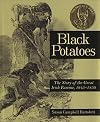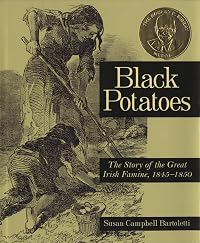
Black Potatoes: The Story of the Great Irish Famine, 1845-1850
by Susan Campbell Bartoletti
On This Page
Description
In 1845, a disaster struck Ireland. Overnight, a mysterious blight attacked the potato crops, turning the potatoes black and destroying the only real food of nearly six million people. Over the next five years, the blight attacked again and again. These years are known today as the Great Irish Famine, a time when one million people died from starvation and disease and two million more fled their homeland. Black Potatoes is the compelling story of men, women, and children who defied landlords show more and searched empty fields for scraps of harvested vegetables and edible weeds to eat, who walked several miles each day to hard-labor jobs for meager wages and to reach soup kitchens, and who committed crimes just to be sent to jail, where they were assured of a meal. It's the story of children and adults who suffered from starvation, disease, and the loss of family and friends, as well as those who died. Illustrated with black and white engravings, it's also the story of the heroes among the Irish people and how they held on to hope. show lessTags
Recommendations





Member Reviews
Bartoletti's account of the Great Irish Famine is like a finely-woven tapestry. Capturing history through personal accounts, actual records, and illustrations, Black Potatoes reads more like a story than a history book. This, perhaps, is the point of her arrangement: behind the larger concept of the Great Irish Famine are all of the personal experiences and political entanglements that allow us to see not only what happened--5 years of the loss of crops--but also who this great tragedy effected. The most interesting segments explored the tension between the Catholic and Protestant faiths (the "We'll feed you if you convert" attitudes of some charities) and the international response toward the Irish famine, particularly how the show more Americans willingly sent money abroad to alleviate hardship, yet harbored prejudice toward Irish immigrants. I liked the consistency of the text's organization, especially how the chapter titles utilized Irish sayings during the famine and contained an excerpt from either Irish literature or Irish faith.
This text seems appropriate for high school students, though to fully appreciate the text, readers need some knowledge about European and American history. I could see incorporating this text into an American literature course as supplemental reading for units studying immigration and its effects on society and literature. show less
This text seems appropriate for high school students, though to fully appreciate the text, readers need some knowledge about European and American history. I could see incorporating this text into an American literature course as supplemental reading for units studying immigration and its effects on society and literature. show less
A very thorough and well written synopsis of the Irish Potato Famine, Black Potatoes provides a well researched and clearly organized look into a commonly neglected period of considerable human suffering. I went into the book with effectively no knowledge of this event, and left feeling something close to an expert.
The book does an excellent job of providing both individual case studies of specific people in the famine from multiple walks of life, and giving a broad overview of the societal and political implications and motivations which impacted the famine. It also provides dozens of artist renderings of famine years, which I thought at first were tacky until I read the text that they were reproduced from the Illustrated London News show more from stories written at the time of the famine. Given this, these photos in fact provide a good reference point to highlight the history addressed in the book.
The book provides a wealth of information but does not become dull or redundant, instead it keeps the reader engaged the whole time. As a new learner on the subject, I felt as though it appropriately provided background knowledge which was necessary to understanding, and clued me in to the historical and political realities which caused and exacerbated the suffering. You get an appropriate feel for how terrible this event really was, from the perspective of the poor living through it, not as a political event to be studied. show less
The book does an excellent job of providing both individual case studies of specific people in the famine from multiple walks of life, and giving a broad overview of the societal and political implications and motivations which impacted the famine. It also provides dozens of artist renderings of famine years, which I thought at first were tacky until I read the text that they were reproduced from the Illustrated London News show more from stories written at the time of the famine. Given this, these photos in fact provide a good reference point to highlight the history addressed in the book.
The book provides a wealth of information but does not become dull or redundant, instead it keeps the reader engaged the whole time. As a new learner on the subject, I felt as though it appropriately provided background knowledge which was necessary to understanding, and clued me in to the historical and political realities which caused and exacerbated the suffering. You get an appropriate feel for how terrible this event really was, from the perspective of the poor living through it, not as a political event to be studied. show less
Black Potatoes tells the story of the famine that afflicted Ireland in the mid to late 1840's and the struggle and bravery of those most effected, the Irish laborers. I was not really sure what to expect when I started reading this book, but was pleasantly surprised. The pages are filled with interesting facts and illustrated with period newspaper drawings. I found the stories as told by those from past generations very compelling. This was an easy read and a hard book for me to put down. The author has an ablility to draw you in and help you feel the human suffering of all and the ultimate perserverence of many. I certainly think this book could be tied into a science course because the cause of the famine, we now know, was due to a show more fungus. I think it's important to draw comparisons and blur the lines between subjects, so students can see that all things are tied to one another, that you don't have history without science and vice versa. show less
Bartoletti expertly describes the events that led to mass Irish starvation and emigration. Even though the tone was very objective, it did show how the British could have done so much more to help the Irish people. Many British believed that the terrible potato blight was meant to teach the Irish a lesson and encourage them to change their ways. The British continued during these years to export massive amounts of food grown in Ireland that could have saved the lives of the starving Irish. The British continued to raise the rents for landowners who then had to pass that increase off to their own tenant farmers. Landowners abandoned their land because the system did not work. Many farmers, even whole villages, were evicted because they show more could not pay their rent. There were some efforts to help from British politicians, such as the import of Indian corn from America, but these gestures often made the person politically unpopular. For the most part, the Irish were left to deal with this immense problem of not having enough food to sustain their population on their own. With the help of relatives in the United States, many Irish were able to emigrate.
The potato was the major staple of the Irish diet. The average person ate between seven to fifteen pounds of potatoes every day (page 7). The blight literally struck and destroyed fields of potatoes overnight. Most people were hard-working peasant farmers, and when their livelihood and source of food was completely destroyed, it was horribly dehumanizing. Some roamed the countryside; some worked hard labor for a scrap of food at the end of the day; some went to workhouses where the conditions were terrible; some were transported to the penal colony of Australia; others booked passage on crowded ships to America. Bartoletti carries the specific stories of a few people through the book, giving the reader updates of their life story as it has been pieced together in history. The Irish culture was not lost, and the author does a beautiful job crediting the Irish people’s strength. This book is decorated with actual pen and ink sketches of the time period. It was a real joy to read and incredibly informative. show less
The potato was the major staple of the Irish diet. The average person ate between seven to fifteen pounds of potatoes every day (page 7). The blight literally struck and destroyed fields of potatoes overnight. Most people were hard-working peasant farmers, and when their livelihood and source of food was completely destroyed, it was horribly dehumanizing. Some roamed the countryside; some worked hard labor for a scrap of food at the end of the day; some went to workhouses where the conditions were terrible; some were transported to the penal colony of Australia; others booked passage on crowded ships to America. Bartoletti carries the specific stories of a few people through the book, giving the reader updates of their life story as it has been pieced together in history. The Irish culture was not lost, and the author does a beautiful job crediting the Irish people’s strength. This book is decorated with actual pen and ink sketches of the time period. It was a real joy to read and incredibly informative. show less
When I first picked up this book I was not looking forward to reading it. It looked dry, partially because of the cover, and the drawings inside. However, when I started reading it I got hooked. Every page I wanted to know more about what had happened- and it seemed with every chapter things got worse, so I wanted to know how it would be resolved. In this way it read like a novel, where the main character suffers over and over (like we read about in Writing Magic.)
As I was reading it I was intrigued by how many key points were made about the history of the famine in relation to trends in world history overall. Every key teaching point about history seemed to be in this book- from the root causes of problems in capitalism, to the role show more of foreign imperialism, religion in politics, international aid, public aid, change in cultural tradition in periods of struggle, to even just the history of the soup kitchen. These key understandings made me realize that this would be an excellent book to teach alongside many other Social Studies books or texts. I thought of many other types of books that this could connect to: from books about famine in other places in the modern world, to books about Irish immigrants in America in the 1800s. I think there are some very strong links to be made across countries and time periods. Also, some of the key historical facts made me think of some related books and movies: Open Veins of Latin America (Eduardo Galeano) -imperialism in Latin America, The Global Banquet: Politics of Food video, Poto Mitan: Haitian Women, Pillars of the Economy video.
I think when presenting this textbook to high school students you would have to be careful of the risk of their initial impressions. I think that the visuals don't actually help- after awhile they all look the same. They also create a certain amount of distance for the reader when thinking about the topic- they look old, and less human because they are drawings. This book might work well as a read aloud- as the dramatic nature of the text would keep kids engaged. show less
As I was reading it I was intrigued by how many key points were made about the history of the famine in relation to trends in world history overall. Every key teaching point about history seemed to be in this book- from the root causes of problems in capitalism, to the role show more of foreign imperialism, religion in politics, international aid, public aid, change in cultural tradition in periods of struggle, to even just the history of the soup kitchen. These key understandings made me realize that this would be an excellent book to teach alongside many other Social Studies books or texts. I thought of many other types of books that this could connect to: from books about famine in other places in the modern world, to books about Irish immigrants in America in the 1800s. I think there are some very strong links to be made across countries and time periods. Also, some of the key historical facts made me think of some related books and movies: Open Veins of Latin America (Eduardo Galeano) -imperialism in Latin America, The Global Banquet: Politics of Food video, Poto Mitan: Haitian Women, Pillars of the Economy video.
I think when presenting this textbook to high school students you would have to be careful of the risk of their initial impressions. I think that the visuals don't actually help- after awhile they all look the same. They also create a certain amount of distance for the reader when thinking about the topic- they look old, and less human because they are drawings. This book might work well as a read aloud- as the dramatic nature of the text would keep kids engaged. show less
A thorough study of the period of history known as the Great Irish Famine (or in Ireland, the Great Hunger). Bartoletti conducted a great deal of research in Ireland finding primary documents, so she is able to talk about this horrible period in history with the addition of the real experience of actual people. Across ten chapters, readers learn about the events and conditions that unraveled between 1845 and 1850. One part of the tragedy of the potato blight is the economic conditions of Ireland at the time; much of the farmland was owned by English landlords, and the farmers sold certain cash crops to pay the rent. They never kept those cash crops and subsisted on potatoes alone. When the potatoes were inedible, the conditions grew show more dire around the country. Bartoletti covers all of this and more of the details in an approachable way and with accompanying 19th century drawings. show less
This historical narrative was fabulous. The Irish Potato Famine of 1845-1850 was a dark time for these devout and lively people. This book displays many personal accounts of Famine survivors' ancestors and intriguing facts throughout. The Irish were left without a source of food or income after the blight struck. English government officials did little to help them. Many relief aids came, the second year of the famine, from all over. Empathetic Americans, English Protestants, neighbors that could, and Irish Emigrants in America sent money and opened soup kitchens to subdue the pains of hunger felt at this time. Situations worsened as the Irish were turned out of their homes, and many applied at the dreaded workhouses, served the public show more work programs, or left their beloved country. The Irish still present, though emaciated and weak, decided to fight back against the English, but did not succeed at forming an army or gathering arms. Reforms were later made for property, International support, and voting platforms, however, many Irish retain their bitter anger towards the British even today.
I would definitely read this book with a classroom. It was educational and entertaining. It would be great to tie in with a class discussion on problems in today's society with starvation. I love the point the author made that a famine is not a lack of food, just the lack of the distribution of the food. There was food in Ireland, but the people that needed it most did not receive it. I would also say that this book would be a good way to discuss politics and get students' opinions on the amount of government interaction taken during this era.
I really liked this book. I am Scot-Irish, so any book like this just fascinates me. I had no idea of the longevity of the blight, nor the depth of its repercussions on the Irish people. I love how so many different groups and peoples donated to the cause. I just realized how America has, from the beginning, tried to solve other countries' problems. It was just kind of funny to me. The author made so many great connections and admitted all of the failure of the British government, but ended it on a positive note. I agree with her that there is, like in most mistakes, much to be learned. show less
I would definitely read this book with a classroom. It was educational and entertaining. It would be great to tie in with a class discussion on problems in today's society with starvation. I love the point the author made that a famine is not a lack of food, just the lack of the distribution of the food. There was food in Ireland, but the people that needed it most did not receive it. I would also say that this book would be a good way to discuss politics and get students' opinions on the amount of government interaction taken during this era.
I really liked this book. I am Scot-Irish, so any book like this just fascinates me. I had no idea of the longevity of the blight, nor the depth of its repercussions on the Irish people. I love how so many different groups and peoples donated to the cause. I just realized how America has, from the beginning, tried to solve other countries' problems. It was just kind of funny to me. The author made so many great connections and admitted all of the failure of the British government, but ended it on a positive note. I agree with her that there is, like in most mistakes, much to be learned. show less
Members
- Recently Added By
Lists

Pleasant Surprises: Books That Exceeded Our Expectations
418 works; 143 members

The Story of the World: Activity Book Four: The Modern Age
333 works; 2 members

Robert F. Sibert Informational Book Medal
102 works; 1 member
Author Information

25+ Works 7,988 Members
A former 8th-grade English teacher, Susan Campbell Bartoletti writes fiction and nonfiction for all ages. Black Potatoes is the winner of the ALA Sibert Award for Best Information book, the NCTE Orbis Pictus Award for Distinguished Nonfiction, and the SCBWI Golden Kite Nonfiction award. She lives with her family in Moscow, PA.
Awards and Honors
Awards
Distinctions
Common Knowledge
- People/Characters
- Robert Peel; John Russell, 1st Earl Russell; Victoria, Queen of the United Kingdom
- Important places
- Ireland; Dublin, Ireland; Grosse Isle, Québec, Canada
- Important events
- Victorian Era (1837 | 1901); Irish Potato Famine (1845 | 1850)
- First words
- In 1845 a disaster struck Ireland.
Classifications
Statistics
- Members
- 561
- Popularity
- 52,522
- Reviews
- 68
- Rating
- (4.00)
- Languages
- Dutch, English
- Media
- Paper, Audiobook, Ebook
- ISBNs
- 14
- UPCs
- 2
- ASINs
- 6