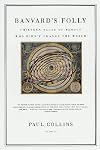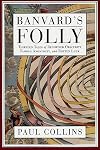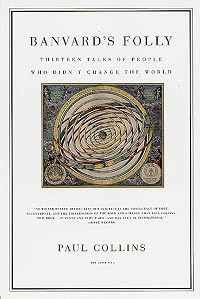
Banvard's Folly: Thirteen Tales of People Who Didn't Change the World
by Paul S. Collins
On This Page
Description
The historical record crowns success. Those enshrined in its annals are men and women whose ideas, accomplishments, or personalities have dominated, endured, and most important of all, found champions. John F. Kennedy's Profiles in Courage, Giorgio Vasari's Lives of the Artists, and Samuel Johnson's Lives of the Poets are classic celebrations of the greatest, the brightest, the eternally constellated.Paul Collins' Banvard's Folly is a different kind of book. Here are thirteen unforgettable show more portraits of forgotten people: men and women who might have claimed their share of renown but who, whether from ill timing, skullduggery, monomania, the tinge of madness, or plain bad luck--or perhaps some combination of them all--leapt straight from life into thankless obscurity. Among their number are scientists, artists, writers, entrepreneurs, and adventurers, from across the centuries and around the world. They hold in common the silenced aftermath of failure, the name that rings no bells.Collins brings them back to glorious life. John Banvard was an artist whose colossal panoramic canvasses (one behemoth depiction of the entire eastern shore of the Mississippi River was simply known as "The Three Mile Painting") made him the richest and most famous artist of his day. . . before he decided to go head to head with P. T. Barnum. Rene Blondot was a distinguished French physicist whose celebrated discovery of a new form of radiation, called the N-Ray, went terribly awry. At the tender age of seventeen, William Henry Ireland signed "William Shakespeare" to a book and launched a short but meteoric career as a forger of undiscovered works by the Bard -- until he pushed his luck too far. John Symmes, a hero of the War of 1812, nearly succeeded in convincing Congress to fund an expedition to the North Pole, where he intended to prove his theory that the earth was hollow and ripe for exploitation; his quixotic quest counted Jules Verne and Edgar Allan Poe among its greatest admirers.Collins' love for what he calls the "forgotten ephemera of genius" give his portraits of these figures and the other nine men and women in Banvard's Folly sympathetic depth and poignant relevance. Their effect is not to make us sneer or p0revel in schadenfreude; here are no cautionary tales. Rather, here are brief introductions-acts of excavation and reclamation-to people whom history may have forgotten, but whom now we cannot." show lessTags
Recommendations











Member Reviews
Most of the people in this collection tried so hard to succeed that you can't help but root for them, even knowing that being included in a book of this title, they failed. Well, that isn't entirely true. Ephraim Bull spent years cross-breeding and cultivating grapes until he created the Concord, which became the most commercially successful grape. His failure was no fault of his own, just that the law didn't allow patents on life forms, including new breeds of plants. This allowed every nursery in the country to buy one of his grape vines and start their own Concord business. Bull, who lived long enough to see a man named Welch become famous for his Concord grape juice, died penniless after losing his money trying to introduce another show more new grape.
Other people in the book include the man who built a precursor to the modern subway, another who spent his life trying to get his international musical language to catch on, and the stories of William Ireland and Robert Coates. Ireland, a neglected teenager, forged Shakespeare's signature and gave his "discovery" to his father as a way to gain approval. His father's regard for the boy's treasure hunting rose to the point that William was able to pen several poems and plays and pass them off as newly found works by Shakespeare.
Coates was another who adored Shakespeare, but he wanted to be an actor. He arrived in Bath in 1809, and made a spectacle of himself by adorning his clothes, shoes and cane with diamonds. His carriage was in the shape of a giant clam. And he put on performances of Romeo and Juliet at the local theater, but in his shows Romeo was the only star. His death scene would go on and on, and he would even get up and repeat it, as the audience would encourage him to do. Coates could fill the theater night after night as everyone loved to watch his horrible acting, and he took their heckles for encouragement. show less
Other people in the book include the man who built a precursor to the modern subway, another who spent his life trying to get his international musical language to catch on, and the stories of William Ireland and Robert Coates. Ireland, a neglected teenager, forged Shakespeare's signature and gave his "discovery" to his father as a way to gain approval. His father's regard for the boy's treasure hunting rose to the point that William was able to pen several poems and plays and pass them off as newly found works by Shakespeare.
Coates was another who adored Shakespeare, but he wanted to be an actor. He arrived in Bath in 1809, and made a spectacle of himself by adorning his clothes, shoes and cane with diamonds. His carriage was in the shape of a giant clam. And he put on performances of Romeo and Juliet at the local theater, but in his shows Romeo was the only star. His death scene would go on and on, and he would even get up and repeat it, as the audience would encourage him to do. Coates could fill the theater night after night as everyone loved to watch his horrible acting, and he took their heckles for encouragement. show less
This book wasn't what I was expecting, for the worse. What seems like a collection of stories about the person who came in second, who just missed the patent office by 10 minutes and ended up missing out to Graham Bell or Thomas Edison (these aren't in the book, just using them as examples)... what happened to that person on the cusp of fame but just missed out. There are a few stories like that in this book, but then you also get stories about a guy who really just sounds like a fraudster. The whole book is just very uneven, I few stories had me on the edge of my seat, the others felt like a slog through the Sahara with low water supplies.
Paul Collins (of Weekend Stubble blog-fame) offers up quite a fantastic cast of forgotten characters in his 2001 book Banvard's Folly: Thirteen Tales of Renowned Obscurity, Famous Anonymity, and Rotten Luck. Collins writes in the preface that he grew curious about all the "other" people that one finds mentioned in historical documents - not the ones we know, but those we've never heard of: "... buried in these footnotes of history are brilliant, fatally flawed thinkers who rose to dizzying heights of intellect and even fame, only to come crashing down into disaster, ridicule, or just the utter silence of oblivion."
From George Psalmanazar, an eighteenth-century Dutch huckster who pretended to be from Formosa and fooled most of London for show more a few years (and even wrote a lengthy history of the island made up of complete nonsense) to Concord grape developer Ephriam Wales Bull and Civil War veteran A.J. Pleasonton - who was convinced that sitting under blue glass would cure what ails you - and beyond, Collins' subjects never fail to amuse, intrigue, and tickle the curiosity. As a source of short character sketches of these folks, it seems unlikely that Banvard's Folly will be surpassed anytime soon.
While there were a couple of minor errors in the book (Edgar Allan Poe's death was not caused by rabies - even if that theory has come into popularity recently - and Jefferson was not inaugurated in 1806), Collins has done his research well, and it shows. I don't hesitate at all in recommending this book; it's well worth a read.
http://philobiblos.blogspot.com/2006/09/book-review-banvards-folly.html show less
From George Psalmanazar, an eighteenth-century Dutch huckster who pretended to be from Formosa and fooled most of London for show more a few years (and even wrote a lengthy history of the island made up of complete nonsense) to Concord grape developer Ephriam Wales Bull and Civil War veteran A.J. Pleasonton - who was convinced that sitting under blue glass would cure what ails you - and beyond, Collins' subjects never fail to amuse, intrigue, and tickle the curiosity. As a source of short character sketches of these folks, it seems unlikely that Banvard's Folly will be surpassed anytime soon.
While there were a couple of minor errors in the book (Edgar Allan Poe's death was not caused by rabies - even if that theory has come into popularity recently - and Jefferson was not inaugurated in 1806), Collins has done his research well, and it shows. I don't hesitate at all in recommending this book; it's well worth a read.
http://philobiblos.blogspot.com/2006/09/book-review-banvards-folly.html show less
This was a quite lovely read, about forgotten people in barely forgotten times. Only in America would we consider these gentlemen and gentlewomen to be 'losers', simply because they had an idea that others stole or their achievements have been forgotten by each succeeding generation. Some of them were just plain eccentrics, and I think we can look at the 21st century and see we have the same idealists today.
The title derives from John Banvard, who created grand works of art on rollout canvas, which drew standing-room only crowds in the 19th century. He shone before the age of cinema, which basically made his type of work obsolete. My favorite story was that of Rene Blondlot, a French scientist who 'discovered' the N-Ray, which really show more was nothing but some changes of light prisms. He believed deeply that he had discovered something extraordinary, and was subsequently laughed out of existence when his theory was disproved.
Here's to the 'losers'...bless them all.
Book Season = YearRound (enjoy!) show less
The title derives from John Banvard, who created grand works of art on rollout canvas, which drew standing-room only crowds in the 19th century. He shone before the age of cinema, which basically made his type of work obsolete. My favorite story was that of Rene Blondlot, a French scientist who 'discovered' the N-Ray, which really show more was nothing but some changes of light prisms. He believed deeply that he had discovered something extraordinary, and was subsequently laughed out of existence when his theory was disproved.
Here's to the 'losers'...bless them all.
Book Season = YearRound (enjoy!) show less
This was a fun little book, and one of the first that I was reading for fun once I moved on to library school. Here is part of what I wrote back when I read it in 2002:
>>All the stories were interesting to read, and in some instances, shed further light on the late 19th century and the American literature of that period. I think the book succeeded not only in telling of men like Banvard or Psalmanazar, which it does in bringing to life such persons with good research and clear writing, but also brings in the context and eras in which the people described lived helping thus to explain how some of them were successful, if for a brief time or how certain frauds could work. I always find interesting to look at the societies as much as the show more people. This is a book I would gladly recommend. show less
>>All the stories were interesting to read, and in some instances, shed further light on the late 19th century and the American literature of that period. I think the book succeeded not only in telling of men like Banvard or Psalmanazar, which it does in bringing to life such persons with good research and clear writing, but also brings in the context and eras in which the people described lived helping thus to explain how some of them were successful, if for a brief time or how certain frauds could work. I always find interesting to look at the societies as much as the show more people. This is a book I would gladly recommend. show less
While doing research for a class one of the SFPL librarians mentioned that this book might be helpful. The title sounded familiar, but it wasn't until she brought over the book that the lightening hit: the author was Paul S. Collins. His book "Sixpence House" is wonderful (feel free to check my review), and in that book he actually mentions working on this book. How perfect that my schoolwork connected me to it!
Anyway, the book is great. Some of the stories are less interesting than others, but even so the writing is brilliant throughout. Bonus: one of the stories describes a specific location in San Francisco, and using Google Maps Street View you can actually see what he's talking about.
Anyway, the book is great. Some of the stories are less interesting than others, but even so the writing is brilliant throughout. Bonus: one of the stories describes a specific location in San Francisco, and using Google Maps Street View you can actually see what he's talking about.
Collins collects stories of mostly-forgotten innovators and fantasists in the arts, literature, agriculture, cosmology, inter alia. We get a man who invented a universal language composed of musical notes (“Beethoven’s 5th begins by saying something about Wednesday”), a polyglot Irish shyster in 18th c. London begging alms in Latin, blue-light baths proffered as an infallible remedy for anything from rheumatism to railway collisions, and a natural theology of universal geometry in accord with the Anthropic Principle that imagined intelligent minds on Jupiter, Saturn and Uranus. Some chapters fascinate more than others, and sometimes the prose falls flat, but overall an entertaining read.
Roy Pitz Best Blonde
Newcastle Brown Ale
Roy Pitz Best Blonde
Newcastle Brown Ale
Members
- Recently Added By
Lists

Read This Next
120 works; 3 members
Author Information

12+ Works 4,476 Members
Some Editions
Work Relationships
Contains
Common Knowledge
- Original publication date
- 2001
- People/Characters
- John Banvard; René Blondlot; William Henry Ireland; Jean François Sudre; John Cleves Symmes; George Psalmanazar (show all 9); Ephraim Wales Bull; A.J. Pleasonton; Delia Bacon
- Important places
- London, England, UK; Stratford-upon-Avon, Warwickshire, England, UK
- Dedication
- THIS BOOK IS DEDICATEDTO MY PREDECESSORS:
Van Wyck Brooks
Isaac D'israeli
Stewart Holbrook
Edmund Pearson
AND TO ANY PUBLISHER WHO WILL PUT THEIR WORKS BACK IN PRINT. - Blurbers
- Eggers, David; Vowell, Sarah
Classifications
- Genres
- Nonfiction, Biography & Memoir, General Nonfiction, History
- DDC/MDS
- 920.02 — History & geography Biographies, Genealogy, Healdry Biographies General and collective by localities World Leaders
- LCC
- CT9990 .C64 — Auxiliary Sciences of History Biography Biography Biography. By subject Other miscellaneous groups
- BISAC
Statistics
- Members
- 561
- Popularity
- 52,672
- Reviews
- 20
- Rating
- (3.87)
- Languages
- Dutch, English, Italian
- Media
- Paper, Audiobook, Ebook
- ISBNs
- 9
- ASINs
- 4