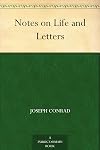
Notes on Life and Letters
by Joseph Conrad
On This Page
Description
Polish-born author Joseph Conrad is best known as one of the finest prose stylists ever to have written in English. In addition to producing such masterpieces as Heart of Darkness and Lord Jim, Conrad also wrote prodigiously in his private life, producing a large body of correspondence. This fascinating collection brings together a large volume of Conrad's letters, personal essays, and other autobiographical writings..
Tags
Recommendations


















Member Reviews
The title might mislead some since it sounds like one of those thick “Life and Letters” biographies that were fashionable a century ago. Instead, this book is a miscellany, collecting some of Conrad’s book reviews and essays. A such, it is a mixed bag.
The collection is divided into two parts, with the “Letters” sections, his reviews, coming first. The first writer treated, after an essay on books, is Henry James. I enjoyed reading what one great writer appreciated about another. Among the keen insights was one I fond particularly apt: James refuses to fulfill the desire for finality that readers want from writers. Some of the other authors he expresses his admiration for are Turgenev, Maupassant, and Stephen Crane. Less show more interesting were some lukewarm and ironic reviews of books now forgotten.
The second section is entitled “Life,” but that’s only true in a limited sense. It contains Conrad’s views on some topical political issues of the day. These range from the Russo-Japanese war and the question of Polish independence to the sinking of the Titanic. Particularly the latter still makes for great reading because of Conrad’s mourning for the lost passengers and seamen mixed with his white-hot scorn for the irresponsible “bigger is better” marketing of the commercial interests.
Conrad is a great writer, but very much of his time. This is not only evident in his elaborate, century-old prose, but also in his attitudes toward people of color and women. Toward the first, he displays a benign colonial superiority, toward the latter, a chivalrous patronization. Admittedly, there were indeed worse ways to think back then, and still are. And it's a futile wish that our favorite writers should be politically correct according to our standards.
He is less charitable toward Russians and Germans (“There was little to choose between the methods of Russian barbarism, which were both crude and rotten, and the cultivated brutality tinged with contempt of Germany’s superficial, grinding civilisation”). His feeling is understandable, given the fate of his native land, Poland, at their hands. As I read the first few essays in the section, my interest waned. But then I was pulled up by a lengthy account of his fatefully-timed visit back to Cracow, arriving just before the guns of August, and kept there by the changed circumstance longer than planned, narrowly escaping being held by the Habsburg empire as an enemy alien. This essay alone made the book worth reading. Five stars for it and the Henry James and first of the Titanic essays, three stars overall. show less
The collection is divided into two parts, with the “Letters” sections, his reviews, coming first. The first writer treated, after an essay on books, is Henry James. I enjoyed reading what one great writer appreciated about another. Among the keen insights was one I fond particularly apt: James refuses to fulfill the desire for finality that readers want from writers. Some of the other authors he expresses his admiration for are Turgenev, Maupassant, and Stephen Crane. Less show more interesting were some lukewarm and ironic reviews of books now forgotten.
The second section is entitled “Life,” but that’s only true in a limited sense. It contains Conrad’s views on some topical political issues of the day. These range from the Russo-Japanese war and the question of Polish independence to the sinking of the Titanic. Particularly the latter still makes for great reading because of Conrad’s mourning for the lost passengers and seamen mixed with his white-hot scorn for the irresponsible “bigger is better” marketing of the commercial interests.
Conrad is a great writer, but very much of his time. This is not only evident in his elaborate, century-old prose, but also in his attitudes toward people of color and women. Toward the first, he displays a benign colonial superiority, toward the latter, a chivalrous patronization. Admittedly, there were indeed worse ways to think back then, and still are. And it's a futile wish that our favorite writers should be politically correct according to our standards.
He is less charitable toward Russians and Germans (“There was little to choose between the methods of Russian barbarism, which were both crude and rotten, and the cultivated brutality tinged with contempt of Germany’s superficial, grinding civilisation”). His feeling is understandable, given the fate of his native land, Poland, at their hands. As I read the first few essays in the section, my interest waned. But then I was pulled up by a lengthy account of his fatefully-timed visit back to Cracow, arriving just before the guns of August, and kept there by the changed circumstance longer than planned, narrowly escaping being held by the Habsburg empire as an enemy alien. This essay alone made the book worth reading. Five stars for it and the Henry James and first of the Titanic essays, three stars overall. show less
At over one hundred years separation it is a refresher to hear again of the matters that were pertinent to the minds of particular contemporary writers; especially so because of the singularity of Conrad's life's experiences.
The "Letters" section contains reviews. The article on Henry James is the best of these. I enjoyed his appreciation for the master and James' unique talent. Conrad's other reviews were less so absorbing.
By far the section that kept up interest was his essays. Conrad's views on the partition of Poland in the Eighteenth Century, squeezed by German and Russian rapacity, is one of outright condemnation of her two neighbours, and mildly less so of Austria-Hungary. His language here is contemptuous. Conrad sees Poland's show more cultural hopes lying in Western Europe and that her aspirations are thwarted at every turn by Russia and Germany.
There is also an engaging account of his return to Poland just as the outbreak of World War 1 occurs. Few are prepared for the subsequent spiral into danger once the assassination in Sarajevo takes place. Once it dawns on Poles, Conrad notes his fellow countrymen's singular determination to mobilise. He and his family needs flee immediately.
Included in this volume too are his views on the Titanic disaster. He attacks the "building big" concept, seeing it as defective for its failure to include safety measures that match the big idea. He scorns the architects for neglecting to adapt the integrity of the whole ship in their schemes at the expense of grandeur in performance and capacity. Conrad offers his own experience at sea and provides some suggestions of varying usefulness, I think, that ought to be incorporated in the design of the then burgeoning fleets of ocean liners. show less
The "Letters" section contains reviews. The article on Henry James is the best of these. I enjoyed his appreciation for the master and James' unique talent. Conrad's other reviews were less so absorbing.
By far the section that kept up interest was his essays. Conrad's views on the partition of Poland in the Eighteenth Century, squeezed by German and Russian rapacity, is one of outright condemnation of her two neighbours, and mildly less so of Austria-Hungary. His language here is contemptuous. Conrad sees Poland's show more cultural hopes lying in Western Europe and that her aspirations are thwarted at every turn by Russia and Germany.
There is also an engaging account of his return to Poland just as the outbreak of World War 1 occurs. Few are prepared for the subsequent spiral into danger once the assassination in Sarajevo takes place. Once it dawns on Poles, Conrad notes his fellow countrymen's singular determination to mobilise. He and his family needs flee immediately.
Included in this volume too are his views on the Titanic disaster. He attacks the "building big" concept, seeing it as defective for its failure to include safety measures that match the big idea. He scorns the architects for neglecting to adapt the integrity of the whole ship in their schemes at the expense of grandeur in performance and capacity. Conrad offers his own experience at sea and provides some suggestions of varying usefulness, I think, that ought to be incorporated in the design of the then burgeoning fleets of ocean liners. show less
¿Cuál fue la reacción de Conrad al hacerse público el hundimiento del Titanic? ¿Cuál era su postura ante la hoy tan debatida «cuestión polaca»? ¿Qué opinaba de sus colegas, fueran estos H. James o Daudet, Anatorle France o Maupassant, Crane o Turgueniev?
La personalidad de Conrad, oculta siempre bajo las máscaras y entresijos de la ficción, se revela clara y precisa en estas notas sin las limitaciones que implica toda trama litararia. Conozcamos las preocupaciones de un autor que cuando se lanza a reflexionar procura hacerlo siempre con una independencia y autenticidad realmente inusuales.
La personalidad de Conrad, oculta siempre bajo las máscaras y entresijos de la ficción, se revela clara y precisa en estas notas sin las limitaciones que implica toda trama litararia. Conozcamos las preocupaciones de un autor que cuando se lanza a reflexionar procura hacerlo siempre con una independencia y autenticidad realmente inusuales.
Nov 3, 2020Spanish
Ratings
Members
- Recently Added By
Author Information

723+ Works 90,953 Members
Joseph Conrad is recognized as one of the 20th century's greatest English language novelists. He was born Jozef Konrad Nalecz Korzeniowski on December 3, 1857, in the Polish Ukraine. His father, a writer and translator, was from Polish nobility, but political activity against Russian oppression led to his exile. Conrad was orphaned at a young age show more and subsequently raised by his uncle. At 17 he went to sea, an experience that shaped the bleak view of human nature which he expressed in his fiction. In such works as Lord Jim (1900), Youth (1902), and Nostromo (1904), Conrad depicts individuals thrust by circumstances beyond their control into moral and emotional dilemmas. His novel Heart of Darkness (1902), perhaps his best known and most influential work, narrates a literal journey to the center of the African jungle. This novel inspired the acclaimed motion picture Apocalypse Now. After the publication of his first novel, Almayer's Folly (1895), Conrad gave up the sea. He produced thirteen novels, two volumes of memoirs, and twenty-eight short stories. He died on August 3, 1924, in England. (Bowker Author Biography) show less
Series
Belongs to Publisher Series
Common Knowledge
- Original title
- Notes on Life & Letters
- Original publication date
- 1921
- Original language
- English
Classifications
Statistics
- Members
- 119
- Popularity
- 273,736
- Reviews
- 3
- Rating
- (3.83)
- Languages
- English, Spanish
- Media
- Paper, Ebook
- ISBNs
- 42
- ASINs
- 14