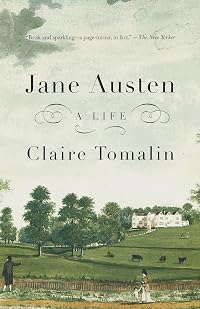
Jane Austen: A Life
by Claire Tomalin
On This Page
Description
At her death in 1817, Jane Austen left the world six of the most beloved novels written in English—but her shortsighted family destroyed the bulk of her letters; and if she kept any diaries, they did not survive her. Now acclaimed biographer Claire Tomalin, author of A Life of My Own, has filled the gaps in the record, creating a remarkably fresh and convincing portrait of the woman and the writer.While most Austen biographers have accepted the assertion of Jane's brother Henry that show more "My dear Sister's life was not a life of events," Tomalin shows that, on the contrary, Austen's brief life was fraught with upheaval. Tomalin provides detailed and absorbing accounts of Austen's ill-fated love for a young Irishman, her frequent travels and extended visits to London, her close friendship with a worldly cousin whose French husband met his death on the guillotine, her brothers' naval service in the Napoleonic wars and in the colonies, and thus shatters the myth of Jane Austen as a sheltered and homebound spinster whose knowledge of the world was limited to the view from a Hampshire village.
. show less
Tags
Recommendations















Member Recommendations

lilithcat Tomalin is one of the finest biographers writing today, with a real knack for explaining the societal context in which her subject lived. Readers of The Invisible Woman will find the same excellent work in Jane Austen: A Life, and vice versa.
20

Member Reviews
An admirably even-handed telling of a life that was sparsely documented despite Austen's popular novels. Tomalin pulls a narrative out of the histories of other better known Austen family members and their friends and neighbors. She discusses the novels as a whole in a way that was new to me. There is a convincing narrative of what life may have been like for JA, the crises and satisfactions.
A photo is included of the most long-lived of Jane's brothers who died at 91, an admiral. The caption identifies him and states that he preserved Jane's letters to him for fifty years but that upon his death his daughter Fanny burned them without consulting with any other family members. I hear much literary historian's regret in that brief show more statement.
The author mentions that more than 500 books were published on the topic of Jane Austen just in the twenty years 1951 - 1971. She somehow doesn't get bogged down in this sea of other opinions but keeps this life story clear.
I am looking forward to reading another biog by Tomalin. show less
A photo is included of the most long-lived of Jane's brothers who died at 91, an admiral. The caption identifies him and states that he preserved Jane's letters to him for fifty years but that upon his death his daughter Fanny burned them without consulting with any other family members. I hear much literary historian's regret in that brief show more statement.
The author mentions that more than 500 books were published on the topic of Jane Austen just in the twenty years 1951 - 1971. She somehow doesn't get bogged down in this sea of other opinions but keeps this life story clear.
I am looking forward to reading another biog by Tomalin. show less
This is a brilliant biography of Jane Austen; I anticipated it would be, as I read the author's biography of Dickens back in 2012. She combines excellent, detailed research with an ability to tell a story of the subject's life that combines colour, incident and intelligent speculation based on her sources. This is more than just a literary biography, but also a history of the Austen and Leigh families, tracing their history back to the late 17th century; one of her great uncles born in the 17th century survived until Jane's teenage years. George Austen's clerical life combined with Cassandra Leigh's aristocratic descent in a successful marriage that produced six sons and two daughters. Jane was the shortest lived in a family that show more generally avoided the early mortality of most large families at that time and for long afterwards. There were plenty of scandals and jealousies and tensions as in all families, though Jane seems to have attempted to get on with all factions. Her literary career was very uneven, with her producing lots of short stories and poems from her teenage years, and before her 25th birthday having already written the first versions of what would later be published as Pride and Prejudice, Sense and Sensibility and (after her death) Northanger Abbey. Then she wrote almost nothing in the first decade of the 19th century, a decade punctuated by the death of her father, and moves around the country, including an unhappy period in Bath, before her final literary period in Chawton, near Winchester. In this small village her activities are described by the author as "making the very modest house into one of the great sites of literary history" - in a period of just six years Sense and Sensibility was published in 1811, Pride and Prejudice in 1813 – and three further novels were written here, Mansfield Park, Emma and Persuasion (Northanger Abbey was written earlier in the 1790s). She also wrote the first 12 chapters of a new novel which was eventually published as Sanditon over a century later. Her early death at the age of 41 in 1817 in Winchester deprived the world of a great literary talent - if she had lived into her 70s as did her father and most of her siblings (and her mother lived to 87) just imagine what further works would have flowed from her pen. A great biography. show less
After reading reviews of this books, I had sort of written it off. I got the impression that it was too speculative and jumped to too many conclusions about what Jane Austen must have been like. But I saw it at the library and figured it wouldn't hurt to read the first chapter and make my own opinion.
I'm glad I did because I ended up loving this biography. Certainly it's true that it's hard to know what Austen was really like or really thinking or really looked like. Most of her correspondence was destroyed by her family and any journals she may have kept are also lost. But there is some remaining correspondence and there is much known about her large family and neighbors. Also, her movements are known and her finances as well. All of show more these things combined paint a much clearer picture about what her life must have been like than I expected. Certainly we don't know her reactions to her life events, but knowing the events themselves is very informative.
There were three interesting large points for me. One were how large her family was and how close she was to them. They all led fairly different lives with varying degrees of success but they seem to be pretty close and definitely supported each other monetarily and by visits to help with child births, child rearing, and death. A second was how different her environs was from what she wrote of in her books. Her books are largely concerned with upper middle class or upper class families living in a small, fairly stable circle of country families. Austen's life was quite different. Her neighbors especially were anything but stable gentry, particularly in her youth and young adulthood. There was lots of moving around and lots of scandal. A third was how her movements influenced her writing. I hadn't realized how long a period came between her leaving her childhood home and moving to Chawton, a residence provided by her brother, Edward. There were almost 10 years here where she moved around, living in rentals in Bath and visiting family and former neighbors. During this time she wrote almost nothing. Her three early books, Northanger Abbey, Sense and Sensibility, and Pride and Prejudice were written while she was still in her childhood home and Mansfield Park, Emma, and Persuasion were written at Chawton. The publication dates don't necessarily reflect this timeline, but the timeline of when they were actually written.
So all in all, I found this both readable and informative. Some conclusions are drawn which it's probably good to approach with a dose of skepticism, but overall I found it very moderate and reasonable in trying to piece together Austen's life. show less
I'm glad I did because I ended up loving this biography. Certainly it's true that it's hard to know what Austen was really like or really thinking or really looked like. Most of her correspondence was destroyed by her family and any journals she may have kept are also lost. But there is some remaining correspondence and there is much known about her large family and neighbors. Also, her movements are known and her finances as well. All of show more these things combined paint a much clearer picture about what her life must have been like than I expected. Certainly we don't know her reactions to her life events, but knowing the events themselves is very informative.
There were three interesting large points for me. One were how large her family was and how close she was to them. They all led fairly different lives with varying degrees of success but they seem to be pretty close and definitely supported each other monetarily and by visits to help with child births, child rearing, and death. A second was how different her environs was from what she wrote of in her books. Her books are largely concerned with upper middle class or upper class families living in a small, fairly stable circle of country families. Austen's life was quite different. Her neighbors especially were anything but stable gentry, particularly in her youth and young adulthood. There was lots of moving around and lots of scandal. A third was how her movements influenced her writing. I hadn't realized how long a period came between her leaving her childhood home and moving to Chawton, a residence provided by her brother, Edward. There were almost 10 years here where she moved around, living in rentals in Bath and visiting family and former neighbors. During this time she wrote almost nothing. Her three early books, Northanger Abbey, Sense and Sensibility, and Pride and Prejudice were written while she was still in her childhood home and Mansfield Park, Emma, and Persuasion were written at Chawton. The publication dates don't necessarily reflect this timeline, but the timeline of when they were actually written.
So all in all, I found this both readable and informative. Some conclusions are drawn which it's probably good to approach with a dose of skepticism, but overall I found it very moderate and reasonable in trying to piece together Austen's life. show less
This is a painstakingly researched bio that proves that Austen was not the home-bound wallflower her reputation makes her out to be. Yes, romance factored little in her life, but she did have more than one opportunity and was even engaged for a matter of hours! She had a large family and circle of friends and seems to have been constantly visiting someone, though not always at her own wishes as money was a constant source of worry for Jane and her unmarried sister, and they had to rely on others in the family to keep them. Much of this changed with the publication of Sense and Sensibility- for the first time Jane had money of her own and was sought out for her own company, even meeting the Prince Regent.
Tomalin does a thorough job with show more the Austen family tree and has been able to piece together a picture of Austen with flaws such as churlishness and a love of tasteless jokes, that makes her seem like a human rather than a romantic ideal. show less
Tomalin does a thorough job with show more the Austen family tree and has been able to piece together a picture of Austen with flaws such as churlishness and a love of tasteless jokes, that makes her seem like a human rather than a romantic ideal. show less
If you read only one biography of Jane Austen, read this one. It's not only extraordinarily well-researched, it's as readable as Austen herself. Witty, detailing the Austen family's daily life, not shirking at scandal (cousin Elizabeth may have really been the daughter of Warren Hastings) and never presenting speculation as fact (though not failing to provide factual support for what speculation there is), Tomalin gives great insight into Jane Austen. She does not make the mistake of assuming that Austen's books are biographical, but does show how Austen (not unlike most authors) has taken the threads of her life, her friends and family, and woven from the briliant tapestry of her novels.
Tomalin provides a good deal of information not show more only about the Austens, but about the world in which they lived, what was happening in it of political importance, what life was like for the different classes, how people lived. Interspersed with the biographical material are thoughtful analyses of Austen's works, and Tomalin shows with great clarity how Austen's fictional world meshes with the one in which she led her life. This really should be required reading for anyone who complains that Austen doesn't share the modern view of what a woman should think and feel and do.
This is a truly impressive undertaking, and one which has well succeeded. Tomalin makes us feel that we know Jane Austen, the girl and the woman, as well as her relations and relationships, and, in so doing, allows us to take our well-read copies of the novels down from our bookshelves and re-read them with greater insight and appreciation. show less
Tomalin provides a good deal of information not show more only about the Austens, but about the world in which they lived, what was happening in it of political importance, what life was like for the different classes, how people lived. Interspersed with the biographical material are thoughtful analyses of Austen's works, and Tomalin shows with great clarity how Austen's fictional world meshes with the one in which she led her life. This really should be required reading for anyone who complains that Austen doesn't share the modern view of what a woman should think and feel and do.
This is a truly impressive undertaking, and one which has well succeeded. Tomalin makes us feel that we know Jane Austen, the girl and the woman, as well as her relations and relationships, and, in so doing, allows us to take our well-read copies of the novels down from our bookshelves and re-read them with greater insight and appreciation. show less
Early 19th century author Jane Austen might be as surprised as anyone to find that she has become one of the most beloved authors in the 21st century. This biography is everything a biography should be and everything a Janeite could wish for. Many of Jane Austen’s letters were destroyed by her sister Cassandra after Jane’s death, and this has frustrated Austen scholars for decades. Tomalin makes up for this gap in the record by mining the letters and papers of Austen’s extended family, friends, and neighbors. The well-selected illustrations, the map of Jane Austen’s Hampshire, her family tree, end notes, and bibliography make it useful for students and scholars. General readers will appreciate Tomalin’s engaging and highly show more readable prose. show less
The summer after graduating from college, I took a bicycle trip through parts of Europe, with a month in England to start. We stayed in a B&B in Winchester one night (the Cricketer's Arms - I wonder if it's still there. They were lovely!), and the next day wandered through the cathedral. I happened to look down at a grave marker in the pavement to find I was standing on Jane Austen, amazed to find the inscription said exactly nothing whatsoever about her writing. While I had gobbled up Bronte and Dickens et al., I had never read any Austen. So we stopped in a local bookstore and bought a paperback of Pride & Prejudice - and I was hooked. That was decades ago.
Tomalin is a fine biographer, who has gone through what documentation there show more remains of Austen's life and family with a fine-toothed comb, and creates a smooth and detailed narrative. It paints an insightful (though sometimes speculative) picture of Jane (alas, we have only a couple of dubious actual portraits of her). She comes to life on the page as smart, witty, observant, sometimes wry and even snide, against the circumstances of the lives led by most women in her era - constant worries about money, and the mercenary pressures to marry (which she chose to resist, though tempted once or twice), and - god help them - giving birth every year or so. Raised in a household of four brothers plus the boys her father took in as boarding students, Jane could be boisterous, outspoken, and chafed by the restrictions placed by social mores and economics on her freedom of action and movement. After watching several sisters-in-law die after delivering their seventh or eleventh child, she finally sighed that she found herself rather tired of all the children and felt herself lucky.
Tomalin's coverage of Jane's books themselves is a good read for those of us who love them, giving some insights into how she developed them (slowly, over a long time), some description of the publishing biz at the time (aided by her brother), and where she might have proceeded with her writing had she had the years to do so.
There is plenty of drama among Jane's family, friends and relations: a cousin's husband beheaded by the French Revolution, disabled children, difficult marriages, a sadistic psychopath of a neighbor, her brothers' travails and successes, death by a runaway horse, etc. - very little of which she wrote about. There is probably too much genealogical padding - Tomalin seems to have sought out every remote cousin, in-law, friend and cousins of friends, and houses and rectories and lodgings... enough to leave a reader floundering (and maybe skimming pages).
Given the dearth of primary evidence from Jane herself (thanks to her sister Cassandra's decision to burn or scissor all her letters), this is likely as full a biography as we can get of Jane Austen. A welcome read for those who already love her. And a relief to those who are sick to death of pseudo-Austenian "Regency romances," spinoffs, sexed-up Netflix and other streaming series (Bridgerton. I'm looking at you). Stick with the wonderful version of Persuasion with Amanda Root and Ciaran Hinds - still the best of them all.
juliestielstra.com show less
Tomalin is a fine biographer, who has gone through what documentation there show more remains of Austen's life and family with a fine-toothed comb, and creates a smooth and detailed narrative. It paints an insightful (though sometimes speculative) picture of Jane (alas, we have only a couple of dubious actual portraits of her). She comes to life on the page as smart, witty, observant, sometimes wry and even snide, against the circumstances of the lives led by most women in her era - constant worries about money, and the mercenary pressures to marry (which she chose to resist, though tempted once or twice), and - god help them - giving birth every year or so. Raised in a household of four brothers plus the boys her father took in as boarding students, Jane could be boisterous, outspoken, and chafed by the restrictions placed by social mores and economics on her freedom of action and movement. After watching several sisters-in-law die after delivering their seventh or eleventh child, she finally sighed that she found herself rather tired of all the children and felt herself lucky.
Tomalin's coverage of Jane's books themselves is a good read for those of us who love them, giving some insights into how she developed them (slowly, over a long time), some description of the publishing biz at the time (aided by her brother), and where she might have proceeded with her writing had she had the years to do so.
There is plenty of drama among Jane's family, friends and relations: a cousin's husband beheaded by the French Revolution, disabled children, difficult marriages, a sadistic psychopath of a neighbor, her brothers' travails and successes, death by a runaway horse, etc. - very little of which she wrote about. There is probably too much genealogical padding - Tomalin seems to have sought out every remote cousin, in-law, friend and cousins of friends, and houses and rectories and lodgings... enough to leave a reader floundering (and maybe skimming pages).
Given the dearth of primary evidence from Jane herself (thanks to her sister Cassandra's decision to burn or scissor all her letters), this is likely as full a biography as we can get of Jane Austen. A welcome read for those who already love her. And a relief to those who are sick to death of pseudo-Austenian "Regency romances," spinoffs, sexed-up Netflix and other streaming series (Bridgerton. I'm looking at you). Stick with the wonderful version of Persuasion with Amanda Root and Ciaran Hinds - still the best of them all.
juliestielstra.com show less
Members
- Recently Added By
Lists

Best Biographies
216 works; 26 members
About Jane Austen...
13 works; 4 members

Top Five Books of 2019
387 works; 111 members

Bibliography for How to be a Heroine
148 works; 12 members

Club Read's Recommended Nonfiction Written by Women
618 works; 30 members

Best Biographies of Notable Women
279 works; 101 members

Top Five Books of 2025
954 works; 303 members

In Our Time books
4,934 works; 2 members
Author Information

Some Editions
Series
Belongs to Publisher Series
Common Knowledge
- Canonical title*
- Jane Austen, passions discrètes
- Original title
- Jane Austen. A Life
- Original publication date
- 1997
- People/Characters
- Jane Austen; Cassandra Austen
- Important places*
- Steventon, Hampshire, Angleterre, Royaume-Uni; Deane, Hampshire, Angleterre, Royaume-Uni; Bath, Somerset, Angleterre, Royaume-Uni; Winchester, Hampshire, Angleterre, Royaume-Uni
- Epigraph
- 'The uneventful nature of the author's life.... has been a good deal exaggerated.'
- Jane Austen's great-nephews, William and R. A. Austen-Leigh - Dedication
- For my good neighbours, Sue and David Gentleman
- First words
- The winter of 1775 was a hard one.
- Last words
- (Click to show. Warning: May contain spoilers.)It is lucky she had so much laughter in her; today, the volume of opinions has swelled to something so huge that they could be laughed at for ever.
- Publisher's editor*
- Dougier, Henri (Directeur de collection)
- Original language
- English
*Some information comes from Common Knowledge in other languages. Click "Edit" for more information.
Classifications
Statistics
- Members
- 1,782
- Popularity
- 12,300
- Reviews
- 35
- Rating
- (4.01)
- Languages
- 7 — Dutch, English, French, Hungarian, Italian, Russian, Spanish
- Media
- Paper, Audiobook, Ebook
- ISBNs
- 23
- ASINs
- 7