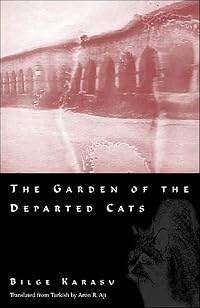
The Garden of the Departed Cats
by Bilge Karasu
On This Page
Description
In an ancient Mediterranean city, a tradition is maintained: every ten years an archaic game of human chess is staged, the players (visitors versus locals) bearing weapons. This archaic game, the central event ofThe Garden of the Departed Cats, may prove as fatal as the deadly attraction our narrator feels for the local man who is the Vizier, or Captain, of the home team. Their "romance" (which, though inconclusive, magnetizes our protagonist to accept the Vizier's challenge to play) show more provides the skeletal structure of this experimental novel. Each of their brief interactions works as a single chapter. And interleaved between their chapters are a dozen fable-like stories. The folk tale might concern a 13th-century herbal that identifies a kind of tulip, a "red salamander," which dooms anyone who eats it to never tell a lie ever again. Or the tale might be an ancient story of a terrible stoat-like creature that feeds for years on the body of whomever it sinks its claws into, like guilt. These strange fables work independently of the main narrative but, in curious and unpredictable ways, (and reminiscent of Primo Levi'sThe Periodic Table), they echo and double its chief themes: love, its recalcitrance, its cat-like finickiness, and its refusal to be rushed. With many strata to mine,The Garden of the Departed Cats is a work of peculiar beauty and strangeness, the whole layered and shiny like a piece of mica. show lessTags
Recommendations
































Member Reviews
Surreal in the vein of Jorge Luis Borges or Italo Calvino. An experimental narrative that comprises a collection of stories interspersed with a framing narrative about a man traveling in a foreign country in which the town’s traditional human chess game is about to take place. The collection defies easy interpretation: Like a faint star, meaning can only be gathered by glancing at the stories together obliquely. The overall effect is strange and sad. No cats die, but love is like a cat and may depart.
Strange narrative about a traveller who grows embroiled into a conspiracy / human chess game, interspersed periodically with fables, metafictions and allegories. Sounds promising: the combo of "fantastic tales plus framing narrative" recalls Calvino, and the tales themselves are akin to Kafka's parables. But in the end, the book misfires more often than it connects, rendering these comparisons tragically superficial.
Ratings
Members
- Recently Added By
Lists

Books with "Living Chess"
17 works; 12 members
Author Information

18+ Works 387 Members
Awards and Honors
Awards
Series
Belongs to Publisher Series
New Directions Paperbook (965)
Common Knowledge
- Original title
- Göçmüş Kediler Bahçesi
- Original publication date
- 1991
- Epigraph
- The truest fairy tale is the one we are afraid to understand.
—Talat Halman - First words
- I arrived one afternoon in the medieval city located in the center of this narrow peninsula that stretches like an arm into the Mediterranean.
- Quotations
- Perhaps everyone liked inventing stories, in the past and today. People readily believed these stories even though they doubted the events unfolding right in front of them or words spoken to their faces—truth was different,... (show all) they insisted, very different from what it seemed; and if reality didn't match the stories they'd invented, then, in their eyes, it was not the stories but the reality that was lying.
- Last words
- (Click to show. Warning: May contain spoilers.)He stopped breathing in my arms. Now what's the good of living after him?
Classifications
- Genres
- Fiction and Literature, General Fiction
- DDC/MDS
- 894.3533 — Literature & rhetoric Literatures of other languages Literatures of Altaic, Uralic, Hyperborean, Dravidian languages; literatures of miscellaneous languages of south Asia Turkic languages Turkish Turkish fiction 1850–2000
- LCC
- PL248 .K33 .G6313 — Language and Literature Languages and literatures of Eastern Asia, Africa, Oceania Languages of Eastern Asia, Africa, Oceania Turkic languages
- BISAC
Statistics
- Members
- 103
- Popularity
- 312,319
- Reviews
- 2
- Rating
- (4.04)
- Languages
- English, Turkish
- Media
- Paper
- ISBNs
- 2