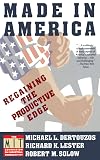
Made in America: Regaining the Productive Edge
by Michael L. Dertouzos, Richard K. Lester, Robert M. Solow
On This Page
Description
Made in America identifies what is best and worth replicating in American industrial practice and sets out five national priorities for regaining the productive edge. What went wrong and how can America become second to none in industrial productivity? This long awaited study by a team of top notch MIT scientists and economists - the MIT Commission on Industrial Productivity - takes a hard look at the recurring weaknesses of American industry that are threatening the country's standard of show more living and its position in the world economy. Made in America identifies what is best and worth replicating in American industrial practice and sets out five national priorities for regaining the productive edge. Unlike other studies that prescribe macroeconomic cures, Made in America focuses on the reorganization and effective integration of human resources and new technologies within the firm as a principal driving force for long term growth in productivity. Made in America examines the relationship between human resources and technological change in detail and singles out the most significant productivity weaknesses from the myriad causes that are typically cited. These include shorttime horizons and a preoccupation with the bottom line, outdated strategies that focus excessively on the domestic market, lack of cooperation within and among U.S. firms, neglect of human resources, technological failures in translating discoveries to products, and a mismatch between governmental actions and the needs of industry. Looking ahead Made in America asserts that industrial performance would improve substantially simply by building on what is best in U.S. industry. It describes representative systems of production that can serve as models of best industrial practice for niche producers, price competitive specialized producers, and flexible mass producers. Among the goals singled out as national priorities are the creation of a new economic citizenship that involves welleducated workers as active partners in the reproduction process, a new strategic focus on production, finding a better balance between cooperation and individualism, learning to live in an increasingly international economy, and making proper provision for the future both in terms of capital and human resources. The findings and goals of Made in America are based on such measures of productivity performance as product quality, innovativeness, time to market, and service in eight manufacturing sectors - semiconductors, computers, and office equipment; automobiles; steel; consumer electronics, chemicals and pharmaceuticals; textiles; machine tools; and commercial aircraft. These measures revealed a large gap between the best and average U.S. practice. show lessTags
Recommendations











































Member Reviews
Members
- Recently Added By
Lists

Alan Kay's Reading List
103 works; 3 members
Author Information

8 Works 451 Members
Michael Dertouzos is the director of the Laboratory for Computer Science at MIT.
3 Works 143 Members
Richard K. Lester is director of the Industrial Performance Center at the Massachusetts Institute of Technology

25+ Works 325 Members
Robert M. Solow is Institute Professor of Economics, Emeritus, Massachusetts Institute of Technology.
Classifications
Statistics
- Members
- 77
- Popularity
- 411,807
- Reviews
- 1
- Rating
- (2.67)
- Languages
- English, French, Italian, Japanese
- Media
- Paper, Ebook
- ISBNs
- 6
- ASINs
- 1