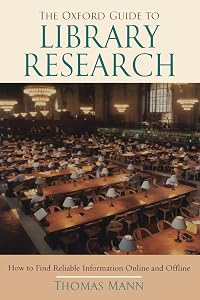
The Oxford Guide to Library Research
by Thomas Mann
On This Page
Description
"The information world has undergone drastic changes since the publication of the 3rd edition of The Oxford Guide to Library Research in 2005, and Thomas Mann, a veteran reference librarian at the Library of Congress, has extensively revised his text to reflect those changes. This book will answer two basic questions: First, what is the extent of the significant research resources you will you miss if you confine your research entirely, or even primarily, to sources available on the open show more Internet? Second, if you are trying to get a reasonably good overview of the literature on a particular topic, rather than just "something quickly" on it, what are the several alternative methods of subject searching--which are not available on the Web--that are usually much more efficient for that purpose than typing keywords into a blank search box, with the results displayed by relevance-ranking computer algorithms? This book shows researchers how to do comprehensive research on any topic. It explains the variety of search mechanisms available, so that the researcher can have the reasonable confidence that s/he has not overlooked something important. This includes not just lists of resources, but discussions of the ways to search within them: how to find the best search terms, how to combine the terms, and how to make the databases (and other sources) show relevant material even when you don't know how to specify the best search terms in advance. The book's overall structuring by nine methods of searching that are applicable in any subject area, rather than by subjects or by types of literature, is unique among guides to research. Also unique is the range and variety of concrete examples of what to do--and of what not to do. The book is not "about" the Internet: it is about the best alternatives to the Internet--the sources that are not on the open Web to begin with, that can be found only through research libraries and that are more than ever necessary for any kind of substantive scholarly research. More than any other research guide available, this book directly addresses and provides solutions to the serious problems outlined in recent studies documenting the profound lack of research skills possessed by today's 'digital natives'"-- show lessTags
Recommendations










Member Reviews
Mann’s Oxford Guide to Library Research is a comprehensive and practical guide for all levels of research and researchers. The guide is based on Mann’s experience working with patrons and materials during his years as a librarian and as a private investigator. His goal is to give readers the tools to experience all levels in the hierarchy of learning (data, information, opinion, knowledge, and understanding), and ultimately to help them achieve a greater wisdom through research. He does this by exploring material types (encyclopedias, for example), explaining how to use subject headings properly, how to browse, how to use indexes, how to properly search by keyword, and so on until it seems that all of the tricks available to show more researchers have been exhausted.
Mann emphasizes the importance of in-depth searching. He often argues that basic internet searches are inefficient. The common misconception that “everything” is on the internet is debunked by many of the real life examples he sites in the book, including the example on lighthouse libraries, which the author was only able to find successfully after he physically leafed through a few books. Although these examples are very helpful for the reader, one cannot help but sense the author’s frustration (and judgment) when dealing with uninformed researchers. Despite the intimidating tone, this work goes a long way in turning the uninformed into the informed. In each chapter Mann lists dozens of potential resources from the Thesaurus of ERIC Descriptors to Wilson’s Library Literature to the Columbia Journalism Review Inflation Calendar .
Unfortunately, due to the nature of a printed book, some of the sources are possibly outdated, as well as the database format examples. But the spirit of the author’s intention, to teach people how to use these databases and where to find certain resources, should enable readers to follow along and still be able to find the suggested resources. Finally, the appendix on “Wisdom” seems out of place. Although it is interesting to read the author’s thoughts on the final level of the hierarchy of learning, the appendix seems tangential to an otherwise great resource for researchers of all levels. show less
Mann emphasizes the importance of in-depth searching. He often argues that basic internet searches are inefficient. The common misconception that “everything” is on the internet is debunked by many of the real life examples he sites in the book, including the example on lighthouse libraries, which the author was only able to find successfully after he physically leafed through a few books. Although these examples are very helpful for the reader, one cannot help but sense the author’s frustration (and judgment) when dealing with uninformed researchers. Despite the intimidating tone, this work goes a long way in turning the uninformed into the informed. In each chapter Mann lists dozens of potential resources from the Thesaurus of ERIC Descriptors to Wilson’s Library Literature to the Columbia Journalism Review Inflation Calendar .
Unfortunately, due to the nature of a printed book, some of the sources are possibly outdated, as well as the database format examples. But the spirit of the author’s intention, to teach people how to use these databases and where to find certain resources, should enable readers to follow along and still be able to find the suggested resources. Finally, the appendix on “Wisdom” seems out of place. Although it is interesting to read the author’s thoughts on the final level of the hierarchy of learning, the appendix seems tangential to an otherwise great resource for researchers of all levels. show less
I have a little librarian crush on Thomas Mann.
He is excellent at communicating the logic of his ideas. He presents a wonderful overview of research methods. To some extent he may be considered a traditionalist. But he makes a well-reasoned case for understanding and using a variety of search methods.
This guide does get a little list-y, as most reference how-to books do. However, even when these resources become outdated, the methods and principles will remain applicable.
He is excellent at communicating the logic of his ideas. He presents a wonderful overview of research methods. To some extent he may be considered a traditionalist. But he makes a well-reasoned case for understanding and using a variety of search methods.
This guide does get a little list-y, as most reference how-to books do. However, even when these resources become outdated, the methods and principles will remain applicable.
This was a textbook for school, so I’m finished for now, but I plan to keep it as a research reference. I haven’t read every chapter, but I’ve read enough to want to own it, because the content is really good, and it’s not a snooze to read.
For class, we were downloading individual chapters, but I really wanted the whole book and discovered it in ebook form for $9.99 on Amazon. I was surprised at such a low price for a school textbook and snapped it up.
There are a lot of good tips for searching effectively online, in OPACs, databases and web search. I can never remember the tricker Boolean stuff, and this book covers it in detail.
This is a great resource I’m planning to put to use in future classes.
For class, we were downloading individual chapters, but I really wanted the whole book and discovered it in ebook form for $9.99 on Amazon. I was surprised at such a low price for a school textbook and snapped it up.
There are a lot of good tips for searching effectively online, in OPACs, databases and web search. I can never remember the tricker Boolean stuff, and this book covers it in detail.
This is a great resource I’m planning to put to use in future classes.
An authoritative and practical guide on how to navigate library systems, catalogs, and databases effectively. Essential for students and researchers.
An excellent book on searching in libraries (online and offline). It is extremely thorough with very many great tips and references. Also, it well written and easy to read. I had it for my Online Searching class in library school and everyone loved reading it!
I cannot say enough about how well-written and informative Mann's text is. I don't know how I got through high school, much less college and a required senior thesis, without this book (except that it hadn't been published yet).
Written more as a guide for students needing to learn how to use a library rather than for librarians. However, it needs to be updated to be of use.
Members
- Recently Added By
Lists

One Book, Many Authors
441 works; 40 members

Read in 2016
107 works; 7 members
Author Information

7 Works 1,219 Members
Thomas Mann was born into a well-to-do upper class family in Lubeck, Germany. His mother was a talented musician and his father a successful merchant. From this background, Mann derived one of his dominant themes, the clash of views between the artist and the merchant. Mann's novel, Buddenbrooks (1901), traces the declining fortunes of a merchant show more family much like his own as it gradually loses interest in business but gains an increasing artistic awareness. Mann was only 26 years old when this novel made him one of Germany's leading writers. Mann went on to write The Magic Mountain (1924), in which he studies the isolated world of the tuberculosis sanitarium. The novel was based on his wife's confinement in such an institution. Doctor Faustus (1947), his masterpiece, describes the life of a composer who sells his soul to the devil as a price for musical genius. Mann is also well known for Death in Venice (1912) and Mario the Magician (1930), both of which portray the tensions and disturbances in the lives of artists. His last unfinished work is The Confessions of Felix Krull, Confidence Man (1954), a brilliantly ironic story about a nineteenth-century swindler. An avowed anti-Nazi, Mann left Germany and lived in the United States during World War II. He returned to Switzerland after the war and became a celebrated literary figure in both East and West Germany. In 1929 he was awarded the Nobel Prize for literature. (Bowker Author Biography) show less
Common Knowledge
- Original publication date
- 1998-09-03
- Important places
- Library of Congress, Washington, D.C., USA
- Dedication
- For Jack Nabholtz
- First words
- The best way to start many inquiries is to see if someone has already written an overview article outlining the most important facts in the subject and providing a concise list of recommended readings.
- Last words
- (Click to show. Warning: May contain spoilers.)For these reasons it is better viewed as something enveloping (or not) the other stages of learning, rather than as their culmination, simply because those persons at the topmost rung of the hierarchy, that of understanding, are not necessarily also wise; and what is regarded as genuine (even if not "full") "wisdom" may still be attained with little or no "academic" knowledge or understanding of its Ultimate ground.
Classifications
- Genres
- Nonfiction, General Nonfiction
- DDC/MDS
- 025.524 — Computer science, information & general works Library & information sciences Administration; Departments Services and programs for users Reference Services Search and Retrieval
- LCC
- Z710 .M23 — Bibliography, Library Science and Information Resources Libraries The collections. The books
- BISAC
Statistics
- Members
- 986
- Popularity
- 26,647
- Reviews
- 13
- Rating
- (4.21)
- Languages
- English
- Media
- Paper, Ebook
- ISBNs
- 15
- ASINs
- 5