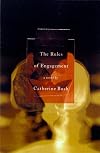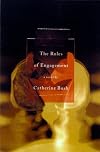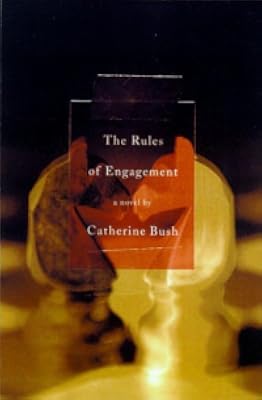
The Rules of Engagement
by Catherine Bush
On This Page
Description
Arcadia Hearne, a researcher who studies contemporary war and specializes in issues of military intervention, has fled to London, but her safe zone is increasingly invaded after her sister arrives.Tags
Recommendations

























Member Reviews
From the book back cover:
Arcadia Hearne is a researcher who studies contemporary war and specializes in issues of military intervention. Far from her hometown of Toronto, she has created a new life for herself in London. While she pursues the study of violence, surveying the rich arsenal of current global conflicts, she refuses to put herself either physically or emotionally at risk. Thrust into a world full of people who, like her, hide secrets and are in flight from difficult pasts, Arcadia is compelled both to contemplate new possibilities for intervention and to confront her own painful history.
This one took some time for me to immerse myself in. The prose is intelligent and elegant, interspersed with a philosophical examination of show more love and conflict. We learn slowly through a series of memory flashbacks why Arcadia fled Toronto and watch as the compulsion within her to face this past grows. It is the exploration of what one is willing to risk and how that made this story a compelling read for me. "It isn't just a matter of risk. Given that you can't act everywhere, do everything, just as you can't intervene in all conflicts, you have to determine your zones of responsibility. That's what we grapple with in intervention studies. You have to choose where you're going to take your risks, set limits. As you travel from zones of safety into zones of danger. That's what makes risk meaningful." Arcadia's shift from safety into zones of danger is triggered when her sister Lux asks her to deliver a package to a refugee from Somalia. Arcadia's personal examination of risks and her boundaries is central to the story.
Arcadia was not an easy character for me to connect with. The daughter of a nuclear engineer, she is an armchair war expert that has never visited the global conflict zones her work focuses on. Never witnessed first hand the brutalities of the civil war in the southern Sudan, the bodies pulled from the mass graves in Srebrenica, the Bosnian refugee camp rape victims. Instead, she deals in the methodical and moralistic examination of how warfare and conflict is personalized, an interesting profession for one whose coping mechanism when faced with an event during her university days is to flee to England and turn her back on the event. When she does decide to face her personal conflict, it is for a self-serving purpose that grated against my sensibilities.
That aside, Bush does an excellent job in taking the cold, impersonal, methodical examination of warfare and transposing this onto the emotional and personal examination of conflict in the arena of love, making what some will call a cliched approach to the topic refreshingly different to read. My favorite quote from the book: "I used to long for love as a clear and steady state, though perhaps there is no love that does not hold the seed of something else - just as there is no steady state of the body, and no state at all without some inconsistency, some internal contradiction, some trace of weather patterns, the possibility of migration or other turbulence. Perhaps the question is simply whether love enfolds an ambivalence you can live with, or one you can't."
Overall, not an easy story as it requires a commitment from the reader to delve into a philosophical discussion of warfare but worth the time and effort to read. show less
Arcadia Hearne is a researcher who studies contemporary war and specializes in issues of military intervention. Far from her hometown of Toronto, she has created a new life for herself in London. While she pursues the study of violence, surveying the rich arsenal of current global conflicts, she refuses to put herself either physically or emotionally at risk. Thrust into a world full of people who, like her, hide secrets and are in flight from difficult pasts, Arcadia is compelled both to contemplate new possibilities for intervention and to confront her own painful history.
This one took some time for me to immerse myself in. The prose is intelligent and elegant, interspersed with a philosophical examination of show more love and conflict. We learn slowly through a series of memory flashbacks why Arcadia fled Toronto and watch as the compulsion within her to face this past grows. It is the exploration of what one is willing to risk and how that made this story a compelling read for me. "It isn't just a matter of risk. Given that you can't act everywhere, do everything, just as you can't intervene in all conflicts, you have to determine your zones of responsibility. That's what we grapple with in intervention studies. You have to choose where you're going to take your risks, set limits. As you travel from zones of safety into zones of danger. That's what makes risk meaningful." Arcadia's shift from safety into zones of danger is triggered when her sister Lux asks her to deliver a package to a refugee from Somalia. Arcadia's personal examination of risks and her boundaries is central to the story.
Arcadia was not an easy character for me to connect with. The daughter of a nuclear engineer, she is an armchair war expert that has never visited the global conflict zones her work focuses on. Never witnessed first hand the brutalities of the civil war in the southern Sudan, the bodies pulled from the mass graves in Srebrenica, the Bosnian refugee camp rape victims. Instead, she deals in the methodical and moralistic examination of how warfare and conflict is personalized, an interesting profession for one whose coping mechanism when faced with an event during her university days is to flee to England and turn her back on the event. When she does decide to face her personal conflict, it is for a self-serving purpose that grated against my sensibilities.
That aside, Bush does an excellent job in taking the cold, impersonal, methodical examination of warfare and transposing this onto the emotional and personal examination of conflict in the arena of love, making what some will call a cliched approach to the topic refreshingly different to read. My favorite quote from the book: "I used to long for love as a clear and steady state, though perhaps there is no love that does not hold the seed of something else - just as there is no steady state of the body, and no state at all without some inconsistency, some internal contradiction, some trace of weather patterns, the possibility of migration or other turbulence. Perhaps the question is simply whether love enfolds an ambivalence you can live with, or one you can't."
Overall, not an easy story as it requires a commitment from the reader to delve into a philosophical discussion of warfare but worth the time and effort to read. show less
college student flees Toronto for London after duel fought over her
9.00
9.00
listening was perhaps not the best for this novel plus the abridgement.
Ratings
Members
- Recently Added By
Published Reviews
Though the territory of conflict is traversed with wide-awake, cliché-subverting intelligence, these connections do occasionally clunk; the parallels occasionally prove excessively neat.
added by lkernagh
While there is some lounging, lolling, and pondering here, coupled with what feels like an overly pat reliance on a schematic framework, these foibles are entirely forgivable, particularly in light of the superbly written ending.
added by lkernagh
Author Information

6 Works 286 Members
Awards and Honors
Awards
Common Knowledge
- Original publication date
- 2000
- People/Characters
- Arcadia Hearne; Lux Hearne; Neil Laurier; Evan Biederman; Amir Barmour; Basra Alale
- Important places
- Toronto, Ontario, Canada; London, England, UK
- Epigraph
- The night I wrote your name in biro on my wrist
we would wake before dawn; back to back; dualists. - Paul Muldoon "Asra" from Madoc: A Mystery - Dedication
- For those without whom
and for my sisters - First words
- Lux was coming.
- Last words
- (Click to show. Warning: May contain spoilers.)There are earphones in my ears, an open cassette case in my lap, a package in my pocket, and as we roar through the darkness, the air fills with the sound of a woman singing.
Classifications
- Genres
- General Fiction, Fiction and Literature, Suspense & Thriller
- DDC/MDS
- 813.54 — Literature & rhetoric American literature in English American fiction in English 1900-1999 1945-1999
- LCC
- PR9199.3 .B797 .R85 — Language and Literature English English Literature English literature: Provincial, local, etc.
- BISAC
Statistics
- Members
- 105
- Popularity
- 309,550
- Reviews
- 3
- Rating
- (3.78)
- Languages
- Dutch, English
- Media
- Paper, Audiobook, Ebook
- ISBNs
- 9
- ASINs
- 1