On This Page
Description
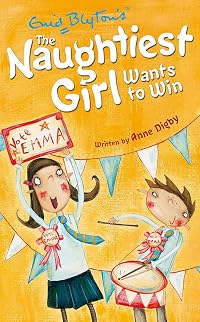
Elizabeth Allen is spoilt and selfish. When she is sent away to boarding school she makes up her mind to be the naughtiest pupil there has ever been But Elizabeth soon discovers that being bad isn't as simple as it seems.Tags
Recommendations







Member Reviews
I think this series is less well-known than Blyton's other two boarding school series (Malory Towers and St. Clare's), but it's a quite interesting and enjoyable read for children.
Unlike the more traditional girl schools in the other two series, the school in the Naughtiest Girl series, Whyteleafe, is a "progressive" boarding school, co-educational, and run as a democratic community, with the children governing themselves with some adult supervision. It's apparently inspired by a real-life school, Summerhill, which was founded in 1921.
Nevertheless, like in the author's other school series, there's a theme of the main character learning to adapt and accept the values of the school community over her own wild, spoiled ways. This was show more written in 1940, and it was a different time. Nowadays people tend to value individuality more than the embrace of the community's values. I can certainly see the value in both approaches, and perhaps a middle way would be valuable, for it is easy to go too far in both directions.
The way the children's self-government is depicted in the book is quite interesting. They do that in quite a responsible way, punishing offenders moderately and more as a way to help them than out of anger or spite. On the other hand, it can be seen, particularly from a modern perspective, as a bit overbearing. I think it's a very interesting theme to discuss with your kids after reading this together. show less
Unlike the more traditional girl schools in the other two series, the school in the Naughtiest Girl series, Whyteleafe, is a "progressive" boarding school, co-educational, and run as a democratic community, with the children governing themselves with some adult supervision. It's apparently inspired by a real-life school, Summerhill, which was founded in 1921.
Nevertheless, like in the author's other school series, there's a theme of the main character learning to adapt and accept the values of the school community over her own wild, spoiled ways. This was show more written in 1940, and it was a different time. Nowadays people tend to value individuality more than the embrace of the community's values. I can certainly see the value in both approaches, and perhaps a middle way would be valuable, for it is easy to go too far in both directions.
The way the children's self-government is depicted in the book is quite interesting. They do that in quite a responsible way, punishing offenders moderately and more as a way to help them than out of anger or spite. On the other hand, it can be seen, particularly from a modern perspective, as a bit overbearing. I think it's a very interesting theme to discuss with your kids after reading this together. show less
I started reading this aloud to my seven-year-old granddaughter who liked it very much. It's probably thirty years since I read the 'Naughtiest Girl' series, but it was one of my favourites as a child. I can see flaws in the writing now, of course, but still thought it a good story, with some amusing scenes, and some quite poignant ones.
The book is naturally dated (it was written around 1940) but Whyteleafe School, which the 'naughty' Elizabeth Allen attends, is an unusual school even by today's standards. Elizabeth learns a lot about herself - and while the eventual outcome is predictable, it's not obvious how it's going to come about.
Definitely recommended to children of about seven and upwards, either to read themselves or as a show more read-aloud to introduce them to this genre of school stories.
Longer review here: https://suesbookreviews.blogspot.com/2024/04/the-naughtiest-girl-in-school-by-en... show less
The book is naturally dated (it was written around 1940) but Whyteleafe School, which the 'naughty' Elizabeth Allen attends, is an unusual school even by today's standards. Elizabeth learns a lot about herself - and while the eventual outcome is predictable, it's not obvious how it's going to come about.
Definitely recommended to children of about seven and upwards, either to read themselves or as a show more read-aloud to introduce them to this genre of school stories.
Longer review here: https://suesbookreviews.blogspot.com/2024/04/the-naughtiest-girl-in-school-by-en... show less
This book describes all the mischievous tricks Elizabeth has attempted at boarding school. This book is a bit slow, but it is worth reading. Enid Blyton includes a very unique style of writing in the book and adds great word choice to it! The "voice" of the book is well written too because it is set to a typical teenage girl who is very spoilt. This character pulls all sorts of little tricks at the school, and it's very funny to visualize the setting of it taking place. This series is worth giving a try, but I have to say that it is not a "must read"!
Opening Sentence: “…“You’ll have to go to school, Elizabeth!” said Mrs Allen…”
Elizabeth is a very spoilt little girl – she plays tricks on her governesses and throws huge temper tantrums when she doesn’t get her own way. But Elizabeth throws one tantrum too many and her governess leaves – forcing Elizabeth’s parents to send her to boarding school.
Elizabeth vows to be so naughty that the school will send her home. But for the first time ever, Elizabeth has to mix with other children. And she soon learns that id she is nasty no-one will talk to her. At first she doesn’t care – but gradually she realises that maybe it is better to be nice and have friends. Does she really want to go home?
I love books were the show more character has growth – and this little girl certainly changes from the beginning to the end. I also love Enid Blyton – and haven’t yet caught up with the naughtiest girl series – I will certainly be finishing it.
My only gripe? I went to boarding school in England – and my school was no way like this one – I wish it had of been. But I was definitely a naughty girl – with a wild imagination. But unlike Elizabeth – I did have friends show less
Elizabeth is a very spoilt little girl – she plays tricks on her governesses and throws huge temper tantrums when she doesn’t get her own way. But Elizabeth throws one tantrum too many and her governess leaves – forcing Elizabeth’s parents to send her to boarding school.
Elizabeth vows to be so naughty that the school will send her home. But for the first time ever, Elizabeth has to mix with other children. And she soon learns that id she is nasty no-one will talk to her. At first she doesn’t care – but gradually she realises that maybe it is better to be nice and have friends. Does she really want to go home?
I love books were the show more character has growth – and this little girl certainly changes from the beginning to the end. I also love Enid Blyton – and haven’t yet caught up with the naughtiest girl series – I will certainly be finishing it.
My only gripe? I went to boarding school in England – and my school was no way like this one – I wish it had of been. But I was definitely a naughty girl – with a wild imagination. But unlike Elizabeth – I did have friends show less
Elizabeth Allen is 10 years old and as an only child of rich parents she has always got her own way. But after her latest governess has had enough and decides to leave, Elizabeth's parents decide to send her to a boarding school. Elizabeth does not want to go to school and decides that she's going to be the naughtiest girl there in order to get sent home.
Once arriving at the school, Elizabeth acts horribly and does everything she can to try to get her own way. However, it doesn't take her long to realise that behaving this way won't get her sent home and perhaps it is better to be nice after all...
By today's standards Elizabeth probably isn't that naughty but she is definitely selfish and acts like a spoiled brat. It was nice to see show more her behaviour change as the story went on and this would be a good story to use to teach children that being naughty doesn't mean you get your own way! show less
Once arriving at the school, Elizabeth acts horribly and does everything she can to try to get her own way. However, it doesn't take her long to realise that behaving this way won't get her sent home and perhaps it is better to be nice after all...
By today's standards Elizabeth probably isn't that naughty but she is definitely selfish and acts like a spoiled brat. It was nice to see show more her behaviour change as the story went on and this would be a good story to use to teach children that being naughty doesn't mean you get your own way! show less
I read this piece as a kid in my school library and I still remember going around telling everyone how well written the protagonist was. At that age it really impressed me and I used to think the Protagonist and I were pretty similar too!
it was great i loved it people said that i'm too old to read it but i proved them wrong cause i read it an enjoyed it
Members
- Recently Added By
Lists

Best School Stories
219 works; 22 members

Children's Chapter Books from 1940s, ...
77 works; 4 members

Children and YA books involving school
58 works; 2 members
Author Information

2,537+ Works 111,690 Members
Enid Blyton, 1897 - November 28, 1968 Enid Blyton was born in London in 1897. She was educated in a private school and thought that she would become a musician until she realized that writing was her passion. She attended Ipswich High School where she trained to become a kindergarten teacher and eventually opened her own school for infants. show more Blyton's first poem was published in 1917, entitled "Have You-" which appeared in Nash's Magazine. In 1922, her first book of verses was published, entitled "Child Whispers." In 1926 she accepted a position editing the children's magazine "Sunny Stories" as well as writing the column "Teachers World." Blyton's first full length children's book was published din 1938 and was titled "The Secret Island." After working on the column for years, Blyton quit "Teachers World" in 1945 and also ended her stint as editor of "Sunny Stories" seven years later. In 1953 she started her own children's magazine called "The Edith Blyton Magazine" which featured stories about her characters and news on the clubs formed around them. Her most famous stories were those of the "Famous Five" The Magazine closed in 1959. In the 50's and 60's Blyton was criticized for the language in her book, for being to simple, but some 300 are still in print today. Blyton has published over 600 books in the course of her career. Enid Blyton died in her sleep on November 28, 1968. She was 71 years old. show less
Some Editions
Series

Belongs to Publisher Series
Valkenserie (M81)
Work Relationships
Is contained in
Is retold in
Common Knowledge
- Canonical title
- The Naughtiest Girl in the School
- Original title
- The Naughtiest Girl in the School
- Original publication date
- 1940
- People/Characters
- Elizabeth Allen
- First words
- "You'll have to go to school, Elizabeth!" said Mrs. Allen.
- Last words
- (Click to show. Warning: May contain spoilers.)Good-bye, Elizabeth--naughtiest girl in the school!
Classifications
Statistics
- Members
- 757
- Popularity
- 37,183
- Reviews
- 11
- Rating
- (3.88)
- Languages
- 9 — Catalan, Dutch, English, French, German, Indonesian, Farsi/Persian, Portuguese, Spanish
- Media
- Paper, Audiobook, Ebook
- ISBNs
- 36
- ASINs
- 25