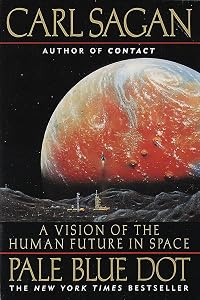
Pale Blue Dot : A Vision of the Human Future in Space
by Carl Sagan
On This Page
Description
“Fascinating . . . memorable . . . revealing . . . perhaps the best of Carl Sagan’s books.”—The Washington Post Book World (front page review)In Cosmos, the late astronomer Carl Sagan cast his gaze over the magnificent mystery of the Universe and made it accessible to millions of people around the world. Now in this stunning sequel, Carl Sagan completes his revolutionary journey through space and time.
Future generations will look back on our epoch as the time when the human race show more finally broke into a radically new frontier—space. In Pale Blue Dot, Sagan traces the spellbinding history of our launch into the cosmos and assesses the future that looms before us as we move out into our own solar system and on to distant galaxies beyond. The exploration and eventual settlement of other worlds is neither a fantasy nor luxury, insists Sagan, but rather a necessary condition for the survival of the human race.
“Takes readers far beyond Cosmos . . . Sagan sees humanity’s future in the stars.”—Chicago Tribune. show less
Tags
Recommendations




















Member Reviews
This was enlightening, though a tad outdated. (Not surprising, considering that it was published in 1994. The space programmes in various countries have crossed several new frontiers since.) The content covers not just what the tagline suggests (human future in space) but also focusses on space insights through the ages. In other words, it devotes an equal time to how we reached here and where we go from the “here” as of 1994.
I enjoyed the various space related anecdotes such as the naming of the planets, the Apollo missions, or the contents of the data discs on the two Voyagers. (I actually enjoyed every titbit about the Voyagers) I especially loved the section on where Sagan mulls over the justification for a human Mars mission, show more taking into account all pros and cons and weighing them very practically rather than claiming that such a mission is a must.
The book gets a tad too dry at times. Nevertheless, it’s a science classic for a strong reason. Much recommended.
Yuval Noah Harari needs to learn from Carl Sagan how to put across his point logically without demeaning anyone.
4.25 stars.
***********************
Join me on the Facebook group, Readers Forever!, for more reviews, book-related discussions and fun. show less
I enjoyed the various space related anecdotes such as the naming of the planets, the Apollo missions, or the contents of the data discs on the two Voyagers. (I actually enjoyed every titbit about the Voyagers) I especially loved the section on where Sagan mulls over the justification for a human Mars mission, show more taking into account all pros and cons and weighing them very practically rather than claiming that such a mission is a must.
The book gets a tad too dry at times. Nevertheless, it’s a science classic for a strong reason. Much recommended.
Yuval Noah Harari needs to learn from Carl Sagan how to put across his point logically without demeaning anyone.
4.25 stars.
***********************
Join me on the Facebook group, Readers Forever!, for more reviews, book-related discussions and fun. show less
A comprehensive and exhilarating account sketching out mankind's place in the universe. Starting from the famous photo of the 'pale blue dot' – Earth as seen from the Voyager spacecraft as it travelled away from us past Jupiter – the book manages to be both chastening to our hubris and inspiring for our future potential.
It covers much more than this, including detailed explorations of the other planets in our solar system as well as climate change (argued in such a way that it manages to not be annoying) and prospects of interplanetary space travel and off-world colonies. Indeed, this is often to the book's detriment, for it is a dense and time-consuming read, despite being only 400 pages long. Pale Blue Dot is at its best when it show more is focused on Earth and the solar system, particular the Voyager missions of which author Carl Sagan was a part, not more abstract speculations beyond. (That said, it also took me a long time to read as there's plenty to chew on: many of the things Sagan discusses deserve to be pondered before moving on to the next chapter.)
Nevertheless, Sagan – perhaps more than any other writer in fact or even fiction – managed to capture the almost spiritual (and certainly non-material) sense of human destiny amongst the stars. Helped by high-quality illustrations of some of outer space's treasures, he evokes the awe and majesty of this universe we live in and the potential it offers us. And this world is visible not only through mere telescope lenses mounted on or around this pale blue dot of a planet, but through Sagan's solemn scientific prose and infectious enthusiasm, which brings barren worlds and the empty void to vivid life. show less
It covers much more than this, including detailed explorations of the other planets in our solar system as well as climate change (argued in such a way that it manages to not be annoying) and prospects of interplanetary space travel and off-world colonies. Indeed, this is often to the book's detriment, for it is a dense and time-consuming read, despite being only 400 pages long. Pale Blue Dot is at its best when it show more is focused on Earth and the solar system, particular the Voyager missions of which author Carl Sagan was a part, not more abstract speculations beyond. (That said, it also took me a long time to read as there's plenty to chew on: many of the things Sagan discusses deserve to be pondered before moving on to the next chapter.)
Nevertheless, Sagan – perhaps more than any other writer in fact or even fiction – managed to capture the almost spiritual (and certainly non-material) sense of human destiny amongst the stars. Helped by high-quality illustrations of some of outer space's treasures, he evokes the awe and majesty of this universe we live in and the potential it offers us. And this world is visible not only through mere telescope lenses mounted on or around this pale blue dot of a planet, but through Sagan's solemn scientific prose and infectious enthusiasm, which brings barren worlds and the empty void to vivid life. show less
Dated, but this is still the most majestic and relevant book you’re likely to find about humanity’s place in the solar system. I actually 'read' Pale Blue Dot by listening to the audiobook, narrated for the most part by the author himself. Carl Sagan's delivery is justifiably the stuff of legend, with his rich, deliberate and passionate enunciation. Years after his death Sagan remains one of the most poetic and thought provoking of writers. Marvellous, marvellous stuff.
I love the story behind the pale blue dot. More than that, I love how Carl Sagan uses a fuzzy little picture to highlight the human condition: small and insignificant yet brash and arrogant. With one image, he puts us in our place in the vast cosmos. Yet, he doesn’t belittle us. Instead, he uses this image to elevate us to new heights and achieve things we haven’t even dreamed of yet.
And that is what this book does to a greater degree. It’s a sobering reminder of what we are, where we are, and when we are. It’s also a glimpse into our future of reaching into space, conquering the final frontier and ushering in an era of peace and progress. While the last bit seemed far fetched in the 80s and 90s - and even more so now - the show more message is clear: we need to forget our differences - be they political, religious, or economical - and forge our future together.
Sagan uses the book to argue space travel in the 90s. Yes, we have come a long way since then, and some of the information is extremely outdated in 2015, but the warrant remains the same. His thesis is clear and the writing is sharp, which results in a highly persuasive read that will convert even the most hardcore anti-spacers out there.
I believe I’ve said more than enough about the book. Stop reading and go grab the book right now and immerse yourself in Sagan’s beautiful prose. You’ll lose yourself among the vastness of space, yet you won’t be alone. show less
And that is what this book does to a greater degree. It’s a sobering reminder of what we are, where we are, and when we are. It’s also a glimpse into our future of reaching into space, conquering the final frontier and ushering in an era of peace and progress. While the last bit seemed far fetched in the 80s and 90s - and even more so now - the show more message is clear: we need to forget our differences - be they political, religious, or economical - and forge our future together.
Sagan uses the book to argue space travel in the 90s. Yes, we have come a long way since then, and some of the information is extremely outdated in 2015, but the warrant remains the same. His thesis is clear and the writing is sharp, which results in a highly persuasive read that will convert even the most hardcore anti-spacers out there.
I believe I’ve said more than enough about the book. Stop reading and go grab the book right now and immerse yourself in Sagan’s beautiful prose. You’ll lose yourself among the vastness of space, yet you won’t be alone. show less
A long time ago, I read Carl Sagan’s Pale Blue Dot. It is proof that science writing can be Literature. I am so in awe of this masterpiece that I feel the only way to do it justice is to quote the master.
“Look again at that dot. That's here. That's home. That's us. On it everyone you love, everyone you know, everyone you ever heard of, every human being who ever was, lived out their lives. The aggregate of our joy and suffering, thousands of confident religions,
ideologies, and economic doctrines, every hunter and forager, every hero and coward, every creator and destroyer of civilization, every
king and peasant, every young couple in love, every mother and father, hopeful child, inventor and explorer, every teacher of morals, every show more corrupt politician, every "superstar," every "supreme leader," every saint and sinner in the history of our species lived there -- on a
mote of dust suspended in a sunbeam.
The Earth is a very small stage in a vast cosmic arena. Think of the rivers of blood spilled by all those generals and emperors so that, in glory and triumph, they could become the momentary masters of a fraction of a dot. Think of the endless cruelties visited by the inhabitants of one corner of this pixel on the scarcely
distinguishable inhabitants of some other corner, how frequent their misunderstandings, how eager they are to kill one another, how fervent their hatreds.
Our posturings, our imagined self-importance, the delusion that we have some privileged position in the Universe, are challenged by this point of pale light. Our planet is a lonely speck in the great enveloping cosmic dark. In our obscurity, in all this vastness, there
is no hint that help will come from elsewhere to save us from ourselves.
The Earth is the only world known so far to harbor life. There is nowhere else, at least in the near future, to which our species could migrate. Visit, yes. Settle, not yet. Like it or not, for the moment the Earth is where we make our stand.” Since global warming has become the clear and present danger of the day, the former has become ominous indeed. show less
“Look again at that dot. That's here. That's home. That's us. On it everyone you love, everyone you know, everyone you ever heard of, every human being who ever was, lived out their lives. The aggregate of our joy and suffering, thousands of confident religions,
ideologies, and economic doctrines, every hunter and forager, every hero and coward, every creator and destroyer of civilization, every
king and peasant, every young couple in love, every mother and father, hopeful child, inventor and explorer, every teacher of morals, every show more corrupt politician, every "superstar," every "supreme leader," every saint and sinner in the history of our species lived there -- on a
mote of dust suspended in a sunbeam.
The Earth is a very small stage in a vast cosmic arena. Think of the rivers of blood spilled by all those generals and emperors so that, in glory and triumph, they could become the momentary masters of a fraction of a dot. Think of the endless cruelties visited by the inhabitants of one corner of this pixel on the scarcely
distinguishable inhabitants of some other corner, how frequent their misunderstandings, how eager they are to kill one another, how fervent their hatreds.
Our posturings, our imagined self-importance, the delusion that we have some privileged position in the Universe, are challenged by this point of pale light. Our planet is a lonely speck in the great enveloping cosmic dark. In our obscurity, in all this vastness, there
is no hint that help will come from elsewhere to save us from ourselves.
The Earth is the only world known so far to harbor life. There is nowhere else, at least in the near future, to which our species could migrate. Visit, yes. Settle, not yet. Like it or not, for the moment the Earth is where we make our stand.” Since global warming has become the clear and present danger of the day, the former has become ominous indeed. show less
I honestly cannot think of too many people who have earned my respect more than Carl Sagan. Since I was a child I have clung to his writing and lecturing. The man just made sense. Pale Blue Dot is so relevant to us, not only as humans but as custodians of a lonely little planet amongst the outer dark. I am biased to this work as I am of all his work. With that being said Pale Blue Dot is an easy read that will weigh heavy on your spirit. Well written and thoughtful. This is our place.
I first had some doubts on reading this thinking it would seem dated in this post-Hubble era of James Webb Telescope, etc. However the lavish photography and illustrations here are engaging and impressive. More than anything, it is great to "hear" Sagan's voice coming through the text as he relates the adventures and discoveries of the Mariner, Viking, and Pioneer programs. As he waxes expansive dreaming of possibilities he imagines exploring the Milky Way over generations and makes strong, cogent arguments against human space travel when robotic and remote technology can serve. Still educating, I learned from him about the Solar gravitational lens where some 5 to 6 hundred AU out telescope imagery and signals can be greatly improved show more due to the effects of gravity there. show less
Members
- Recently Added By
Lists

Libros para periodistas de ciencia
25 works; 1 member

Powell's 50 Books for 50 Years
50 works; 4 members

Useful Space Colonization Non-fiction
40 works; 12 members

A Rainbow of Books: Colors in the Title
570 works; 24 members

Isaac Arthur’s Book Recommendations
98 works; 3 members

SHOULD Read Books!
354 works; 9 members

The r/AskScience Reading List
159 works; 3 members

Books recommended in the history category on FiveBooks.com
329 works; 4 members

The Five Books That Represent Us
391 works; 148 members
Author Information

A respected planetary scientist best known outside the field for his popularizations of astronomy, Carl Sagan was born in New York City on November 9, 1934. He attended the University of Chicago, where he received a B.A. in 1954, a B.S. in 1955, and a M.S. in 1956 in physics as well as a Ph.D. in 1960 in astronomy and astrophysics. He has several show more early scholarly achievements including the experimental demonstration of the synthesis of the energy-carrying molecule ATP (adenosine triphosphate) in primitive-earth experiments. Another was the proposal that the greenhouse effect explained the high temperature of the surface of Venus. He was also one of the driving forces behind the mission of the U.S. satellite Viking to the surface of Mars. He was part of a team that investigated the effects of nuclear war on the earth's climate - the "nuclear winter" scenario. Sagan's role in developing the "Cosmos" series, one of the most successful series of any kind to be broadcast on the Public Broadcasting System, and his book The Dragons of Eden (1977) won the Pulitzer Prize in 1978. He also wrote the novel Contact, which was made into a movie starring Jodie Foster. He died from pneumonia on December 20, 1996. (Bowker Author Biography) show less
Some Editions
Awards and Honors
Distinctions
Notable Lists
Work Relationships
Is abridged in
Common Knowledge
- Canonical title
- Pale Blue Dot : A Vision of the Human Future in Space
- Original title
- Pale Blue Dot: A Vision of the Human Future in Space
- Original publication date
- 1994
- Important places
- Earth; Mars; Milky Way Galaxy; Venus
- Dedication
- For Sam, another wanderer. May your generation see wonders undreamt.
- First words
- We were wanderers from the beginning.
- Quotations
- Look again at that dot. That's here. That's home. That's us. On it everyone you love, everyone you know, everyone you ever heard of, every human being who ever was, lived out their lives. The aggregate of our joy and sufferin... (show all)g, thousands of confident religions, ideologies, and economic doctrines, every hunter and forager, every hero and coward, every creator and destroyer of civilization, every king and peasant, every young couple in love, every mother and father, hopeful child, inventor and explorer, every teacher of morals, every corrupt politician, every "superstar," every "supreme leader," every saint and sinner in the history of our species lived there-on a mote of dust suspended in a sunbeam.
The Earth is a very small stage in a vast cosmic arena. Think of the endless cruelties visited by the inhabitants of one corner of this pixel on the scarcely distinguishable inhabitants of some other corner, how frequent their misunderstandings, how eager they are to kill one another, how fervent their hatreds. Think of the rivers of blood spilled by all those generals and emperors so that, in glory and triumph, they could become the momentary masters of a fraction of a dot.
Our posturings, our imagined self-importance, the delusion that we have some privileged position in the Universe, are challenged by this point of pale light. Our planet is a lonely speck in the great enveloping cosmic dark. In our obscurity, in all this vastness, there is no hint that help will come from elsewhere to save us from ourselves.
The Earth is the only world known so far to harbor life. There is nowhere else, at least in the near future, to which our species could migrate. Visit, yes. Settle, not yet. Like it or not, for the moment the Earth is where we make our stand.
It has been said that astronomy is a humbling and character-building experience. There is perhaps no better demonstration of the folly of human conceits than this distant image of our tiny world. To me, it underscores our responsibility to deal more kindly with one another, and to preserve and cherish the pale blue dot, the only home we've ever known.
How is it that hardly any major religion has looked at science and concluded, “This is better than we thought! The Universe is much bigger than our prophets said, grander, more subtle, more elegant?” Instead they say, “... (show all)No, no, no! My god is a little god, and I want him to stay that way.” A religion, old or new, that stressed the magnificence of the Universe as revealed by modern science might be able to draw forth reserves of reverence and awe hardly tapped by the conventional faiths.
The significance of our lives and our fragile planet is then determined only by our own wisdom and courage. We are the custodians of life's meaning. We long for a Parent to care for us, to forgive us our errors, to save us fr... (show all)om our childish mistakes. But knowledge is preferable to ignorance. Better by far to embrace the hard truth than a reassuring fable. If we crave some cosmic purpose, then let us find ourselves a worthy goal.
The Cosmos extends, for all practical purposes, forever. After a brief sedentary hiatus, we are resuming our ancient nomadic way of life. Our remote descendants, safely arrayed on many worlds throughout the Solar System and b... (show all)eyond, will be unified by their common heritage, by their regard for their home planet, and by the knowledge that, whatever other life may be, the only humans in all the Universe come from Earth. They will gaze up and strain to find the blue dot in their skies. They will love it no less for its obscurity and fragility. They will marvel at how vulnerable the repository of all our potential once was, how perilous our infancy, how humble our beginnings, how many rivers we had to cross before we found our way. - Last words
- (Click to show. Warning: May contain spoilers.)They will marvel at how vulnerable the repository of all our potential once was, how perilous our infancy, how humble our beginnings, how many rivers we had to cross before we found our way.
- Original language
- English
- Canonical DDC/MDS
- 919.904
Classifications
- Genres
- Science & Nature, General Nonfiction, Nonfiction
- DDC/MDS
- 919.904 — History & geography Geography & travel Geography of and travel in Australasia, Pacific Ocean islands, Atlantic Ocean islands, Arctic islands, Antarctica and on extraterrestrial worlds Extraterrestrial regions
- LCC
- QB500.262 .S24 — Science Astronomy Astronomy Descriptive astronomy Solar system
- BISAC
Statistics
- Members
- 3,359
- Popularity
- 5,016
- Reviews
- 35
- Rating
- (4.30)
- Languages
- 10 — Chinese, English, German, Japanese, Korean, Polish, Romanian, Spanish, Turkish, Portuguese (Portugal)
- Media
- Paper, Audiobook, Ebook
- ISBNs
- 35
- UPCs
- 1
- ASINs
- 14