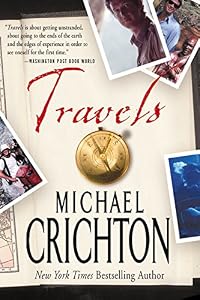
Travels
by Michael Crichton
On This Page
Description
From the bestselling author of Jurassic Park, Timeline, and Sphere comes a deeply personal memoir full of fascinating adventures as he travels everywhere from the Mayan pyramids to Kilimanjaro.Fueled by a powerful curiosity—and by a need to see, feel, and hear, firsthand and close-up—Michael Crichton's journeys have carried him into worlds diverse and compelling—swimming with mud sharks in Tahiti, tracking wild animals through the jungle of Rwanda. This is a record of those show more travels—an exhilarating quest across the familiar and exotic frontiers of the outer world, a determined odyssey into the unfathomable, spiritual depths of the inner world. It is an adventure of risk and rejuvenation, terror and wonder, as exciting as Michael Crichton's many masterful and widely heralded works of fiction.
. show less
Tags
Recommendations










Member Reviews
It takes a while, but eventually Crichton makes clear the point of this book and that is that he feels we should not outright dismiss the paranormal until we’ve actually investigated it for ourselves, as he has. I have to admit, as a firm advocate of the scientific method that he was able to bend my ear a bit. Hard science talks of other dimensions. Could some people have an ability to access some parts of them? For me it still requires a scientific method to prove it outright. Crichton may have experienced some real phenomena, but as he allows himself, maybe he’s just been in sou Cal too long. Mass hysteria seems more likely to me to be at the root of some of his experiences more than anything else.
Some great early material about his medical studies and some of his travels, but goes completely off the rails when he gets into spoon bending, auras and exorcism.
I didn't expect this memoir to be very interesting, and the cover description gives no indication that it is heavily focused on Crichton's deeply-felt experiences with the occult and "new age" spirituality. I was fascinated with the lack of concern he expressed about preserving any duality between the scientific worldview versus his spiritual extrasensory experience. For example, he recounts his ability, since childhood, to induce his consciousness to leave his body.
While experiences like these can only be convincing to the subject directly involved, Crichton's accounts struck me as very genuine, and I'm still awed by the idea of a sciency person who can fully acknowledge experiences that have no apparent physical explanation without a show more priori demeaning them as illusions of the physical. show less
While experiences like these can only be convincing to the subject directly involved, Crichton's accounts struck me as very genuine, and I'm still awed by the idea of a sciency person who can fully acknowledge experiences that have no apparent physical explanation without a show more priori demeaning them as illusions of the physical. show less
An appropriate read as I start week #2 of being away from home traveling, sitting in an airport I've never been to before.
I've enjoyed all of Micheal Crichton's fiction - under his name or one of his pseudonyms. I enjoyed learning about his early life and that he wrote books to pay for med school. I really did enjoy reading about his travels and how the travels changed him. When he started getting into the paranormal and spiritual side of his inner travels, I lost a bit of enthusiasm about this book.
I've enjoyed all of Micheal Crichton's fiction - under his name or one of his pseudonyms. I enjoyed learning about his early life and that he wrote books to pay for med school. I really did enjoy reading about his travels and how the travels changed him. When he started getting into the paranormal and spiritual side of his inner travels, I lost a bit of enthusiasm about this book.
Michael Crichton is an author renowned for his tech-thriller novels, but in Travels, Crichton takes a break from the thriller circuit, dons a travel writer's cap and writes about his journeys instead. His reason for doing so is because "writing is how you make the experience your own, how you explore what it means to you." The book is also Crichton's journey within, struggling with his fears and limitations, to search for himself. He writes, "Eventually, I realised that many of the most important changes in my life had come about because of my travel experiences."
Starting out as a medical student who "resented the fact that our education system seemed to be as much about emotions as about the factual content of what we were learning", show more we discover that the writer of State of Fear already had, by then, a scientific mind and had little patience for the mystical. This belief has no doubt helped him immensely when writing his novels, because a lot of scientific theory and logic goes into them, adding a kind of pseudo-legitimacy into his otherwise outlandish fiction. But along his travels, which take him from Hollywood to the jungles of Pahang, Crichton slowly realises that knowledge of science is not enough to help him live his life, that there is more beyond "the fringe". And it is this realisation, plus a huge dose of curiosity, that brings him to meet psychics and other such mystics, to engage in spiritual sessions. He starts out a skeptic but is soon forced to accept that there are some things that science cannot explain, therefore becoming a believer.
Some of the chapters were published in Esquire and the Conde Nast Traveller and can be read as stand-alone chapters. But by reading them randomly you'll miss the transformation from skeptic to believer that happens from beginning to end. However, there is one drawback to this: Crichton occasionally assumes we don't already know what has gone before and repeats information from previous chapters.
Though a non-fiction book, Travels reads like one of Crichton's thrillers--fast-paced and sprinkled throughout with scientific trivia. This pace falters in the end though, when Crichton inserts, as the last chapter, a speech on why he "believed there was validity to certain psychic phenomena." It is a reminder to the scientific community "not to discredit science, but to place the workings of science in a more realistic perspective with regard to unaccepted phenomena." The contents of the speech is a fitting conclusion to the book, but after reading through his travels at what seems like breathless speed, the slow-paced speech was jarring to the overall reading experience and seemed out of place.
Michael Crichton is fuelled by an intense curiosity that drives him to understand and discover unknown things. This intensity is channelled through his writing and his experiences serve as an interesting and thought-provoking journey, whether outward or inward. show less
Starting out as a medical student who "resented the fact that our education system seemed to be as much about emotions as about the factual content of what we were learning", show more we discover that the writer of State of Fear already had, by then, a scientific mind and had little patience for the mystical. This belief has no doubt helped him immensely when writing his novels, because a lot of scientific theory and logic goes into them, adding a kind of pseudo-legitimacy into his otherwise outlandish fiction. But along his travels, which take him from Hollywood to the jungles of Pahang, Crichton slowly realises that knowledge of science is not enough to help him live his life, that there is more beyond "the fringe". And it is this realisation, plus a huge dose of curiosity, that brings him to meet psychics and other such mystics, to engage in spiritual sessions. He starts out a skeptic but is soon forced to accept that there are some things that science cannot explain, therefore becoming a believer.
Some of the chapters were published in Esquire and the Conde Nast Traveller and can be read as stand-alone chapters. But by reading them randomly you'll miss the transformation from skeptic to believer that happens from beginning to end. However, there is one drawback to this: Crichton occasionally assumes we don't already know what has gone before and repeats information from previous chapters.
Though a non-fiction book, Travels reads like one of Crichton's thrillers--fast-paced and sprinkled throughout with scientific trivia. This pace falters in the end though, when Crichton inserts, as the last chapter, a speech on why he "believed there was validity to certain psychic phenomena." It is a reminder to the scientific community "not to discredit science, but to place the workings of science in a more realistic perspective with regard to unaccepted phenomena." The contents of the speech is a fitting conclusion to the book, but after reading through his travels at what seems like breathless speed, the slow-paced speech was jarring to the overall reading experience and seemed out of place.
Michael Crichton is fuelled by an intense curiosity that drives him to understand and discover unknown things. This intensity is channelled through his writing and his experiences serve as an interesting and thought-provoking journey, whether outward or inward. show less
This book clearly displays a side of Michael Crichton which I would not have expected. It is an autobiographical memoir which presents Crichton's life as a series of travels - the first phase of which involved his medical training; the second phase, his travels through the world - these segments are the best and most interesting, involving diving adventures (and near-death experiences) and African safaris; and the third phase which involves his "inner travels" and experiments with various psychic phenomena. Crichton presents all phases as a journey of self-discovery, including the psychic, metaphysical elements. Frankly, that part of the book saddened me, to think that someone of his obvious intelligence could so readily accept these show more various phenomena. I suppose it speaks well of his openness and willingness to consider non-traditional approaches to...everything?...and it's this openness which accounts for his wildly imaginitive fictional plots. But reading about his tears at saying goodbye to a cactus, which had presented itself as his "teacher" at a pyschic healing conference, was actually embarassing. If you enjoy Crichton, and want to know more about the man behind Jurassic Park, you should read the book - it took a brave man to write it. show less
This is kind of like wading through a Carribean beach that has had a large fish kill on it, but is wonderful once you get out into th e warm sea water, it can be wonderful. He often had me laughing out loud, which takes one heluva ood writer to do. I'm pretty sure this is labbelled non-fiction and, if so, the few chapters on body auras and weird perceptions need to be investigated, especially siknce these ujnusual occurances were witnessed by scores of people over a period of time.
Members
- Recently Added By
Lists

Carole's List
445 works; 13 members
Author Information

142+ Works 171,654 Members
John Michael Crichton, known as Michael Crichton, was born on October 28, 1942 in Chicago, Illinois. He wrote novels while attending Harvard University and Harvard Medical School to help pay the tuition. One of these, The Andromeda Strain, which was published in 1969, became a bestseller. After graduating summa cum laude, he was a postdoctoral show more fellow at the Salk Institute in California before becoming a full-time writer and film director. His carefully researched novels included Eaters of the Dead, The Terminal Man, The Great Train Robbery, Congo, Sphere, Jurassic Park, Rising Sun, Disclosure, The Lost World, Airframe, and Micro. He also wrote non-fiction works including Five Patients: The Hospital Explained, Jasper Johns, and Travels. In the late 1960s, he also wrote under the pen names Jeffrey Hudson and John Lange. He has received several awards including Writer of the Year in 1970 from the Association of American Medical Writers and two Edgar Awards in 1968 and in 1979. Many of his novels have been made into highly successful films, six of which he directed. He was also the creator and executive producer of the Emmy Award-winning television series ER. In addition to his writing and directorial success, his expertise in information science enabled him to run a software company and develop a computer game. He died of cancer on November 4, 2008 at the age of 66. (Bowker Author Biography) show less
Some Editions
Awards and Honors
Awards
Work Relationships
Contains
Common Knowledge
- Canonical title*
- Voyages
- Original title
- Travels
- Alternate titles*
- L'auteur de "Jurassic park" raconte ses aventures extraordinaires
- Original publication date
- 1988
- Epigraph
- In self-analysis the danger of incompleteness is particularly great. One is too soon satisfied with a part explanation.
-Sigmund Freud
Existence is beyond the power of words to define.
-Lao-Tzu
What you see is what you see.
-Frank Stella - First words
- For many years I traveled for myself alone.
- Last words
- (Click to show. Warning: May contain spoilers.)But I was never invited to speak there, so I never gave it.
*Some information comes from Common Knowledge in other languages. Click "Edit" for more information.
Classifications
Statistics
- Members
- 1,529
- Popularity
- 14,969
- Reviews
- 26
- Rating
- (3.61)
- Languages
- 6 — Czech, English, French, German, Italian, Spanish
- Media
- Paper, Audiobook, Ebook
- ISBNs
- 30
- ASINs
- 15