Free Live Free
by Gene Wolfe
On This Page
Description
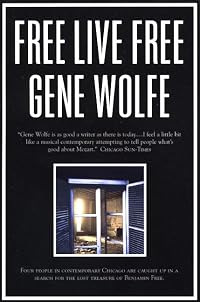
"Free Live Free," said the newspaper ad, and the out-of-work detective Jim Stubb, the occultist Madame Serpentina, the salesman Ozzie Barnes, and the overweight prostitute Candy Garth are brought together to live for a time in Free's old house, a house scheduled for demolition to make way for a highway. Free drops mysterious hints of his exile from his homeland, and of the lost key to his return. And so, when demolition occurs and Free disappears, the four make a pact to continue the search, show more which ultimately takes them far beyond their wildest dreams. This is character-driven science fiction at its best by a writer whom, at the time of its first publication, the Chicago Sun-Times called "science fiction's best genuine novelist.". show lessTags
Recommendations

















Member Reviews
The standalone 1984 Gene Wolfe novel Free Live Free is set in a contemporary American city, and it plays its science-fictional cards very close to the chest for more than four-fifths of its total length. Written after the magisterial Book of the New Sun, it is similarly coy about its crucial speculative underpinnings, to the point where the Tor Books edition of 1985 appended a short explanatory chronology demanded by the editors. Unlike the nearly solipsistic first-person focus of the Book of the New Sun, Free Live Free centers on a set of four characters, each richly detailed, who are made interdependent by circumstance.
Nearly all readers seem to have appreciated the grittiness and empathy of the storytelling, and in these respects I show more was more than a little reminded of some of the best work of Theodore Sturgeon, who featured as a blurber on the jacket of my copy. The plot and pacing received a more mixed reception. The neo-noir features of the book perhaps led readers to expect a more conventional dramatic arc, but I suspect that Wolfe's designs for this book were determined by other considerations.
Reviewers and even the cover copy of the current edition have all said that the story is set in Chicago, but I haven't been able to figure out why. Perhaps it is because Wolfe himself lived in the Chicago area? The city is unnamed in the book. The pivotal address of 808 S. 38th Street is impossible for that city (whose numbered streets run east-west), and while the urban texture is credibly Chicagoan, no distinctive Chicago features (e.g. the Loop, lakefront, or O'Hare) are ever specified. When one character makes an excursion to the suburbs, I was sure that Wolfe modeled the location on his own Barrington neighborhood, but that didn't mean that he intended it to be there. He makes reference to other specific cities--Buffalo and Kansas City, to name two--but I think that the city where the story transpires is significantly undetermined.
The nebulousness of place helps mark out the book as an allegory. Overweight whore Candy Garth is the appetitive dimension of humanity, novelty salesman Osgood Barnes our affectional dimension, the snoop Jim Stubb our intellectual dimension, and the witch Madame Serpentina our spiritual dimension. But these characters are each so vividly drawn that they never seem like mere symbols. Considering them in this way can provoke a re-evaluation of the "gizmo" and its function in the final resolution of the story. As with other books by Wolfe, there is much to enjoy in the atomic level of its episodes and much to ponder in its larger frame and continuity. show less
Nearly all readers seem to have appreciated the grittiness and empathy of the storytelling, and in these respects I show more was more than a little reminded of some of the best work of Theodore Sturgeon, who featured as a blurber on the jacket of my copy. The plot and pacing received a more mixed reception. The neo-noir features of the book perhaps led readers to expect a more conventional dramatic arc, but I suspect that Wolfe's designs for this book were determined by other considerations.
Reviewers and even the cover copy of the current edition have all said that the story is set in Chicago, but I haven't been able to figure out why. Perhaps it is because Wolfe himself lived in the Chicago area? The city is unnamed in the book. The pivotal address of 808 S. 38th Street is impossible for that city (whose numbered streets run east-west), and while the urban texture is credibly Chicagoan, no distinctive Chicago features (e.g. the Loop, lakefront, or O'Hare) are ever specified. When one character makes an excursion to the suburbs, I was sure that Wolfe modeled the location on his own Barrington neighborhood, but that didn't mean that he intended it to be there. He makes reference to other specific cities--Buffalo and Kansas City, to name two--but I think that the city where the story transpires is significantly undetermined.
The nebulousness of place helps mark out the book as an allegory. Overweight whore Candy Garth is the appetitive dimension of humanity, novelty salesman Osgood Barnes our affectional dimension, the snoop Jim Stubb our intellectual dimension, and the witch Madame Serpentina our spiritual dimension. But these characters are each so vividly drawn that they never seem like mere symbols. Considering them in this way can provoke a re-evaluation of the "gizmo" and its function in the final resolution of the story. As with other books by Wolfe, there is much to enjoy in the atomic level of its episodes and much to ponder in its larger frame and continuity. show less
Four misfits answer an ad from an old man, living free in his home in exchange for helping him to resist its demolition. They fail, the old man disappears, and we have a series of mad adventures as each of the four must face up to his or her shortcomings and desires. As they search for the old man, they realize that someone is also searching for them. Their adventures take them from a swank hotel to an insane asylum. References to Baum's Oz books, childhood favorites of Wolfe's, abound. Is this a retelling of The Wonderful Wizard of Oz? Or is it just another garden-variety roman noir about detectives, witches, and time travel?
Wolfe indulges in more humor here than in his longer--and justly more famous--works. This one is more similar show more to Castleview or, particularly, Pandora by Holly Hollander, than to his multi-volume science fiction novels. Cleverness abounds, in word choices, characters' names, and settings. Difficult to classify but a good bit of fun. show less
Wolfe indulges in more humor here than in his longer--and justly more famous--works. This one is more similar show more to Castleview or, particularly, Pandora by Holly Hollander, than to his multi-volume science fiction novels. Cleverness abounds, in word choices, characters' names, and settings. Difficult to classify but a good bit of fun. show less
A commonality that I've noticed in lesser Wolfe books is serious pacing problems, where little seems to happen for many pages, where inconsequential dialogue extends far beyond its needed length, and then where a rush of things is jammed into the final few pages of a section or of the book. For its first fifty pages or so Free Live Free dodges this problem, introducing us to our main characters and their situation as down-on-their-luck Chicagoans, and then having things actually happen. It's great! If you've read any Wolfe before, you know the man can write- in the beginning pages of Free Live Free he shows that he can write about poverty and the struggle for daily survival to rival Steinbeck or Hemingway. Stubbs scrounging food, Barnes show more attempting to keep his dignity despite his lack of money, Candy and her career as an overweight prostitute, I could read a whole book that was just about their struggle to make it through a Chicago winter together in an old boarding house (though Madame Serpentina wouldn't exactly fit in a book like that). But this is Wolfe, of course, so the story doesn't stay so simple.
After the characters have put up a valiant effort but failed to save Ben Free's boarding house (which I would consider the end to the introduction of the story), the book falls smack into the pacing problem I mentioned above. For long swaths of pages we have dialogue in hotel rooms about food, pulp magazine article interviews, and various other minor intrigues. There's seventy-five pages on the protagonists visiting/getting trapped in/escaping a mental hospital, then another thirty on them navigating a Chicago blackout, with new characters introduced every few pages. We get to know the main quadrumvirate of characters very well, but the rest are bare sketches. Much of the "action," what little there is, seems inconsequential. There are extended segments of Stubbs delivering middling Sherlock Holmes detective exposition and explanation, a feature that also dragged down early volumes of The Book of the Long Sun (making that work inferior to the works in the series that it was sandwiched between). Once we get to the resolution, it's pretty out of left field, not very satisfying, and delivered in jumbled dialogue and crammed into the final twenty pages of the book.
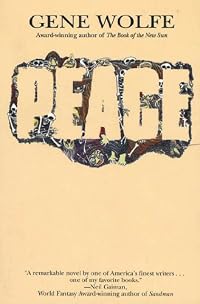
Wolfe is one of my favorite writers. Unlike a lot of the top-tier science fiction writers, he's doesn't rely on his ideas to mask an inability to write, as he can craft stunning prose. He's not just a one-hit-wonder, either: though not many reach it, The Book of the Short Sun is phenomenal, a rival to The Book of the New Sun. Peace and The Fifth Head of Cerberus are also great, and The Wizard Night is a fun take on fantasy. Even what I would consider some of his lesser works are interesting, like Pandora By Holly Hollander and how it tells you a mystery without giving you the real solution. Wolfe is also a frustrating writer. Many of his books never rise above mediocrity- the only thing I can remember about Castleview is that it featured a cat named G. Gordon Kitty. He writes books that are filled with riddles, even when the book might be better without them. He's been on a streak lately of unimpressive books. I'll keep reading him as long as he keeps writing, but I expect I've already read (and he's already written) his best. Free Live Free is a lesser work of Gene Wolfe, if you're an adherent of his like I am then you'll probably read it regardless of what I say here. If you aren't, you should skip it and read the books I highlighted earlier in this paragraph. show less
After the characters have put up a valiant effort but failed to save Ben Free's boarding house (which I would consider the end to the introduction of the story), the book falls smack into the pacing problem I mentioned above. For long swaths of pages we have dialogue in hotel rooms about food, pulp magazine article interviews, and various other minor intrigues. There's seventy-five pages on the protagonists visiting/getting trapped in/escaping a mental hospital, then another thirty on them navigating a Chicago blackout, with new characters introduced every few pages. We get to know the main quadrumvirate of characters very well, but the rest are bare sketches. Much of the "action," what little there is, seems inconsequential. There are extended segments of Stubbs delivering middling Sherlock Holmes detective exposition and explanation, a feature that also dragged down early volumes of The Book of the Long Sun (making that work inferior to the works in the series that it was sandwiched between). Once we get to the resolution, it's pretty out of left field, not very satisfying, and delivered in jumbled dialogue and crammed into the final twenty pages of the book.
Wolfe is one of my favorite writers. Unlike a lot of the top-tier science fiction writers, he's doesn't rely on his ideas to mask an inability to write, as he can craft stunning prose. He's not just a one-hit-wonder, either: though not many reach it, The Book of the Short Sun is phenomenal, a rival to The Book of the New Sun. Peace and The Fifth Head of Cerberus are also great, and The Wizard Night is a fun take on fantasy. Even what I would consider some of his lesser works are interesting, like Pandora By Holly Hollander and how it tells you a mystery without giving you the real solution. Wolfe is also a frustrating writer. Many of his books never rise above mediocrity- the only thing I can remember about Castleview is that it featured a cat named G. Gordon Kitty. He writes books that are filled with riddles, even when the book might be better without them. He's been on a streak lately of unimpressive books. I'll keep reading him as long as he keeps writing, but I expect I've already read (and he's already written) his best. Free Live Free is a lesser work of Gene Wolfe, if you're an adherent of his like I am then you'll probably read it regardless of what I say here. If you aren't, you should skip it and read the books I highlighted earlier in this paragraph. show less
As always, I loved the writing between all the dialogue. There are some very imaginative set pieces. The four main protagonists were living charicatures, but believable and filled with human flaws and hopes. On the other hand, Wolfe's conversations could be frustrating and hard to follow. You
I will say that the ending was not disappointing at all as other reviews have said; it actually resonates quite a bit with some of the concepts in Book/Urth of the New Sun.
That being said, I know this book will be more fulfilling on a reread, so hopefully I will find the energy sometime to do a closer reading of it.
I will say that the ending was not disappointing at all as other reviews have said; it actually resonates quite a bit with some of the concepts in Book/Urth of the New Sun.
That being said, I know this book will be more fulfilling on a reread, so hopefully I will find the energy sometime to do a closer reading of it.
Mostly just a decent noir/detective/heist novel. At the end, the MacGuffin suddenly decides to pretend that it was a urban-fantasy/sci-fi novel all along. WIUWT?! Wolfe seems to like barely genre stories, which is not the same as either crossover or magical realism. It's disconcerting, but at least I like noir/detective novels.
This was not my favorite of Wolfe's books. While it worked well as a noir/detective story, its sudden lurch towards sci-fi made for a muddled ending. I wouldn't warn anyone against it, but there are much better novels out there by Gene Wolfe.
Not my kind of book really, a book that almost reads as urban fantasy but is really sf, although really by the end of it I didn't care what was the resolution and the why behind the book.
Several characters are living free in Ben Frees house. The house is scheduled for demolition and Ben Free goes missing during their search they find that there are secrets within secrets. Each person has their problems and issues and they have to face up to their issues in order to find Ben and what his secrets are. Amusingly there are also mentions of Dion Fortune and Alaistair Crowley.
Several characters are living free in Ben Frees house. The house is scheduled for demolition and Ben Free goes missing during their search they find that there are secrets within secrets. Each person has their problems and issues and they have to face up to their issues in order to find Ben and what his secrets are. Amusingly there are also mentions of Dion Fortune and Alaistair Crowley.
Members
- Recently Added By
Published Reviews
ThingScore 67
[A] deeply engaging book, with each story twist helping us to feel for the flawed characters at the book's heart.
added by paradoxosalpha
Mr. Wolfe's writing, as always, is literate without being fussy. The plot, which promises little, is full of surprises that I can't even hint at without ruining the pleasure of discovery that awaits those who enter the worlds that Mr. Wolfe creates.
added by Shortride
A hybrid novel of many parts but little overall cohesion or shape--Wolfe often seems merely to be extemporizing; and the ending, which violates all the tried-and-true sf rules concerning mysterious gizmos, is a bust.
added by paradoxosalpha
Author Information

313+ Works 43,441 Members
Gene Wolfe was born in New York City on May 7, 1931. He dropped out of Texas A&M University during his junior year and was drafted into the Army to fight in the Korean War. After the war, he received a degree in mechanical engineering from the University of Houston. He worked as an industrial engineer for Procter and Gamble, where he developed the show more machine that cooks the dough used to make Pringles potato chips. He was an editor of the trade journal Plant Engineering from 1972 to 1984 before retiring to become a full-time writer. He wrote more than 30 books during his lifetime including The Fifth Head of Cerberus, Peace, The Book of the New Sun, and The Land Across. He received the Campbell Memorial Award, the Edward E. Smith Memorial Award, the Locus Award four times, and the Nebula Award and the World Fantasy Award two times each. In 1996, he was given the World Fantasy Award for Lifetime Achievement. He was inducted into the Science Fiction Hall of Fame in 2007 and was named a Grand Master by the Science Fiction and Fantasy Writers of America in 2012. He died after a long battle with heart disease on April 14, 2019 at the age of 87. (Bowker Author Biography) show less
Some Editions
Awards and Honors
Awards
Common Knowledge
- Original publication date
- 1984
- People/Characters
- Samuel Benjamin Whitten; Madame Serpentina; Osgood Barnes; Jim Stubb; Candy Garth; Alexandra Duck
- Important places
- 808 South 38th Street; The High Country
- First words
- It was not yet night, though the streets were already dark.
- Blurbers
- Ursula K. LeGuin; Theodore Sturgeon
Classifications
Statistics
- Members
- 583
- Popularity
- 50,218
- Reviews
- 8
- Rating
- (3.27)
- Languages
- English, German
- Media
- Paper, Ebook
- ISBNs
- 8
- ASINs
- 4