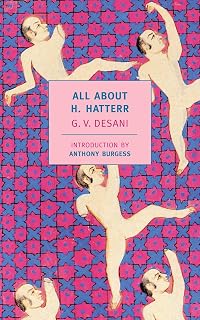
All About H. Hatterr
by G. V. Desani
On This Page
Description
Wildly funny and wonderfully bizarre, All About H. Hatterr is one of the most perfectly eccentric and strangely absorbing works modern English has produced. H. Hatterr is the son of a European merchant officer and a lady from Penang who has been raised and educated in missionary schools in Calcutta. His story is of his search for enlightenment as, in the course of visiting seven Oriental cities, he consults with seven sages, each of whom specializes in a different aspect of 'Living.' Each show more teacher delivers himself of a great 'Generality,' each great Generality launches a new great 'Adventure,' from each of which Hatter escapes not so much greatly edified as by the skin of his teeth. The book is a comic extravaganza, but as Anthony Burgess writes in his introduction, 'it is the language that makes the book. . . . It is not pure English; it is like Shakespeare, Joyce, and Kipling, gloriously impure.' show lessTags
Recommendations









































Member Recommendations
Member Reviews
Desani is a master of language, wit, and absurdity! Almost every sentence in this book is a masterpiece.
The book takes us through a magical journey that Hatterr embarks on -- spiritual search of truth through hilarious examination of eastern & western worlds.
It's a difficult book as the language can get really ultra-creative at times, yet one of the funniest books I have ever read.
The book takes us through a magical journey that Hatterr embarks on -- spiritual search of truth through hilarious examination of eastern & western worlds.
It's a difficult book as the language can get really ultra-creative at times, yet one of the funniest books I have ever read.
Desani G. V. is a lofty lion of literature. The best work on cultural receptio that ever has been written by any feller Oriental or Occidental.
And any suggestion to the contrary will be reviewed by Y. Beliram, legum vir, and published as an appendix.
And any suggestion to the contrary will be reviewed by Y. Beliram, legum vir, and published as an appendix.
Ratings
Members
- Recently Added By
Published Reviews
ThingScore 100
If there’s a worldwide shortage of exclamation points today, you can probably blame it on the 1948 publication of G. V. Desani’s All About H. Hatterr, a book so demented and brilliant that it not only detonates about a dozen “!”s per page, but actually justifies this extravagance. For sheer hilarity, All About cannot be beaten. It deserves to be reprinted a thousand times over.
In fact, show more it nearly has been. It is a perpetually lost classic.
This is more than just good (or bad) publishing karma. Narrated by the eponymous H. Hatterr as he lurches from swami to swami in India, seeking enlightenment and gaining notoriety instead, All About was the first work to employ “rigmarole English,” a mishmash of Indian rhythms and English propriety. Thankfully, it wears this novelty lightly. Hatterr—who is part-Malay, part-Anglo, and completely nuts—doesn’t overexplain his rude, freewheeling syntax. His description of how he befriends a fellow shyster, for instance, is priceless: “My poor-taste compliment as to his sister, and his vulgar return tribute-abuse as to my mother, absolutely established cordial relations between us, both in the E minor and the D major, so to speak.” Then, characteristically, he kicks it up a notch: “A perfect understanding!”
It was this cheeky and hysterical style that Salman Rushdie admiringly amplified in his masterpiece Midnight’s Children. For South Asian writers, then, Desani is a grandfatherly figure, if a relatively obscure one: he died in 2000 and wrote only this one novel and a collection of stories. Further, Desani marshaled all his autodidactic genius for language and Indian culture and Latin medical terms and swindling swamis not to explore political issues that would have ensured posterity, but rather to be as hilarious as possible. “The people would be furious if they knew this was written entirely during the war years, and in London, and during the bombing!” he wrote in his prologue, with exactly the same devilish humor that animates H. Hatterr.
Each section of the book begins with an “Instruction” from a sage, a “Presumption” held by Hatterr (“‘Kismet,’ i.e., fate—if at all anything, and as potent as suspected for centuries—is a dam’ baffling thing!”), and a long “Life-Encounter” in which Hatterr inevitably falls into questionable company; makes a promise he can’t keep; gets utterly hoodwinked; expresses his bewilderment in a hail of exclamations; and then flagrantly and disastrously flouts the advice he has sought from the sage. A typical scenario might involve Hatterr allowing a circus tiger to eat a steak off his chest in order to impress a married woman who has no interest in him at all.
Indeed, the only person Hatterr defers to is a Bengali, Shakespeare-obsessed fellow called Banerrji. Banerrji speaks with the semi-apologetic formal English that you can still hear in the right bureaucratic offices in India and is (for unknown reasons) always rescuing the good Mr. Hatterr and then offering to publish accounts of his bravery in the “fortnightly” for which he works. When Hatterr tries to thank him, Banerrji has none of it. “No. India thanks you.” Banerrji is in this sense an uproarious and calculated comic invention: the Anglicized Indian foil to the Indianized H. Hatterr, and a way for Desani to show that ridiculousness, in the end, is relative. show less
In fact, show more it nearly has been. It is a perpetually lost classic.
This is more than just good (or bad) publishing karma. Narrated by the eponymous H. Hatterr as he lurches from swami to swami in India, seeking enlightenment and gaining notoriety instead, All About was the first work to employ “rigmarole English,” a mishmash of Indian rhythms and English propriety. Thankfully, it wears this novelty lightly. Hatterr—who is part-Malay, part-Anglo, and completely nuts—doesn’t overexplain his rude, freewheeling syntax. His description of how he befriends a fellow shyster, for instance, is priceless: “My poor-taste compliment as to his sister, and his vulgar return tribute-abuse as to my mother, absolutely established cordial relations between us, both in the E minor and the D major, so to speak.” Then, characteristically, he kicks it up a notch: “A perfect understanding!”
It was this cheeky and hysterical style that Salman Rushdie admiringly amplified in his masterpiece Midnight’s Children. For South Asian writers, then, Desani is a grandfatherly figure, if a relatively obscure one: he died in 2000 and wrote only this one novel and a collection of stories. Further, Desani marshaled all his autodidactic genius for language and Indian culture and Latin medical terms and swindling swamis not to explore political issues that would have ensured posterity, but rather to be as hilarious as possible. “The people would be furious if they knew this was written entirely during the war years, and in London, and during the bombing!” he wrote in his prologue, with exactly the same devilish humor that animates H. Hatterr.
Each section of the book begins with an “Instruction” from a sage, a “Presumption” held by Hatterr (“‘Kismet,’ i.e., fate—if at all anything, and as potent as suspected for centuries—is a dam’ baffling thing!”), and a long “Life-Encounter” in which Hatterr inevitably falls into questionable company; makes a promise he can’t keep; gets utterly hoodwinked; expresses his bewilderment in a hail of exclamations; and then flagrantly and disastrously flouts the advice he has sought from the sage. A typical scenario might involve Hatterr allowing a circus tiger to eat a steak off his chest in order to impress a married woman who has no interest in him at all.
Indeed, the only person Hatterr defers to is a Bengali, Shakespeare-obsessed fellow called Banerrji. Banerrji speaks with the semi-apologetic formal English that you can still hear in the right bureaucratic offices in India and is (for unknown reasons) always rescuing the good Mr. Hatterr and then offering to publish accounts of his bravery in the “fortnightly” for which he works. When Hatterr tries to thank him, Banerrji has none of it. “No. India thanks you.” Banerrji is in this sense an uproarious and calculated comic invention: the Anglicized Indian foil to the Indianized H. Hatterr, and a way for Desani to show that ridiculousness, in the end, is relative. show less
added by kidzdoc
Lists

This is the Canon: Decolonize Your Bookshelf in 50 Books
51 works; 5 members

1,001 BYMRBYD Concensus
723 works; 27 members

My TBR
371 works; 3 members

Michael Dirda's 100 Best Comic Novels
100 works; 1 member
Author Information

7 Works 470 Members
Awards and Honors
Distinctions
Series
Belongs to Publisher Series
Common Knowledge
- Canonical title
- All About H. Hatterr
- Original publication date
- 1948
- People/Characters
- H. Hatterr
- Important places
- India
- Epigraph
- Warning!
'Melodramatic gestures against public security are a common form of self-expression in the East. For instance, an Indian peasant, whose house has been burgled, will lay a tree across a railway line, hop... (show all)ing to derail a goods train, just to show his opinion of life. And the Magistrates are far more understanding...'
Anglo-Indian writer
Indian middle-man (to Author): Sir, if you do not identify your composition a novel, how then do we itemise it? Sir, the rank and file is entitled to know.
Author (to Indian middle-man): Sir I identify it as a gesture. Sir, the rank and file is entitled to know.
Indian middle-man (to Author): Sir, there is no immediate demand for gestures. There is immediate demand for novels. Sir, we are literary agents not free agents.
Author (to Indian middle-man): Sir, I identify it as a novel. Sir, itemise it accordingly. - Dedication
- For Kanhayalal Savaldas
to acknowledge
a debt of gratitude - First words
- It was F.W. Bateson who made the distinction between the native English writer and the métèque - 'the writer with a non-English linguistic, racial, or political background' who, being on the fringe of a language and ... (show all)the culture that begot it, lacks respect 'for the finer rules of English idiom and grammer.' This, says Bateson, leads métèques to 'attempt effects of style, sometimes successfully, that the English writer would feel to be a perverse defiance of the genius of the language.' -Introduction, Anthony Burgess, 1969
London, October 23, 1945
Wherefore...during '39-'45, these warring years, an appalling thing happened to me. I acquired a major Fault. I became secretive, told lies, at any rate, rarely the whole truth. Life seemed so ... (show all)many clashes and contents, sorry! and, well, Invention helps. - Last words
- (Click to show. Warning: May contain spoilers.)Lastly, I thank the ladies and gentlemen who will read this Critique. To them I say, in the word of the bard T. Moore, 'Goodbye, my paper is out nearly, I have only room for, yours sincerely...'
Classifications
Statistics
- Members
- 445
- Popularity
- 68,582
- Reviews
- 2
- Rating
- (4.06)
- Languages
- English, German
- Media
- Paper
- ISBNs
- 9
- ASINs
- 3