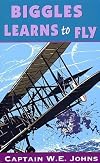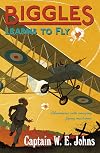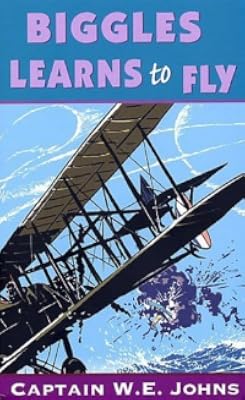
Biggles Learns to Fly
by W. E. Johns
Biggles - Dutch Chron. (1916/17), Biggles - Chronological List (3), Biggles (6)
On This Page
Description
SPECIAL MISSION! It's the First World War and Biggles is just 17. The planes are primitive; combat tactics are non-existent; the only form of communication for pilots and their gunners is by hand signals. They are reliant on the skill of their fellow crew, their wit and, above all else, bravery. In hostile enemy skies, where instinct and fast reactions are everything, Biggles must learn to be a real fighter pilot, or die...but does he have what it takes?Tags
Recommendations


















Member Reviews
The beginnings of James Bigglesworth's (Biggles) career as an airman. Starting with his lying to get into the Flying Corps at 17 and his first missions you can tell that a lot of this is based on John's own career. Littered with footnotes this was a fascinating read when I was younger and it survived reading it when I was older. It's all Boys Own Adventure stuff but people are also injured or are killed during the course of the story. I blame this series for knowing way to much about Airplanes of the era and wartime survival.
There are echoes of PTSD in some of the accounts.
There are echoes of PTSD in some of the accounts.
Tally ho for a thrilling read!
This is a book best consumed under the blankets, read by torchlight after lights out in the dorm, possibly eating forbidden tuck. It is probably best not to read just before or during any sort of flight as a passenger, as it will have you demanding entry to the cockpit so that you can have a go at a spot of trench strafing, which is the sort of behaviour most commercial airlines frown upon, even from their senior pilots.
What comes across most strongly is just how brave the characters are, and how trusting. Brave because from the descriptions of the flying machines, the combat aeroplanes appear to be constructed from fabric, wire and wood, not unlike the corset of a Victorian heroine. To this fragile show more construction is added a bloody huge engine (how can we make this innocent lump of metal more dangerous, I know, fill it with petrol and put a spinny thing rotating really quickly on the front of it!), and a couple of machine guns! Then get a couple of chaps to climb in and fly into the teeth of the enemy.
Basically it’s a tent with a bloody big engine and some machine guns added. Tents can be many things, but bullet-proof is not the first term one associates with them. Dog fights regularly end with Biggles’s flying machine resembling a collender.
The characters are trusting because they have to depend upon one another. Biggles relies upon his gunner, Mark, not just spit leaden death at the Hun* while in dog fights but also to spot aircraft, navigate and not get himself killed. Mark, in turn, has to trust Biggles to fly the aeroplane, depending on him not to crash, fly into ack ack fire, crash in a field, crash into the enemy, fly into fog and lose them, or fly into one of the many obstacles that seem to positively litter the skies of France during the Great War.
The characters, and Biggles in particular, are shown as fallible and fragile. Physically, Biggles is described as a slight youth (probably for the best, don’t want any damned fatties weighing the ‘plane down) who starts out with pristine flying gear but soon has the trademark filthy leathers and gauntlets of Great War aviators and motorcycle gangs everywhere.
In terms of temperament Biggles is remarkably human. He expresses boredom when on dull missions (‘dull’ being characterised as not being exposed to the imminent danger of death at every airborne moment) and impatient and irritated when the artillery he is ‘spotting’ for repeatedly miss the target he is flying over.
He’s also pretty annoyed at the futility of war. But while he recognises that it’s a filthy business this does not stop him from strafing trenches, bombing troop columns and blowing the living hell out of anything with black crosses painted on its wings.
He does, however, empathise with the troops on the ground, having to work his way back through the lines on a couple of occasions through a landscape which appears to consist entirely of mud and Huns*.
Luckily for action lovers, Biggles despises cowards and people who try to shoot him or his friends rather more than he despises war. And there is plenty of action with more lead flying around than you find in a Chinese toy factory.
The story details the progression of Biggles from a novice to a pilot well on his way to becoming an ace, a youth growing up, mastering wild emotion and developing as a shrewd tactician. As the tale of a young man becoming a man against a backdrop of warfare and violence, it’s a tale for our time.
* Huns. Johns explains that this is not a derogatory term for Germans (although there are plenty of those here too!) and indeed claims that new boys at his school were called Huns. If this is true, and there’s no reason to doubt it is, then we should I suppose count ourselves lucky that Johns did not attend an inner-city comp. where new boys might have been described by language fruiter than Carmen Miranda’s hat. ‘I say Biggles, fokkers at twelve o’clock’! show less
This is a book best consumed under the blankets, read by torchlight after lights out in the dorm, possibly eating forbidden tuck. It is probably best not to read just before or during any sort of flight as a passenger, as it will have you demanding entry to the cockpit so that you can have a go at a spot of trench strafing, which is the sort of behaviour most commercial airlines frown upon, even from their senior pilots.
What comes across most strongly is just how brave the characters are, and how trusting. Brave because from the descriptions of the flying machines, the combat aeroplanes appear to be constructed from fabric, wire and wood, not unlike the corset of a Victorian heroine. To this fragile show more construction is added a bloody huge engine (how can we make this innocent lump of metal more dangerous, I know, fill it with petrol and put a spinny thing rotating really quickly on the front of it!), and a couple of machine guns! Then get a couple of chaps to climb in and fly into the teeth of the enemy.
Basically it’s a tent with a bloody big engine and some machine guns added. Tents can be many things, but bullet-proof is not the first term one associates with them. Dog fights regularly end with Biggles’s flying machine resembling a collender.
The characters are trusting because they have to depend upon one another. Biggles relies upon his gunner, Mark, not just spit leaden death at the Hun* while in dog fights but also to spot aircraft, navigate and not get himself killed. Mark, in turn, has to trust Biggles to fly the aeroplane, depending on him not to crash, fly into ack ack fire, crash in a field, crash into the enemy, fly into fog and lose them, or fly into one of the many obstacles that seem to positively litter the skies of France during the Great War.
The characters, and Biggles in particular, are shown as fallible and fragile. Physically, Biggles is described as a slight youth (probably for the best, don’t want any damned fatties weighing the ‘plane down) who starts out with pristine flying gear but soon has the trademark filthy leathers and gauntlets of Great War aviators and motorcycle gangs everywhere.
In terms of temperament Biggles is remarkably human. He expresses boredom when on dull missions (‘dull’ being characterised as not being exposed to the imminent danger of death at every airborne moment) and impatient and irritated when the artillery he is ‘spotting’ for repeatedly miss the target he is flying over.
He’s also pretty annoyed at the futility of war. But while he recognises that it’s a filthy business this does not stop him from strafing trenches, bombing troop columns and blowing the living hell out of anything with black crosses painted on its wings.
He does, however, empathise with the troops on the ground, having to work his way back through the lines on a couple of occasions through a landscape which appears to consist entirely of mud and Huns*.
Luckily for action lovers, Biggles despises cowards and people who try to shoot him or his friends rather more than he despises war. And there is plenty of action with more lead flying around than you find in a Chinese toy factory.
The story details the progression of Biggles from a novice to a pilot well on his way to becoming an ace, a youth growing up, mastering wild emotion and developing as a shrewd tactician. As the tale of a young man becoming a man against a backdrop of warfare and violence, it’s a tale for our time.
* Huns. Johns explains that this is not a derogatory term for Germans (although there are plenty of those here too!) and indeed claims that new boys at his school were called Huns. If this is true, and there’s no reason to doubt it is, then we should I suppose count ourselves lucky that Johns did not attend an inner-city comp. where new boys might have been described by language fruiter than Carmen Miranda’s hat. ‘I say Biggles, fokkers at twelve o’clock’! show less
Biggles Learns To Fly was first published by Boy's Friend Library, London in 1935, while the events were fresh in the author's mind, long before there was any talk of Hitler and a Second World War.
In September 1916, a seventeen-year-old officer (James Bigglesworth – otherwise known as Biggles, 'the author') appeared in the doorway of one of the narrow wooden huts that had sprung up all over England during the previous eighteen months. He was wearing his distinctive uniform of the Royal Flying Corps. Apart from his Sam Browne belt, still squeaking when he moved, like a pair of new boots, there was little about him to distinguish him from thousands of others in whose ears the call to arms had sounded in vain, and who were doing show more precisely the same thing in various parts of the country. Indeed, there was nothing remarkable, or even martial, about his physique; on the contrary, he was slim, rather below average height, and somewhat delicate-looking.
During the past two months, Biggles had learnt the art of flying at 'ground' school; an aerodrome in Norfolk known as No 17 Flying Training School, where great looming buildings with hangars, housed an extraordinary collection of hastily built aeroplanes.
Remarkably, Biggles, with less than fifteen hours flying experience, finds himself on the cross-Channel boat to France. Once there, he is sent to tackle the enemy in the hostile skies over First World War France – that were often considered as suicidal missions! In a theatre of war where instinct and lightning-fast reactions are the most important skills that a person can possess.
As far as Biggles was concerned, he had to learn to be a real flier quickly – or die... To his credit, he picked up the art of war-flying with an aptitude that amazed everyone, particularly his flight-commander.
I understand that some people have questioned the author's 'footnotes', but please, let's not forget that this book was originally written in 1935 – and anyway, I found the 'footnotes' most helpful and extremely informative, admittedly, because of my own personal knowledge of such military activities and aviation facts, being somewhat limited!
What I really liked about this well-written book is the fact that the writer's own experiences have been credited as being much the same as described, in this highly entertaining story. So, overall, I found this book well worth reading.
I'm sure this story will have a wide appeal to lots of young readers, as well as a wiser and more mature reader because it 'highlights' the 'nerve and sheer bravery', that those pilots undoubtedly possessed! show less
In September 1916, a seventeen-year-old officer (James Bigglesworth – otherwise known as Biggles, 'the author') appeared in the doorway of one of the narrow wooden huts that had sprung up all over England during the previous eighteen months. He was wearing his distinctive uniform of the Royal Flying Corps. Apart from his Sam Browne belt, still squeaking when he moved, like a pair of new boots, there was little about him to distinguish him from thousands of others in whose ears the call to arms had sounded in vain, and who were doing show more precisely the same thing in various parts of the country. Indeed, there was nothing remarkable, or even martial, about his physique; on the contrary, he was slim, rather below average height, and somewhat delicate-looking.
During the past two months, Biggles had learnt the art of flying at 'ground' school; an aerodrome in Norfolk known as No 17 Flying Training School, where great looming buildings with hangars, housed an extraordinary collection of hastily built aeroplanes.
Remarkably, Biggles, with less than fifteen hours flying experience, finds himself on the cross-Channel boat to France. Once there, he is sent to tackle the enemy in the hostile skies over First World War France – that were often considered as suicidal missions! In a theatre of war where instinct and lightning-fast reactions are the most important skills that a person can possess.
As far as Biggles was concerned, he had to learn to be a real flier quickly – or die... To his credit, he picked up the art of war-flying with an aptitude that amazed everyone, particularly his flight-commander.
I understand that some people have questioned the author's 'footnotes', but please, let's not forget that this book was originally written in 1935 – and anyway, I found the 'footnotes' most helpful and extremely informative, admittedly, because of my own personal knowledge of such military activities and aviation facts, being somewhat limited!
What I really liked about this well-written book is the fact that the writer's own experiences have been credited as being much the same as described, in this highly entertaining story. So, overall, I found this book well worth reading.
I'm sure this story will have a wide appeal to lots of young readers, as well as a wiser and more mature reader because it 'highlights' the 'nerve and sheer bravery', that those pilots undoubtedly possessed! show less
Finally we get to hear about James Bigglesworth's first day as a pilot. This book is a sequence of short stories that takes Biggles all the way from training camp (a week or so) to 266 Squadron via a number of adventures.
Na zijn opleiding op de kostschool, krijgt James Bigglesworth (of Biggles) de kans om piloot te worden bij de Engelse luchtmacht. Na een korte opleiding wordt hij naar Frankrijk gestuurd om daar als nieuwe piloot acties uit te voeren tegen de Duitsers.
Diverse korte verhalen.
Diverse korte verhalen.
I to nejlepší letecké eso se někdy muselo učit létat. A to se neobešlo bez chyb! Tímto obdobím Bigglesova života a jeho prvními týdny nad frontou Vás provede tato kniha.
Feb 11, 2022Czech
Ratings
Members
- Recently Added By
Lists

Children's Books about World War I (1914-1918)
91 works; 11 members
Author Information

275+ Works 10,630 Members
Series


Belongs to Publisher Series
Work Relationships
Common Knowledge
- Canonical title*
- Biggles leert vliegen
- Original title
- Biggles Learns to Fly
- Original publication date
- 1935
*Some information comes from Common Knowledge in other languages. Click "Edit" for more information.
Classifications
Statistics
- Members
- 252
- Popularity
- 128,394
- Reviews
- 6
- Rating
- (3.54)
- Languages
- 5 — Czech, Dutch, English, French, Swedish
- Media
- Paper, Audiobook, Ebook
- ISBNs
- 15
- ASINs
- 12