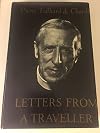
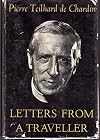
Letters from a traveller
by Pierre Teilhard de Chardin, Pierre Teilhard de Chardin (Author)
On This Page
Description
Letters From A Traveler is a collection of personal letters written by the French philosopher and Jesuit priest, Pierre Teilhard de Chardin, during his travels across the world. The letters were written between 1916 and 1955 and cover a wide range of topics, including Teilhard's experiences as a soldier in World War I, his scientific research, and his spiritual beliefs.The book provides a unique insight into Teilhard's life and work, as well as his views on the relationship between science show more and religion. The letters also offer a fascinating glimpse into the historical and cultural context of the time, as Teilhard describes his encounters with different cultures and societies.Throughout the book, Teilhard's writing is characterized by his deep sense of wonder and curiosity about the world around him. He explores the mysteries of nature and the universe, and reflects on the meaning of life and the human condition.Overall, Letters From A Traveler is a compelling and thought-provoking read, offering readers a glimpse into the mind of one of the most influential thinkers of the 20th century.This is a new release of the original 1962 edition.This scarce antiquarian book is a facsimile reprint of the old original and may contain some imperfections such as library marks and notations. Because we believe this work is culturally important, we have made it available as part of our commitment for protecting, preserving, and promoting the world's literature in affordable, high quality, modern editions, that are true to their original work. show lessTags
Recommendations






















Member Reviews
Letters from a Traveller is a collection of the letters of the Jesuit paleontologist Pere Teilhard de Chardin. His fascinating letters prove what can happen when a brilliant mind is united with a warm heart. His explorations in several parts of the world, but primarily in China, furthered understanding of the age and development of the earth’s geology and the development of man. His ideas were not well received by the church thus his apparent exile to out of the way parts of the world. The development of his ideas of reconciling religion with science rattled a few Vatican cages. After WWII began in Europe but prior to the opening of the Pacific theater he requested that he be allowed to an attend a scientific conference in New York. show more That request was denied stranding him in China for seven years. With the Japanese occupation his work ground to a near halt. His anxiety about the uncertainty of the situation was palpable in his letters. Shortly after he finally made it home to France he promptly had a heart attack. Although he recovered, he had lost some vigor as well as many opportunities and discoveries were lost or destroyed in the ensuing chaos.This is a fascinating read that gives insight into one of the most brilliant minds of the twentieth century. show less
Bought for a course I was taking in comparative religion at Pomona/Harvey Mudd Colleges as a senior.
background on other writings of his
PB-3
Dec 28, 2020Catalan
Ratings
Members
- Recently Added By
Author Information

182+ Works 7,807 Members
Born in Sarcenat, France, Teilhard de Chardin was the son of a landowner and was educated at a Jesuit school. In 1911 he was ordained a Jesuit priest, but also became interested in geology and paleontology. In 1918 Teilhard de Chardin became professor of geology at the Institut Catholique in Paris. Between 1923 and 1946, he went on paleontological show more and anthropological expeditions to China and Central Asia, where he helped discover Peking Man in 1929. His work in Cenozoic geology and paleontology earned him widespread recognition, including the French Legion of Honour (1946). Early Man in China, one of his writings from his period as a scientist, is still available. Teilhard de Chardin's lively mind moved beyond science to speculative cosmology. He ranks as an interpreter of naturalistic evolution within a broadened framework of spirituality. During his lifetime his writings were disapproved by the authorities in his order and the church; however, their posthumous publication in the wake of Vatican II catapulted Teilhard into the very center of attention, by intellectuals and philosophers throughout the world. Although his views seem insupportable to many more cautious minds, they have been taken seriously and have stimulated considerable discussion. Teilhard's system on philosophy has been ably epitomized by J. E. Bruns in his review of Phenomenon of Man: ""The story of life is not more than a movement of consciousness veiled by morphology.' These words of the author, referring to consciousness as related to organic structure, express the essential theme of his book. . . . Evolution has not run its course. Geogenesis led to biogenesis, "which turned out in the end to be nothing else than psychogenesis. . . . Psychogenesis has led to man. Now it efficaces itself, relieved or absorbed by another and a higher function---the engendering and subsequent development of all the stages of the mind, in one word noogenesis noogenesis.' Noogenesis implies the production of a "superabundance of mind' and looks forward to the ultimate earth, a "universe of conscious substance.' Teilhard envisions mankind, through an ever increasing psychosocial unity, concentrating on the transcendent center of this psychic convergence---God---until it reaches the "Omega point,' the "fulfillment of the spirit of the earth,' a detachment of the mind from its material matrix and an abandonment of its organoplanetary foothold" (Catholic World). (Bowker Author Biography) show less
All Editions
Series
Belongs to Publisher Series
Classifications
Statistics
- Members
- 251
- Popularity
- 129,207
- Reviews
- 4
- Rating
- (3.78)
- Languages
- 6 — Dutch, English, French, German, Italian, Spanish
- Media
- Paper
- ISBNs
- 10
- ASINs
- 18