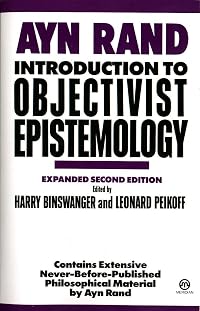
Introduction to Objectivist Epistemology: Expanded Second Edition
by Ayn Rand 
On This Page
Description
Today man's mind is under attack by all the leading schools of philosophy. We are told that we cannot trust our senses, that logic is arbitrary, that concepts have no basis in reality. Ayn Rand opposes that torrent of nihilism, and she provides the alternative in this eloquent presentation of the essential nature--and power--of man's conceptual faculty. She offers a startlingly original solution to the problem that brought about the collapse of modern philosophy: the problem of universals. show more This brilliantly argued, superbly written work, together with an essay by philosophy professor Leonard Peikoff, is vital reading for all those who seek to discover that human beings can and should live by the guidance of reason. show lessTags
Recommendations









Member Reviews
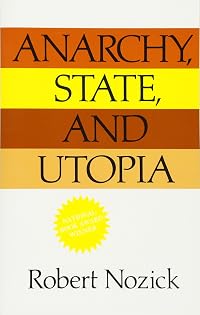
I know many sneer at the idea of Ayn Rand as a philosopher. (Just look at reviews below.) I believe mainly because they're so radically opposed to her views and so consider her a threat to their values. And many find it easy to be derogatory because she won fame as a writer of fiction and didn't have the academic credentials of those who usually call themselves philosophers. And sorry to say, it probably didn't help back then--may even hurt her now--that she was a woman poaching on very male territory. All I can tell you is that the much-lauded Anarchy, State and Utopia by Robert Nozick, which won a National Book Award in philosophy and religion, basically takes Ayn Rand's political arguments and presents them in academic language and show more is by someone with those academic credentials--and it's awarded respect.
But if any aspect of her philosophy has some grudging acknowledgement from philosophers, and is truly original, it's probably her epistemology. Epistemology is that branch of philosophy that deals with knowledge--its nature, what can we know, how do we know it. Once, when Ayn Rand was asked to define her philosophy while standing on one foot, she replied: "Metaphysics: Objective Reality; Epistemology: Reason; Ethics: Self-Interest, Politics: Capitalism." Well, I might take issue with "capitalism" as the name of a political, rather than economic concept, but otherwise that's summarizes her beliefs well. But then a lot of philosophers might define themselves similarly. What makes a philosophical system are the details and the arguments. In the case of epistemology this book actually has a pretty narrow focus--though a crucial one. The original edition was not much longer than 100 pages--a very slim mass paperback. Peikoff has added to it material from taped lectures. Basically, this focuses on the nature of concepts and especially concept formation and how that feeds into consciousness and identity.
These are difficult concepts--within any philosophy. Just try reading Locke or Kant on the subject. In this Rand's lack of an academic background and her strengths as a popularizer of philosophy is a blessing: because the arguments she presents are lucid and clear. You can find the main criticisms of the arguments on the Wiki--that it doesn't take cognitive psychology into account and that "conflates the perceptual process by which judgments are formed with the way in which they are to be justified." I haven't read the counterarguments in their entirely in a way I can judge their validity. But personally, and I know this is not in itself an argument for her epistemology--but I know how relieved I felt to find a thinker defending the validity of the senses and reason after I had been filled with philosophers in school that would deny their reality. So yes, I find this book amazing, powerful and valuable. show less
But if any aspect of her philosophy has some grudging acknowledgement from philosophers, and is truly original, it's probably her epistemology. Epistemology is that branch of philosophy that deals with knowledge--its nature, what can we know, how do we know it. Once, when Ayn Rand was asked to define her philosophy while standing on one foot, she replied: "Metaphysics: Objective Reality; Epistemology: Reason; Ethics: Self-Interest, Politics: Capitalism." Well, I might take issue with "capitalism" as the name of a political, rather than economic concept, but otherwise that's summarizes her beliefs well. But then a lot of philosophers might define themselves similarly. What makes a philosophical system are the details and the arguments. In the case of epistemology this book actually has a pretty narrow focus--though a crucial one. The original edition was not much longer than 100 pages--a very slim mass paperback. Peikoff has added to it material from taped lectures. Basically, this focuses on the nature of concepts and especially concept formation and how that feeds into consciousness and identity.
These are difficult concepts--within any philosophy. Just try reading Locke or Kant on the subject. In this Rand's lack of an academic background and her strengths as a popularizer of philosophy is a blessing: because the arguments she presents are lucid and clear. You can find the main criticisms of the arguments on the Wiki--that it doesn't take cognitive psychology into account and that "conflates the perceptual process by which judgments are formed with the way in which they are to be justified." I haven't read the counterarguments in their entirely in a way I can judge their validity. But personally, and I know this is not in itself an argument for her epistemology--but I know how relieved I felt to find a thinker defending the validity of the senses and reason after I had been filled with philosophers in school that would deny their reality. So yes, I find this book amazing, powerful and valuable. show less
I like Ayn Rands fiction, but must admit, I did not expect her to be much of a philosopher. But I was positively surprised. First of all, it is actually a real introduction to (her theory of) epistemology, written without to much "look-at-me-I-am-doing-philosophy".. I do not agree with her conceptual realism, that concepts exists completely independent of humans. It smacks of Platonisms, which neither she or I believe in. But towards the end in the chapter called 'The cognitive role of concepts', I feel her theory comes together, and she really has something to contribute: an anti-metaphysical philosophy that is far from relativism. It also supports her political antagonism of communist social engineering, by believing fully in basic show more condition of being human. This may not be material for 'The 20 greatest philosophers', but her - somewhat 'simple' - common sensical philosophy is an interesting contribution to a theory of the human situation. show less
Despite the title, the book deals as much with metaphysics as epistemology. Its centre is Ayn Rand's attempt to provide a solution to the traditional Problem of Universals. However, the theory touted as startlingly original turns out to be just a version of traditional conceptualism. Rand tries to make out that her theory is original by mischaracterizing all other versions of conceptualism as more subjectivistic than most of them are.
Unlike Rand's ethics, her theoretical philosophy is not clearly absurd or abhorrent (though it shares all the well-known problems of conceptualism), but there is nothing original or very profound about it. It is presented vigorously but very dogmatically, not recognizing any chance of error.
Unlike Rand's ethics, her theoretical philosophy is not clearly absurd or abhorrent (though it shares all the well-known problems of conceptualism), but there is nothing original or very profound about it. It is presented vigorously but very dogmatically, not recognizing any chance of error.
This makes me think of an old Cheech and Chong routine. If it looks like bullshit, and smells like bullshit, you probably don’t need to step in it. Rand tried to invent an entirely new approach to epistemology by disregarding 300 years of philosophic thought and political economy. Some people think she was a philosopher but, no, she wasn’t.
Just the ramblings of an absolutist utopian narcissistic know-it-all. I can't recommend it.
Easy to read foundation of Objectivist epistemology which details the foundation of abstract axioms - "existence" and "identity."
2nd edition, edited by Harry Binswanger and Leonard Peikoff
Ayn Rand states her revolutionary theory of concepts; transcripts of invaluable epistemology workshops she conducted are also included.
Topics covered include: What qualifies as an entity? How the act of abstracting is volitionally initiated. Do definitions narrow or expand as knowledge increases? How to validate induction. The meaning of "implicit concept."
Ayn Rand states her revolutionary theory of concepts; transcripts of invaluable epistemology workshops she conducted are also included.
Topics covered include: What qualifies as an entity? How the act of abstracting is volitionally initiated. Do definitions narrow or expand as knowledge increases? How to validate induction. The meaning of "implicit concept."
Members
- Recently Added By
Author Information

180+ Works 76,552 Members
Ayn Rand, 1905 - 1982 Novelist and philosopher Ayn Rand was born Alice Rosenbaum on February 2, 1905 in St. Petersburg, Russia. She graduated with highest honors in history from the University of Petrograd in 1924, and she came to the United States in 1926 with dreams of becoming a screenwriter. In 1929, she married actor Charles "Frank" O'Connor. show more After arriving in Hollywood, Rand was spotted by Cecil B. DeMille standing at the gate of his studio and gave her a job as an extra in King of Kings. She also worked as a script reader and a wardrobe girl and, in 1932, she sold Red Pawn to Universal Studios. In the 1950's, she returned to New York City where she hosted a Saturday night group she called "the collective." It was also during this time that Rand received a fan letter from a young man, Nathaniel Branden. She was impressed with his letter, and she wrote him back. Her correspondence with him eventually led to an affair that lasted over a decade. He became her chief spokesperson and codified the principles of her novels into a strict philosophical system (objectivism) and founded an institute bearing his name. Their affair ended in 1968 when Branden got involved with another one of Rand's disciples. According to Rand, people are inherently selfish and act only out of personal interest making a selfish act, a rational one. It is from this belief that her characters play out their lives. Rand's first novel was "We the Living" (1936) and was followed by "Anthem" (1938), "The Fountainhead" (1943), and "Atlas Shrugged" (1957). All four of her novels made the top ten of the controversial list of the 100 Best Novels of the 20th Century. On March 6, 1982, Ayn Rand died in her New York City apartment. (Bowker Author Biography) show less
Ayn Rand has a Legacy Library. Legacy libraries are the personal libraries of famous readers, entered by LibraryThing members from the Legacy Libraries group.
Work Relationships
Is abridged in
Is an expanded version of
Common Knowledge
- Original publication date
- 1979-04
- Last words
- (Click to show. Warning: May contain spoilers.)A major step in that direction is elimination of the death-carrier known as the analytic-syntehtic dichotomy.
Classifications
Statistics
- Members
- 735
- Popularity
- 38,376
- Reviews
- 10
- Rating
- (3.79)
- Languages
- Chinese, English, Portuguese, Spanish
- Media
- Paper, Ebook
- ISBNs
- 12
- UPCs
- 1
- ASINs
- 7