On This Page
Description
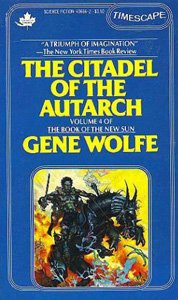
Severian the Torturer continues his epic journey across the lands of Urth, carrying with him the Claw of the Conciliator and the great sword, Terminus Est. All his travels are leading towards a destiny that he dare not refuse. This is the fourth and last volume in the series.Tags
Recommendations


















Member Recommendations
Member Reviews
This is an odd review for me to write. I've read this book three times now. It's the final volume in a four-book cycle. And I haven't reviewed any of the previous books, but I have reviewed the series as a whole. However, I'm trying to review every book I read this year (wish me luck!) so here goes:
The Citadel of the Autarch is the final volume of Gene Wolfe's career-defining masterpiece, The Book of the New Sun, which I've read every December (sometimes carrying over into January) for the past three years. It's a dense, mysterious, powerful, bewildering, and moving saga that rewards rereads like nothing else this side of Steven Erikson's Malazan Book of the Fallen. If you haven't read it before, (A) do it!, and (B) I feel compelled to show more warn you that this review contains spoilers.
Following from the end of the last volume, The Sword of the Lictor, this book sees Severian heading north from Lake Diuturna, where he comes face-to-face with the war against the Ascians. I've long considered this book (along with the previous volume) as the weaker half of TBotNS, with the flight from Thrax (in Sword) and the war in this book being—to me—fairly uninteresting affairs. I had to reconsider that opinion when I recently reread Sword, and ran into the same situation with Citadel this last time through.
Severian approaches the war obliquely at first, encountering a dead soldier who appears to be resurrected by the Claw of the Conciliator, then accompanying said soldier to a lazaret where the war's victims are being treated. At this point in the narrative, Severian transcribes a collection of tales heard during his time in the lazaret. During my first read, I was irritated with the break in the narrative that these stories created. The second time, I knew it was coming and was able to hunker down and power through, as it were. This time around, I found myself looking forward to the stories, especially "The Armiger's Daughter", which I read a couple of times, I love it so much now. When Severian leaves the lazaret (all too soon) he is thrust into the war proper, and though this section of the book is still one of the most confusing in the entire Book, it's far shorter than I remembered. His direct involvement in the war over, he goes through a series of encounters with old "friends", culminating in his becoming the Autarch of the Commonwealth (not a spoiler; he reveals this at the end of the second chapter in the first book.)
After that, there are a handful of chapters devoted to tying up loose ends or clarifying a select few of the sequence's mysteries. For me, this is part of the big payoff of the series, but only part; most of the payoff is actually going back and reading it all over again to try and make sense of everything with a new perspective. As Severian says in the final chapter:
"Have I told you all I promised? I am aware that at various places in my narrative I have pledged that this or that should be made clear in the knitting up of the story. I remember them all, I am sure, but then I remember so much else. Before you assume that I have cheated you, read again, as I will write again."
I can think of little else to say other than that this is a powerful conclusion to a SF masterpiece, almost a religious experience, with a scope of overwhelming extragalactic magnitude, but which also—viewed through Severian's eyes—reaches down and touches at an intimately personal level. 5 out of 5 stars for this final volume, and 5/5 for the Book as a whole. show less
The Citadel of the Autarch is the final volume of Gene Wolfe's career-defining masterpiece, The Book of the New Sun, which I've read every December (sometimes carrying over into January) for the past three years. It's a dense, mysterious, powerful, bewildering, and moving saga that rewards rereads like nothing else this side of Steven Erikson's Malazan Book of the Fallen. If you haven't read it before, (A) do it!, and (B) I feel compelled to show more warn you that this review contains spoilers.
Following from the end of the last volume, The Sword of the Lictor, this book sees Severian heading north from Lake Diuturna, where he comes face-to-face with the war against the Ascians. I've long considered this book (along with the previous volume) as the weaker half of TBotNS, with the flight from Thrax (in Sword) and the war in this book being—to me—fairly uninteresting affairs. I had to reconsider that opinion when I recently reread Sword, and ran into the same situation with Citadel this last time through.
Severian approaches the war obliquely at first, encountering a dead soldier who appears to be resurrected by the Claw of the Conciliator, then accompanying said soldier to a lazaret where the war's victims are being treated. At this point in the narrative, Severian transcribes a collection of tales heard during his time in the lazaret. During my first read, I was irritated with the break in the narrative that these stories created. The second time, I knew it was coming and was able to hunker down and power through, as it were. This time around, I found myself looking forward to the stories, especially "The Armiger's Daughter", which I read a couple of times, I love it so much now. When Severian leaves the lazaret (all too soon) he is thrust into the war proper, and though this section of the book is still one of the most confusing in the entire Book, it's far shorter than I remembered. His direct involvement in the war over, he goes through a series of encounters with old "friends", culminating in his becoming the Autarch of the Commonwealth (not a spoiler; he reveals this at the end of the second chapter in the first book.)
After that, there are a handful of chapters devoted to tying up loose ends or clarifying a select few of the sequence's mysteries. For me, this is part of the big payoff of the series, but only part; most of the payoff is actually going back and reading it all over again to try and make sense of everything with a new perspective. As Severian says in the final chapter:
"Have I told you all I promised? I am aware that at various places in my narrative I have pledged that this or that should be made clear in the knitting up of the story. I remember them all, I am sure, but then I remember so much else. Before you assume that I have cheated you, read again, as I will write again."
I can think of little else to say other than that this is a powerful conclusion to a SF masterpiece, almost a religious experience, with a scope of overwhelming extragalactic magnitude, but which also—viewed through Severian's eyes—reaches down and touches at an intimately personal level. 5 out of 5 stars for this final volume, and 5/5 for the Book as a whole. show less
In what was touted as the closing volume of Wolfe's The Book of the New Sun, the by now former torturer Severian has survived the fight at the castle of Baldanders, met aliens, had his great executioner's sword Terminus Est shattered, and the mystical gem, the Claw of the Conciliator, likewise broken into a million pieces, leaving Severian with an actual claw, which may or may not retain healing properties.
Now he journeys north to the war between the Ascians and the forces of the Autarch. He falls in with various soldiers of both sides; and eventually with the Autarch himself, who reveals that Severian has had a destiny all along...
Read on one level, this is a coming-of-age novel; at one point, Severian returns to the Citadel of the show more Torturers in Nessus, and his Guild classmates are still there; and we realise that for all his life-changing adventures, Severian is still a young man, though he has acquired more maturity than his contemporaries. But the story is not only about Severian; we see more of the world of Urth and the deep future it represents for us. We also begin to understand the nature of the catastrophe that is overcoming the Sun, and we hear for the first time about the White Fountain that might bring about the New Sun that has been in the background of everyone's thoughts throughout all four books.
So many of Severian's strands are brought to an end here; Dorcas, Vodalus, Dr.Talos and Agia all make their final appearances. Other mysteries remain unresolved - for instance, were Severian's healing powers a consequence of his possession of the Claw, or something he possessed subconsciously all the time? Wolfe's wordplay provides us with clues.
This whole sequence of books provides rich pickings for those who like to concentrate on details; others will revel in the whole rich tapestry of time spread out for us to reflect upon. Our entire span of recorded history so far is just a blink of an eye compared to the ages that have passed between our time and Severian's; we should not expect every aspect of life on Urth to be immediately clear to us.
Although this book is the end of The Book of the New Sun, Wolfe then continued with a coda novel, The Urth of the New Sun, as well as two further series set in the same universe. There is still much to explore here. show less
Now he journeys north to the war between the Ascians and the forces of the Autarch. He falls in with various soldiers of both sides; and eventually with the Autarch himself, who reveals that Severian has had a destiny all along...
Read on one level, this is a coming-of-age novel; at one point, Severian returns to the Citadel of the show more Torturers in Nessus, and his Guild classmates are still there; and we realise that for all his life-changing adventures, Severian is still a young man, though he has acquired more maturity than his contemporaries. But the story is not only about Severian; we see more of the world of Urth and the deep future it represents for us. We also begin to understand the nature of the catastrophe that is overcoming the Sun, and we hear for the first time about the White Fountain that might bring about the New Sun that has been in the background of everyone's thoughts throughout all four books.
So many of Severian's strands are brought to an end here; Dorcas, Vodalus, Dr.Talos and Agia all make their final appearances. Other mysteries remain unresolved - for instance, were Severian's healing powers a consequence of his possession of the Claw, or something he possessed subconsciously all the time? Wolfe's wordplay provides us with clues.
This whole sequence of books provides rich pickings for those who like to concentrate on details; others will revel in the whole rich tapestry of time spread out for us to reflect upon. Our entire span of recorded history so far is just a blink of an eye compared to the ages that have passed between our time and Severian's; we should not expect every aspect of life on Urth to be immediately clear to us.
Although this book is the end of The Book of the New Sun, Wolfe then continued with a coda novel, The Urth of the New Sun, as well as two further series set in the same universe. There is still much to explore here. show less
This is probably the best ending you could expect from the Book of the New Sun. This is a series I felt was mix of a few interesting moments and good writing, combined with a nonsensical plot and needless pretension. The Citadel of the Autarch gives you a little bit more of the former and a little bit less of the latter. I didn't expect to understand any of the series myriad mysterious by the end. Citadel of the Autarch actually explains some things and there is a somewhat satisfying ending. All in all, it was a pleasant surprise.
Make no mistake, this series is deeply flawed. I'm just so shocked the last book wasn't complete nonsense, I can't help but write a somewhat positive review. At the end of the day, I still believe Wolfe has show more built a false symbolism. When something strange happens in the book, something that has no explanation, it isn't because it has any deeper meaning. Wolfe created strangeness and mystery for its own sake, and fooled many into viewing this as a great work of literature. I had to slog through all four books in several times the length it normally would take me to read four novels. The Book of the New Sun is an exercise in frustration.
Overall, the Book of the New Sun has a few compelling ideas, but for the most part, it is a poor example of the greatness the speculative fiction genre has to offer. show less
Make no mistake, this series is deeply flawed. I'm just so shocked the last book wasn't complete nonsense, I can't help but write a somewhat positive review. At the end of the day, I still believe Wolfe has show more built a false symbolism. When something strange happens in the book, something that has no explanation, it isn't because it has any deeper meaning. Wolfe created strangeness and mystery for its own sake, and fooled many into viewing this as a great work of literature. I had to slog through all four books in several times the length it normally would take me to read four novels. The Book of the New Sun is an exercise in frustration.
Overall, the Book of the New Sun has a few compelling ideas, but for the most part, it is a poor example of the greatness the speculative fiction genre has to offer. show less
ORIGINALLY POSTED AT Fantasy Literature.
The Citadel of the Autarch is a satisfying conclusion to Gene Wolfe’s The Book of the New Sun. (A fifth book, The Urth of the New Sun, is a coda to the original four books.) We’ve known all along that Severian the torturer would be the autarch by the end of his story, but his fascinating journey to the throne is what this saga is all about… on the surface, at least.
What it’s really about, for those who want to see it, is the juxtaposition of future and past, the nature of time and space, perception and reality, religion and science, and the Earth’s and humanity’s need for redemption. All of this is explored in the context of the strange characters, situations, and places that Severian show more meets on his way.
The Book of the New Sun is not an easy read, but it’s what speculative fiction is all about — it’s brain-bending, it makes the reader consider and question, it stretches the intellect and opens the mind to new ideas and experiences. In The Book of the New Sun, Gene Wolfe accomplishes all this and does it in a beautiful way. This is my measuring rod for excellent fantasy literature.
For readers who don’t want to be bothered by allegory and symbolism, or don’t want to risk scorching their synapses, there’s still much to admire in The Book of the New Sun, for though it wallows in weirdness, all of it is tied loosely together by Wolfe’s lovely language, detailed world-building, smart ideas, and astounding imagination.
I look forward to reading on in Gene Wolfe’s Solar Cycle (there are two sequel series: The Book of the Long Sun and The Book of the Short Sun.) show less
The Citadel of the Autarch is a satisfying conclusion to Gene Wolfe’s The Book of the New Sun. (A fifth book, The Urth of the New Sun, is a coda to the original four books.) We’ve known all along that Severian the torturer would be the autarch by the end of his story, but his fascinating journey to the throne is what this saga is all about… on the surface, at least.
What it’s really about, for those who want to see it, is the juxtaposition of future and past, the nature of time and space, perception and reality, religion and science, and the Earth’s and humanity’s need for redemption. All of this is explored in the context of the strange characters, situations, and places that Severian show more meets on his way.
The Book of the New Sun is not an easy read, but it’s what speculative fiction is all about — it’s brain-bending, it makes the reader consider and question, it stretches the intellect and opens the mind to new ideas and experiences. In The Book of the New Sun, Gene Wolfe accomplishes all this and does it in a beautiful way. This is my measuring rod for excellent fantasy literature.
For readers who don’t want to be bothered by allegory and symbolism, or don’t want to risk scorching their synapses, there’s still much to admire in The Book of the New Sun, for though it wallows in weirdness, all of it is tied loosely together by Wolfe’s lovely language, detailed world-building, smart ideas, and astounding imagination.
I look forward to reading on in Gene Wolfe’s Solar Cycle (there are two sequel series: The Book of the Long Sun and The Book of the Short Sun.) show less
Gene Wolfe’s deceptively long Book of the New Sun comes to a close with this, the final volume, The Citadel of the Autarch. (Actually, that’s not quite true – he apparently wrote an extra book in 1987 called The Urth of the New Sun, which I may or may not read in the future.)
This was a difficult series to review because it’s really just one long book split into four, and – like many promising stories whose ultimate value hinges on how well they turn out – I couldn’t really judge it until now. So this is going to be a review of both The Citadel of the Autarch and the Book of the New Sun as a whole, and spoilers will abound.
I originally heard about this series in 2011 when I was working in a bookstore and trying to get back show more into the fantasy genre. The Book of the New Sun and George R.R. Martin’s A Song of Ice and Fire were the two series which, above all others, were mentioned as the high point of fantasy fiction in the last fifty years. The only reason I chose to go with Martin first was that 2012 was clearly his year, with the TV series coming out and out store shifting more than 50 copies of A Game of Thrones every day. Given how thick that series is, I didn’t get around to the Book of the New Sun until last month.
It’s ostensibly fantasy, but is really science fiction; a good example of why these sections are often lumped together in bookstores. The protagonist, Severian, is a journeyman apprentice from the Seekers of Truth and Penitence, more commonly known as the guild of torturers. After breaking his vow, Severian is expelled from the guild and sent out to face the wonders and dangers of Wolfe’s rich fantasy world, which is actually our own planet far into the future, when the sun is slowly dying.
Wolfe excels at fantasy world-building – not just in the imaginative creation of the world itself, but the techniques he uses to create it. Unusually for a fantasy series, The Book of the New Sun is narrated in first person, and Severian’s point of view is used to great effect. He regularly interprets certain scientific processes as magical and casually skims over tantalising details because he considers them mundane. Much of the enjoyment of the book comes from parsing Severian’s story for details about his world, and trying to piece together what’s going on and what kind of a place he’s in.
The Citadel of the Autarch does and doesn’t lead to answers. This isn’t Lost, and it’s not like I really expected precise answers, given that so much of the book was written in mystic, arcane prose designed to hint at the truth rather than reveal it. The central conceit of the book – the awaited New Sun – is dealt with in a way that perfectly summarises Wolfe’s marriage of fantasy and science fiction, describing processes of such high, theoretical quantum physics that to a layman they are almost fantasy, and planting them in a world where the inhabitants do indeed consider them to be the stuff of religion, myth and prophecy:
“You know of the chasms of space, which some call the Black Pits, from which no speck of matter or gleam of light ever returns. But what you have not known until now is that these chasms have their counterparts in the White Fountains, from which matter and energy rejected from a higher universe flow in endless cataract into this one. If you pass – if our race is judged ready to reenter the wide seas of space – such a White Fountain will be created in the heart of our sun.”
The Book of the New Sun embraces, more than any other work I have seen, Arthur C. Clarke’s axiom that “any sufficiently advanced technology is indistinguishable from magic.”
Remaining on the subject of things I enjoyed in The Citadel of the Autarch, Severian’s ascent to the throne – which is casually mentioned to be his fate early in the first book – always seemed unlikely given his station in life, but is handled perfectly believably, utilising fantasy/sci-fi elements that were a major part of the series from the very first chapter. (It also gives a clever twist to the royal pronoun “we.”)
The problem with the Book of the New Sun is that while Severian’s retrospective memoir narrative works wonders in establishing a great fantasy world, it fails at actually telling a good story. It can be overly dry and constantly digresses, and the plot-driven parts of the book suffer for it. The Citadel of the Autarch, in particular, has a clump of unforgivably tedious battle sequences at its centre which almost sent me to sleep. And The Book of the New Sun is, overall, a plot-driven story, which means that more often than not I was pushing myself through because I was fascinated by the world, rather than genuinely enjoying the book because I liked the story. (See also – China Mieville.) The Book of the New Sun is undoubtedly a series that would reward re-reading, but I doubt I’ll ever have the inclination to do so.
The series also feels far too constrained and dictated. Severian is a free agent with free will, and throughout the book he regularly informs to the reader of his goals and motives. Yet he feels like a puppet on a string, because he keeps randomly encountering important people and major events and recurring characters. It feels as though everything he does is pre-ordained. Which, as far as I can tell from the book’s conclusion, it may be – but then there’s the problem of deus ex machina, which the series is marinated in. Wolfe even has the cheek to have a minor character say:
“It refers to some supernatural force, personified and brought onto the stage in the last act in order that the play may end well. None but poor playwrights do it, they say, but those who say so forget that it is better to have a power lowered on a rope, and a play that ends well, than nothing, and a play that ends badly.”
The Book of the New Sun often feels more like conceptual literary fantasy/sci-fi than an actual story that one reads for enjoyment. I find it quite interesting that it’s considered to rank alongside A Song of Ice and Fire, because the two are apples and oranges. I definitely prefer Martin’s series, because it’s easier to read, more entertaining, and bucks enough cliches to elevate itself above schlock genre fiction. Wolfe’s series, on the other hand, pulls up just shy of the point where I’d call it pretentious, and I can easily see how it’s stuck in an uneasy niche – too literary for fantasy readers, and too fantasy for literary readers.
They’re not bad books. They aren’t the books I was expecting them to be, and I can’t say I truly enjoyed them, but they are bold and unique and worth at least checking out for fans of both fantasy and science fiction. I also suspect that, like certain other critically acclaimed books that I didn’t give great reviews to (Wolf Hall, True History of the Kelly Gang) I’ll find that they stick in my mind and I come to think much better of them than I do right now.
A final note, which didn’t fit elsewhere – Wolfe’s note-bearing epilogues at the end of each book are just plain strange. The epilogues – which run at the end of each of the four books, for only three or four pages – are in-universe frame story notes written from the point of view of a “scholar,” apparently of our own time, studying the Book of the New Sun as a “manuscript” and attempting to learn about Severian’s world. They go some way to explaining a few bits and piece, but I’m confused as to why Wolfe would insert them in the first place when he obviously trusted most readers to be smart enough and engaged enough to pick out the details themselves. Furthermore, if he was going to use this technique, it should have been employed more regularly, in footnotes and endnotes and chapter breaks all over the novels, ala Jonathan Strange and Mr Norrell. Instead we have four epilogues, totalling about 10 pages, versus 1,212 pages of narrative. Why bother? Either put them in often or cut them entirely. show less
This was a difficult series to review because it’s really just one long book split into four, and – like many promising stories whose ultimate value hinges on how well they turn out – I couldn’t really judge it until now. So this is going to be a review of both The Citadel of the Autarch and the Book of the New Sun as a whole, and spoilers will abound.
I originally heard about this series in 2011 when I was working in a bookstore and trying to get back show more into the fantasy genre. The Book of the New Sun and George R.R. Martin’s A Song of Ice and Fire were the two series which, above all others, were mentioned as the high point of fantasy fiction in the last fifty years. The only reason I chose to go with Martin first was that 2012 was clearly his year, with the TV series coming out and out store shifting more than 50 copies of A Game of Thrones every day. Given how thick that series is, I didn’t get around to the Book of the New Sun until last month.
It’s ostensibly fantasy, but is really science fiction; a good example of why these sections are often lumped together in bookstores. The protagonist, Severian, is a journeyman apprentice from the Seekers of Truth and Penitence, more commonly known as the guild of torturers. After breaking his vow, Severian is expelled from the guild and sent out to face the wonders and dangers of Wolfe’s rich fantasy world, which is actually our own planet far into the future, when the sun is slowly dying.
Wolfe excels at fantasy world-building – not just in the imaginative creation of the world itself, but the techniques he uses to create it. Unusually for a fantasy series, The Book of the New Sun is narrated in first person, and Severian’s point of view is used to great effect. He regularly interprets certain scientific processes as magical and casually skims over tantalising details because he considers them mundane. Much of the enjoyment of the book comes from parsing Severian’s story for details about his world, and trying to piece together what’s going on and what kind of a place he’s in.
The Citadel of the Autarch does and doesn’t lead to answers. This isn’t Lost, and it’s not like I really expected precise answers, given that so much of the book was written in mystic, arcane prose designed to hint at the truth rather than reveal it. The central conceit of the book – the awaited New Sun – is dealt with in a way that perfectly summarises Wolfe’s marriage of fantasy and science fiction, describing processes of such high, theoretical quantum physics that to a layman they are almost fantasy, and planting them in a world where the inhabitants do indeed consider them to be the stuff of religion, myth and prophecy:
“You know of the chasms of space, which some call the Black Pits, from which no speck of matter or gleam of light ever returns. But what you have not known until now is that these chasms have their counterparts in the White Fountains, from which matter and energy rejected from a higher universe flow in endless cataract into this one. If you pass – if our race is judged ready to reenter the wide seas of space – such a White Fountain will be created in the heart of our sun.”
The Book of the New Sun embraces, more than any other work I have seen, Arthur C. Clarke’s axiom that “any sufficiently advanced technology is indistinguishable from magic.”
Remaining on the subject of things I enjoyed in The Citadel of the Autarch, Severian’s ascent to the throne – which is casually mentioned to be his fate early in the first book – always seemed unlikely given his station in life, but is handled perfectly believably, utilising fantasy/sci-fi elements that were a major part of the series from the very first chapter. (It also gives a clever twist to the royal pronoun “we.”)
The problem with the Book of the New Sun is that while Severian’s retrospective memoir narrative works wonders in establishing a great fantasy world, it fails at actually telling a good story. It can be overly dry and constantly digresses, and the plot-driven parts of the book suffer for it. The Citadel of the Autarch, in particular, has a clump of unforgivably tedious battle sequences at its centre which almost sent me to sleep. And The Book of the New Sun is, overall, a plot-driven story, which means that more often than not I was pushing myself through because I was fascinated by the world, rather than genuinely enjoying the book because I liked the story. (See also – China Mieville.) The Book of the New Sun is undoubtedly a series that would reward re-reading, but I doubt I’ll ever have the inclination to do so.
The series also feels far too constrained and dictated. Severian is a free agent with free will, and throughout the book he regularly informs to the reader of his goals and motives. Yet he feels like a puppet on a string, because he keeps randomly encountering important people and major events and recurring characters. It feels as though everything he does is pre-ordained. Which, as far as I can tell from the book’s conclusion, it may be – but then there’s the problem of deus ex machina, which the series is marinated in. Wolfe even has the cheek to have a minor character say:
“It refers to some supernatural force, personified and brought onto the stage in the last act in order that the play may end well. None but poor playwrights do it, they say, but those who say so forget that it is better to have a power lowered on a rope, and a play that ends well, than nothing, and a play that ends badly.”
The Book of the New Sun often feels more like conceptual literary fantasy/sci-fi than an actual story that one reads for enjoyment. I find it quite interesting that it’s considered to rank alongside A Song of Ice and Fire, because the two are apples and oranges. I definitely prefer Martin’s series, because it’s easier to read, more entertaining, and bucks enough cliches to elevate itself above schlock genre fiction. Wolfe’s series, on the other hand, pulls up just shy of the point where I’d call it pretentious, and I can easily see how it’s stuck in an uneasy niche – too literary for fantasy readers, and too fantasy for literary readers.
They’re not bad books. They aren’t the books I was expecting them to be, and I can’t say I truly enjoyed them, but they are bold and unique and worth at least checking out for fans of both fantasy and science fiction. I also suspect that, like certain other critically acclaimed books that I didn’t give great reviews to (Wolf Hall, True History of the Kelly Gang) I’ll find that they stick in my mind and I come to think much better of them than I do right now.
A final note, which didn’t fit elsewhere – Wolfe’s note-bearing epilogues at the end of each book are just plain strange. The epilogues – which run at the end of each of the four books, for only three or four pages – are in-universe frame story notes written from the point of view of a “scholar,” apparently of our own time, studying the Book of the New Sun as a “manuscript” and attempting to learn about Severian’s world. They go some way to explaining a few bits and piece, but I’m confused as to why Wolfe would insert them in the first place when he obviously trusted most readers to be smart enough and engaged enough to pick out the details themselves. Furthermore, if he was going to use this technique, it should have been employed more regularly, in footnotes and endnotes and chapter breaks all over the novels, ala Jonathan Strange and Mr Norrell. Instead we have four epilogues, totalling about 10 pages, versus 1,212 pages of narrative. Why bother? Either put them in often or cut them entirely. show less
This was a good read, but not a must read for me. I felt it held together a bit better than the previous 3rd volume but I found the ending a little bit of a let down. The entire 4 volumes of the Book of the New Sun really is about the journey rather than the destination. What makes this series of book so pleasurable to read is Wolfe’s prose and the wonderings he poses via Severian’s thought processes. I still don’t understand why Severian was chosen to be Autarch. I still don’t understand why he has unreliable powers of resurrection and healing. I still don’t understand the role of the Undines and the cacogenes (aliens). It feels to me as if humanity is a pawn in a much larger game to which Severian is finally admitted to the show more table to play at the end of the book. Clearly there is time travel occurring throughout the entire 4 volumes of this book. Is this why humanity stopped travelling to the stars? Because they figured out how to traverse time? So many questions that I still wonder about. Is Severian/The Autarch a good person or simply someone who is carrying out their role in the game? The first two volumes in this series ended up being my favourites because they introduced the world and also seemed to develop relationships to a better extent between Severian and his travelling companions (Shadow of the Torturer; Claw of the Conciliator). In the last two volumes, relationships seem to be tossed aside too wantonly for a variety of reasons but typically because they simply die. So there is little chance to become invested in the characters that Severian meets (Sword of the Lictor; Citadel of the Autarch). Despite these criticisms, I am still very happy I read this book. It is interesting but not fully satisfying. show less
The Book of the New Sun series is the best sci-fi I've ever read, and the best fantasy I've ever read. Any discussion of why would be a spoiler. But: in the same way Dark Souls reveals its world, though snatched moments, architecture, and poetry, so too does this book series disclose a yawning vastness. And critically it allows that vastness to yawn like the night sky.
Members
- Recently Added By
Lists

Books Read in 2002
197 works; 8 members

Books Read in 2025
4,090 works; 97 members
Talk Discussions
Past Discussions
The Book of the New Sun Vol 4- The Citadel of the Autarch in Group Reads - Sci-Fi (October 2008)
Author Information

313+ Works 43,435 Members
Gene Wolfe was born in New York City on May 7, 1931. He dropped out of Texas A&M University during his junior year and was drafted into the Army to fight in the Korean War. After the war, he received a degree in mechanical engineering from the University of Houston. He worked as an industrial engineer for Procter and Gamble, where he developed the show more machine that cooks the dough used to make Pringles potato chips. He was an editor of the trade journal Plant Engineering from 1972 to 1984 before retiring to become a full-time writer. He wrote more than 30 books during his lifetime including The Fifth Head of Cerberus, Peace, The Book of the New Sun, and The Land Across. He received the Campbell Memorial Award, the Edward E. Smith Memorial Award, the Locus Award four times, and the Nebula Award and the World Fantasy Award two times each. In 1996, he was given the World Fantasy Award for Lifetime Achievement. He was inducted into the Science Fiction Hall of Fame in 2007 and was named a Grand Master by the Science Fiction and Fantasy Writers of America in 2012. He died after a long battle with heart disease on April 14, 2019 at the age of 87. (Bowker Author Biography) show less
Some Editions
Awards and Honors
Awards
Series


Belongs to Publisher Series
Work Relationships
Is contained in
Has as a commentary on the text
Common Knowledge
- Canonical title
- The Citadel of The Autarch
- Original title
- The Citadel of the Autarch
- Original publication date
- 1982
- People/Characters
- Severian
- Important places
- Urth
- Epigraph
- At two o'clock in the morning, if you open your window and listen,
You will hear the feet of the Wind that is going to call the sun.
And the trees in the shadow rustle and the trees in the moonlight glisten,
And thou... (show all)gh it is deep, dark night, you feel that the night is done.
—Rudyard Kipling - First words
- I had never seen war, or even talked of it at length with someone who had, but I was young and knew something of violence, and so believed the war would be no more than a new experience for me, as other things—the posse... (show all)ssion of authority in Thrax, say, or my escape from the House Absolute—had been new experiences.
- Last words
- (Click to show. Warning: May contain spoilers.)To this account, I, Severian the Lame, Autarch, do set my hand in what shall be called the last year of the old sun.
(Click to show. Warning: May contain spoilers.)It is possible that from the beginning Severian had some presentiment of his future.
Classifications
Statistics
- Members
- 1,492
- Popularity
- 15,469
- Reviews
- 28
- Rating
- (4.12)
- Languages
- 11 — Danish, Dutch, English, Finnish, French, German, Italian, Polish, Portuguese, Spanish, Swedish
- Media
- Paper, Audiobook, Ebook
- ISBNs
- 24
- ASINs
- 21