On This Page
Description
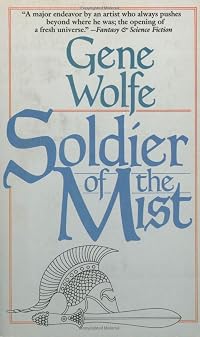
Latro, a mercenary soldier from the north, has suffered a head wound in battle but has developed the ability to see and converse with all of the invisible gods, goddesses, ghosts, demons, and werewolfves that inhabit the land.Tags
Recommendations

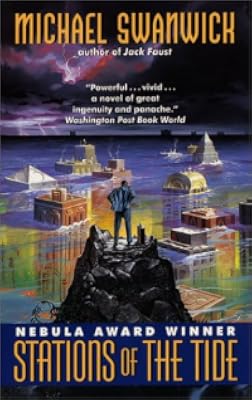
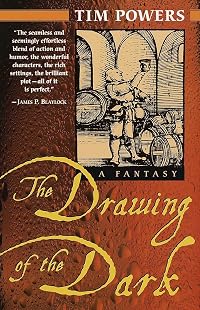


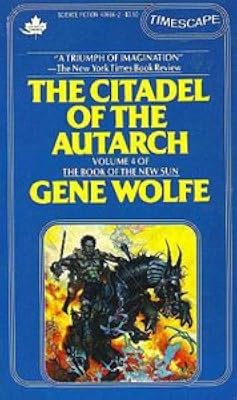
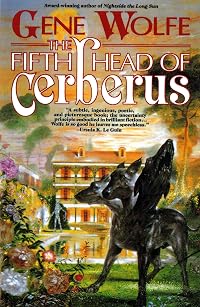


















Member Recommendations
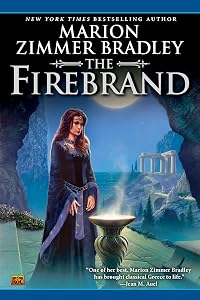
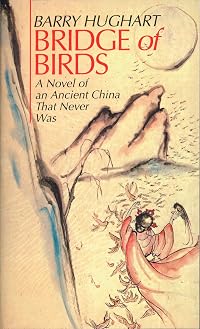
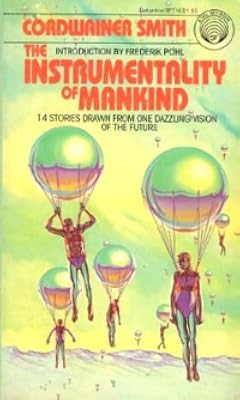
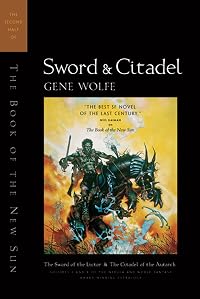
LamontCranston Soldier of the Mist is dedicated to Herodotus, draws heavily upon The Histories for reference material and is set concurrently with the events towards the end (the sacking of Athens and retreat of the Persians) and continues after
20


Member Reviews
3.5 to 4 stars
Perhaps I’m finally growing into Gene Wolfe. There are still a lot of things about his writing that irritate me, but now that I’ve got a fair number of his works under my belt (some even read multiple times) and have a clearer idea of what to expect I am finding myself more able to accept most of these elements as challenging rather than offensive. I’ve come to expect several things from a book by Gene Wolfe: an unreliable narrator of course (this narrator tends to be a ‘hero’ with exceptional abilities granted either through birth or the blessings of the gods and is usually irresistible to the opposite sex, a bit of a pill personality wise and often follows some version of the ‘innocent fool’ template mixed show more with the more traditional martial hero and who tends to be less interesting than the secondary characters around him); a puzzle-like narrative that obscures more than it reveals and implies more than it states; erudition that can be somewhat oppressive in its range and obscurantism; the encroachment upon the mundane by the supernatural in both physical and immaterial ways (often in the guise of the inexplicable interference of gods or godlike beings with an agenda for the outcome of human affairs…water gods and nymphs are an especial favourite); and finally a favourite chestnut of Wolfe’s is the inclusion of some kind of vampire-like creature and/or a shapeshifter. _Soldier in the Mist_ certainly partakes liberally of all of these.
I might go so far as to say that Latro, the main character in _Solider of the Mist_, is pretty much Gene Wolfe’s wet-dream of a protagonist. Here we get a narrator so unreliable that he has to sift through his own words each day in order to make sense of them, never mind the poor reader! In this Latro is pretty much the polar opposite of Severian, Wolfe’s hero from the New Sun series: where the young torturer-apprentice from the last days of Urth was cursed with an eidetic memory (which he still parsed to his own convenience) Latro is cursed with a loss of short-term memory that makes him unable to remember anything that happened to him on the previous day. This state of affairs was brought about by a head injury suffered by the mercenary in (as we find out through the course of events) the battle of Plataea as he fought for the Persian King Xerxes against the Greek Confederacy. The resulting story follows a format not altogether unlike the movie ‘Memento’ in which a character in a similar situation was forced to rely on post-it notes, journals, and tattoos to help him remember who he was and that he was on a path of vengeance. For his part Latro has been writing out the events of each day on a scroll and is forced, at least at those times when he is lucky enough either to be reminded by others or happens to read the injunction to “Read This Every Day” that is emblazoned on the outside of his scroll, to go back and read his own composition in order to understand where he is and who everyone around him might be. Like I said…the perfect Gene Wolfe narrator. The reader of course participates in this attempt to make sense of strange and inexplicable events at the same time as Latro does.
To add to the confusion for the modern reader (and really, it wouldn’t be a Gene Wolfe book if he wasn’t trying to confuse you now would it?) is the fact that we are placed squarely in the ancient world and Latro tells us the names of events, places and characters in a literal, and sometimes misconstrued, translation of their name. Thus, for example, Athens becomes “Thought”, the island of Achaia is “Redface Island”, and Corinth becomes “Tower Hill”. I have to admit that I found this aspect of the novel to be something that added to the flavour of the text for me as opposed to one that jarred. I suppose I felt that in adding to the strangeness of the names of places that would otherwise seem too familiar to me from other sources I was better able to approach the world of classical Greece in a new and interesting way. The final layer of confusion and obfuscation is added by the fact that in this world the gods and eldritch beings of classical mythology do indeed walk amongst men and are ever ready to utter a gnomic phrase or attempt to further their own mysterious ends by manipulating mere mortals. They are usually invisible to those who walk only in the mundane world, but as strange things begin to come visibly to the fore as we read it becomes apparent that a bizarre side-effect of Latro’s injury is an ability to see this invisible world clearly (though of course it’s always possible that Latro is just having hallucinations). Sometimes these supernatural beings attempt to aid Latro with cryptic guidance while others seem inimical to whatever actions he attempts to take. Either way it becomes apparent that he is a pawn in their great game.
In essence the story is about Latro’s quest to be healed of his malady, or barring that to at least find out where he comes from and return to his native land. Of course, even with a prophecy from the Shining God to guide him (or perhaps because of it) things are not that easy. We follow Latro across the land of the Hellenes as he attempts to follow the path laid out for him by the god with the aid of several new friends and allies he picks up along the way. We are treated throughout to a view of the Greek Confederacy during the time of the Graeco-Persian wars from the point of view of a true outsider. We also glimpse many of the gods and supernatural beings with which their country appears to be densely populated and learn that more often than not human events appear to have been driven by the will of the gods and reflect wars that, while perhaps more grand in their scope, are no less petty in their motivations. I especially enjoyed Wolfe’s characterization of the gods which seemed to be partially Graves-ian in the anthropological and geographical emphasis he placed on their names, powers, and nature, but which didn’t lose its eldritch character for all of that. These are not the relatively clear-cut (though all-too human) versions of the Greek gods most readers may be more familiar with. Beneath the veneer of civilization and regal glory the chthonic hearts of these gods are dark and dangerous indeed. The world of ancient Greece that Wolfe presents is a fascinating one and the struggles and wars of the gods that impinge upon the world of mortals is intriguing, he seems to have a real flair for the numinous and its impact on human life. I think having just finished [b:The Iliad|1371|The Iliad|Homer|http://d.gr-assets.com/books/1309201311s/1371.jpg|3293141] was a distinct advantage for me in coming to this book. Not only was I still ‘in the mood’ for the world of ancient Greece, but I was even able to see some of the same concerns (and many of the same characters) even though the events portrayed in _Soldier of the Mist_ are happening centuries after the fall of Troy. I also didn’t get the feeling that Wolfe was simply writing modern characters into an ancient setting, his characters were relatable and all displayed familiar aspects of human nature that rang true, but they also seemed to be uniquely suited to (and representative of) their own milieu. I quite enjoyed this book and dove immediately into the sequel [b:Soldier of Arete|630402|Soldier of Arete|Gene Wolfe|http://d.gr-assets.com/books/1176493516s/630402.jpg|19201593]. I haven’t lost all of my reservations in regards to Wolfe’s method and madness, but overall I think I’m becoming more willing to sit back and enjoy the ride…I just make sure to stop and look around a lot more than I might feel is needed for another author. show less
Perhaps I’m finally growing into Gene Wolfe. There are still a lot of things about his writing that irritate me, but now that I’ve got a fair number of his works under my belt (some even read multiple times) and have a clearer idea of what to expect I am finding myself more able to accept most of these elements as challenging rather than offensive. I’ve come to expect several things from a book by Gene Wolfe: an unreliable narrator of course (this narrator tends to be a ‘hero’ with exceptional abilities granted either through birth or the blessings of the gods and is usually irresistible to the opposite sex, a bit of a pill personality wise and often follows some version of the ‘innocent fool’ template mixed show more with the more traditional martial hero and who tends to be less interesting than the secondary characters around him); a puzzle-like narrative that obscures more than it reveals and implies more than it states; erudition that can be somewhat oppressive in its range and obscurantism; the encroachment upon the mundane by the supernatural in both physical and immaterial ways (often in the guise of the inexplicable interference of gods or godlike beings with an agenda for the outcome of human affairs…water gods and nymphs are an especial favourite); and finally a favourite chestnut of Wolfe’s is the inclusion of some kind of vampire-like creature and/or a shapeshifter. _Soldier in the Mist_ certainly partakes liberally of all of these.
I might go so far as to say that Latro, the main character in _Solider of the Mist_, is pretty much Gene Wolfe’s wet-dream of a protagonist. Here we get a narrator so unreliable that he has to sift through his own words each day in order to make sense of them, never mind the poor reader! In this Latro is pretty much the polar opposite of Severian, Wolfe’s hero from the New Sun series: where the young torturer-apprentice from the last days of Urth was cursed with an eidetic memory (which he still parsed to his own convenience) Latro is cursed with a loss of short-term memory that makes him unable to remember anything that happened to him on the previous day. This state of affairs was brought about by a head injury suffered by the mercenary in (as we find out through the course of events) the battle of Plataea as he fought for the Persian King Xerxes against the Greek Confederacy. The resulting story follows a format not altogether unlike the movie ‘Memento’ in which a character in a similar situation was forced to rely on post-it notes, journals, and tattoos to help him remember who he was and that he was on a path of vengeance. For his part Latro has been writing out the events of each day on a scroll and is forced, at least at those times when he is lucky enough either to be reminded by others or happens to read the injunction to “Read This Every Day” that is emblazoned on the outside of his scroll, to go back and read his own composition in order to understand where he is and who everyone around him might be. Like I said…the perfect Gene Wolfe narrator. The reader of course participates in this attempt to make sense of strange and inexplicable events at the same time as Latro does.
To add to the confusion for the modern reader (and really, it wouldn’t be a Gene Wolfe book if he wasn’t trying to confuse you now would it?) is the fact that we are placed squarely in the ancient world and Latro tells us the names of events, places and characters in a literal, and sometimes misconstrued, translation of their name. Thus, for example, Athens becomes “Thought”, the island of Achaia is “Redface Island”, and Corinth becomes “Tower Hill”. I have to admit that I found this aspect of the novel to be something that added to the flavour of the text for me as opposed to one that jarred. I suppose I felt that in adding to the strangeness of the names of places that would otherwise seem too familiar to me from other sources I was better able to approach the world of classical Greece in a new and interesting way. The final layer of confusion and obfuscation is added by the fact that in this world the gods and eldritch beings of classical mythology do indeed walk amongst men and are ever ready to utter a gnomic phrase or attempt to further their own mysterious ends by manipulating mere mortals. They are usually invisible to those who walk only in the mundane world, but as strange things begin to come visibly to the fore as we read it becomes apparent that a bizarre side-effect of Latro’s injury is an ability to see this invisible world clearly (though of course it’s always possible that Latro is just having hallucinations). Sometimes these supernatural beings attempt to aid Latro with cryptic guidance while others seem inimical to whatever actions he attempts to take. Either way it becomes apparent that he is a pawn in their great game.
In essence the story is about Latro’s quest to be healed of his malady, or barring that to at least find out where he comes from and return to his native land. Of course, even with a prophecy from the Shining God to guide him (or perhaps because of it) things are not that easy. We follow Latro across the land of the Hellenes as he attempts to follow the path laid out for him by the god with the aid of several new friends and allies he picks up along the way. We are treated throughout to a view of the Greek Confederacy during the time of the Graeco-Persian wars from the point of view of a true outsider. We also glimpse many of the gods and supernatural beings with which their country appears to be densely populated and learn that more often than not human events appear to have been driven by the will of the gods and reflect wars that, while perhaps more grand in their scope, are no less petty in their motivations. I especially enjoyed Wolfe’s characterization of the gods which seemed to be partially Graves-ian in the anthropological and geographical emphasis he placed on their names, powers, and nature, but which didn’t lose its eldritch character for all of that. These are not the relatively clear-cut (though all-too human) versions of the Greek gods most readers may be more familiar with. Beneath the veneer of civilization and regal glory the chthonic hearts of these gods are dark and dangerous indeed. The world of ancient Greece that Wolfe presents is a fascinating one and the struggles and wars of the gods that impinge upon the world of mortals is intriguing, he seems to have a real flair for the numinous and its impact on human life. I think having just finished [b:The Iliad|1371|The Iliad|Homer|http://d.gr-assets.com/books/1309201311s/1371.jpg|3293141] was a distinct advantage for me in coming to this book. Not only was I still ‘in the mood’ for the world of ancient Greece, but I was even able to see some of the same concerns (and many of the same characters) even though the events portrayed in _Soldier of the Mist_ are happening centuries after the fall of Troy. I also didn’t get the feeling that Wolfe was simply writing modern characters into an ancient setting, his characters were relatable and all displayed familiar aspects of human nature that rang true, but they also seemed to be uniquely suited to (and representative of) their own milieu. I quite enjoyed this book and dove immediately into the sequel [b:Soldier of Arete|630402|Soldier of Arete|Gene Wolfe|http://d.gr-assets.com/books/1176493516s/630402.jpg|19201593]. I haven’t lost all of my reservations in regards to Wolfe’s method and madness, but overall I think I’m becoming more willing to sit back and enjoy the ride…I just make sure to stop and look around a lot more than I might feel is needed for another author. show less
This book manifests the Gene Wolfe enigma. Such tight prose, such subtlety. The conversation between the Spartan and the Athenian Stratgist outside Sestos for example -- it's as elegant as a rapier duel. And the evocation of an alien, god-haunted world -- it's really strange and powerful. And all through, you feel you are getting hints and crumbs of meaning, shards of some larger design you should be able to piece together. But in the end, what is it all in aid of?
Glad I read it. Vivid, memorable, and strange. But there's a part of me that just wants a narrative, and meaning, right there on the surface and not veiled in mist.
Glad I read it. Vivid, memorable, and strange. But there's a part of me that just wants a narrative, and meaning, right there on the surface and not veiled in mist.
Historical fiction is rarely, *rarely* this good. The author often (and understandably) errs by projecting the stuff of the present into the past. Or the research is insufficient. Or the story lacks vitality somehow, because the author doesn't quite raise the story out of its entrenched history -- after all, it has already happened. Not so with Wolfe. He seems as divinely inspired as his protagonist in his portrayal of such a bygone age, which he manages so briskly, with such deftness and unfailing honesty, that my jaw dropped routinely during the reading.
Don't expect a Hollywood ending to this one. The protagonist, Latro, founders from beginning to end -- his short and long-term amnesia causes much trouble for the reader, and largely show more because of Wolfe's deadly accurate narration, one vicariously experiences the mist that Latro wanders through until the very last page. The narrative is brutally honest, and reminded me a bit of the story of Job.
Probably deserves 5 stars once I get around to a second read. (Wolfe is one of the very few writers who reads better the second time around.) show less
Don't expect a Hollywood ending to this one. The protagonist, Latro, founders from beginning to end -- his short and long-term amnesia causes much trouble for the reader, and largely show more because of Wolfe's deadly accurate narration, one vicariously experiences the mist that Latro wanders through until the very last page. The narrative is brutally honest, and reminded me a bit of the story of Job.
Probably deserves 5 stars once I get around to a second read. (Wolfe is one of the very few writers who reads better the second time around.) show less
Really impressed by this title, Wolfe excellently blends Historical Fiction with Mythology. I enjoyed how the Gods/Goddesses were handled here, perhaps almost like the ancients perceived them. Mainly in the periphery, mysterious, and always with their own machinations and desires.
The story itself beyond that is well done with the characters being interesting and developed nicely.
The story itself beyond that is well done with the characters being interesting and developed nicely.
A fractured tale, beautifully rendered: Anybody who has seen the recent movie "Memento" knows the premise: the protagonist (in this case a wounded mercenary) has lost his longterm memory, and so can only remember what happens to him for one day. In both the movie and this book, he tries to compensate by writing down what he needs to know. Gene Wolfe's fine novel, however, far predates "Memento", and the world it describes, Greece in the 5th century BC, is a far more exotic and alien place.
As a piece of craft, this is a wonderful book--full of apt and elegant descriptions, sparely but deftly rendered characters, and eruptions of violence that pack surprising power. Wolfe is a writer who transcends the genre he happens to be working in, show more which is something of a miracle in today's pigeon-holed, dumbed-down publishing climate. My only complaint is that he perhaps takes his conceit too far, throwing in one or two too many shifts in time and place (and, in the case of one character, even gender) so that the plot remains less involving that it might have been.
All in all, this is a remarkable achievement. show less
As a piece of craft, this is a wonderful book--full of apt and elegant descriptions, sparely but deftly rendered characters, and eruptions of violence that pack surprising power. Wolfe is a writer who transcends the genre he happens to be working in, show more which is something of a miracle in today's pigeon-holed, dumbed-down publishing climate. My only complaint is that he perhaps takes his conceit too far, throwing in one or two too many shifts in time and place (and, in the case of one character, even gender) so that the plot remains less involving that it might have been.
All in all, this is a remarkable achievement. show less
I wish it had been the first Wolfe I had read, or that I’d read it instead of The Wizard-Knight, because there is a definite Pattern to Wolfe’s books: a young man doesn’t know (has forgotten) (has lost) his position in Society; the book is dedicated to him finding out what that position is; there is no real plot. Of the two, Soldier of the Mist is better than The Wizard-Knight, though that might be influenced by my own predilection for Greek mythology. Wolfe’s use of the mythology is very good, and he has the appropriate degree of awe before the gods. Still, Wolfe’s formula is wearing, especially due to the lack of plot. Four stars because it's beautifully written, and for the treatment of the gods.
Latro has taken a head injury in battle, which has the effect of making him forget everything about a day after it happens. Writing daily on a scroll, which he must read to tell him who he is, who his freinds are and what he's doing, he journeys across the ancient world in search of a cure at the hands of whatever deity he has offended. Wonderfully strange and eerie.
Members
- Recently Added By
Lists

Best Historical Fiction
620 works; 257 members

Unreliable Narrators
170 works; 43 members
Author Information

313+ Works 43,569 Members
Gene Wolfe was born in New York City on May 7, 1931. He dropped out of Texas A&M University during his junior year and was drafted into the Army to fight in the Korean War. After the war, he received a degree in mechanical engineering from the University of Houston. He worked as an industrial engineer for Procter and Gamble, where he developed the show more machine that cooks the dough used to make Pringles potato chips. He was an editor of the trade journal Plant Engineering from 1972 to 1984 before retiring to become a full-time writer. He wrote more than 30 books during his lifetime including The Fifth Head of Cerberus, Peace, The Book of the New Sun, and The Land Across. He received the Campbell Memorial Award, the Edward E. Smith Memorial Award, the Locus Award four times, and the Nebula Award and the World Fantasy Award two times each. In 1996, he was given the World Fantasy Award for Lifetime Achievement. He was inducted into the Science Fiction Hall of Fame in 2007 and was named a Grand Master by the Science Fiction and Fantasy Writers of America in 2012. He died after a long battle with heart disease on April 14, 2019 at the age of 87. (Bowker Author Biography) show less
Some Editions
Awards and Honors
Awards
Series

Belongs to Publisher Series
Work Relationships
Is contained in
Common Knowledge
- Canonical title
- Soldier of the Mist
- Original title
- The Soldier in the Mist
- Alternate titles
- Soldat des brumes
- Original publication date
- 1986-10
- People/Characters
- Latro; Seven Lions; Io; Pindar
- Important places
- Ancient Greece
- Epigraph
- First there was a struggle at the barricade of shields; then, the barricade down, a bitter and protracted fight, hand to hand, at the temple of Demeter... - Herodotos.
- Dedication
- This book is dedicated with the greatest respect and affection to Herodotos of Halicarnassos.
- First words*
- Je note ce qui vient de se passer à l'instant.
- Last words*
- (Click to show. Warning: May contain spoilers.)Comme les voies des dieux sont étranges, souffla-t-il, comme elles sont cruelles...
- Original language
- English
*Some information comes from Common Knowledge in other languages. Click "Edit" for more information.
Classifications
- Genres
- Fiction and Literature, Fantasy, General Fiction, Historical Fiction
- DDC/MDS
- 813.54 — Literature & rhetoric American literature in English American fiction in English 1900-1999 1945-1999
- LCC
- PS3573 .O52 .S65 — Language and Literature American literature American literature Individual authors 1961-
- BISAC
Statistics
- Members
- 1,230
- Popularity
- 20,053
- Reviews
- 25
- Rating
- (3.83)
- Languages
- 8 — English, Finnish, French, German, Italian, Polish, Portuguese, Spanish
- Media
- Paper, Audiobook, Ebook
- ISBNs
- 15
- ASINs
- 15