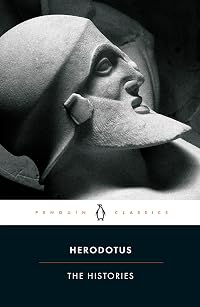
The Histories
by Herodotus
On This Page
Description
Herodotus was an ancient Greek historian who lived in the fifth century BC (c.484 - 425 BC). He has been called the "Father of History", and was the first historian known to collect his materials systematically, test their accuracy to a certain extent and arrange them in a well-constructed and vivid narrative. The Histories-his masterpiece and the only work he is known to have produced-is a record of his "inquiry", being an investigation of the origins of the Greco-Persian Wars and including show more a wealth of geographical and ethnographical information. The Histories, were divided into nine books, named after the nine Muses: the "Muse of History", Clio, representing the first book, then Euterpe, Thaleia, Melpomene, Terpsichore, Erato, Polymnia, Ourania and Calliope for books 2 to 9, respectively. show lessTags
Recommendations








Member Recommendations
Voracious_Reader More emotional and probably less factually accurate than Herodutus, it's more fun to read. Its inaccuracies do not take away from its amazing quality
91

anonymous user Bold revisionist treatment in novel form. Masterfully written in the first person singular. Much more fun to read and much greater in scope account of the 5th century BC.
20
timspalding It's instructive to read Herodotus alongside the fragments of Ctesias, particularly the Indica—available on the web or in Photius here.
21
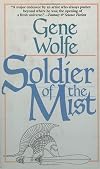
LamontCranston Soldier of the Mist is dedicated to Herodotus, draws heavily upon The Histories for reference material and is set concurrently with the events towards the end (the sacking of Athens and retreat of the Persians) and continues after
21
Member Reviews
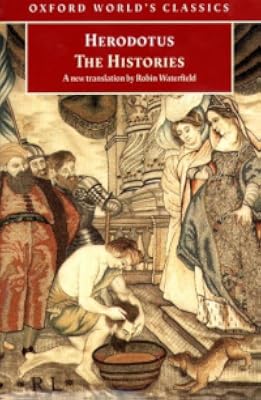
I finally tackled this “I really ought to read this one of these days” doorstopper of a book and found myself thoroughly entertained. One reason for this experience is the edition I read. Instead of the worthy nineteenth-century Rawlinson translation that has sat on my shelf for years and that I occasionally dipped into, I sprang for the recent translation by Robin Waterfield. I’ve heard that Herodotus’s Greek is reasonably straightforward, especially in contrast to the more formal Thucydides, so I found the tone of Waterfield’s translation appropriately colloquial.
For instance, Rawlinson renders the words of a gloomy Persian on the eve of the decisive battle of Plataea: “Verily ’tis the sorest of all human ills, to abound show more in knowledge and yet have no power over action” (9.16). Undeniably eloquent, but compare Waterfield’s rendering: “There’s no more terrible pain a man can endure than to see clearly and be able to do nothing.” It’s clear that both translations are correct (and a check of the Greek confirmed it). Still, given the length of the book (nearly 600 pages apart from the excellent introduction by Carolyn Dewald and a judicious amount of notes), I felt that a modern translation would serve me better.
Compared to modern history-writing, Herodotus has little interest in population density, economic factors, or technological advances as causes of conflict and determinants of outcomes. Instead, it is a tale of heroes, fate, and retribution. Most conflicts have very personal causes, and the result often has to do with righting an ancient wrong. Although Herodotus’s sympathies are with the Greeks, especially the Athenians, he is even-handed, admiring courage and integrity and censuring cowardice and treachery wherever it appears.
Herodotus declares at the outset that his aim is to explore the causes of the conflict between Greece and Persia, and the book culminates in his stirring account of the doomed attempt of Xerxes to subjugate the Greeks. Yet, he takes many detours along the way. It seems as if he set out to include in his book everything he could find out about the known world. Book Two, for instance, is a detailed and lively account of Egypt, a land which even then could boast an ancient history. Some readers may grow impatient with Herodotus’s reluctance to pass up any excuse to work in a diverting anecdote. Still, if you’re willing to follow him down these sidelines, you may find yourself enjoying them. Herodotus simply knows how to tell a story.
Ah, yes, you might say. A story-teller is surely not the same as a historian. How much of this is reliable? If you take into account the fact that Herodotus was inventing the genre of long-form narrative as he went along, I think it can be argued that, in the course of these “inquiries” (the meaning of “histories” back then), Herodotus lays the groundwork for later critical evaluation of sources. He employs an arsenal of phrases to reflect his judgment -- ranging from trusting to skeptical -- about the tales he includes.
Herodotus traveled widely with an insatiable curiosity and reflected both on what he heard and what he saw first-hand. Many of his conclusions remain valid, two-and-a-half millennia later, For instance, his conviction that no nation stays on top forever, and that the turning point often comes through overreach. show less
For instance, Rawlinson renders the words of a gloomy Persian on the eve of the decisive battle of Plataea: “Verily ’tis the sorest of all human ills, to abound show more in knowledge and yet have no power over action” (9.16). Undeniably eloquent, but compare Waterfield’s rendering: “There’s no more terrible pain a man can endure than to see clearly and be able to do nothing.” It’s clear that both translations are correct (and a check of the Greek confirmed it). Still, given the length of the book (nearly 600 pages apart from the excellent introduction by Carolyn Dewald and a judicious amount of notes), I felt that a modern translation would serve me better.
Compared to modern history-writing, Herodotus has little interest in population density, economic factors, or technological advances as causes of conflict and determinants of outcomes. Instead, it is a tale of heroes, fate, and retribution. Most conflicts have very personal causes, and the result often has to do with righting an ancient wrong. Although Herodotus’s sympathies are with the Greeks, especially the Athenians, he is even-handed, admiring courage and integrity and censuring cowardice and treachery wherever it appears.
Herodotus declares at the outset that his aim is to explore the causes of the conflict between Greece and Persia, and the book culminates in his stirring account of the doomed attempt of Xerxes to subjugate the Greeks. Yet, he takes many detours along the way. It seems as if he set out to include in his book everything he could find out about the known world. Book Two, for instance, is a detailed and lively account of Egypt, a land which even then could boast an ancient history. Some readers may grow impatient with Herodotus’s reluctance to pass up any excuse to work in a diverting anecdote. Still, if you’re willing to follow him down these sidelines, you may find yourself enjoying them. Herodotus simply knows how to tell a story.
Ah, yes, you might say. A story-teller is surely not the same as a historian. How much of this is reliable? If you take into account the fact that Herodotus was inventing the genre of long-form narrative as he went along, I think it can be argued that, in the course of these “inquiries” (the meaning of “histories” back then), Herodotus lays the groundwork for later critical evaluation of sources. He employs an arsenal of phrases to reflect his judgment -- ranging from trusting to skeptical -- about the tales he includes.
Herodotus traveled widely with an insatiable curiosity and reflected both on what he heard and what he saw first-hand. Many of his conclusions remain valid, two-and-a-half millennia later, For instance, his conviction that no nation stays on top forever, and that the turning point often comes through overreach. show less
I think what I enjoyed most was the honesty. Herodotus was trying to write about the known world and the people in it. He reported stuff that he didn’t always personally believe, but he was up front about it and would admit, “Yeah, I’m not so sure, but this is what they say in Myconos,” or wherever. And he did TRY to get reliable sources. Which isn’t to say he didn’t sometimes get his leg pulled – there is not, in fact, a tribe of people in the Sahara who don’t have heads. But again, “that’s what the Libyans told me…” It made the book feel like a friend telling you a story as opposed to someone trying to lecture at you.
I really really really (REALLY) liked that he didn’t have an agenda. By which I mean his show more unbiased coverage: He was Greek, and Greece had just had a bunch of wars with the Persian Empire (ever see “300?” He writes about it). So for him, as a Greek, to say anything nice about the Persian people or anything they do—and he does when it’s deserved—is pretty unheard of in his time. Or, let’s be honest, ours. He tells the story WITHOUT inflicting his personal value judgments on it.
It being the ancient world, women are generally ignored, but there are a few notable ladies he writes about for being wise or clever or what have you (plus there’s Amazons!). Also, the science of geography being the massive joke it was back then, he had NO idea how big Africa really was, and the British Isles were an unproved rumor as far as he was concerned. However, I have to say it was REALLY nice to read a book written before 19-sumpty-some that ISN’T racist. He’ll helpfully inform his European audience that yes, people in Egypt and Ethiopia tend to be a bit dark compared to us, etc. etc., but there are no implicit or explicit judgments associated with skin tone. Maybe because the various Greek city-states were so busy fighting *each other* all the time, meaning that the person most likely to kill you looked like you. As a matter of fact, he can’t say enough nice things about Egypt, and he thought Ethiopians were “the tallest, most handsome and longest lived of all men.”
The book has so many great passages here and there that I actually took to marking their place in the margin – in pencil, of course, but for me to write in my books at all is saying something. show less
I really really really (REALLY) liked that he didn’t have an agenda. By which I mean his show more unbiased coverage: He was Greek, and Greece had just had a bunch of wars with the Persian Empire (ever see “300?” He writes about it). So for him, as a Greek, to say anything nice about the Persian people or anything they do—and he does when it’s deserved—is pretty unheard of in his time. Or, let’s be honest, ours. He tells the story WITHOUT inflicting his personal value judgments on it.
It being the ancient world, women are generally ignored, but there are a few notable ladies he writes about for being wise or clever or what have you (plus there’s Amazons!). Also, the science of geography being the massive joke it was back then, he had NO idea how big Africa really was, and the British Isles were an unproved rumor as far as he was concerned. However, I have to say it was REALLY nice to read a book written before 19-sumpty-some that ISN’T racist. He’ll helpfully inform his European audience that yes, people in Egypt and Ethiopia tend to be a bit dark compared to us, etc. etc., but there are no implicit or explicit judgments associated with skin tone. Maybe because the various Greek city-states were so busy fighting *each other* all the time, meaning that the person most likely to kill you looked like you. As a matter of fact, he can’t say enough nice things about Egypt, and he thought Ethiopians were “the tallest, most handsome and longest lived of all men.”
The book has so many great passages here and there that I actually took to marking their place in the margin – in pencil, of course, but for me to write in my books at all is saying something. show less
In the world's first history textbook (so to speak), Herodotus chronicles the wars between Persia and Greece - and so much more. As new historical figure or locales are introduced into the narrative, he frequently pauses to detail that person or place's history even when it has little bearing on the main event. The sum is a fascinating amalgam of fact and fiction: enough facts to provide an outline of the Greco-Persian Wars and the environs in which they took place, together with the people who carried it out; and enough fiction to add an aura of mythology to the undertakings, providing a challenge in prose to Homer's poetry.
Inevitably the question arises of what to believe, so you'll want a good edition with footnotes or endnotes to show more help you parse it all. Herodotus' absurd description of a hippopotamus alone is enough to throw everything else into question, and that's just one of many examples. Whether he travelled as widely as his narrative implies, or saw with his own eyes as much as he claims, are open questions. There's also no telling how reliable his other sources were - something he gamely questions, but never enough to prevent him from sharing a good story. Expect some entertainment with your history.
It's much easier reading than I'd assumed going in, and translator Aubrey de Selincourt's 1954 effort probably deserves the credit for making this such a compelling read. Even if you don't believe a word of what Herotodus says (although archeology has been able to back up quite a bit), the 'Father of History' still put together a great epic. For all that his effort is slandered, dating all the way back to ancient times, at least he gave it a shot and - most telling - none of his contemporaries ever tried to top him. show less
Inevitably the question arises of what to believe, so you'll want a good edition with footnotes or endnotes to show more help you parse it all. Herodotus' absurd description of a hippopotamus alone is enough to throw everything else into question, and that's just one of many examples. Whether he travelled as widely as his narrative implies, or saw with his own eyes as much as he claims, are open questions. There's also no telling how reliable his other sources were - something he gamely questions, but never enough to prevent him from sharing a good story. Expect some entertainment with your history.
It's much easier reading than I'd assumed going in, and translator Aubrey de Selincourt's 1954 effort probably deserves the credit for making this such a compelling read. Even if you don't believe a word of what Herotodus says (although archeology has been able to back up quite a bit), the 'Father of History' still put together a great epic. For all that his effort is slandered, dating all the way back to ancient times, at least he gave it a shot and - most telling - none of his contemporaries ever tried to top him. show less
The point of ploughing through this 1858 translation of Herodotus' 'world classic' is precisely to read the text that Victorian imperialists would have read. Go to a later translation with annotations if you want to hear the fully authentic voice of the Greek but this one will do.
The book meets two needs. It is a geography (of the centres of power and civilisation in the fifth century BC) and a history, not only of those specific centres but of the massive clash between the hegemonic Persian Empire and the last nearby 'free' zone, that of the Greeks.
Herodotus is, of course, writing as a Greek but a cosmopolitan one who has travelled to many of the places he describes. His achievement is remarkable. The slanderous 'father of lies' claim show more is grossly unfair ... he may take an absurd story at face value but he will also frequently question claims.
The further away from Ionia he is, the more dodgy the data and the nearer, the more reliable, but, given the technology of travel and information transmission and preservation of the day, sneering strikes me as wholly inappropriate. It is not a religious text. We are all free to critique his claims.
Truth to tell, the geography is much duller than the history. The micro-histories of provinces and the founding of empires is very much less interesting than the second half of the text (made up of nine books) which centres on the Persian Wars.
If you can get through the first half, you will find (considering we are dealing with a text nearly 2,500 years old) some serious excitement as Darius and Xerxes build their forces, transport them around the Aegean and face off the mostly united Greek armies and navies.
The battle of Marathon in the first invasion (490-492BC) and those of Salamis and Plataea during the second invasion (480-479BC) are events placed in their context, filled with detail (sometimes more than one account of a particular event) and written to thrill.
If there is one section to read, it is the Spartan defence of the pass at Thermopylae which has become a by-word in Western culture for communitarian military sacrifice in defence of the homeland (Book VII) and has even inspired a contemporary comic book and film.
There are gaps, of course, that we must regret. He rarely goes far West so, although we know something of the tyrants of Greek Italy and Sicily, he tells us nothing about Etruria, little about Carthage and virtually nothing useful about the Western Mediterranean or Central Europe.
Nubia and Ethiopia are only palely reflected in relation to the Persian occupation of Egypt, Arabia, India and Central Asia are places of myth and legend and the South Russian steppes only interesting because of the peoples who harried civilisation.
Later commentators often position the books as a morality tale about civilisation and oriental barbarism but this is self-serving by those wanting to be inheritors of Hellenic culture. It has created a myth about difference that has been exaggerated,
It is a set of books about hegemony and the right of resistance. The Persians are representatives of imperial realpolitik rather than exporters of values. The Greeks have provoked them and the Persians find an irritating gap in control over the known world of consequence to them.
The Greeks themselves are not a polity but a distinctive culture. It becomes clear that (just as many Britons would prefer to serve a hegemonic European Union than be free) many Greeks will submit to Persian lordship from vulnerability or for profit.
The massive Persian forces also include many unstable Greek elements whose homelands are not being threatened with sack and massacre but who have thrown themselves in with the Persians either because they have little choice or, frankly, prefer mercantile stability to rebellion.
Herodotus is not a theoretician, ideologue or social scientist. He just tells it like it is but the clues are there to mercantile interests who quite like access to the 'single market' built by the Persians but who are ready to switch sides at the drop of a hat if necessary.
The Greeks who are defending their territory are an anarchic lot but they are able to sink their differences (Herodotus is good on the summits and councils where different interests are played out) to preserve their homelands.
What is remarkable is the relative discipline, not based entirely on fear and shame but on consultation and interest. This is explained by factors alien to us today but they include a culture of shame and honour and a fatalistic but interpretative approach to oracles and the will of the gods.
We are looking at a world both familiar to ourselves (in terms of interests, double-dealing, cynicism and political machination) and apparently unfamiliar (in terms of self-sacrifice, contempt for the cowardly, cultural coherence and shared religion).
I say unfamiliar but this would not be quite so unfamiliar to our grandparents and to all the generations before them. World War I was fought in part on the basis of Hellenic virtue which brings us full circle to the 1858 edition and its role in creating an imperial honour culture.
Herodotus can be read at many levels - as a source of data that would otherwise be lost, as a rattling narrative that reads as true history for the most part, as an incomplete picture of an Eastern Mediterranean civilisational zone and as exemplar.
One gets the impression that Herodotus was keen to tell the story of the Persian Wars as a culturally patriotic tale but he is never dismissive of the enemy. Persians are always treated with respect as worthy opponents who are different from Greeks but not radically so.
They come across 'just like us' as human beings (a theme to be brought out in Euripides 'The Persians') which is not incompatible with being triumphalist about victory. This is all about men against men with 'great men' (and the odd woman like Artemesia) on both sides.
The victory is all the sweeter because the gods are fickle and because Greek heroism matched Persian organisational might. Indeed, in battle sections, it is clear that the Persians themselves are fine fighters and that both sides had wobbly and inexperienced allies.
Similarly, the organisational structures of the two sides are central to the story. Both are capable organisers. Imperial might could bring vast numbers of men and material long distances. Hellenic fear could bring squabbling locals into one battle front that could hold a line.
Men were defending their homelands (and would go back to warring with each other as soon as the danger was over) against 'imperialism' while quite happy to build empires if they could (as Athens and Macedon were to do).
These wars are thus just one incident in the constant ebb and flow of raw power, organisation and morale where the ideology is merely culture - being a 'people' distinct from other people without necessarily wanting to exterminate them or not to trade or mate with them.
Indeed, civilisation might be defined as conquest and expansion that utilises what it controls instead of destroying it.
What is also heartening about Herodotus' world is that persuasion is just a tool for struggle and power - as in the references to the persuasive and cunning Athenian C-in-C Themistocles. There are no theorising philosophers trying to justify slaughter or getting in the way.
The books are riddled with pagan virtue, less ritualised than in Homer and without the magical thinking of Plato. This was a culture of power defending itself against another culture of power that had miscalculated the organisational and cultural cohesion of its opponent on its home territory. show less
The book meets two needs. It is a geography (of the centres of power and civilisation in the fifth century BC) and a history, not only of those specific centres but of the massive clash between the hegemonic Persian Empire and the last nearby 'free' zone, that of the Greeks.
Herodotus is, of course, writing as a Greek but a cosmopolitan one who has travelled to many of the places he describes. His achievement is remarkable. The slanderous 'father of lies' claim show more is grossly unfair ... he may take an absurd story at face value but he will also frequently question claims.
The further away from Ionia he is, the more dodgy the data and the nearer, the more reliable, but, given the technology of travel and information transmission and preservation of the day, sneering strikes me as wholly inappropriate. It is not a religious text. We are all free to critique his claims.
Truth to tell, the geography is much duller than the history. The micro-histories of provinces and the founding of empires is very much less interesting than the second half of the text (made up of nine books) which centres on the Persian Wars.
If you can get through the first half, you will find (considering we are dealing with a text nearly 2,500 years old) some serious excitement as Darius and Xerxes build their forces, transport them around the Aegean and face off the mostly united Greek armies and navies.
The battle of Marathon in the first invasion (490-492BC) and those of Salamis and Plataea during the second invasion (480-479BC) are events placed in their context, filled with detail (sometimes more than one account of a particular event) and written to thrill.
If there is one section to read, it is the Spartan defence of the pass at Thermopylae which has become a by-word in Western culture for communitarian military sacrifice in defence of the homeland (Book VII) and has even inspired a contemporary comic book and film.
There are gaps, of course, that we must regret. He rarely goes far West so, although we know something of the tyrants of Greek Italy and Sicily, he tells us nothing about Etruria, little about Carthage and virtually nothing useful about the Western Mediterranean or Central Europe.
Nubia and Ethiopia are only palely reflected in relation to the Persian occupation of Egypt, Arabia, India and Central Asia are places of myth and legend and the South Russian steppes only interesting because of the peoples who harried civilisation.
Later commentators often position the books as a morality tale about civilisation and oriental barbarism but this is self-serving by those wanting to be inheritors of Hellenic culture. It has created a myth about difference that has been exaggerated,
It is a set of books about hegemony and the right of resistance. The Persians are representatives of imperial realpolitik rather than exporters of values. The Greeks have provoked them and the Persians find an irritating gap in control over the known world of consequence to them.
The Greeks themselves are not a polity but a distinctive culture. It becomes clear that (just as many Britons would prefer to serve a hegemonic European Union than be free) many Greeks will submit to Persian lordship from vulnerability or for profit.
The massive Persian forces also include many unstable Greek elements whose homelands are not being threatened with sack and massacre but who have thrown themselves in with the Persians either because they have little choice or, frankly, prefer mercantile stability to rebellion.
Herodotus is not a theoretician, ideologue or social scientist. He just tells it like it is but the clues are there to mercantile interests who quite like access to the 'single market' built by the Persians but who are ready to switch sides at the drop of a hat if necessary.
The Greeks who are defending their territory are an anarchic lot but they are able to sink their differences (Herodotus is good on the summits and councils where different interests are played out) to preserve their homelands.
What is remarkable is the relative discipline, not based entirely on fear and shame but on consultation and interest. This is explained by factors alien to us today but they include a culture of shame and honour and a fatalistic but interpretative approach to oracles and the will of the gods.
We are looking at a world both familiar to ourselves (in terms of interests, double-dealing, cynicism and political machination) and apparently unfamiliar (in terms of self-sacrifice, contempt for the cowardly, cultural coherence and shared religion).
I say unfamiliar but this would not be quite so unfamiliar to our grandparents and to all the generations before them. World War I was fought in part on the basis of Hellenic virtue which brings us full circle to the 1858 edition and its role in creating an imperial honour culture.
Herodotus can be read at many levels - as a source of data that would otherwise be lost, as a rattling narrative that reads as true history for the most part, as an incomplete picture of an Eastern Mediterranean civilisational zone and as exemplar.
One gets the impression that Herodotus was keen to tell the story of the Persian Wars as a culturally patriotic tale but he is never dismissive of the enemy. Persians are always treated with respect as worthy opponents who are different from Greeks but not radically so.
They come across 'just like us' as human beings (a theme to be brought out in Euripides 'The Persians') which is not incompatible with being triumphalist about victory. This is all about men against men with 'great men' (and the odd woman like Artemesia) on both sides.
The victory is all the sweeter because the gods are fickle and because Greek heroism matched Persian organisational might. Indeed, in battle sections, it is clear that the Persians themselves are fine fighters and that both sides had wobbly and inexperienced allies.
Similarly, the organisational structures of the two sides are central to the story. Both are capable organisers. Imperial might could bring vast numbers of men and material long distances. Hellenic fear could bring squabbling locals into one battle front that could hold a line.
Men were defending their homelands (and would go back to warring with each other as soon as the danger was over) against 'imperialism' while quite happy to build empires if they could (as Athens and Macedon were to do).
These wars are thus just one incident in the constant ebb and flow of raw power, organisation and morale where the ideology is merely culture - being a 'people' distinct from other people without necessarily wanting to exterminate them or not to trade or mate with them.
Indeed, civilisation might be defined as conquest and expansion that utilises what it controls instead of destroying it.
What is also heartening about Herodotus' world is that persuasion is just a tool for struggle and power - as in the references to the persuasive and cunning Athenian C-in-C Themistocles. There are no theorising philosophers trying to justify slaughter or getting in the way.
The books are riddled with pagan virtue, less ritualised than in Homer and without the magical thinking of Plato. This was a culture of power defending itself against another culture of power that had miscalculated the organisational and cultural cohesion of its opponent on its home territory. show less
Herodotus of Halicarnassus proved to be like a lot of us: he got a chance to travel his world and was very interested in the events which shaped that world. To this end he wrote what he simply called historiai, and which we call The History. In so doing he changed everything.
Ostensibly, Herodotus set out to describe the events of the Persian Wars between the Greeks and Persians in 490 and 480-479 BCE and to explain how such enmity developed, in a sense hearkening back to the Achaeans vs. Trojans of the Trojan War days, but more “practically” in terms of the growth of the Lydian Empire, its fall at the hands of Cyrus the Persian, the growth of the Persian Empire and its conquest of Ionia, the Ionian Revolt, and then descriptions of show more Darius’ Scythian and Greek campaigns and Xerxes’ Greek campaign in greater detail.
Yet such a description does not do any sort of justice to what Herodotus wrote. Herodotus is way more fun than that.
For generations a lot of people hated on Herodotus because of his particular brand of story telling. Historians in general tend to want to laud Thucydides and his account of the Peloponnesian Wars; to them Herodotus was too enamored with mythology and whatever fantastic tales were told to him by various people.
But that’s what makes Herodotus so fun and interesting. For most of the book you can forget it is intending to be setting forth the story of the Persian Wars. Herodotus will unfailingly stop any sort of narrative to provide some story he heard about some ancestor of the people in the action, or of the stories about the land, as in Egypt or other places. He will often provide contradictory accounts. Sometimes he will tell you what he thinks. Many times he just left it to the audience to figure out what they want to accept.
Herodotus is known as the “Father of History,” and for good reason; all historigraphical writing ever since has been based, in some way or another, on Herodotus and Thucydides. Herodotus was well timed and well placed for this endeavor: as far as we can tell, the primary events he described all happened before he was born or soon afterward; if born in 484 BCE, he would have been 5 when the battles at Plataea and Mycale were fought. His would have been the days of the Peloponnesian Wars; yet having originated in Halicarnassus of Ionia and eventually ending up a citizen of Thurii in modern-day Italy, he could view them at some remove. He has clearly traveled much: certainly to Egypt, likely to Persia. We have to wonder if many people could have written a historical travelogue like his at many points before him.
We certainly need to be careful about bias and prejudice, but we should also be able to understand why the definition of “pre-history” has been “the time before Herodotus.” So much of what we know about the world of the fifth century BCE, and in many respects the previous worlds of the ancient Near Eastern world, comes from various aspects of what Herodotus recorded. And Herodotus has been vindicated many times by archaeology in terms of the chronicles he has provided, although matters regarding the number of soldiers in various battles remains challenging.
If you have any interest at all in ancient history, Herodotus remains critical reading. Biblical personages like Darius and Xerxes (the Ahasuerus of Esther) take center stage in The History, and so its study can add an extra dimension to understanding the age of the post-exilic period. Grene’s translation is decent; his notes are often helpful. show less
Ostensibly, Herodotus set out to describe the events of the Persian Wars between the Greeks and Persians in 490 and 480-479 BCE and to explain how such enmity developed, in a sense hearkening back to the Achaeans vs. Trojans of the Trojan War days, but more “practically” in terms of the growth of the Lydian Empire, its fall at the hands of Cyrus the Persian, the growth of the Persian Empire and its conquest of Ionia, the Ionian Revolt, and then descriptions of show more Darius’ Scythian and Greek campaigns and Xerxes’ Greek campaign in greater detail.
Yet such a description does not do any sort of justice to what Herodotus wrote. Herodotus is way more fun than that.
For generations a lot of people hated on Herodotus because of his particular brand of story telling. Historians in general tend to want to laud Thucydides and his account of the Peloponnesian Wars; to them Herodotus was too enamored with mythology and whatever fantastic tales were told to him by various people.
But that’s what makes Herodotus so fun and interesting. For most of the book you can forget it is intending to be setting forth the story of the Persian Wars. Herodotus will unfailingly stop any sort of narrative to provide some story he heard about some ancestor of the people in the action, or of the stories about the land, as in Egypt or other places. He will often provide contradictory accounts. Sometimes he will tell you what he thinks. Many times he just left it to the audience to figure out what they want to accept.
Herodotus is known as the “Father of History,” and for good reason; all historigraphical writing ever since has been based, in some way or another, on Herodotus and Thucydides. Herodotus was well timed and well placed for this endeavor: as far as we can tell, the primary events he described all happened before he was born or soon afterward; if born in 484 BCE, he would have been 5 when the battles at Plataea and Mycale were fought. His would have been the days of the Peloponnesian Wars; yet having originated in Halicarnassus of Ionia and eventually ending up a citizen of Thurii in modern-day Italy, he could view them at some remove. He has clearly traveled much: certainly to Egypt, likely to Persia. We have to wonder if many people could have written a historical travelogue like his at many points before him.
We certainly need to be careful about bias and prejudice, but we should also be able to understand why the definition of “pre-history” has been “the time before Herodotus.” So much of what we know about the world of the fifth century BCE, and in many respects the previous worlds of the ancient Near Eastern world, comes from various aspects of what Herodotus recorded. And Herodotus has been vindicated many times by archaeology in terms of the chronicles he has provided, although matters regarding the number of soldiers in various battles remains challenging.
If you have any interest at all in ancient history, Herodotus remains critical reading. Biblical personages like Darius and Xerxes (the Ahasuerus of Esther) take center stage in The History, and so its study can add an extra dimension to understanding the age of the post-exilic period. Grene’s translation is decent; his notes are often helpful. show less
I loved this, it kept me gripped right the way through the 4 volume edition I borrowed from the library. He sets out to tell the history for the Persian wars, only he gets a bit sidetracked! Takes a whole book to describe Egypt, for example. Full of action, fine descriptions of places and tells tales. And he's so interested in anything and everything that it is full of little details, a real magpie of a mind at work. I can quite see how he comes to be called the father of history and the first writer of literature, because this doesn't actually fall into either category neatly - it is probably best described as a history embroidered with literature. It isn't all entirely factual, the men with eyes in their chests probably never existed, show more except in heresay, but that's how he gained his information - visit places and ask everyone about what's just over the horizon. show less
Father of History? Not in the modern sense of the word, and certainly he wasn’t the first to desire to record great deeds for prosperity. “Father of Lies”? Maybe according to some lights, but how douchey to call him that. No, Herodotus’s tale-spinning is as accurate for my purposes as Thucydides’s conscientious citing of sources, because they both make history great. Which is all I’m in it for—good times. And Herodotus gives us Marathon and Thermopylae and Salamis and Plataea, and tells us a story about mighty events with bluff Greek heroes and moustache-twirling Persian villains (the degeneration of the Persian royal house from Cyrus to Xerxes is one of humanity’s great decline-and-fall narratives), and one that may show more occasionally self-contradict and not dot its t’s, but it doesn’t matter, because it’s powerful and plausible and we WANT it to be the way it was. Herodotus is the Father of Wonder, here deployed in the service of the narrative, so we say “Amazing! They truly were the Greatest Generation.”
And that’s not all that Herodotus gives us. When he leaves his central story behind, which is often, he becomes the father of geography, ethnography, anthropology and much more besides. And he does it with such joyful savoir faire, all of it, the true and the false and the how could you possibly say. Without him we wouldn’t have the Scythian corpse sculptures, or the great birds from whose nests the Arabs pluck cinnamon bark, which comes from parts unknown. We wouldn’t have the Androphagi, or the man who had his son served up to him at banquet, or the people who eat their compeers when they reach the ripe old age, and in general we would have no idea how totally absurdly rife with cannibalism the non-Greek world is, which would be to our disadvantage. (We also wouldn’t have a hundred instances of horrible and unnecessary death inflicted by humans on their fellows to remind us just how awful these ancients could turn at the drop of an oracular censer.) And that is just as important as the story of the seven conspirators and the rise of Darius, or of the relationship that sprung up between Cyrus and Croesus the king of Libya, the crotchety guardian angel for all his captor’s endeavours. Or the Spartans throwing the envoys in the well, or "come and get them!" or “if their arrows block out the sun, then at least we’ll be fighting in the shade!” (We certainly wouldn’t have the movie 300, is what I’m saying.) It’s a different kind of wonder that the epideictic sort of above: it’s what the Dictionary of Obscure Sorrows called:
"la cuna, n. a twinge of sadness that there’s no frontier left, that as the last explorer trudged with his armies toward a blank spot on the map, he didn’t suddenly remember his daughter’s upcoming piano recital and turn for home, leaving a new continent unexplored so we could set its mists and mountains aside as a strategic reserve of mystery, if only to answer more of our children’s questions with "Nobody knows! Out there, anything is possible.'"
And so the wonder of the unexplored-becoming-explored contends with sadness; and the wonder of great deeds too contends with the sorrow of a life that always threatens to turn brutish and short, where wonder is temporary and suffering is infinite. There is that stunning, gut-wrenching conversation between Xerxes and his uncle Artabanus as they sit by the Hellespont watching the construction of the pontoon bridge, ready to invade Europe and inflict unthinkable horror on millions.
And Xerxes looks over his war mans in rows like waves and starts to cry. And he explains:
"I was overcome with pathos, sadness at the thought that even among all these thousands of men I behold, in one hundred years, not one will be alive."
And his wise uncle Artabanus, the only one to advise against the invasion (until some prophetic dreams scared him into error) and a model for uncles everywhere, replies:
"In one’s life we have deeper sorrows to bear than that. Short as our lives are, there is no human being either here or elsewhere so fortunate that it will not occur to him, often and not just once, to wish himself dead rather than alive. For misfortunes fall upon us and sicknesses trouble us, so that they make this life, for all its shortness, seem long."
It is to weep, non? But at least--Zeus be praised--there are those moments of Wonder; and Herodotus is their Father. show less
And that’s not all that Herodotus gives us. When he leaves his central story behind, which is often, he becomes the father of geography, ethnography, anthropology and much more besides. And he does it with such joyful savoir faire, all of it, the true and the false and the how could you possibly say. Without him we wouldn’t have the Scythian corpse sculptures, or the great birds from whose nests the Arabs pluck cinnamon bark, which comes from parts unknown. We wouldn’t have the Androphagi, or the man who had his son served up to him at banquet, or the people who eat their compeers when they reach the ripe old age, and in general we would have no idea how totally absurdly rife with cannibalism the non-Greek world is, which would be to our disadvantage. (We also wouldn’t have a hundred instances of horrible and unnecessary death inflicted by humans on their fellows to remind us just how awful these ancients could turn at the drop of an oracular censer.) And that is just as important as the story of the seven conspirators and the rise of Darius, or of the relationship that sprung up between Cyrus and Croesus the king of Libya, the crotchety guardian angel for all his captor’s endeavours. Or the Spartans throwing the envoys in the well, or "come and get them!" or “if their arrows block out the sun, then at least we’ll be fighting in the shade!” (We certainly wouldn’t have the movie 300, is what I’m saying.) It’s a different kind of wonder that the epideictic sort of above: it’s what the Dictionary of Obscure Sorrows called:
"la cuna, n. a twinge of sadness that there’s no frontier left, that as the last explorer trudged with his armies toward a blank spot on the map, he didn’t suddenly remember his daughter’s upcoming piano recital and turn for home, leaving a new continent unexplored so we could set its mists and mountains aside as a strategic reserve of mystery, if only to answer more of our children’s questions with "Nobody knows! Out there, anything is possible.'"
And so the wonder of the unexplored-becoming-explored contends with sadness; and the wonder of great deeds too contends with the sorrow of a life that always threatens to turn brutish and short, where wonder is temporary and suffering is infinite. There is that stunning, gut-wrenching conversation between Xerxes and his uncle Artabanus as they sit by the Hellespont watching the construction of the pontoon bridge, ready to invade Europe and inflict unthinkable horror on millions.
And Xerxes looks over his war mans in rows like waves and starts to cry. And he explains:
"I was overcome with pathos, sadness at the thought that even among all these thousands of men I behold, in one hundred years, not one will be alive."
And his wise uncle Artabanus, the only one to advise against the invasion (until some prophetic dreams scared him into error) and a model for uncles everywhere, replies:
"In one’s life we have deeper sorrows to bear than that. Short as our lives are, there is no human being either here or elsewhere so fortunate that it will not occur to him, often and not just once, to wish himself dead rather than alive. For misfortunes fall upon us and sicknesses trouble us, so that they make this life, for all its shortness, seem long."
It is to weep, non? But at least--Zeus be praised--there are those moments of Wonder; and Herodotus is their Father. show less
Members
- Recently Added By
Published Reviews
OVER the course of the past decade Tom Holland, a British popular historian, has produced a succession of highly readable works of fiction and non-fiction about the classical world. He has adapted Homer, Virgil and Thucydides for the radio and, as a labour of love and at a rate of a paragraph a day, he has translated Herodotus, the man Cicero called “the Father of History”. Mr Holland’s show more preface states that “Herodotus is the most entertaining of historians”, indeed “as entertaining as anyone who has ever written”. This lively, engaging version of the “Histories” provides ample support for what might otherwise appear to be a wild exaggeration. show less
added by John_Vaughan
Lists

100 Books to Read in a Lifetime (That Are Older Than 200 Years)
415 works; 176 members

Books that changed the world
67 works; 65 members

The Telegraph's 110 Best Books: The Perfect Library
101 works; 18 members

501 Must-Read Books
529 works; 71 members

Newsweek's Top 100 Books: The Meta-List
100 works; 18 members

Unread books
1,063 works; 83 members

Harold Bloom - The Western Canon: A. The Theocratic Age
97 works; 13 members

The Road to Freedom (Will Durant's 100 Best Books for an Education)
100 works; 8 members

r/History Recommended Reading List
603 works; 12 members
Philip Ward's Lifetime Reading Plan
592 works; 22 members

Africa
109 works; 8 members
Ten Books That Have Stayed With Me
160 works; 30 members

Well-Educated Mind
150 works; 3 members

Books I Want to Read
36 works; 1 member

Works Cited in The Life and Death of Democracy by John Keane
278 works; 1 member

Recommended Reading : 600 Classics Reviewed, Editors of Salem Press, 2015
634 works; 6 members

THE WAR ROOM
813 works; 24 members

The Well-Educated Mind, Susan Wise Bauer, 2016
179 works; 3 members

In Our Time books
4,934 works; 2 members

TBR Insta
81 works; 1 member
Works Cited in The History of White People by Nell Irvin Painter
321 works; 2 members

Books recommended in the history category on FiveBooks.com
329 works; 4 members
Reading LIst
648 works; 1 member

Books talked about in Pamela Dean's Tam Lin
74 works; 1 member

The Five Books That Represent Us
391 works; 150 members
My List
302 works; 1 member

New Lifetime Reading Plan by Fadiman and Major
225 works; 5 members

The Art of Manliness' 100+ Books Every Man Should Read
108 works; 2 members

Mustich's 1000 Books to Read Before You Die: A Life Changing List
1,001 works; 20 members

Greatest Books, allegedly
484 works; 9 members

infjsarah's wishlist
408 works; 2 members
How to Read a Book's Recommended Reading List
309 works; 10 members
Favourite Books
1,820 works; 316 members
A Reading List
100 works; 3 members
Folio Society
831 works; 53 members
Kilobook
19 works; 1 member

Trinity College Booklist (1951): Class Eight, Classic Civilization
39 works; 3 members

Literary Works Read in College
316 works; 15 members

CCE 100 Great Books List
145 works; 8 members
1001 Books You Must Read Before You Die
1,448 works; 1,137 members

Classics you know you should have read but probably haven't
421 works; 409 members

Global Reads: Books Set in the Middle East and North Africa
50 works; 8 members
Talk Discussions
Past Discussions
Herodotus Reread of Book I in Ancient History (February 2021)
New Herodotus in Ancient History (November 2013)
help to choose a translation from Herodutus Histories in Ancient History (May 2010)
Herodotus (Anything and Everything) in Ancient History (December 2008)
Herodotus - article (The "300", book commentaries...) in Ancient History (June 2008)
Herodotus vs. Thucydides in Ancient History (March 2007)
Author Information

719+ Works 19,847 Members
Herodotus was the inventor of universal history. Often called the Father of History, his histories are divided into nine books named after the nine muses. A native of Halicarnassus on the coast of Asia Minor (modern Bodrum, Turkey), he traveled extensively, writing lively descriptions of the lands he saw and the peoples he encountered. Herodotus show more set out to relate the story of the conflict of the Greeks of his own time against the "barbarian" Asiatic empire of Achaemenid Persia. His long narrative, titled by modern convention The Histories, begins with the earliest traditions he believed reliable. It ends with a highly colored account of the defeat of the Persian emperor Xerxes and his immense army of slaves by a much smaller number of Greeks fighting to preserve their freedom. Herodotus wrote history, but his methods and assumptions were not those of a modern historian, and his work was unjustly rejected by his successor Thucydides as factually highly unreliable and full of inappropriate romance. By his own admission, Herodotus retold the stories of other peoples without necessarily believing them all. This allowed him total artistic freedom and control to create a picture of the world that corresponded entirely to his own view of it. The result is a picture of Herodotus's world that is also a picture of his mind and, therefore, of many other Greek minds during the period known as "late Archaic." During this period, the Greek mind was dominated by reason, the domain of the first philosophers and the observant and thoughtful medical theorists of the Hippocratic school. Traditional beliefs in the gods of Homer and in their Oracles, especially the Oracle at Delphi, also dominated during this period. The literary genius of Herodotus consisted in the art of the storyteller. The stories he chose to tell, and the order in which he told them, provide his readers with a total view of his world and the way in which the will of the gods and the ambitions of humans interacted to produce what is known as history. For this reason the ancient critic Longinus justly called Herodotus "the most Homeric of all authors." Like Homer, Herodotus strove to understand the world theologically---a goal that makes his work difficult for the reader to understand at first. But, in place of Homer's divine inspiration, Herodotus used his eyes and ears and wrote not poetry but prose. Rejecting what is commonly known as myth, he accepted instead "oral tradition" about remembered events. For example, although he believed that the Trojan War had been fought, he could not investigate it beyond what the poets had said. In his view this "ancient history" of the Greeks and the peoples of Asia was not like contemporary history, because the heroes of old who had created it were beings of a different and superior order who had had a different, direct, and personal relationship with the gods. In recognizing this distinction, Herodotus defined for all time the limits of the historian's discipline. (Bowker Author Biography) show less
Some Editions
Awards and Honors
Awards
Notable Lists
Series
Belongs to Publisher Series
Work Relationships
Is contained in
Contains
Is abridged in
Inspired
Has as a reference guide/companion
Has as a study
Has as a commentary on the text
Common Knowledge
- Canonical title
- The Histories
- Original title
- ἱστορία
- Alternate titles*
- Geschichten : neun Bücher griechischer Geschichte; Das Geschichtswerk des Herodot von Halikarnassos; Neun Bücher zur Geschichte : ausführliche Historie der antiken Welt
- Original publication date
- 0420 BC (c.) (c.)
- People/Characters
- Xerxes I; Herodotus; Darius the Great; Croesus; Cyrus the Great; Gyges of Lydia (king) (show all 42); Agenor; Leonidas I of Sparta; Tomyris; Artemisia I of Caria; Io; Europa; Medea; Paris of Troy (Alexandros); Priam; Helen of Troy; Kandaules (or Myrsilos); Gorgo of Sparta; Rhodopis; Doricha; Cleisthenes of Sicyon; Kleomenes I of Sparta; Anaxandridas II of Sparta; Amasis II; Apries; Nitetis; Cambyses II; Psamtik III (Psammeticus); Ladice of Cyrene; Phanes of Halicarnassus; Archidike; Iadmon; Polycrates of Samos; Charaxus; Sappho; Aesop (c.620-564 BC); Chilon; Atossa; Artystone; Cassandane (wife of Cyrus the Great); Democedes; King Rhampsinitus
- Important places
- Persia; Mediterranean Region; Sparta, Greece; Athens, Greece; Egypt; Scythia (show all 17); Caria, Anatolia; Achaemenid Empire; Abdera, Thrace; Anaphlystus; Argos, Greece; Phoenicia; Cappadocia; Lydia; Babylon; Persian Empire; Hyperborea
- Important events
- Greco-Persian Wars (499 BCE | 449 BCE); Battle of Marathon (490 BCE); Second Persian Invasion of Greece (480 BCE | 479 BCE); Battle of Thermopylae (480 BCE); Battle of Salamis (480 BCE-09); Reign of Amasis II (show all 9); Reign of Cambyses II; Twenty-Sixth Dynasty of Egypt; 5th century BCE
- Related movies
- The 300 Spartans (1962 | IMDb)
- First words
- This is the showing forth of the Inquiry of Herodotus of Halicarnassos so that neither the deeds of men may be forgotten by lapse of time, nor the works great and marvellous, which have been produced some by Hellenes and some... (show all) by Barbarians, may lose their renown; and especially that the causes may be remembered for which these waged war with one another.
Herodotus of Halicarnassus, his Researches are here set down to preserve the memory of the past by putting on record the astonishing achievements both of our own and of other peoples; and more particularly, to show how... (show all) they came into conflict.
(Penguin Classics, rev. ed., 1972). - Quotations
- No one is so foolish as to prefer war to peace, in which, instead of sons burying their fathers, fathers bury their sons.
Such was the number of the barbarians, that when they shot forth their arrows the sun would be darkened by their multitude." Dieneces, not at all frightened at these words, but making light of the Median numbers, answered "Ou... (show all)r Trachinian friend brings us excellent tidings. If the Medes darken the sun, we shall have our fight in the shade. - Last words
- (Click to show. Warning: May contain spoilers.)So the Persians acknowledged that he was right and departed from his presence, having their opinion defeated by that of Cyrus; and they chose rather to dwell on poor land and be rulers, than to sow crops in a level plain and be slaves to others.
(Click to show. Warning: May contain spoilers.)The Persians had to admit that this was true and that Cyrus was wiser than they; so they left him, and chose rather to live in a rugged land and rule than to cultivate rich plains and be subject to others.
(Penguin Classics, rev. ed., 1972). - Original language
- Greek (Ancient) (Ancient)
- Disambiguation notice
- Herodotus in translation, the whole book in a single volume or in multiple volumes catalogued as one.
*Some information comes from Common Knowledge in other languages. Click "Edit" for more information.
Classifications
Statistics
- Members
- 11,593
- Popularity
- 773
- Reviews
- 98
- Rating
- (4.13)
- Languages
- 24 — Catalan, Chinese, Czech, Danish, Dutch, English, Estonian, Finnish, French, German, Greek (Ancient), Greek, Italian, Latin, Lithuanian, Norwegian (Bokmål), Polish, Russian, Serbian, Slovak, Spanish, Swedish, Turkish, Portuguese (Portugal)
- Media
- Paper, Audiobook, Ebook
- ISBNs
- 207
- UPCs
- 1
- ASINs
- 137