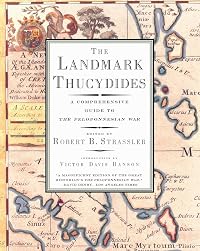
The Landmark Thucydides: A Comprehensive Guide to the Peloponnesian War
by Thucydides
The Landmark Ancient Histories (1)
On This Page
Description
Thucydides called his account of two decades of war between Athens and Sparta "a possession for all time," and indeed it is the first and still the most famous work in the Western historical tradition. Considered essential reading for generals, statesmen, and liberally educated citizens for more than 2,000 years. The Peloponnesian War is a mine of military, moral, political, and philosophical wisdom. However, this classic book has long presented obstacles to the. Uninitiated reader. Written show more centuries before the rise of modern historiography. Thucydides' narrative is not continuous or linear. His authoritative chronicle of what he considered the greatest war of all time is rigorous and meticulous, yet omits the many aids to comprehension modern readers take for granted - such as brief biographies of the story's main characters, maps and other visual enhancements, and background on the military, cultural, and political traditions. Of ancient Greece. Robert Strassler's new edition amends these omissions, and not only provides a new coherence to the narrative overall but effectively reconstructs the lost cultural context that Thucydides shared with his original audience. Based on the venerable Richard Crawley translation, updated and revised for modern readers, The Landmark Thucydides includes a vast array of superbly designed and presented maps, brief informative appendices by outstanding classical. Scholars on subjects of special relevance to the text, explanatory marginal notes on each page, an index of unprecedented subtlety and depth, and numerous other useful features. Readers will find that with this edition they can dip into the text at any point and be immediately oriented with regard to the geography, season, date, and stage of the conflict. show lessTags
Recommendations















Member Recommendations
Member Reviews
I have seen many reviews claiming that, although an accomplished historian, Thucydides is a dry writer. Thus I've started reading this book with some trepidation, expecting to be bored out of my mind. And indeed, the beginning was more than a little dry.
However, somewhere after the first 1/3 of the book my opinion changed. I hardly know enough of history to judge Thucydides on his accuracy on these matters, but he is certainly a talented writer. His writing is subtle, elegant and powerful, invoking a great tragedy about pride, fall and the price of power.
The effect is reached by foreshadowing, by subtly but constantly recurring themes and by the composition itself rather than colorful statements. To illustrate what I am talking about: a show more "pure" dispassionate historian would simply describe the events and left finding similarities between the expansion, overreach and fall of Athens and defeat of Persia earlier to the discretion of the reader. A somewhat talented author would have spelled it out explicitly and drew analogies in author's voice. But Thucydides makes Athens reference their own defeat of Persia as a justification to their deeds over and over again, even as they are about to commit the very same mistakes, both marking the similarity, underscoring dramatic irony and foretelling an inevitability of defeat.
On the same note, the passionate plea for justice followed by a few short sentences to the effect "and then they got killed" is often more powerful than a vivid description would have been.
A few words about the edition: While Landmark edition is probably the best one so far, Kindle version has serious issues. Namely, it was next to impossible to navigate between the footnotes while reading - they are all concentrated at the end of the chapter with no hyperlinks for quick navigation provided. The maps are definitely helpful, but after a while become redundant. The same goes for footnotes themselves - they constantly provide redundant information while failing to clarify difficult places. I don't need to be reminded what a proxenus is each time the word is mentioned - once is enough. But I would like to be reminded who the person I've last seen mentioned a hundred pages ago is and how did they come to their current situation, but this is usually not covered by footnotes. show less
However, somewhere after the first 1/3 of the book my opinion changed. I hardly know enough of history to judge Thucydides on his accuracy on these matters, but he is certainly a talented writer. His writing is subtle, elegant and powerful, invoking a great tragedy about pride, fall and the price of power.
The effect is reached by foreshadowing, by subtly but constantly recurring themes and by the composition itself rather than colorful statements. To illustrate what I am talking about: a show more "pure" dispassionate historian would simply describe the events and left finding similarities between the expansion, overreach and fall of Athens and defeat of Persia earlier to the discretion of the reader. A somewhat talented author would have spelled it out explicitly and drew analogies in author's voice. But Thucydides makes Athens reference their own defeat of Persia as a justification to their deeds over and over again, even as they are about to commit the very same mistakes, both marking the similarity, underscoring dramatic irony and foretelling an inevitability of defeat.
On the same note, the passionate plea for justice followed by a few short sentences to the effect "and then they got killed" is often more powerful than a vivid description would have been.
A few words about the edition: While Landmark edition is probably the best one so far, Kindle version has serious issues. Namely, it was next to impossible to navigate between the footnotes while reading - they are all concentrated at the end of the chapter with no hyperlinks for quick navigation provided. The maps are definitely helpful, but after a while become redundant. The same goes for footnotes themselves - they constantly provide redundant information while failing to clarify difficult places. I don't need to be reminded what a proxenus is each time the word is mentioned - once is enough. But I would like to be reminded who the person I've last seen mentioned a hundred pages ago is and how did they come to their current situation, but this is usually not covered by footnotes. show less
This well-edited edition, with lots of footnotes and maps is about the only way for a non-classically educated reader to appreciate Thucydides' account of the horrors of the Peloponnesian War. But while there are some things to admire about the Greeks, this story of mass murder masquerading as war and the endless stupidity that destroyed Athens won't raise your opinion of the Greeks or the Ancients in general.
This is a lightly revised edition of Richard Crawley's old 19th-century translation; reasonably accurate, readable if not particularly inspiring. The maps, notes, and appendices (standard features of the Landmark series) make it much easier to follow the events and keep track of people and places.
As for the actual history, Thucydides does seem to try to be objective. He was an Athenian and a general during the earlier part of the war, then exiled and resident in the Peloponnesus for the later part. He was an eyewitness to much and knew many of the players. He does not hide his admiration for Pericles, or his contempt for Cleon and Alcibiades. Nor does he whitewash the Athenians' hubris and overreach, which led to their downfall. His show more enumeration of the evils of political factions (stasis) is a cautionary tale for contemporary America. show less
As for the actual history, Thucydides does seem to try to be objective. He was an Athenian and a general during the earlier part of the war, then exiled and resident in the Peloponnesus for the later part. He was an eyewitness to much and knew many of the players. He does not hide his admiration for Pericles, or his contempt for Cleon and Alcibiades. Nor does he whitewash the Athenians' hubris and overreach, which led to their downfall. His show more enumeration of the evils of political factions (stasis) is a cautionary tale for contemporary America. show less
Don't let the fact this book was written over 2,000 years ago sway you from reading it! I'll admit I was hesitant about reading Thucydides because I'm not a big fan of non-fiction or a serious military history buff, and more specifically, was never that interested in ancient Greek history.
However, after I happened to watch the movie 300 (I know, that movie is basically all fantasy and action Hollywood style, but it was still good!) I became instantly fascinated by the history behind the movie and started buying books on the ancient Greeks to learn more.
Prior to investing the money into purchasing this version of the History of the Peloponnesian War, I borrowed a different version at the library that didn't include maps or appendices show more to explain about ancient Greek society and life. That was a wrong move for a novice! It is imperative that you read Thucydides with lots of maps of ancient Greece so you can follow the narrative of battles taking place around Attica, Peloponnese, and surrounding islands. It is easier to understand what is going on if you have good maps. The Landmark Thucydides was very helpful in that regard. There are enough maps scattered throughout the book, in addition, with side margins and footnotes that I felt were very helpful for the beginner. The book is quite hefty so you'll have a hard time lugging it around, but all you really need is a quiet spot to settle down and read.
I was pleasantly surprised to find that this book didn't really read as a "history book". It had a story-like quality and feel to the narrative that I enjoyed immensely and I found myself quickly enthralled. At times I had to stop and remember that this author has been dead and gone for over 2,000 years. Thucydides' words literally came alive from the pages, and it was eerie how many things he observed so long ago still hold true today.
I have only read this translation (Crawley), and although it isn't written in a direct style of English, I found it was surprisingly easy to read. It took me a few pages to become accustomed to it, but I became so engrossed in Thucydide's narrative that it wasn't really an issue for me. I would recommend reading this book slowly, it's not meant to be read quickly, but to savor and ponder over what you have just read.
If you've ever had a passing interest in ancient Greek history, in particular ancient military battles, Thucydides would be a good starting point. show less
However, after I happened to watch the movie 300 (I know, that movie is basically all fantasy and action Hollywood style, but it was still good!) I became instantly fascinated by the history behind the movie and started buying books on the ancient Greeks to learn more.
Prior to investing the money into purchasing this version of the History of the Peloponnesian War, I borrowed a different version at the library that didn't include maps or appendices show more to explain about ancient Greek society and life. That was a wrong move for a novice! It is imperative that you read Thucydides with lots of maps of ancient Greece so you can follow the narrative of battles taking place around Attica, Peloponnese, and surrounding islands. It is easier to understand what is going on if you have good maps. The Landmark Thucydides was very helpful in that regard. There are enough maps scattered throughout the book, in addition, with side margins and footnotes that I felt were very helpful for the beginner. The book is quite hefty so you'll have a hard time lugging it around, but all you really need is a quiet spot to settle down and read.
I was pleasantly surprised to find that this book didn't really read as a "history book". It had a story-like quality and feel to the narrative that I enjoyed immensely and I found myself quickly enthralled. At times I had to stop and remember that this author has been dead and gone for over 2,000 years. Thucydides' words literally came alive from the pages, and it was eerie how many things he observed so long ago still hold true today.
I have only read this translation (Crawley), and although it isn't written in a direct style of English, I found it was surprisingly easy to read. It took me a few pages to become accustomed to it, but I became so engrossed in Thucydide's narrative that it wasn't really an issue for me. I would recommend reading this book slowly, it's not meant to be read quickly, but to savor and ponder over what you have just read.
If you've ever had a passing interest in ancient Greek history, in particular ancient military battles, Thucydides would be a good starting point. show less
I'm rating this at 5***** primarily for the quality of this "Landmark" edition edited by Robert B. Strassler. Personally, I find most of Thucydides a very tedious read because of the "chronicle" style in which he writes, which follows the history of the Peloponnesian War in strict chronological order and fails to give a good presentation of the overall strategy of individual land and naval campaigns. (Book VI, the history of the Sicilian Campaign, is an exception, probably because not much else occurred in other combat theaters during that period so that the Sicilian events proceed largely uninterruptedly.) My own particular interest was the "treason of Alcibiades," considering his involvement with Socrates and his presence in Plato's show more dialogues.
What makes it possible to get through this lengthy history is the high quality of annotations and the numerous maps included in this edition (which seems typical of "Landmark" editions). If you read straight through, you'll find much of the footnoting repetitive, as are the numerous maps, but the editor's goal is to protect the reader from the need to flip back and forth to a "maps section" by providing a new map, however repetitive, within a couple of pages of the referring text. Also, the repetitiveness of the annotations (I don't know how many times the terms "hoplite" and "pelast" are footnote-defined) makes the text readable for someone who is not going through sequentially from start to finish, which makes this a useful edition for classroom use. The excellent maps are particularly helpful in a text that concentrates so much on military history, both land and naval warfare.
This "Landmark" edition also includes eleven appendices on such subjects as Athenian and Spartan society, military and naval warfare, religion, coinage, and other topics.
I'm not at all urging the reading of Thucydides, but if you're going to read him, use this "Landmark" edition (ISBN 978-0684827902). show less
What makes it possible to get through this lengthy history is the high quality of annotations and the numerous maps included in this edition (which seems typical of "Landmark" editions). If you read straight through, you'll find much of the footnoting repetitive, as are the numerous maps, but the editor's goal is to protect the reader from the need to flip back and forth to a "maps section" by providing a new map, however repetitive, within a couple of pages of the referring text. Also, the repetitiveness of the annotations (I don't know how many times the terms "hoplite" and "pelast" are footnote-defined) makes the text readable for someone who is not going through sequentially from start to finish, which makes this a useful edition for classroom use. The excellent maps are particularly helpful in a text that concentrates so much on military history, both land and naval warfare.
This "Landmark" edition also includes eleven appendices on such subjects as Athenian and Spartan society, military and naval warfare, religion, coinage, and other topics.
I'm not at all urging the reading of Thucydides, but if you're going to read him, use this "Landmark" edition (ISBN 978-0684827902). show less
This bad-boy took me literally years, off-and-on, to finish, a true exercise in patience. The annotations, especially the summaries in the margins were extremely valuable, as were the interesting glossary chapters. If you're going to read Thucydides, read this wonderful edition. Only Strassler could make this palatable.
What an amazing civil war! Imagine a 3-decade long war with NYC against Boston. Yonkers, Queens, Newark, Hartford, Lawrence, and Lowell side with Boston. Cambridge, Providence, Worcester, New Haven Albany, Brooklyn, Staten Island and Cincinnati side with New York. A full-out civil war, with cruelty, deceit, bullying, scheming and conniving at every turn. What a slog. I'm very happy that I finished it.
What an amazing civil war! Imagine a 3-decade long war with NYC against Boston. Yonkers, Queens, Newark, Hartford, Lawrence, and Lowell side with Boston. Cambridge, Providence, Worcester, New Haven Albany, Brooklyn, Staten Island and Cincinnati side with New York. A full-out civil war, with cruelty, deceit, bullying, scheming and conniving at every turn. What a slog. I'm very happy that I finished it.
The Peloponnesian War (431- 404 BC) was a civil war of unprecedented savagery which engulfed nearly the entire Greek world. Thucydides tells us that he foresaw that war between Athens and Sparta would be terrible and "more worthy of relation than any that had preceded it." Accordingly he wrote his history of the conflict "as an aid to the understanding of the future, which in the course of human beings must resemble it if not reflect it." and "not as an essay which is to win the applause of the moment, but as a possession for all time."
Not least among the work's themes is leadership. Thucydides saw the tragedy that befell Athens due in no small part to the ascendancy of demagogic leaders following the death of Pericles, who "led [the show more multitude] instead of being led by them; for as he [Pericles] never sought power by improper means, he was never compelled to flatter them..With his successors it was different. More on a level with one another, and each grasping for supremacy, they ended by committing even the conduct of state affairs to the whims of the multitude."
The Landmark Thucydides, first published in 1996, is an extraordinary work of scholarship. The editor, Robert Strassler, conceived the work when he noticed that many of his students who enjoyed Homer and Herodotus became hopelessly lost in Thucydides. What was needed was a reader-friendly edition. The Landmark Thucydides magnificently fulfills this need with specially commissioned maps, explanatory marginal notes, appendices on subjects of special relevance to the text, and a comprehensive index. The work is introduced by the renowned classics scholar Victor Davis Hanson. Described by one reviewer as "the finest edition of Thucydides' history ever produced," The Landmark Thucydides is an ideal introduction and guide to the greatest historian of the ancient world.
Published in Regent University Library Link, September 2005 (http://www.regent.edu/lib/news-archives/2005_08.cfm#book) show less
Not least among the work's themes is leadership. Thucydides saw the tragedy that befell Athens due in no small part to the ascendancy of demagogic leaders following the death of Pericles, who "led [the show more multitude] instead of being led by them; for as he [Pericles] never sought power by improper means, he was never compelled to flatter them..With his successors it was different. More on a level with one another, and each grasping for supremacy, they ended by committing even the conduct of state affairs to the whims of the multitude."
The Landmark Thucydides, first published in 1996, is an extraordinary work of scholarship. The editor, Robert Strassler, conceived the work when he noticed that many of his students who enjoyed Homer and Herodotus became hopelessly lost in Thucydides. What was needed was a reader-friendly edition. The Landmark Thucydides magnificently fulfills this need with specially commissioned maps, explanatory marginal notes, appendices on subjects of special relevance to the text, and a comprehensive index. The work is introduced by the renowned classics scholar Victor Davis Hanson. Described by one reviewer as "the finest edition of Thucydides' history ever produced," The Landmark Thucydides is an ideal introduction and guide to the greatest historian of the ancient world.
Published in Regent University Library Link, September 2005 (http://www.regent.edu/lib/news-archives/2005_08.cfm#book) show less
Members
- Recently Added By
Lists

Favourite Books
1,820 works; 316 members

In Our Time books
4,934 works; 2 members
Author Information

293+ Works 15,111 Members
Born into a family of Athens's old nobility claiming descent from the Homeric hero Ajax of Salamis, Thucydides pursued a political career under Pericles and served as a general in the Great Peloponnesian War of 431--404 b.c. His subsequent exile for failure to prevent a Spartan takeover of an Athenian colony in Thrace enabled him to observe the show more war from both sides. In his history of the war, he examines the policies and motives of the people involved with a calculated rationality that nevertheless conveys great passion. Although his narrative style is lucid and astringent, the language of the speeches that he gives his protagonists is some of the most difficult, yet rhetorically powerful, Greek from any period of antiquity. The work is deeply serious in tone. As Thucydides tells his readers at the beginning of the work, it contains nothing of entertainment value. He meant it, as he says, to be not simply a set-piece written for the delectation of an audience, but a "possession for ever." As Herodotus was the inventor of universal history, Thucydides was the inventor of the analytical historical monograph. He wrote in conscious contrast to Herodotus, whose work is full of entertaining fable and romance. While Herodotus wrote about the past by using all manner of traditions gleaned in his travels, Thucydides considered only contemporary history to be reliable and writes as an interrogator and witness of contemporary men and events. The gods, too, are absent from Thucydides's work, which scrutinizes human motivations as the exclusive business of history. The most powerful intellectual influences visible are the fully rational method of description and prognosis developed by the Hippocratic physicians and the tools of logical analysis and verbal argument then being forged by the Sophists. Behind these, however, lay a sense of tragedy. The history of Thucydides possesses the rhythm of a Sophoclean drama of reversal of fortune in which Athens falls from the pinnacle of imperial success and brilliance into political corruption, ruthless and amoral imperial aggression, and finally utter defeat and disaster. Athens's imperial hubris leads to its nemesis at the hands of Sparta, a conservative and landlocked state that had been powerless at the beginning of the war to inflict significant harm on the Athenians. Thucydides's work is unfinished. It ends abruptly in midsentence during a discussion of the events of the year 411 b.c. It was continued to the end of the war by Xenophon. Although very much the intellectual inferior of Thucydides, Xenophon managed by imitation to infuse this part of his Hellenica (his continuation to 362 b.c. of the history of Thucydides) with an elevation absent in the rest of his work. Until relatively recently, scholars took Thucydides at his word as an objective writer. More recently it has been recognized that his work skillfully promotes a patriotic and political argument, written in the climate of postwar recriminations. He presents Athens's empire as a natural consequence of the position of that city-state in the Greek world and the Athenian leader Pericles as Athens's greatest statesman, a leader who had governed Athens and preserved the empire with a firm and intelligent hand. Thucydides wanted to persuade his readers that Pericles was not the villain who destroyed Athens, that the blame fell to the politicians who came after him and pandered to the most extreme ambitious of the common citizens, the politicians who were the ultimate arbiters of policy in Athens's democracy. Some modern historians remain persuaded by Thucydides's portrait of Pericles and the Athenian democracy, but others argue from Thucydides's own testimony that Pericles led Athens into an unnecessary war in the belief that the opportunity had arrived to advance Athenian domination over the whole of the Greek world. (Bowker Author Biography) show less
All Editions
Some Editions
Series

Work Relationships
Contains
Common Knowledge
- Canonical title
- The Landmark Thucydides: A Comprehensive Guide to the Peloponnesian War
- Original title
- The History of the Peloponnesian War
- Alternate titles
- The Landmark Thucydides : a comprehensive guide to the Peloponnesian War
- Original publication date
- 411 BC; 1996
- People/Characters
- Alcibiades; Agis; Alcidas; Archidamus II, King of Sparta; Astyochus; Brasidas (show all 14); Cleon; Demosthenes; Eurymedon; Nicias; Perdiccas, King of Macedonia; Pericles; Pisander; Thucydides
- Important places
- Abdera, Thrace; Ancient Greece; Athens, Greece; Sparta, Greece; Scily
- Important events
- Peloponnesian War; Battle of Pylos
- Dedication
- To Samuel A. Stassler
- First words
- "Thucydides, an Athenian wrote the history of the war" is the first pronouncement of "The Pelopennesian War."
- Last words
- (Click to show. Warning: May contain spoilers.)Accordingly he went first to Ephesus and offered sacrifice to Artemis.
- Original language
- Greek (Ancient) (Ancient)
Classifications
- Genres
- History, Nonfiction, General Nonfiction
- DDC/MDS
- 938.05 — History & geography History of ancient world (to ca. 499) Greece to 323 Greece to 323 Peloponnesian War (431-404 BC)
- LCC
- DF229 .T55 .C7 — History of Europe, Asia, Africa and Oceania Greece History of Greece History By period Peloponnesian War, 431-404 B.C.
- BISAC
Statistics
- Members
- 2,762
- Popularity
- 6,693
- Reviews
- 24
- Rating
- (4.37)
- Languages
- English
- Media
- Paper, Audiobook, Ebook
- ISBNs
- 5
- ASINs
- 10