
About the Author
Paul Cartledge is A. G. Leventis Professor of Greek Culture Emeritus at the University of Cambridge. He is an honorary citizen of modern Sparta and holds the Gold Cross of the Order of Honor awarded by the President of Greece. His previous books include The Cambridge Illustrated History of Ancient show more Greece, The Spartans, Alexander the Great, Thermopylae, Ancient Greece, and After Thermopylae: The Oath of Plataea and the End of the Graeco-Persian Wars. show less
Series
Works by Paul Cartledge
The Spartans: The World of the Warrior-Heroes of Ancient Greece, from Utopia to Crisis and Collapse (2002) 1,068 copies, 11 reviews
After Thermopylae: the oath of Plataea and the end of the Graeco-Persian Wars (2013) 86 copies, 1 review
The Cambridge World History of Slavery: Volume 1, The Ancient Mediterranean World (2011) — Editor — 29 copies
Responses to Oliver Stone's Alexander: Film, History, and Cultural Studies (2010) — Editor — 21 copies, 2 reviews
Money, Labour and Land: Approaches to the economics of ancient Greece (Routledge Classical Monographs) (2001) — Editor — 20 copies
The Oxford History of the Archaic Greek World. Volume I: Argos to Corcyra (2024) — Editor — 8 copies
Crux : essays in Greek history presented to G.E.M. de Ste. Croix on his 75th birthday (1985) — Editor — 4 copies
The Oxford History of the Archaic Greek World: Volume III: Cumae to Cyprus (2025) — Editor — 4 copies
The Oxford History of the Archaic Greek World: Volume VI: Rhodes to Western Sicily (2025) — Editor — 3 copies
The Oxford History of the Archaic Greek World: Volume IV: Cyrene to Metapontion (2024) — Editor — 3 copies
Ancient Monuments and Modern Identities : a Critical History of Archaeology in 19th and 20th Century Greece (2017) 1 copy
A new classical archaeology? 1 copy
Fixed positions 1 copy
Associated Works
The Landmark Thucydides: A Comprehensive Guide to the Peloponnesian War (0411) — Contributor, some editions — 2,767 copies, 24 reviews
The Landmark Herodotus: The Histories (0440) — Contributor, some editions — 2,045 copies, 25 reviews
The Landmark Arrian: The Campaigns of Alexander (0146) — Introduction, some editions — 567 copies, 5 reviews
The World of Athens: Introduction to Classical Athenian Culture [Second Edition] (2008) — Contributor — 103 copies
The Cambridge History of Greek and Roman Political Thought (2000) — Contributor — 83 copies, 2 reviews
Brill's Companion to Thucydides (Brill's Companions in Classical Studies) (2006) — Contributor — 22 copies
Classical Sparta: Techniques Behind Her Success (Oklahoma Series in Classical Culture) (1989) — Foreword — 17 copies, 1 review
When Men Were Men: Masculinity, Power and Identity in Classical Antiquity (Leicester-Nottingham Studies in Ancient Society) (1999) — Contributor — 13 copies, 1 review
Helots and Their Masters in Laconia and Messenia: Histories, Ideologies, Structures (2004) — Contributor — 11 copies
War and democracy : a comparative study of the Korean War and the Peloponnesian War (2000) — Contributor — 8 copies
Periplous : papers on classical art and archaeology presented to Sir John Boardman (2000) — Contributor — 5 copies
Aristophanes and Politics: New Studies (Columbia Studies in the Classical Tradition) (2020) — Contributor — 3 copies
Arethusa (vol 8 no 1): Marxism and the Classics — Contributor — 2 copies
Tagged
Common Knowledge
- Canonical name
- Cartledge, Paul
- Legal name
- Cartledge, Paul Anthony
- Birthdate
- 1947-03-24
- Gender
- male
- Education
- New College, Oxford University (BA|1969|D.Phil|1975)
St Paul's School, London, England, UK - Occupations
- professor
historian
classicist - Organizations
- Cambridge University
University of Warwick
Trinity College, Dublin
New University of Ulster
Society for the Promotion of Hellenic Studies - Awards and honors
- Order of Honour (Gold Cross, 2002)
Honorary Citizen of Sparta (2005)
Order of Honour (Commander, 2021)
Society of Antiquaries of London (Fellow, 1980)
Royal Society of Arts (Fellow)
Fellow of Clare College, University of Cambridge - Relationships
- De Ste. Croix, G. E. M. (professor)
Boardman, Sir John (doctoral advisor) - Nationality
- UK
- Birthplace
- London, England, UK
- Places of residence
- Dublin, Ireland
London, England, UK - Associated Place (for map)
- UK
Members
Reviews
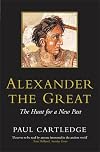
Very enjoyable history of Alexander, mixing chronological chapters with thematic ones. A huge plus is an Appendix where Cartledge examines the sources that are available to us and that were probably available to writers of the extant texts. Well written and lucidly argued, I would definitely recommend this book to anyone interested in Alexander. Cartledge appears to enjoy Mary Renault's fictional accounts of Alexander, which of course is a plus with me, although for some reason Cartledge show more puts forward quite a negative view of Hephaistion - with his understanding of the problems with the existing sources and the sources used by the sources, I thought the view of Hephaistion as a "dump brute" (like Bucephalas) was singularly one-sided. But maybe I just lack the facts, I don't know. Nonetheless, Cartledge speaks of Alexander's relationship with Hephaistion as probably physical at certain points of their lives in a matter-of-fact manner and is not really amused at a recent biographer of Oscar Wilde describing Hephaistion as Alexander's catamite (I think he means McKenna, I noticed that too). And apart from this, I really enjoyed this book. show less
I am just beginning my intensive reading program on ancient Greek history. So I start with introductions, such as this Very Short Introduction. That was a bit disappointing. Paul Cartledge (Cambridge University UK) presents Greek history on the basis of eleven cities, 1 for each period. That is a handy find, certainly. However, that didactic approach is completely undone by Cartledge's very difficult writing style and by his adherence to old theories.
Take that of the "hoplitic revolution", show more which I myself was taught in my college years in the 1970s. That is the theory that in the 7th century BCE the Greek cities changed from a limited army of (individual) warriors to citizens operating in ranks (in what later became the well-known phalanxes), the so-called hoplites. That military democratization was linked to the political, and in that way also to the emergence of the typical ancient Greek form of government, the polis, and ultimately democracy. There are many things wrong with this theory (fighting in ranks happened much earlier, political changes were separate from military ones, and real phalanxes are now only dated to the 4th century). Almost all researchers have written off the theory, but Cartledge clearly still holds on to it.
And there are more comments to be made. Calling the Mycenaean civilization a false start, because it (seemingly) came to nothing, shows a very teleological view of history, as if only the “Golden 5th century” is the norm, and everything that did not lead directly to it a failure. Strange. In short: this very short introduction certainly does not seem to me to be recommended. show less
Take that of the "hoplitic revolution", show more which I myself was taught in my college years in the 1970s. That is the theory that in the 7th century BCE the Greek cities changed from a limited army of (individual) warriors to citizens operating in ranks (in what later became the well-known phalanxes), the so-called hoplites. That military democratization was linked to the political, and in that way also to the emergence of the typical ancient Greek form of government, the polis, and ultimately democracy. There are many things wrong with this theory (fighting in ranks happened much earlier, political changes were separate from military ones, and real phalanxes are now only dated to the 4th century). Almost all researchers have written off the theory, but Cartledge clearly still holds on to it.
And there are more comments to be made. Calling the Mycenaean civilization a false start, because it (seemingly) came to nothing, shows a very teleological view of history, as if only the “Golden 5th century” is the norm, and everything that did not lead directly to it a failure. Strange. In short: this very short introduction certainly does not seem to me to be recommended. show less
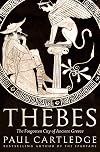
When it's all said and done I had a hard time deciding how to rate this book, flirting at one point for giving it top marks. That I did not do so is a commentary on how hard it is to say anything coherent about Classical Thebes, on the basis of the sources that have come down to us. That Cartledge goes to some lengths to explain what we know about the city, and how, is one of the things that makes this a fairly hard read, while making me respect the author as a historian. Still, Cartledge show more does have enough to work with to give the reader a sense of how, over time, Thebes evolved from being one of the more conservative Grecian polities, and prepared to ally themselves with the Persians, to being a great defender of Greek freedom under the leadership of Epaminondas, the man most responsible for breaking Spartan hegemony.
Perhaps the ultimate irony in all this, and this ties into heroic Theban legend still being a vital metaphor in modern culture, is that the Classical Greeks were just as fascinated and worked the stories of Oedipus and Antigone and the like into their literature. Though much of this might have boiled down to the great Athenian dramatists enjoying nothing more than wallowing in the misfortunes of a great political rival! show less
Perhaps the ultimate irony in all this, and this ties into heroic Theban legend still being a vital metaphor in modern culture, is that the Classical Greeks were just as fascinated and worked the stories of Oedipus and Antigone and the like into their literature. Though much of this might have boiled down to the great Athenian dramatists enjoying nothing more than wallowing in the misfortunes of a great political rival! show less
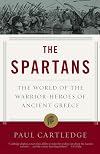
My approach to learning about something new is to get as many books as I can – in no particular order – read them all, and try to average things out. Thus Paul Catledge’s The Spartans is my second book on Sparta, after W.C. Forrest’s A History of Sparta, so I now have some standard of comparison.
Forrest’s book, published 1967, is a straightforward history; information is presented in chronological order. Cartledge’s (published 2002) is more of a cultural history and is only show more chronologic in the grand scheme. Instead, Cartledge (apparently intentionally, based on frequent references) emulates Plutarch and presents Spartan history as a series of biographies of noted Spartan figures, with enough background to enable the reader to grasp what’s going on. Sometimes this works; sometimes it doesn’t; it helps that Cartledge is a more fluid writer than Forrest.
Presumably because of changes in modern cultural sensibilities, Cartledge is much more open about the role of women and homosexuality in Spartan culture than Forrest (it’s just possible that he’s too open – that he’s reading more into the scanty textual record than it justifies; don’t have enough data to say for sure). At any rate, Cartledge contends that organized and State-enforced pederasty was a significant part of Spartan military training. When a Spartan boy was removed from his mother’s care at age 6 or 7 he went through the ἀγωγή (agoge), which is related to the ancient Greek word for cattle raising; the official in overall charge of the process was called the “Boy Herd”. Each boy was matched with an older lover, who was supposed to be his mentor and instructor in Spartan military virtues. Forrest goes so far as to say the younger boys “were under the control” of older ones but doesn’t imply a sexual relationship. Forrest and Cartledge also disagree on part of the training regimen – according to Forrest the younger boys could only eat what they could forage or steal; Cartledge contends that this was only true for a selected group – the crypteia (κρυπτεία) – who were boys marked out for future leadership roles. The crypteia boys were sent out into the countryside armed only with a dagger – and killed helots. The whole nature of the crypteia is unclear; was it only for certain boys or did some members carry on in adulthood? Were the helots killed at random or did some higher authority pick out ones that seemed particularly troublesome? Cartledge goes so far as to call the crypteia the “Special Operations Executive”, which is drawing an analogy that the historical record doesn’t seem to justify.
Forrest says nothing I remember about the role of Spartan women, while they get considerable coverage from Cartledge (including two of the capsule biographies – of Gorgo, queen to King Leonidas I, and Cynisca, the only woman of any Greek state ever to win a prize at the Olympics (she did it twice just to prove it wasn’t a fluke)). Perhaps their names say something about the supposed lack of a sense of humor among Spartan; “Gorgo” is a diminutive for “Gorgon”, whose glace turned men to stone, and “Cynisca” means “female puppy” – or “little bitch”. At any rate, Spartan women were vastly freer than women in any other Greek state; for example, they could own property in their own name (something American and English women couldn’t do until the 19th century). Spartan girls went through a training regime like Spartan boys – training was lighter, and they could live at home, but they were still expected to wrestle, throw the javelin and discus, and race – naked or in short skirts, leading to other Greeks to call them “thigh flashers”. Cartledge states there’s evidence that they were assigned lesbian relationships with older girls, just like the boys – but doesn’t say what that evidence is. Education for girls included literacy, unique in the Greek world – it’s possible that more Spartan women than men were literate.
It was a religious duty for Spartan men to marry and procreate, and any who remained bachelors too long were subjected to ritualized ridicule by the girls. Spartan marriage customs included simulated rape – the prospect of having to rape, even symbolically, a girl who had been training in wrestling and basic melee weapons might have left some Spartan men willing to face the ridicule ceremony instead.
Finally, again unlike all other Greek states, there was no penalty for adultery in Sparta; in fact Cartledge claims (and here has explicit evidence from ancient authors) that it was encouraged as a way to form alliances between families. It was apparently a point of pride for a Spartan woman to be shared between two husbands – she got to manage two households. Since all the housework that other Greek women did – spinning, weaving, cleaning, cooking, nursing – was done by helots in Sparta there wasn’t that much difficulty involved.
Cartledge attributes the downfall of Sparta to the same reasons as Forrest; the State overextended itself in terms of manpower. It’s actually surprising that Sparta lasted as long as it did as a military power, its reputation overawing potential enemies – by the time of the final conflict with Thebes there were less around 1000 adult male Spartans of military age and the army had to be filled out with armed helots and troops from client states. Cartledge notes the same phenomenon as Forrest regarding Spartan kings; their power and influence increased in inverse proportion to Sparta’s military strength. Neither proposes a strong reason for this, although Cartledge speculates that the kings may have acquired considerable wealth from campaigning. Notably, after the victory over Mardonius at Plataea in 479 BC, Spartan king Pausanius reportedly distributed the spoils – not to his own troops, but to allies and helots. Later king Agesilaus II kept 1000 talents worth spoils from an Asian campaign (394/5 BC) for himself; one Attic talent was 26 kilograms of silver and worth about $225000 in ancient purchasing power, or around $25000 in modern bullion value – and Cartledge notes that the campaign wasn’t even particularly successful.
Cartledge’s last chapter is an account of the influence of Sparta on European history. John Stuart Mill notably claimed that the battle of Marathon in 490 BC was more important to English history that the battle of Hastings in 1066. I find that problematical; the suggestion is that somehow the idea of democracy wouldn’t have taken root without the Greek example. That’s not clear; I think a greater loss would have been Greek poetry and literature – and maybe not even that, as the Persians were not particularly concerned about their subjects’ customs and presumably would have allowed Greek religious festivals (the source of Greek drama) and Greek writing to continue. Thermopylae and Leonidas were – and are – subjects for European literature; The Spartans was written before the graphic novel and movie 300; the book Cartledge has in mind for continuing the legend is Gates of Fire, which was considered for a movie with Brad Pitt or Bruce Willis as Leonidas. An appendix on Spartan hunting is tacked on almost as an afterthought; it’s based on a lecture by Cartledge on fox hunting and is strangely irrelevant to the rest of the book.
Good maps of the Peloponnese; an assortment of relevant photographs; a long bibliography but no footnotes; I would have appreciated sources for some of Cartledge’s claims. If you’re looking for a military history, this isn’t it; Cartledge mentions all the battles but there’s no discussion of the tactics involved or maps of the locations. Overall, I think this a better book than Forrest but you need to have more background in ancient Greece to read it with profit. show less
Forrest’s book, published 1967, is a straightforward history; information is presented in chronological order. Cartledge’s (published 2002) is more of a cultural history and is only show more chronologic in the grand scheme. Instead, Cartledge (apparently intentionally, based on frequent references) emulates Plutarch and presents Spartan history as a series of biographies of noted Spartan figures, with enough background to enable the reader to grasp what’s going on. Sometimes this works; sometimes it doesn’t; it helps that Cartledge is a more fluid writer than Forrest.
Presumably because of changes in modern cultural sensibilities, Cartledge is much more open about the role of women and homosexuality in Spartan culture than Forrest (it’s just possible that he’s too open – that he’s reading more into the scanty textual record than it justifies; don’t have enough data to say for sure). At any rate, Cartledge contends that organized and State-enforced pederasty was a significant part of Spartan military training. When a Spartan boy was removed from his mother’s care at age 6 or 7 he went through the ἀγωγή (agoge), which is related to the ancient Greek word for cattle raising; the official in overall charge of the process was called the “Boy Herd”. Each boy was matched with an older lover, who was supposed to be his mentor and instructor in Spartan military virtues. Forrest goes so far as to say the younger boys “were under the control” of older ones but doesn’t imply a sexual relationship. Forrest and Cartledge also disagree on part of the training regimen – according to Forrest the younger boys could only eat what they could forage or steal; Cartledge contends that this was only true for a selected group – the crypteia (κρυπτεία) – who were boys marked out for future leadership roles. The crypteia boys were sent out into the countryside armed only with a dagger – and killed helots. The whole nature of the crypteia is unclear; was it only for certain boys or did some members carry on in adulthood? Were the helots killed at random or did some higher authority pick out ones that seemed particularly troublesome? Cartledge goes so far as to call the crypteia the “Special Operations Executive”, which is drawing an analogy that the historical record doesn’t seem to justify.
Forrest says nothing I remember about the role of Spartan women, while they get considerable coverage from Cartledge (including two of the capsule biographies – of Gorgo, queen to King Leonidas I, and Cynisca, the only woman of any Greek state ever to win a prize at the Olympics (she did it twice just to prove it wasn’t a fluke)). Perhaps their names say something about the supposed lack of a sense of humor among Spartan; “Gorgo” is a diminutive for “Gorgon”, whose glace turned men to stone, and “Cynisca” means “female puppy” – or “little bitch”. At any rate, Spartan women were vastly freer than women in any other Greek state; for example, they could own property in their own name (something American and English women couldn’t do until the 19th century). Spartan girls went through a training regime like Spartan boys – training was lighter, and they could live at home, but they were still expected to wrestle, throw the javelin and discus, and race – naked or in short skirts, leading to other Greeks to call them “thigh flashers”. Cartledge states there’s evidence that they were assigned lesbian relationships with older girls, just like the boys – but doesn’t say what that evidence is. Education for girls included literacy, unique in the Greek world – it’s possible that more Spartan women than men were literate.
It was a religious duty for Spartan men to marry and procreate, and any who remained bachelors too long were subjected to ritualized ridicule by the girls. Spartan marriage customs included simulated rape – the prospect of having to rape, even symbolically, a girl who had been training in wrestling and basic melee weapons might have left some Spartan men willing to face the ridicule ceremony instead.
Finally, again unlike all other Greek states, there was no penalty for adultery in Sparta; in fact Cartledge claims (and here has explicit evidence from ancient authors) that it was encouraged as a way to form alliances between families. It was apparently a point of pride for a Spartan woman to be shared between two husbands – she got to manage two households. Since all the housework that other Greek women did – spinning, weaving, cleaning, cooking, nursing – was done by helots in Sparta there wasn’t that much difficulty involved.
Cartledge attributes the downfall of Sparta to the same reasons as Forrest; the State overextended itself in terms of manpower. It’s actually surprising that Sparta lasted as long as it did as a military power, its reputation overawing potential enemies – by the time of the final conflict with Thebes there were less around 1000 adult male Spartans of military age and the army had to be filled out with armed helots and troops from client states. Cartledge notes the same phenomenon as Forrest regarding Spartan kings; their power and influence increased in inverse proportion to Sparta’s military strength. Neither proposes a strong reason for this, although Cartledge speculates that the kings may have acquired considerable wealth from campaigning. Notably, after the victory over Mardonius at Plataea in 479 BC, Spartan king Pausanius reportedly distributed the spoils – not to his own troops, but to allies and helots. Later king Agesilaus II kept 1000 talents worth spoils from an Asian campaign (394/5 BC) for himself; one Attic talent was 26 kilograms of silver and worth about $225000 in ancient purchasing power, or around $25000 in modern bullion value – and Cartledge notes that the campaign wasn’t even particularly successful.
Cartledge’s last chapter is an account of the influence of Sparta on European history. John Stuart Mill notably claimed that the battle of Marathon in 490 BC was more important to English history that the battle of Hastings in 1066. I find that problematical; the suggestion is that somehow the idea of democracy wouldn’t have taken root without the Greek example. That’s not clear; I think a greater loss would have been Greek poetry and literature – and maybe not even that, as the Persians were not particularly concerned about their subjects’ customs and presumably would have allowed Greek religious festivals (the source of Greek drama) and Greek writing to continue. Thermopylae and Leonidas were – and are – subjects for European literature; The Spartans was written before the graphic novel and movie 300; the book Cartledge has in mind for continuing the legend is Gates of Fire, which was considered for a movie with Brad Pitt or Bruce Willis as Leonidas. An appendix on Spartan hunting is tacked on almost as an afterthought; it’s based on a lecture by Cartledge on fox hunting and is strangely irrelevant to the rest of the book.
Good maps of the Peloponnese; an assortment of relevant photographs; a long bibliography but no footnotes; I would have appreciated sources for some of Cartledge’s claims. If you’re looking for a military history, this isn’t it; Cartledge mentions all the battles but there’s no discussion of the tactics involved or maps of the locations. Overall, I think this a better book than Forrest but you need to have more background in ancient Greece to read it with profit. show less
Lists
Awards


You May Also Like


Associated Authors
Statistics
- Works
- 43
- Also by
- 46
- Members
- 4,195
- Popularity
- #5,994
- Rating
- 4.1
- Reviews
- 54
- ISBNs
- 196
- Languages
- 13
- Favorited
- 7