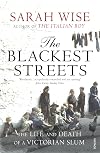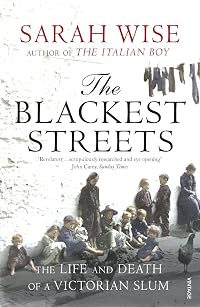
The Blackest Streets: The Life and Death of a Victorian Slum
by Sarah Wise
On This Page
Description
'An excellent and intelligent investigation of the realities of urban living that respond to no design or directive... This is a book about the nature of London itself' Peter Ackroyd, The Times A powerful exploration of the seedy side of Victorian London by one of our most promising young historians. In 1887 government inspectors were sent to investigate the Old Nichol, a notorious slum on the boundary of Bethnal Green parish, where almost 6,000 inhabitants were crammed into thirty or so show more streets of rotting dwellings and where the mortality rate ran at nearly twice that of the rest of Bethnal Green. Among much else they discovered that the decaying 100-year-old houses were some of the most lucrative properties in the capital for their absent slumlords, who included peers of the realm, local politicians and churchmen. The Blackest Streets is set in a turbulent period of London's history when revolution was in the air. Award-winning historian Sarah Wise skilfully evokes the texture of life at that time, not just for the tenants but for those campaigning for change and others seeking to protect their financial interests. She recovers Old Nichol from the ruins of history and lays bare the social and political conditions that created and sustained this black hole which lay at the very heart of the Empire. A revelatory and prescient read about cities, class and inequality, the message at the heart of The Blackest Streets still resonates today. show lessTags
Recommendations





Member Recommendations
Member Reviews
Sarah Wise writes a detailed and varied account of the Old Nichol, a 15 acre East End slum in Victorian London, a place of desperate poverty yet brave and stoic community. She uses personal stories and varied sources to chronicle the depths of the problems: from filthy sewage contaminated streets and houses, to rising child mortality, malnutrition and overcrowding, whole families often forced into single room accommodations below ground and sharing with their donkeys and animals. She also exposes the ironic fact that the landlords making money out of this abysmal poverty were often London’s richest, including members of the peerage, lawyers and churchmen.
“The Nichol’s thirty or so streets and courts of more or less rotten show more early-nineteenth-century houses were home to around 5,700 people, of whom four-fifths were children. Its death rate was almost double that of the rest of Bethnal Green, the very poor East London parish at whose western boundary the Nichol stood….The annual mortality rate of the Nichol in the late 1880s was 40 per 1,000 people; Bethnal Green’s hovered between 22 and 23 per 1,000 for these years, not much above the London (and, indeed, the national) figure of 19 to 20 per 1,000. (Today, the death rate for England and Wales is 5.94 per 1,000.) One-third of all these London deaths were those of babies and infants. Bethnal Green’s death rate for babies under the age of one was in line with the average figure for England and Wales of 150 per 1,000 live births; in the Nichol it was a horrific 252 per 1,000….the Nichol was for many an East Ender a final stopping-off point before entry into the dreaded workhouse, and the less-dreaded death therein.”
Wide also turns her attentions to the efforts of the wealthy to “rescue” the poor, a scope which spans from the ludicrous and self-aggrandizing to the truly altruistic. The philosophies range from socialism, religious fervour, to a belief that the poor are so because of their own moral vices, a hatred and contempt towards them, sometimes backed up by pseudoscience such as eugenics. She looks at various characters working within the Old Nichol such as the larger-than-life Father Jay of Holy Trinity with his boxing clubs and shelters. Finally the only plausible solution seemed to be demolition. The London City Council was created and began the building of a model new housing called Boundary Estate, which ironically when it was finally built, displacing thousands from the Old Nichol, only housed eleven of the original inhabitants due to being either unaffordable for them or unsuited to their needs.
I found this to be a highly informative, honest and sympathetic account which I appreciated as an insight into the real day-to-day lives of some of my ancestors who were unfortunate enough to live in the Old Nichol. Thank you Sarah Wise. show less
“The Nichol’s thirty or so streets and courts of more or less rotten show more early-nineteenth-century houses were home to around 5,700 people, of whom four-fifths were children. Its death rate was almost double that of the rest of Bethnal Green, the very poor East London parish at whose western boundary the Nichol stood….The annual mortality rate of the Nichol in the late 1880s was 40 per 1,000 people; Bethnal Green’s hovered between 22 and 23 per 1,000 for these years, not much above the London (and, indeed, the national) figure of 19 to 20 per 1,000. (Today, the death rate for England and Wales is 5.94 per 1,000.) One-third of all these London deaths were those of babies and infants. Bethnal Green’s death rate for babies under the age of one was in line with the average figure for England and Wales of 150 per 1,000 live births; in the Nichol it was a horrific 252 per 1,000….the Nichol was for many an East Ender a final stopping-off point before entry into the dreaded workhouse, and the less-dreaded death therein.”
Wide also turns her attentions to the efforts of the wealthy to “rescue” the poor, a scope which spans from the ludicrous and self-aggrandizing to the truly altruistic. The philosophies range from socialism, religious fervour, to a belief that the poor are so because of their own moral vices, a hatred and contempt towards them, sometimes backed up by pseudoscience such as eugenics. She looks at various characters working within the Old Nichol such as the larger-than-life Father Jay of Holy Trinity with his boxing clubs and shelters. Finally the only plausible solution seemed to be demolition. The London City Council was created and began the building of a model new housing called Boundary Estate, which ironically when it was finally built, displacing thousands from the Old Nichol, only housed eleven of the original inhabitants due to being either unaffordable for them or unsuited to their needs.
I found this to be a highly informative, honest and sympathetic account which I appreciated as an insight into the real day-to-day lives of some of my ancestors who were unfortunate enough to live in the Old Nichol. Thank you Sarah Wise. show less
Ratings
Members
- Recently Added By
Lists

Books Read in 2023
5,638 works; 147 members

In Our Time books
4,934 works; 2 members
Author Information

7 Works 849 Members
Sarah Wise studied at Birkbeck College at the University of London. Her most recent book, The Blackest Streets was shortlisted for the Ondaatje Prize (2009), and her first book, The Italian Boy: Murder and Grave Robbery in London, was shortlisted for the 2005 Samuel Johnson Prize and won the Crime Writer's Gold Dagger for nonfiction.
Awards and Honors
Awards
Distinctions
Common Knowledge
- Original publication date
- 2008
- Important places
- Old Nichol, London, England, UK; Bethnal Green, London, England, UK; London, England, UK
- Dedication
- For Anne-Marie Collins
- First words
- At four o'clock in the afternoon of a damp, chilly Saturday in November 1887, two men kept an appointment with each other at Shoreditch railway station.
- Last words
- (Click to show. Warning: May contain spoilers.)Let's give the final word to Arthur, our unreliable narrator: 'The poor were the salt of the earth, you know. There was nobody like the poor; I mean, they don't show off, you know. The blocks of flats have ruined them.'
Classifications
- Genres
- History, Nonfiction, General Nonfiction
- DDC/MDS
- 942.1081 — History & geography History of Europe England and Wales London Historical periods; Modified standard subdvisions of London 1837- 1837-1901, Victoria
- LCC
- HV4086 .L66 .W57 — Social sciences Social pathology. Social and public welfare. Criminology Social pathology. Social and public welfare. Protection, assistance and relief Poor in cities. Slums
- BISAC
Statistics
- Members
- 194
- Popularity
- 168,388
- Reviews
- 1
- Rating
- (4.02)
- Languages
- English
- Media
- Paper, Ebook
- ISBNs
- 4
- ASINs
- 3