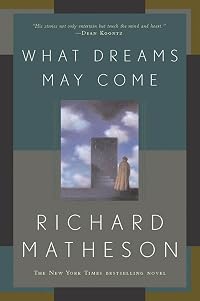
What Dreams May Come
by Richard Matheson
On This Page
Description
What happens to us after we die? Chris Nielsen had no idea, until an unexpected accident cut his life short, separating him from his beloved wife, Annie. Now Chris must discover the true nature of life after death. But even Heaven is not complete without Annie, and the divided soul mates will do anything to reach each other across the boundaries between life and death. When tragedy threatens to divide them forever, Chris risks his very soul to save Annie from an eternity of despair.Tags
Recommendations










Member Reviews
I’ve often been disappointed by a movie based on a book I like. However, when I find that a movie I like is based on a novel I haven’t read, I often find I like the novel. After the death of Robin Williams, I thought about his movie What Dreams May Come. I love this movie, which is based on the novel by Richard Matheson. I’ve loved everything I ever read by Matheson, but had never read What Dreams May Come. So naturally I decided to finally read it.
The book is told from the point of view of Chris Nielsen, a man who has just died. It begins by chronicling his journey from death into the afterlife. Being a good man, Chris eventually finds himself in a place that most readers will recognize as heaven. These opening scenes are classic show more Matheson, very tightly focused on Chris, very fast moving, and with a tense and thrilling atmosphere.
Once Chris reaches heaven, however, I was very surprised to find the book bogged down over the course of the middle section of the novel. Matheson did a lot of research for this book about the nature of afterlife, which he references in a bibliography at the end, and he uses this middle section to basically deliver what he feels the afterlife must be like. By itself, I have no problem with an author doing this. In fact, when done well, a novel can be the perfect vehicle for bringing an author’s concept of reality to readers in an exciting and engaging way. Unfortunately, and much to my surprise, Matheson’s attempt at this felt very forced. The whole middle section felt like a confusing mish-mash of new age concepts.
In the final section Matheson pulls out of his nosedive and finishes strong. In fact, the end section is Matheson at his best. In this section Chris finds that the beloved wife he left behind has committed suicide and damned herself to hell. Chris is told that there is noting he can do for her, but he cannot accept this and decides to try and rescue her. He is told that not only is this impossible, but that he himself could well end up damned by even attempting it. But he won’t be dissuaded, and journeys to hell to find her.
He does find her, but she doesn’t recognize him and cannot be pulled out of the fatal depression that caused her suicide and has damned her. Chris is relentless, but the longer he is with her the more he is overwhelmed by her despair. This is what he was warned about, that he would be swallowed by despair and end up trapped in hell by it. At the last moment, when he realizes that he must leave now or be damned, he consciously decides that he would rather be with her in hell than without her in heaven. This moment of decision, in both novel and movie, is stunning.
I’ve thought about Chris’s decision over and over. I am repulsed by the idea of someone abandoning their loved one to hell while enjoying heaven. In fact, I find it hard to believe that such a person could ever be worthy of heaven. It seems the only moral decision is the one Chris makes. What a conundrum! In the story, this sacrifice is the catalyst to finally rouse his wife from her despair and save them both. The reader, however, is left pondering many hard questions. Given the way Robin Williams end up, it just adds more fuel to the moral fire.
Overall, because of the middle section, I find that the movie was better than the novel. I can’t remember ever saying this before (excluding, of course, the always awful novels written to rehash a successful movie). However, if one considers just the beginning and ending sections of the novel, one gets the excellence expected from Matheson. In the end, I’d recommend seeing the movie first and only consider the novel afterwards. But be ready for some serious moral turmoil. show less
The book is told from the point of view of Chris Nielsen, a man who has just died. It begins by chronicling his journey from death into the afterlife. Being a good man, Chris eventually finds himself in a place that most readers will recognize as heaven. These opening scenes are classic show more Matheson, very tightly focused on Chris, very fast moving, and with a tense and thrilling atmosphere.
Once Chris reaches heaven, however, I was very surprised to find the book bogged down over the course of the middle section of the novel. Matheson did a lot of research for this book about the nature of afterlife, which he references in a bibliography at the end, and he uses this middle section to basically deliver what he feels the afterlife must be like. By itself, I have no problem with an author doing this. In fact, when done well, a novel can be the perfect vehicle for bringing an author’s concept of reality to readers in an exciting and engaging way. Unfortunately, and much to my surprise, Matheson’s attempt at this felt very forced. The whole middle section felt like a confusing mish-mash of new age concepts.
In the final section Matheson pulls out of his nosedive and finishes strong. In fact, the end section is Matheson at his best. In this section Chris finds that the beloved wife he left behind has committed suicide and damned herself to hell. Chris is told that there is noting he can do for her, but he cannot accept this and decides to try and rescue her. He is told that not only is this impossible, but that he himself could well end up damned by even attempting it. But he won’t be dissuaded, and journeys to hell to find her.
He does find her, but she doesn’t recognize him and cannot be pulled out of the fatal depression that caused her suicide and has damned her. Chris is relentless, but the longer he is with her the more he is overwhelmed by her despair. This is what he was warned about, that he would be swallowed by despair and end up trapped in hell by it. At the last moment, when he realizes that he must leave now or be damned, he consciously decides that he would rather be with her in hell than without her in heaven. This moment of decision, in both novel and movie, is stunning.
I’ve thought about Chris’s decision over and over. I am repulsed by the idea of someone abandoning their loved one to hell while enjoying heaven. In fact, I find it hard to believe that such a person could ever be worthy of heaven. It seems the only moral decision is the one Chris makes. What a conundrum! In the story, this sacrifice is the catalyst to finally rouse his wife from her despair and save them both. The reader, however, is left pondering many hard questions. Given the way Robin Williams end up, it just adds more fuel to the moral fire.
Overall, because of the middle section, I find that the movie was better than the novel. I can’t remember ever saying this before (excluding, of course, the always awful novels written to rehash a successful movie). However, if one considers just the beginning and ending sections of the novel, one gets the excellence expected from Matheson. In the end, I’d recommend seeing the movie first and only consider the novel afterwards. But be ready for some serious moral turmoil. show less
I was willing to say this book just wasn't to my taste, until I hit the part near the end where the main character, without any plot related reason, muses (paraphrased to avoid spoilers) that people from india have a difficult time becoming doctors. I'm guessing the author didn't mean for it to be casually racist (I mean, does he think that doctors don't exist in india?), but it speaks to a laziness in characterization, writing, and editing that plagues the whole book. Thousands of words were dedicated to how people in the afterlife can warp from place to place, but not that place, and sometimes to another place, and sometimes to places they think of. And dogs go to the same afterlife and I guess birds do too. Thousands of words that show more could have been better spent on why the main character doesn't like indian doctors. show less
I am going to start this review by talking about the one thing that caused this to be a 4-star book rather than a 5-star book. That one thing is the author's note at the beginning.
Now, I almost never read author's notes or introductions, because I find that they inevitably ruin some aspect of the book for me. Whether it is a spoiler, or an introducer's opinion which causes me to think of the book in a certain way, or interpret things in a certain way, or whatever the case may be, it lessens my enjoyment of the book. I never know whether I would have thought of the interpretation on my own without the thought having been planted, for instance, and therefore I feel as if I have been cheated out of the full experience of reading, show more absorbing and pondering the book. I enjoy that part as much as a good story.
So, with that in mind, I avoid anything written about or pertaining to the book which I am reading, at least until after I have read the book proper. But in this case, no matter which order I'd have read it in, the author's note would have annoyed me and caused me to take a star off. Matheson doesn't spoil anything, technically, nor does he really change the way I interpret the book (honestly!), but what he does, is claim that everything in the book, except the characters, is true.
This is a book about the afterlife. Generally speaking, it's impossible for any of us to know anything about the afterlife until we're no longer living our present life. I know that there are people who hold strong beliefs in the afterlife, or who believe that their religion holds the key to their afterlife, and even those who have died briefly and have come back to tell about their experiences. And these may be similar in nature, but it doesn't make it true. There is no proof to back up the statement that this book makes, which I will get to in a moment. And while it is true that "the absence of evidence is not the evidence of absence", any claim of "truth" regarding something that cannot be proven by anyone still alive feels very irresponsible.
I don't think that there is anything in this book that would physically harm anyone, and I do think that everyone should be exposed to ideas from all different walks of life, not just their own belief system, so I don't mean "irresponsible" in that way. I just mean that stating something as true when it is virtually unverifiable, and very subject to belief, is a fine line to walk when your career and livelihood depend on not alienating people by your beliefs.
I don't happen to be a religious sort, so in that respect, I was kind of wary of reading this book, given the claim of "truth" that I mentioned before. But I decided to read it as I would any other, and go from there. And while Matheson does touch on "God" and "The Creator" briefly, it is in very general terms, and does not specify any further than that. In fact, he even goes so far as to show people of the Christian faith as being a bit closed-minded in the afterlife that he depicts here, in that they are unable to imagine any other belief system as having an afterlife, and making demands, etc. Nothing outright negative, just that they weren't as open to possibility, so to speak. So I was pleasantly surprised that I wasn't preached at, as I was half-expecting.
So, anyway. Now that I've covered the one thing that bothered me, I can move on. For those of you who know anything about my afterlife beliefs, you'll know that I believe that what happens after a person dies is dependent on their own personal belief system. For instance, a Christian who has led a good life and expects to get into Heaven, will. For an atheist who thinks that there is nothing after death, there will be nothing. For someone who believes that they will make it to Valhalla, they will. A follower of Islam who believes that they will make it to Paradise, will. And so on...
I don't really know how long I've held this belief, but I do know that it makes the most sense to me. There are so many religions, and so many sects among each one, that it seems like no two people ever believe the exact same thing. We all interpret religion differently, if we follow one at all, so who's to say what's right? Why fight and kill and hate over a belief? My theory, they're ALL right. Whatever you personally believe is what you will experience. It's kind of comforting, right?
Matheson's book is similar to this, but different in a few major ways.
*********Possible Spoilers Below*********
His book states that there is a sort of ethereal energy plane which occupies the same space as Life, but on a higher level. People who are receptive to higher planes of existence, those who meditate, for instance, are sometimes able to travel in this plane, never realizing it is real, but thinking instead it is a dream or a vision. The higher in the plane we go, the more knowledge we acquire and "divine" we become on our way to rejoining God or the Creator. ("Divine" is my word, not Matheson's.)
What makes his afterlife similar to my theory is that the afterlife plane is a sort of template, onto which the recently deceased imprints their expectations of afterlife. There are certain laws, supposedly handed down from the Creator, which make lower levels (those closer to earth) into a sort of Hell (although there are countless Hells depending on what sort you create for yourself). People who have lived violent lives, for instance, aren't able to rise to the higher levels because they wallow in the misery that they've caused others, and do not seek to better their souls. Sometimes, they aren't even aware they're dead, and just go on living horrible, bleak existences until they ask for and receive help to change and try for more.
The higher levels, of which we only see Summerland, a sort of way station, is adjustable depending on the wishes and beliefs of the individual soul. If your idea of heaven is to have a library full of books in a house by the sea, you have only to create it. So, the higher levels are templates that are adjustable by will, whereas the lower levels are templates that are pre-written by the life you've just led, if that makes sense.
It's a nice thought, that we will all survive death, in a way. It gives us hope that there's not just a one time shot, and if we blow it, or it's taken from us, that's not all there is. We aren't just forsaken and lost forever. It makes me hope that something like this is true, and that I will see my loved ones again when we're gone.
This again is a major theme in this book. Love transcending death. This, I must say, is the facet of the book that most touched and affected me. Matheson's writing about relationships is mesmerizing. He is able, with so few words, to convey to me a lifetime of love and trust and intimacy between Chris, the main character, and his wife Ann, that at times I felt almost like I was spying on their lives. The way that he shows their love made me hope that when my life ends, I can feel as though I've had the kind of connection they shared. Chris's thank you to Ann for being everything to him was heart-rending, and I read it with a pain in my chest and a lump in my throat. Yet I didn't feel like it was contrived or fake, or that I was being manipulated. I just felt as if I was party to his goodbye.
Matheson's writing is simple, but he is a master at depicting life in all its glory and ugliness. He is quickly becoming a favorite author, and despite the fact that I disliked the truth claim, I'm sorry that I put off reading this book for as long as I did. I will definitely need to find and read more Matheson in the future. show less
Now, I almost never read author's notes or introductions, because I find that they inevitably ruin some aspect of the book for me. Whether it is a spoiler, or an introducer's opinion which causes me to think of the book in a certain way, or interpret things in a certain way, or whatever the case may be, it lessens my enjoyment of the book. I never know whether I would have thought of the interpretation on my own without the thought having been planted, for instance, and therefore I feel as if I have been cheated out of the full experience of reading, show more absorbing and pondering the book. I enjoy that part as much as a good story.
So, with that in mind, I avoid anything written about or pertaining to the book which I am reading, at least until after I have read the book proper. But in this case, no matter which order I'd have read it in, the author's note would have annoyed me and caused me to take a star off. Matheson doesn't spoil anything, technically, nor does he really change the way I interpret the book (honestly!), but what he does, is claim that everything in the book, except the characters, is true.
This is a book about the afterlife. Generally speaking, it's impossible for any of us to know anything about the afterlife until we're no longer living our present life. I know that there are people who hold strong beliefs in the afterlife, or who believe that their religion holds the key to their afterlife, and even those who have died briefly and have come back to tell about their experiences. And these may be similar in nature, but it doesn't make it true. There is no proof to back up the statement that this book makes, which I will get to in a moment. And while it is true that "the absence of evidence is not the evidence of absence", any claim of "truth" regarding something that cannot be proven by anyone still alive feels very irresponsible.
I don't think that there is anything in this book that would physically harm anyone, and I do think that everyone should be exposed to ideas from all different walks of life, not just their own belief system, so I don't mean "irresponsible" in that way. I just mean that stating something as true when it is virtually unverifiable, and very subject to belief, is a fine line to walk when your career and livelihood depend on not alienating people by your beliefs.
I don't happen to be a religious sort, so in that respect, I was kind of wary of reading this book, given the claim of "truth" that I mentioned before. But I decided to read it as I would any other, and go from there. And while Matheson does touch on "God" and "The Creator" briefly, it is in very general terms, and does not specify any further than that. In fact, he even goes so far as to show people of the Christian faith as being a bit closed-minded in the afterlife that he depicts here, in that they are unable to imagine any other belief system as having an afterlife, and making demands, etc. Nothing outright negative, just that they weren't as open to possibility, so to speak. So I was pleasantly surprised that I wasn't preached at, as I was half-expecting.
So, anyway. Now that I've covered the one thing that bothered me, I can move on. For those of you who know anything about my afterlife beliefs, you'll know that I believe that what happens after a person dies is dependent on their own personal belief system. For instance, a Christian who has led a good life and expects to get into Heaven, will. For an atheist who thinks that there is nothing after death, there will be nothing. For someone who believes that they will make it to Valhalla, they will. A follower of Islam who believes that they will make it to Paradise, will. And so on...
I don't really know how long I've held this belief, but I do know that it makes the most sense to me. There are so many religions, and so many sects among each one, that it seems like no two people ever believe the exact same thing. We all interpret religion differently, if we follow one at all, so who's to say what's right? Why fight and kill and hate over a belief? My theory, they're ALL right. Whatever you personally believe is what you will experience. It's kind of comforting, right?
Matheson's book is similar to this, but different in a few major ways.
*********Possible Spoilers Below*********
His book states that there is a sort of ethereal energy plane which occupies the same space as Life, but on a higher level. People who are receptive to higher planes of existence, those who meditate, for instance, are sometimes able to travel in this plane, never realizing it is real, but thinking instead it is a dream or a vision. The higher in the plane we go, the more knowledge we acquire and "divine" we become on our way to rejoining God or the Creator. ("Divine" is my word, not Matheson's.)
What makes his afterlife similar to my theory is that the afterlife plane is a sort of template, onto which the recently deceased imprints their expectations of afterlife. There are certain laws, supposedly handed down from the Creator, which make lower levels (those closer to earth) into a sort of Hell (although there are countless Hells depending on what sort you create for yourself). People who have lived violent lives, for instance, aren't able to rise to the higher levels because they wallow in the misery that they've caused others, and do not seek to better their souls. Sometimes, they aren't even aware they're dead, and just go on living horrible, bleak existences until they ask for and receive help to change and try for more.
The higher levels, of which we only see Summerland, a sort of way station, is adjustable depending on the wishes and beliefs of the individual soul. If your idea of heaven is to have a library full of books in a house by the sea, you have only to create it. So, the higher levels are templates that are adjustable by will, whereas the lower levels are templates that are pre-written by the life you've just led, if that makes sense.
It's a nice thought, that we will all survive death, in a way. It gives us hope that there's not just a one time shot, and if we blow it, or it's taken from us, that's not all there is. We aren't just forsaken and lost forever. It makes me hope that something like this is true, and that I will see my loved ones again when we're gone.
This again is a major theme in this book. Love transcending death. This, I must say, is the facet of the book that most touched and affected me. Matheson's writing about relationships is mesmerizing. He is able, with so few words, to convey to me a lifetime of love and trust and intimacy between Chris, the main character, and his wife Ann, that at times I felt almost like I was spying on their lives. The way that he shows their love made me hope that when my life ends, I can feel as though I've had the kind of connection they shared. Chris's thank you to Ann for being everything to him was heart-rending, and I read it with a pain in my chest and a lump in my throat. Yet I didn't feel like it was contrived or fake, or that I was being manipulated. I just felt as if I was party to his goodbye.
Matheson's writing is simple, but he is a master at depicting life in all its glory and ugliness. He is quickly becoming a favorite author, and despite the fact that I disliked the truth claim, I'm sorry that I put off reading this book for as long as I did. I will definitely need to find and read more Matheson in the future. show less
I'm a big fan of Matheson's classic horror novel I Am Legend. I was intrigued then when I discovered Matheson had written the novel, the movie What Dreams May Come was based on. I consider that movie among my favorites, though it was largely panned by critics. I hoped the source of that excellent film would not disappoint. Reading Matheson's departure from horror and his take on the afterlife, I was very pleased.
Matheson tells the story from the perspective of an average man named Chris just after he has had a deadly car accident. The novel is told in flashback through a letter Chris has dictated to a psychic from beyond the grave. We are taken on a journey, as Chris proceeds through the afterlife and tries to reunite with his wife. We show more get to see flashbacks within flashbacks (sounds confusing, but it works well) as Chris recounts some of the most memorable moments with his wife and family. Not all of these memories are pleasant, and the novel does a good job of examining the reality of life rather than our preferred vision.
Matheson lists several resources as justification for his view of the afterlife at the end of the novel. He makes it clear this is a fictional story about a nonfictional subject. Matheson is projecting what he believes is the most realistic account of what happens when we die, based on his research into near death experiences and multiple religious perspectives. The fact that Matheson isn't just making all this up lends the book credence even if you ultimately reject his view of the next world.
The story itself starts very slow. Part I is the most difficult and least interesting part to read. In fact, the story doesn't really get good until Part 3, but once it does, it is gripping in true Matheson fashion. The ending is satisfying, and somewhat unexpected even if you've seen the movie. Enough is different here that the whole book feels fresh even if you've watched the film. The book and film are trying to do two different things, and I didn't see anything wrong with that. Staying strictly to Matheson's work would have been impossible as key parts are unfilmable.
The book is not without its drawbacks. I didn't particularly care for his treatment of religion, which had a level of certitude that was ridiculous for someone asking us to be open-minded about the afterlife. Yet ultimately, Matheson's message is one I approved of. His vision is believable and while the afterlife is undoubtedly unlike anything Matheson or anyone else can possibly imagine, Matheson's guess is as good as any. show less
Matheson tells the story from the perspective of an average man named Chris just after he has had a deadly car accident. The novel is told in flashback through a letter Chris has dictated to a psychic from beyond the grave. We are taken on a journey, as Chris proceeds through the afterlife and tries to reunite with his wife. We show more get to see flashbacks within flashbacks (sounds confusing, but it works well) as Chris recounts some of the most memorable moments with his wife and family. Not all of these memories are pleasant, and the novel does a good job of examining the reality of life rather than our preferred vision.
Matheson lists several resources as justification for his view of the afterlife at the end of the novel. He makes it clear this is a fictional story about a nonfictional subject. Matheson is projecting what he believes is the most realistic account of what happens when we die, based on his research into near death experiences and multiple religious perspectives. The fact that Matheson isn't just making all this up lends the book credence even if you ultimately reject his view of the next world.
The story itself starts very slow. Part I is the most difficult and least interesting part to read. In fact, the story doesn't really get good until Part 3, but once it does, it is gripping in true Matheson fashion. The ending is satisfying, and somewhat unexpected even if you've seen the movie. Enough is different here that the whole book feels fresh even if you've watched the film. The book and film are trying to do two different things, and I didn't see anything wrong with that. Staying strictly to Matheson's work would have been impossible as key parts are unfilmable.
The book is not without its drawbacks. I didn't particularly care for his treatment of religion, which had a level of certitude that was ridiculous for someone asking us to be open-minded about the afterlife. Yet ultimately, Matheson's message is one I approved of. His vision is believable and while the afterlife is undoubtedly unlike anything Matheson or anyone else can possibly imagine, Matheson's guess is as good as any. show less
What Dreams May Come presents a confusing amalgam of disparate beliefs about the possibility and nature of an afterlife. There is no character development and we simply have to take the protagonist's word that he will do anything to reunite with his wife. She is barely two-dimensional and their children are nothing more than names.
Despite the interesting premise, the plot feels hollow and the descriptions of heaven fall flat. The last part comes across as didactic and preachy. The inclusion of a bibliography is unexpected but gives the reader insight into Matheson's inspiration.
This is one of the few cases of a movie being better than the book.
Despite the interesting premise, the plot feels hollow and the descriptions of heaven fall flat. The last part comes across as didactic and preachy. The inclusion of a bibliography is unexpected but gives the reader insight into Matheson's inspiration.
This is one of the few cases of a movie being better than the book.
First, my apologies for sitting on this book for so long! (My explanation involves a lot of words ending with "-itis", and maybe even a few attempts to spell a dramatic coughing fit or two.)
And then I finished it days ago, but have only just had time to write my review.
And THEN, I didn't even enjoy the book. (Don't you hate it when that happens?)
I did like the movie, but I guess it was more the visuals of the movie that I enjoyed rather than the philosophy or the plot. In the book, I found the plot completely wet and sappy and the philosophy completely opposed to what I believe in. It rubbed me up the wrong way completely with the comments at the beginning that the details of the book are all based on the TRUTH, and it must be true, show more because he read it in a book somewhere. (Granted, there is a long bibliography at the back of the book.) Hell, I can read all sorts of things in books, and that doesn't make it all true!
I do not believe in life after death. I am willing to read about life after death in a novel. I am not willing to have life after death forced down my throat as the TRUTH.
I especially enjoyed reading about the book in Summerland's library that denies life after death and was giving off bad vibes. Mate, come over here and read my aura, and you'll be seeing some bad vibes!!
On the plus side, it was an easy read. It wasn't as if I was struggling with bad writing on top of bad philosophy/theology. And some of the sappier elements of the movie were obviously a product of Hollywood, not Richard Matheson, which was a relief.
And Mr TQD has recommended that I lift my lifelong ban on reading Robert Heinlein novels and give Job a go as an antidote for sappy life-after-death plots. Just mentioning this in case anyone else feels the need for an antidote after reading this book. show less
And then I finished it days ago, but have only just had time to write my review.
And THEN, I didn't even enjoy the book. (Don't you hate it when that happens?)
I did like the movie, but I guess it was more the visuals of the movie that I enjoyed rather than the philosophy or the plot. In the book, I found the plot completely wet and sappy and the philosophy completely opposed to what I believe in. It rubbed me up the wrong way completely with the comments at the beginning that the details of the book are all based on the TRUTH, and it must be true, show more because he read it in a book somewhere. (Granted, there is a long bibliography at the back of the book.) Hell, I can read all sorts of things in books, and that doesn't make it all true!
I do not believe in life after death. I am willing to read about life after death in a novel. I am not willing to have life after death forced down my throat as the TRUTH.
I especially enjoyed reading about the book in Summerland's library that denies life after death and was giving off bad vibes. Mate, come over here and read my aura, and you'll be seeing some bad vibes!!
On the plus side, it was an easy read. It wasn't as if I was struggling with bad writing on top of bad philosophy/theology. And some of the sappier elements of the movie were obviously a product of Hollywood, not Richard Matheson, which was a relief.
And Mr TQD has recommended that I lift my lifelong ban on reading Robert Heinlein novels and give Job a go as an antidote for sappy life-after-death plots. Just mentioning this in case anyone else feels the need for an antidote after reading this book. show less
A husband dies young and his death is too much for his wife to bear so she commits suicide convinced there is no afterlife. After an introduction to the glorious Summerland (heaven) he goes in search of his soulmate in her own personal hell, not willing to leave her there alone until she's able to ascend to the higher realm. The book was better than the movie, which is almost always the case (my exceptions are Stardust and Fear & Loathing in Las Vegas). It is a beautiful concept for a love story and is fairly well executed. I enjoyed pieces of it, mainly the ending and his trek through the bottom crater of hell. Overall I wouldn't recommend it. "People are not punished for their deeds but by them."
Members
- Recently Added By
Lists

Ten+ Books About the Afterlife
13 works; 2 members
Author Information

291+ Works 30,240 Members
Richard Matheson was born on February 20, 1926 in Allendale, New Jersey. He was eight when his stories appeared in a local newspaper, the Brooklyn Eagle. He served during World War II. He received a degree in journalism from the University of Missouri in 1949. In 1950 he first was noticed as an upcoming writer-to-watch, starting with the short show more story Born of Man and Woman. He wrote numerous novels and short stories during his lifetime including I am Legend, The Shrinking Man, What Dreams May Come, and Hell House. He won the World Fantasy Convention's Life Achievement Award, the Bram Stoker Award for Life Achievement, the Hugo Award, the Golden Spur Award, and the Writer's Guild Award. He also was inducted into the Science Fiction Hall of Fame in 2010. When Hollywood approached him for the rights to his novel The Shrinking Man, he negotiated the chance to write the screenplay. This began a long career in screenwriting and adapting. He wrote the screenplay for Steven Spielberg's Duel and 16 episodes of the television series The Twilight Zone. He won an Edgar Allan Poe Award in 1973 for The Night Stalker. He died on June 23, 2013 at the age of 87. (Bowker Author Biography) show less
Work Relationships
Is contained in
Has the adaptation
Common Knowledge
- Canonical title
- What Dreams May Come
- Original title
- What Dreams May Come
- Alternate titles
- Liefde na de dood; Vad drömmar månde komma
- Original publication date
- 1978
- People/Characters
- Chris Nielsen; Robert Nielsen; Ann; Albert; Leona
- Important places
- Summerland; Hell; Earth
- Related movies
- What Dreams May Come (1998 | IMDb)
- Disambiguation notice
- Novel
Classifications
Statistics
- Members
- 1,702
- Popularity
- 13,076
- Reviews
- 40
- Rating
- (3.77)
- Languages
- 13 — Catalan, Czech, Dutch, English, German, Greek, Hungarian, Italian, Japanese, Portuguese, Russian, Spanish, Ukrainian
- Media
- Paper, Audiobook, Ebook
- ISBNs
- 35
- ASINs
- 7