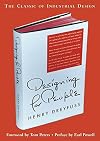
Designing for People
by Henry Dreyfuss
On This Page
Description
From the first answering machine (""the electronic brain"") and the Hoover vacuum cleaner to the SS Independence and the Bell telephone, the creations of Henry S. Dreyfuss have shaped the cultural landscape of the 20th century. Written in a robust, fresh style, this book offers an inviting mix of professional advice, case studies, and design history along with historical black-and-white photos and the author's whimsical drawings. In addition, the author's uncompromising commitment to public show more service, ethics, and design responsibility makes this masterful guide a timely read for today's designer show lessTags
Recommendations









































Member Reviews
Henry Dreyfuss was responsible for a greater variety of attractive, useful industrial designs than any other 20th century designer. The Big Ben alarm clock, the round Honeywell thermostat, seven iconic models of John Deere tractors, a whole series of ubiquitous home telephones, the late '40s iteration of the Royal portable typewriter, ocean liners, locomotives, airliners, the Polaroid SX-70 camera...the list goes on and on. The amazing thing is that all these designs are good. You never look at one and think how it could be better. So I'd hoped for a book that was as exciting as its author's designs. Unfortunately, like a lot of really creative people, Dreyfuss isn't particularly great at communicating his genius. He thought of himself show more as a craftsman, and so his book is a book about craft. He seems to view all of his designs as the result of research and common sense. But if it were that easy, bad design would be a rare thing.
Only persons with a serious interest in the history of commercial design will be well served by this book's discussion of design. For the rest of us, including those such as me who have a serious but more casual interest in the field, the book is interesting more as a guide to how to think about design and as a time capsule to the 1950s. When it came to predictions, Dreyfuss was visionary in many ways, and blinkered in others. Like everybody back then, he thought that Americans of the future would be awash in leisure time, and that energy would be limitless and cheap. It's fun to look at his predictions and see which panned out and which did not. But the world has changed too much for Dreyfuss' pioneering thoughts about design — he was one of the first people to call himself an "industrial designer," a new term — to be really applicable to the modern day. I could recommend Donald Norman for a 1980s and '90s perspective, and the Macintosh Human Interface Guidelines of 1992 as more accessible guides to modern design, and I'm sure there have been still better examples during the generation since. The bottom line? Fun to look into, but a curiosity piece. show less
Only persons with a serious interest in the history of commercial design will be well served by this book's discussion of design. For the rest of us, including those such as me who have a serious but more casual interest in the field, the book is interesting more as a guide to how to think about design and as a time capsule to the 1950s. When it came to predictions, Dreyfuss was visionary in many ways, and blinkered in others. Like everybody back then, he thought that Americans of the future would be awash in leisure time, and that energy would be limitless and cheap. It's fun to look at his predictions and see which panned out and which did not. But the world has changed too much for Dreyfuss' pioneering thoughts about design — he was one of the first people to call himself an "industrial designer," a new term — to be really applicable to the modern day. I could recommend Donald Norman for a 1980s and '90s perspective, and the Macintosh Human Interface Guidelines of 1992 as more accessible guides to modern design, and I'm sure there have been still better examples during the generation since. The bottom line? Fun to look into, but a curiosity piece. show less
It is striking for an interaction designer how prescient Dreyfuss was in terms of focusing on users and uses in his industrial design practice. I particularly note how he combines a rigorous approach to usability and user testing with a strong sensibility to aesthetic qualities. The other main strand of the book is speculation about future life, where Dreyfuss in hindsight comes across as a quite naive representative of 1950s modernism and belief in the wondrous potentials of technological progress. But all in all, I would rate the book as a must-read for interaction designers interested in the intellectual traditions of our field.
Ratings
Members
- Recently Added By
Lists

Bret Victor's Five-Star List
46 works; 5 members
Author Information
13 Works 280 Members
Classifications
Statistics
- Members
- 141
- Popularity
- 231,326
- Reviews
- 2
- Rating
- (3.79)
- Languages
- English
- Media
- Paper, Ebook
- ISBNs
- 3
- ASINs
- 3