
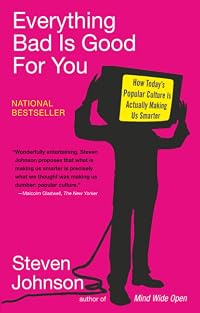
Everything Bad is Good for You
by Steven Johnson
On This Page
Description
The $10 billion video gaming industry is now the second-largest segment of the entertainment industry in the United States, outstripping film and far surpassing books. Reality television shows featuring silicone-stuffed CEO wannabes and bug-eating adrenaline junkies dominate the ratings. But prominent social and cultural critic Steven Johnson argues that our popular culture has never been smarter. Drawing from fields as diverse as neuroscience, economics, and literary theory, the author show more argues that the junk culture we're so eager to dismiss is in fact making us more intelligent. A video game will never be a book nor should it aspire to be-and, in fact, video games, from Tetris to the Sims to Grand Theft Auto, have been shown to raise IQ scores and develop cognitive abilities that can't be learned from books. Likewise, successful television, when examined closely and taken seriously, reveals surprising narrative sophistication and intellectual demands. This book is a hopeful and spirited account of contemporary culture. The author demonstrates that our culture is not declining but changing-in exciting and stimulating ways we'd do well to understand. The glow of the video game or television screen will never be regarded the same way again. show lessTags
Recommendations











Member Reviews
At the end of the introduction to the book, the author writes this, "Today's popular culture may not be showing us the righteous path. But it is making us smarter." To which I would say, making us smarter while not on the righteous path is a useless endeavor, isn't it?
That is the rub though, while I would argue you can consume popular culture and be edified by it, I don't think that is what the author is arguing. He seems to be content with improving our cognitive smarts at the expense of, or without regard for, our moral smarts. He heralds the show Survivor as a good example of this. I say, why must we settle? Why can't we have cognitively challenging TV as well as morally edifying?
This reminds me of what you often hear from public show more educators, something like, "whether or not God exists is irrelevant to what we will teach you in school". Applying it here, to this book, whether or not a show that challenges your cognitive ability has a sound moral base is irrelevant to whether the show is worthy of consumption since it provides a cognitive challenge. A cognitive challenge, in my mind, is not in and of itself worthy of my time. Grand Theft Auto may provide a great cognitive challenge and my cognitive abilities may improve if I were to play the game but the complete lack of any kind of moral edification is reason enough for me to avoid it.
I have other thoughts about this book I may express but for now this will do. Very interested to hear Remy Wilkins take on this. With regard to how this book challenged me, 'twas a good read. show less
That is the rub though, while I would argue you can consume popular culture and be edified by it, I don't think that is what the author is arguing. He seems to be content with improving our cognitive smarts at the expense of, or without regard for, our moral smarts. He heralds the show Survivor as a good example of this. I say, why must we settle? Why can't we have cognitively challenging TV as well as morally edifying?
This reminds me of what you often hear from public show more educators, something like, "whether or not God exists is irrelevant to what we will teach you in school". Applying it here, to this book, whether or not a show that challenges your cognitive ability has a sound moral base is irrelevant to whether the show is worthy of consumption since it provides a cognitive challenge. A cognitive challenge, in my mind, is not in and of itself worthy of my time. Grand Theft Auto may provide a great cognitive challenge and my cognitive abilities may improve if I were to play the game but the complete lack of any kind of moral edification is reason enough for me to avoid it.
I have other thoughts about this book I may express but for now this will do. Very interested to hear Remy Wilkins take on this. With regard to how this book challenged me, 'twas a good read. show less
In Everything Bad is Good for You, Johnson attempts to de-bunk the popular narrative that the culture industry is making us stupider, by feeding us more and more banal television shows, video games, and movies. He argues for understanding a Sleeper Curve in popular culture that is actually making texts more complicated over time. That is, many video games, television shows, Internet sites, and movies are making us smarter by challenging out mental faculties: we have to make more mental and social connections, these texts leave out information that we have to figure out, and they rely on delayed gratification, and we have to figure out the rules of the game/text because they aren't told to us explicitly.
Johnson shows that IQ tests show more scores have been improving over the last few decades, and while it's problematic to compare IQ tests across cultures, races, and locations (because the tests probably are biased), it's not as problematic to compare them across generations. (He readily admits that IQ tests don't actually test all of our mental capacities, but rather serve as an indicator that at least gives us some data.)
I think Johnson provides some pretty good nuance to his book and gives some pretty strong evidence for his case. A lot of the first half of the book reads like James Paul Gee's What Video Games Can Teach Us about Learning and Literacy, though without the methodological explanation and some of the depth. Additionally, Johnson is clear to explain that he's not advocating quitting reading books, and that books do provide a kind of intellectual work unique to them. He's less likely to see declined book reading as a threat to culture, because he notes that all sorts of activities are in decline (television viewing, movie going, etc.). Also, he's not advocating playing video games 24/7, and he cautions that his book is not about the effects of texts' contents (e.g., violence, sexism, etc.). He argues that "[t]he work of the critic, in this instance, is to diagram those forces [neurological appetites, economics of culture industry, changing technological platforms], not decode them" (10).
Overall, this is a pretty good read and makes a convincing case. I am inclined to agree with him, though I do wonder more about the economic effects of all of this, and who benefits and who is left out of his narrative. Johnson, defending himself against critiques of his book that he is supporting capitalism, notes that some of the effects of gaming culture have been to question capitalist notions of private property, and also states that he sees himself as "much more of a technological determinist than an economic determinist." He doesn't want to ask "What is capitalism doing to our minds? Rather, the question is: What is the reigning technological paradigm — combined with both market and public-sector forces — doing to our minds?" (205). While I don't see myself as much of a determinist, I do think there is much to be said of the economic consequences (who is getting rich, and who is "feeding" those that get rich). Additionally, what does it much matter if we are getting cognitively smarter when most those energies are focused on perpetuating a capitalist system? Okay, that's cynical. It matters. But, from my vantage point, systems analysis needs to be coupled with an imagination for what's outside the system: what other worlds are possible, and how can they be achieved? Perhaps this is best left to follow up work to Johnson's text. show less
Johnson shows that IQ tests show more scores have been improving over the last few decades, and while it's problematic to compare IQ tests across cultures, races, and locations (because the tests probably are biased), it's not as problematic to compare them across generations. (He readily admits that IQ tests don't actually test all of our mental capacities, but rather serve as an indicator that at least gives us some data.)
I think Johnson provides some pretty good nuance to his book and gives some pretty strong evidence for his case. A lot of the first half of the book reads like James Paul Gee's What Video Games Can Teach Us about Learning and Literacy, though without the methodological explanation and some of the depth. Additionally, Johnson is clear to explain that he's not advocating quitting reading books, and that books do provide a kind of intellectual work unique to them. He's less likely to see declined book reading as a threat to culture, because he notes that all sorts of activities are in decline (television viewing, movie going, etc.). Also, he's not advocating playing video games 24/7, and he cautions that his book is not about the effects of texts' contents (e.g., violence, sexism, etc.). He argues that "[t]he work of the critic, in this instance, is to diagram those forces [neurological appetites, economics of culture industry, changing technological platforms], not decode them" (10).
Overall, this is a pretty good read and makes a convincing case. I am inclined to agree with him, though I do wonder more about the economic effects of all of this, and who benefits and who is left out of his narrative. Johnson, defending himself against critiques of his book that he is supporting capitalism, notes that some of the effects of gaming culture have been to question capitalist notions of private property, and also states that he sees himself as "much more of a technological determinist than an economic determinist." He doesn't want to ask "What is capitalism doing to our minds? Rather, the question is: What is the reigning technological paradigm — combined with both market and public-sector forces — doing to our minds?" (205). While I don't see myself as much of a determinist, I do think there is much to be said of the economic consequences (who is getting rich, and who is "feeding" those that get rich). Additionally, what does it much matter if we are getting cognitively smarter when most those energies are focused on perpetuating a capitalist system? Okay, that's cynical. It matters. But, from my vantage point, systems analysis needs to be coupled with an imagination for what's outside the system: what other worlds are possible, and how can they be achieved? Perhaps this is best left to follow up work to Johnson's text. show less
It's about time someone wrote a view in opposition to continuous reactionary stance that every new trend is bad for our future. Steven Johnson is effective in this work because he's balanced yet unapologetic. For every criticism we can make about video games relative to time spent reading, we can also find a plus. Video games require logical thought. They train quick decision making. Increasingly, they foster new relationships and teach communication. Reading has it's place, but it's passive and isolating. Johnson show similar advantages about Dungeons & Dragons and modern TV. Compare the complexity of Lost or 24 with that of the top hits of the 1970s. This book makes and important point, and it does it in a compact, enjoyable format.
Johnson has written several books on science and technology and his analyses are provocative. He suggests that television has evolved from shows that are essentially linear, with few characters and a simple story line, to shows like "The Sopranos" in which a single show would encompass multiple narrative threads and characters who move in and out of the plot, often with little explanation, requiring the viewer to do a lot of "filling in." Television now forces an engagement of the viewer that forces cognitive demands on the spectator.
Video games have evolved similarly. Today's games might require forty hours to complete and require the player to make strategic decisions based on multiple sources of information. "This is why many of us show more [me, certainly:] find modern video games baffling: we're not used to being in a situation where we have to figure out what to do. We think we only have to learn how to press the buttons faster."
A quote for us book lovers to mull over:
"Reading books chronically understimulates the senses. Unlike the longstanding tradition of game playing--which engages the child in a vivid, three-dimensional world filled with moving images and musical soundscapes, navigated and controlled with complex muscular movements--books are simply a barren string of words on the page. . . .
"Books are also tragically isolating [something I've always considered a benefit :))] While games have for many years engaged the young in complex social relationships with their peers, building and exploring worlds together, books force the child to sequester him or herself in a quiet space, shut off from interaction with other children. . . .
"But perhaps the most dangerous property of books is the fact that they follow a fixed linear path. You can't control their narratives in any fashion--you simply sit back and have the story dictated to you. . . .This risks instilling a general passivity in our children, making them feel as though they're powerless to change their circumstances. Reading is not an active, participatory process; it's a submissive one."
Johnson, in a jocular manner, is making the point that reading "is a form of explicit learning." Video games make you think. Of course, reading this book certainly got me thinking. . . . show less
Video games have evolved similarly. Today's games might require forty hours to complete and require the player to make strategic decisions based on multiple sources of information. "This is why many of us show more [me, certainly:] find modern video games baffling: we're not used to being in a situation where we have to figure out what to do. We think we only have to learn how to press the buttons faster."
A quote for us book lovers to mull over:
"Reading books chronically understimulates the senses. Unlike the longstanding tradition of game playing--which engages the child in a vivid, three-dimensional world filled with moving images and musical soundscapes, navigated and controlled with complex muscular movements--books are simply a barren string of words on the page. . . .
"Books are also tragically isolating [something I've always considered a benefit :))] While games have for many years engaged the young in complex social relationships with their peers, building and exploring worlds together, books force the child to sequester him or herself in a quiet space, shut off from interaction with other children. . . .
"But perhaps the most dangerous property of books is the fact that they follow a fixed linear path. You can't control their narratives in any fashion--you simply sit back and have the story dictated to you. . . .This risks instilling a general passivity in our children, making them feel as though they're powerless to change their circumstances. Reading is not an active, participatory process; it's a submissive one."
Johnson, in a jocular manner, is making the point that reading "is a form of explicit learning." Video games make you think. Of course, reading this book certainly got me thinking. . . . show less
Before I read this book, I believed modern entertainment was progressively getting dumber, catering more and more to the lowest common denominator. Now, I have been convinced otherwise. Even the worst dreck of modern TV is in many ways more complex and intellectually demanding than comparable programs from earlier times.
Does this mean books will soon go extinct, to be replaced by superior modern media?
Mr. Johnson writes, "No cultural form in history has rivaled the novel’s capacity to re-create the mental landscape of another consciousness, to project you into the first person experience of other human beings. Movies and theater can make you feel as though you’re part of the action, but the novel gives you an inner vista that is show more unparalleled: you are granted access not just to the events of another human’s life, but to the precise way those events settle in his or her consciousness."
In this statement he sums up precisely what I love about fiction. Authors distill the best parts of their imagination and then translate that distillate into words. Impossibly, I inhabit and assimilate their imagined lives.
Other people have written about the benefits of literacy, social interaction, exercise, and sports. Maybe I'm too fond of contrarianism, but I loved reading arguments for the benefits of junk entertainment. show less
Does this mean books will soon go extinct, to be replaced by superior modern media?
Mr. Johnson writes, "No cultural form in history has rivaled the novel’s capacity to re-create the mental landscape of another consciousness, to project you into the first person experience of other human beings. Movies and theater can make you feel as though you’re part of the action, but the novel gives you an inner vista that is show more unparalleled: you are granted access not just to the events of another human’s life, but to the precise way those events settle in his or her consciousness."
In this statement he sums up precisely what I love about fiction. Authors distill the best parts of their imagination and then translate that distillate into words. Impossibly, I inhabit and assimilate their imagined lives.
Other people have written about the benefits of literacy, social interaction, exercise, and sports. Maybe I'm too fond of contrarianism, but I loved reading arguments for the benefits of junk entertainment. show less
This book is effective for easing the parental guilt I feel when I allow my children to play video games or watch TV so that I can have some peace and quiet. The author argues convincingly that popular culture is neither vacuous nor harmful, and it's a comforting counterpoint to the feeling that letting kids play these games or watch these shows is akin to feeding them poison that modern parental perfectionism has instilled in me.
That said, nothing he says is entirely unfamiliar to me. Maybe that's because I'm reading it so long after he published it and so his ideas have already percolated around a bit. The references to The Apprentice make me cringe with my knowledge of where that led, and I have a hard time forgiving him for using show more it as an example of good popular culture. In retrospect, that example just opens another front for arguing that popular culture is harmful, just not in the way he's responding to. The book was written too early to respond to more recent concerns about the effects of social media, so his examples of how social media allow people to interact and connect, like his references to The Apprentice, just lead to more objections to which he can't respond.
His argument doesn't actually convince me that popular culture is "making us smarter" as he claims, but only that it isn't making us dumb. I don't actually believe his claim that the increased complexity of popular culture is making anyone smarter. Life itself already has all these complexities of decision making, persistence, planning, delayed gratification, and personal interactions, and popular culture doesn't offer them where they were lacking. It just fills time. However, while he fails to convince me that it makes people smarter, he does at least convince me that it's not so harmful that I should feel guilty when I let my kids partake in it so that I can read a good book. show less
That said, nothing he says is entirely unfamiliar to me. Maybe that's because I'm reading it so long after he published it and so his ideas have already percolated around a bit. The references to The Apprentice make me cringe with my knowledge of where that led, and I have a hard time forgiving him for using show more it as an example of good popular culture. In retrospect, that example just opens another front for arguing that popular culture is harmful, just not in the way he's responding to. The book was written too early to respond to more recent concerns about the effects of social media, so his examples of how social media allow people to interact and connect, like his references to The Apprentice, just lead to more objections to which he can't respond.
His argument doesn't actually convince me that popular culture is "making us smarter" as he claims, but only that it isn't making us dumb. I don't actually believe his claim that the increased complexity of popular culture is making anyone smarter. Life itself already has all these complexities of decision making, persistence, planning, delayed gratification, and personal interactions, and popular culture doesn't offer them where they were lacking. It just fills time. However, while he fails to convince me that it makes people smarter, he does at least convince me that it's not so harmful that I should feel guilty when I let my kids partake in it so that I can read a good book. show less
After hearing laments of "kids today" from practically everyone, this book was -- for me at least -- something of a revelation. Johnson does a great job debunking the myths surrounding television, movies, video games, and the like.
Many cultural critics compare today's popular culture with the classics and find contemporary culture sorely lacking. The problem with this is that it's not comparing apples to apples. Comparing Shakespeare to Halo 3 is hardly fair. Johnson instead compares our popular culture to the popular culture of the past. And this is his most telling point. Our kids consume some pretty sophisticated stuff.
When I compare "kids today" with kids of my generation, I'm pretty impressed with how kids are today and this book show more supplies some solid supporting evidence. show less
Many cultural critics compare today's popular culture with the classics and find contemporary culture sorely lacking. The problem with this is that it's not comparing apples to apples. Comparing Shakespeare to Halo 3 is hardly fair. Johnson instead compares our popular culture to the popular culture of the past. And this is his most telling point. Our kids consume some pretty sophisticated stuff.
When I compare "kids today" with kids of my generation, I'm pretty impressed with how kids are today and this book show more supplies some solid supporting evidence. show less
Members
- Recently Added By
Published Reviews
ThingScore 75
Johnson, a cross-disciplinary thinker who has written about neuroscience, media studies and computer technology, wants to convince us that pop culture is not the intellectual tranquilizer that its sound-alike critics have made it out to be but a potent promoter of cerebral fitness.
added by mikeg2
Lists

Penguin Random House
458 works; 4 members
Author Information

19+ Works 16,019 Members
Some Editions
Common Knowledge
- Canonical title*
- Tutto quello che fa male ti fa bene: perché la televisione, i videogiochi e il cinema ci rendono più intelligenti
- Original title
- Everything Bad is Good for You: How Today's Popular Culture Is Actually Making Us Smarter
- Original publication date
- 2005
- Epigraph
- [an excerpt from Woody Allen's film *Sleeper* that cannot be properly formatted here]
Ours is an age besotted with graphic entertainments. And in an increasingly infantilized society, whose moral philosophy is reducible to a celebration of "choice," adults are decreasingly distinguishable from children in thei... (show all)r absorption in entertainments and the kinds of entertainments they are absorbed in—video games, computer games, hand-held games, movies on their computers and so on. This is progress: more sophisticated delivery of stupidity.
—George Will - Dedication
- For Lydia, true believer.
- First words
- Every childhood has its talismans, the sacred objects that look innocuous enough to the outside world, but that trigger an onslaught of vivid memories when the grown child confronts them.
- Quotations
- It's the story of how systems analysis, probability theory, pattern recognition, and—amazingly enough—old-fashioned patience became indispensable tools for anyone trying to make sense of modern pop culture.
To summarize, the cognitive benefits of reading involve these faculties: effort, concentration, attention, the ability to make sense of words, to follow narrative threads, to sculpt imagined worlds out of mere sentences on th... (show all)e page. Those benefits are themselves amplified by the fact that society places a substantial emphasis on precisely this set of skills.
The first and last thing that should be said about the experience of playing today's video games, the thing you almost never hear in the mainstream coverage, is that games are fiendishly, sometimes maddeningly, hard.
THE DIRTY little secret of gaming is how much time you spend not having fun.
It's not what you're thinking about when you're playing a game, it's the way you're thinking that matters.
Collateral learning in the way of formation of enduring attitudes, of likes and dislikes, may be and often is much more important than the spelling lesson or lesson in geography or history that is learned. For these attitudes... (show all) are fundamentally what count in the future.
Where our media diets are concerned for all of us— young, old, or somewhere in the middle—the commonsense rule still applies: moderation in everything.
On playing Dungeons and dragons "This was what my friends and I were doing: creating narratives to make sense of feeling socially marginal."
On games being good for hand-eye co-ordination "When I read these ostensibly positive accounts of video games, they strike me as the equivalent of writing a story about the merits of the great novels and focusing on how readi... (show all)ng them can improve your spelling."
On kid's being able to program a VCR while their parents cannot. "They don't know how to program a VCR because they've memorized the instructions for every model on the market; they know how to program a VCR because they've l... (show all)earned general rules for probing and exploring a piece of technology, rules that come in handy no matter what model VCR you put in front of them." - Last words
- (Click to show. Warning: May contain spoilers.)The great unsung story of our culture today is how many welcome trends are going up.
- Original language*
- englanti
*Some information comes from Common Knowledge in other languages. Click "Edit" for more information.
Classifications
- Genres
- Sociology, Nonfiction, General Nonfiction, Technology, Science & Nature
- DDC/MDS
- 306.0973 — Society, government, & culture Social sciences, sociology & anthropology Social Behavior - Dating, Marriage, Divorce Social history North America United States
- LCC
- HM621 .J64 — Social sciences Sociology (General) Sociology Culture
- BISAC
Statistics
- Members
- 2,041
- Popularity
- 10,197
- Reviews
- 47
- Rating
- (3.59)
- Languages
- 9 — Catalan, Dutch, English, Finnish, French, German, Italian, Portuguese, Spanish
- Media
- Paper, Audiobook, Ebook
- ISBNs
- 21
- ASINs
- 8